




Blog

2WD or 4WD Colorado? A Guide for Drivers Near Longs, SC

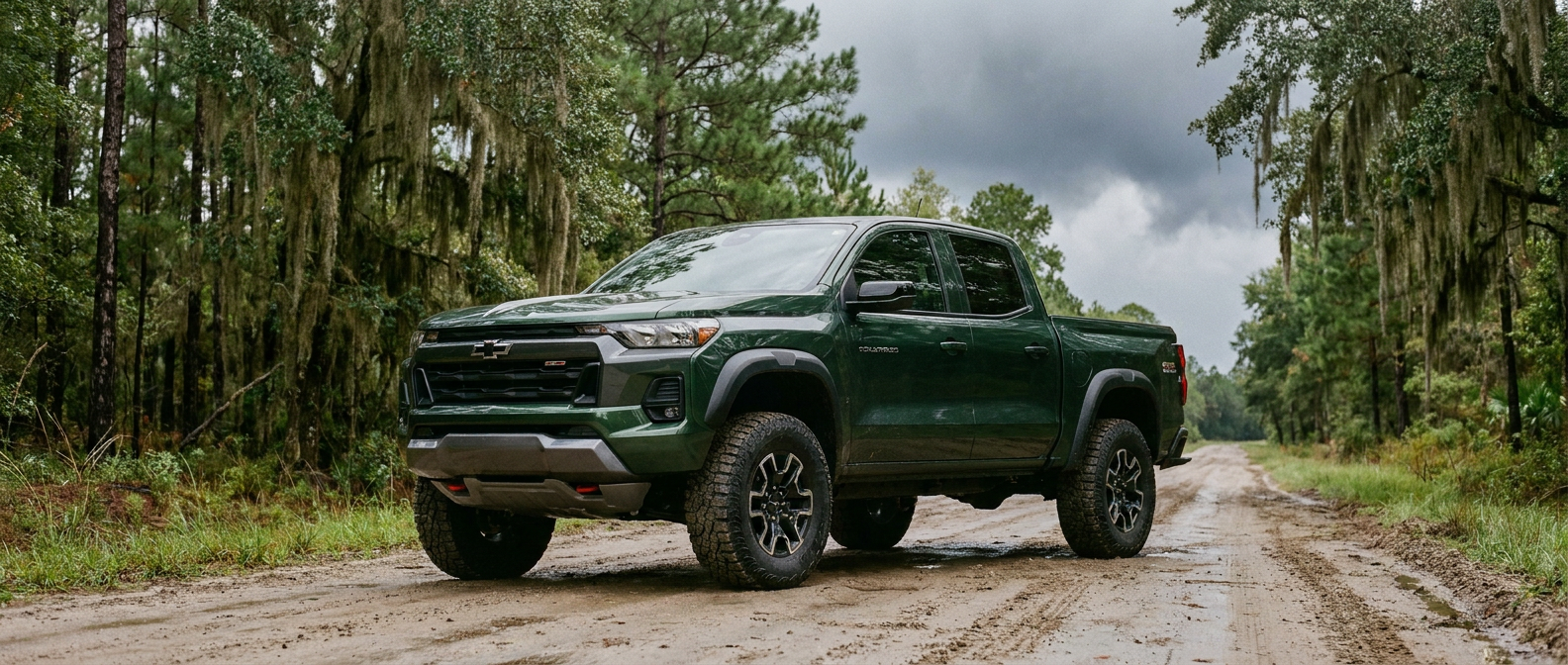
2026 Chevrolet Colorado Trail Boss on a rural Horry County road near Longs, SC

If you're shopping a Chevrolet Colorado near Longs, the drivetrain question comes up fast. Snow barely touches the Grand Strand, so the gut reaction is to skip 4WD and save the money. On the surface that logic holds. But Horry County throws a few things at a truck that pure snow logic misses, and we've watched shoppers talk themselves into 2WD for the wrong reasons and into 4WD for the wrong ones too.

The straight answer runs like this. 2WD's the right call for a work truck or daily driver that stays on maintained roads and carries light loads. 4WD earns its keep the moment your regular route touches sand, unpaved shoulders, or a flooded stretch of SC 90 after a summer storm.

Browse the 2026 Chevrolet Colorado at Palmetto Chevrolet

On the Grand Strand, 4WD buys you sand traction, wet-surface confidence on flash-flooded back roads, and stronger resale value. It costs you about 2 MPG on the highway. Whether that trade is worth it depends entirely on where you actually drive.

How Does the Colorado's Drivetrain Actually Work?

The two drivetrains differ in more than wheel count, and each one changes how the truck behaves on Horry County roads. In 2WD the engine drives the rear axle alone, which keeps things light and efficient, while 4WD splits torque to both axles for grip when the surface won't cooperate.

In 2WD, which is rear-wheel drive on the Colorado, the engine sends all its power to the rear axle only. The front wheels just come along for the ride. That keeps the drivetrain simpler, lighter, and more fuel-efficient. The EPA rates the 2026 Colorado in 2WD at 19 city and 24 highway MPG. On dry pavement it stays predictable, and it'll tow confidently because the rear wheels do the pushing.

Switch to 4WD High and the front driveshaft engages through the transfer case, splitting torque between both axles. That gives you grip on sand, mud, or slick wet roads. 4WD Low multiplies torque further for technical off-road work, crawling out of a sandy boat ramp, or pulling a trailer up a rain-softened grade. The EPA rates the 2026 Colorado in 4WD at 17 city and 22 highway MPG. That's a 2 MPG gap on the highway. Real, but not dramatic.

Then there's 4Auto, the mode that trips up a lot of buyers. It doesn't switch between 2WD and 4WD based on slippage the way some folks assume. In 4Auto the front driveshaft stays engaged at all times, and the transfer case uses an internal clutch to vary how much torque goes forward. Think of it as a heavy-duty all-wheel-drive mode you can run on wet or mixed-surface roads around Longs without worrying about drivetrain damage. What it'll do is nudge fuel economy toward the 4WD figures even on dry pavement, because that added rotating mass is always working.

ConfigurationHow It WorksBest SurfaceEPA City / Hwy
2WD (RWD)Power to rear axle onlyDry / maintained pavement19 / 24 MPG
4WD HighFront + rear axles engagedSand, mud, wet gravel, flooded roads17 / 22 MPG
4WD LowHigh-torque crawl modeDeep sand, steep grades, technical off-road17 / 22 MPG
4AutoFront driveshaft always spinning; clutch varies torque forwardMixed wet / dry surfacesNear 4WD figures

EPA figures above are for the 2026 Colorado WT and LT configurations without mud-terrain tires. The ZR2 wears heavier off-road rubber, so it's rated at 17 city and 17 highway across the board.

Which Drivetrain Do You Need Near Longs?

Your route decides this more than the weather does, and both answers are legitimate depending on where the truck spends its day. Stay on maintained highway with light loads and 2WD is the smart, efficient pick. Touch sand, soft shoulders, or a flooded back road with weight in the bed, and 4WD starts paying for itself.

Longs sits at the intersection of SC 9 and SC 905, with the SC 90 corridor running through the broader community area. That mix puts you on well-traveled state highway and on the rural shoulders and unpaved side roads that Horry County's still upgrading through its RIDE 3 dirt-road paving program.

The roads here are getting better. They're not all there yet.

Summer flash flooding matters more than winter snow here. In summer, heat and heavy rain damage Grand Strand roads in ways that create localized flooding and surface hazards, a pattern well-documented by SCDOT and local emergency management. A 2WD Colorado in 4Auto handles wet pavement just fine. Load a half-ton of job-site material into that same bed on a flooded stretch of SC 905, and you'll feel rear-wheel traction go thin.

Sandy access roads are the more constant issue. The Waccamaw River corridor and the waterways near Longs generate real boat-ramp and fishing traffic year-round. Sand is the off-pavement surface you're most likely to meet, and rear-wheel-drive trucks are notoriously hard to manage on loose sand under any meaningful load (the rear tires just dig). Drop your tire pressure a bit before a soft-sand ramp and air back up once you're on pavement.

The honest case for 2WD. Run US-501 to Myrtle Beach and back, keep your cargo light, and never touch a gravel driveway or a boat ramp, and 2WD keeps you at 24 MPG on the highway. When you need more tow capacity than a midsize truck offers, a Chevrolet Silverado 1500 steps in. For a daily hauler on maintained roads, though, 2WD Colorado is a capable, fuel-sensible choice, and it's a real one, not a compromise.

The honest case for 4WD. Tradespeople working job sites with soft or sandy ground, anyone pulling a boat to a ramp off SC 905, and drivers logging regular miles on rural Horry County roads where surface quality varies all get genuine value from 4WD. The Trail Boss trim comes standard with 4WD, a factory 2-inch lift, all-terrain tires, and a transfer case shield. That's a meaningful capability package without reaching for the ZR2.

TrimStandard Drivetrain4WD Available?
WT (Work Truck)2WDYes, add-on
LT2WDYes, add-on
Trail Boss4WD standardIncluded
Z714WD standardIncluded
ZR24WD standardIncluded

Get Pre-Approved for Your 2026 Colorado

Quick Glossary: Colorado Drivetrain Terms

TermPlain-Language Meaning
RWD / 2WDEngine power goes to the rear wheels only. Efficient and capable on dry, maintained pavement.
4WD High (4Hi)Both axles fully engaged for sand, mud, and slick surfaces at normal road speeds.
4WD Low (4Lo)Maximum torque multiplication for slow, technical terrain. Use it for crawling out of a sandy ramp or off-road recovery.
4AutoFront driveshaft always spinning; transfer case clutch balances torque automatically. Best for mixed wet/dry or transitional surfaces.
Transfer caseThe mechanical unit that splits power between front and rear axles in 4WD modes.

What This Means for Your Next Colorado

Every trim makes the same power, so the drivetrain choice never costs you an engine, and the 2026 Colorado's TurboMax produces 310 horsepower and 430 lb-ft of torque in every single trim. What changes is how that power reaches the ground when the ground isn't ideal.

Towing capacity reaches up to 7,700 lbs when properly equipped, and your door-jamb label carries the exact number for your specific configuration. Whether you're pulling a center-console boat down SC 905 or hauling landscape material to a job site around Longs, the drivetrain choice shapes how confidently that tow capacity performs on the surfaces between you and where you're headed.

Our team at Palmetto Chevrolet in Conway can pull the window sticker on any Colorado on our lot and walk you through exactly which transfer case modes, tires, and ground clearance each trim includes. The Trail Boss and Z71 both come standard with 4WD, but they're set up differently for different buyers. Worth having that conversation before you decide. And if you're trading in a current vehicle, knowing that number early can shift the trim math in a real way.

See What Your Trade Is Worth

Frequently Asked Questions

Is 4WD worth it on a Colorado if it rarely snows near Longs, SC?

Snow isn't the main reason to consider 4WD in Horry County. Sandy boat-ramp access, summer flash flooding on rural state routes like SC 905 and SC 90, and the occasional winter ice event on smaller roads are the real traction tests here. If your driving is mostly maintained highway with light loads, 2WD is a legitimate and fuel-efficient choice. If your work or recreation regularly puts you on soft, wet, or sandy surfaces, 4WD recovers its cost in traction confidence quickly.

Does running 4Auto all the time hurt the Colorado's drivetrain or fuel economy?

Driving in 4Auto won't damage the Colorado's drivetrain. The front driveshaft stays engaged at all times in that mode, and the transfer case clutch balances torque automatically, so there's no mechanical stress from switching back and forth. What it costs you is fuel economy. On dry highway miles, 4Auto keeps you closer to the 4WD EPA figures of 17 city and 22 highway rather than the 2WD figures of 19 city and 24 highway. On wet or mixed-surface roads in Horry County, it's a sensible mode to leave on. For long dry highway runs, switching back to 2WD is worth it.

Palmetto Chevrolet

1122 4th Ave, Conway, SC 29526

(843) 248-4283

Recommended Posts

2026 Chevrolet Trailblazer parked near Coastal Carolina University in Conway SC

3 Chevy SUVs Compared for Students Near Coastal Carolina University

Parking at CCU is genuinely rough right now, and it's not getting easier. Record enrollment means more cars fighting for the same finite lots, and US-501 through Conway is still under a widening project that makes rush-hour commutes feel longer than the map suggests. What you drive matters here, and so does how big it is. We're a short drive from campus on 4th Ave in Conway, and the three questions below are worth answering before you shop. Students and parents sometimes arrive set on the Chevy they think they want, then pick a different one once we work through those questions. Consider this guide those three questions, answered with the numbers so you can decide before you ever set foot on the lot. The short version Tight budget and city driving only: The Trax is the leanest entry point with an EPA-estimated 30 mpg combined and a genuinely compact footprint. Best all-around for CCU life: The Trailblazer hits the sweet spot, with available AWD, an EPA-estimated 31 mpg combined on the 1.3L FWD, and a size that still fits in a standard campus spot. Roommates, road trips, hauling everything you own: The Equinox wins on cargo (63.5 cu ft max vs 54.4 in the Trailblazer) but it's 9 inches longer and steps up in entry cost. The one thing Trax can't do: AWD is not available on any 2026 Trax trim. If you're planning winter road trips home or want grip on a rainy night on SC-544, that matters. All three seat five and include wireless Apple CarPlay and Android Auto standard. How Do They Compare? The Full Matrix All three are compact Chevy SUVs that seat five, yet they split along size, drivetrain, and cargo, so the right one depends on how far you drive and how much you'll haul. The short version is that the Trax runs leanest, the Trailblazer balances, and the Equinox carries the most. If you just want the difference spelled out, you'll find it in the table below. 2026 Trax 2026 Trailblazer 2026 Equinox Body length 178.6 in 174.1 in 183.2 in Standard engine 1.2L Turbo (137 hp) 1.2L Turbo (137 hp) 1.5L Turbo (175 hp) Available engine FWD only 1.3L Turbo (155 hp) 1.5L Turbo (175 hp) Drivetrain FWD only FWD or AWD FWD or AWD EPA combined (best trim) 30 mpg 31 mpg 27 mpg Max cargo (seats folded) 54.0 cu ft 54.4 cu ft 63.5 cu ft Towing capacity Not rated Up to 1,000 lbs Up to 1,500 lbs Standard screen Available 11-in 11-in standard 11.3-in standard Best for Lowest entry cost, pure FWD commuting AWD availability + efficiency balance Maximum cargo + family-size space Sources: Chevrolet.com model pages (accessed October 2026); EPA fuel economy figures. A couple of things jump out of that table. The Trax is actually 4.5 inches longer than the Trailblazer, which catches people off guard. Inside it feels smaller because it's narrower and lower. The Equinox runs a full 9 inches longer than the Trailblazer, and in the overflow lot across US-501 from campus, that inch count turns into a parking decision. Browse the Trax on our lot if the entry-level price is the filter that matters most. Is AWD Worth It for a CCU Student? AWD earns its keep for some CCU students and not others, and the deciding factor is where you point the car when you're off campus, since Conway winters stay mild while a January run up I-26 or a February stretch on I-77 is a different road entirely. The national comparison articles tend to skip that split. So who actually needs it? If every break you take lands in Myrtle Beach or Hilton Head, you'll be fine with front-wheel drive, and the same goes for a student heading home to flat, warm Jacksonville. South Carolina winters are mild, and Conway rarely sees ice, with snow on the Grand Strand rare enough to be memorable. Road trips home change that math, because a student from the North Carolina mountains or the mid-Atlantic who takes I-26 in January or I-77 in February is driving a very different road. AWD won't match true 4WD in deep snow, so keep your expectations in check there. On wet pavement, though, and on fast acceleration out of a rain-soaked intersection on SC-544, the extra grip truly helps. Among these three, the Trailblazer is the only one where you'll even find AWD as an option. The 2026 Trax is front-wheel drive on every single trim, as Chevrolet's specs confirm. The Equinox offers AWD too, but you're stepping up to a larger vehicle to get it. If your priority is AWD in the most efficient, most compact package here, look hard at the Trailblazer RS or ACTIV with the 1.3L and the 9-speed automatic. The 2026 Trailblazer with the 1.3L and AWD returns an EPA-estimated 28 mpg combined, while the FWD version of the same engine earns 31 mpg combined. Adding AWD costs you about 3 mpg, and that's the whole tradeoff. There's one local detail worth flagging before you shop. The US-501 corridor between downtown Conway and the CCU campus entrance gets legitimately heavy during move-in weekends and home football games, so a smaller vehicle is easier to thread through traffic and park. The Trailblazer's 174.1-inch length (per Chevrolet) comes in shorter than the Trax overall, which still catches shoppers off guard. If you're living in one of the SC-544 complexes, here's what the week looks like: A commute that's easy on a Tuesday morning and 25 minutes longer on game day Parking structures with tight turning radii that punish anything wider than a midsize Trips to downtown Conway's Riverwalk area where street parking requires maneuvering Weekend runs to the beach that put a premium on real cargo flexibility Get Pre-Approved Before You Visit Which SUV Fits Which CCU Student There's no single winner here, because the right SUV tracks your budget, your routes, and your cargo, so sort yourself by those three and the answer falls out quickly. You know your own week better than we do, and the picks below line up with it. Choose the Trax if: your budget is the hard ceiling, you stay in Horry County almost exclusively, and AWD has never crossed your mind. The EPA-estimated 30 mpg combined holds up in everyday driving, and the entry-price gap versus the Trailblazer means something on a student budget. Choose the Trailblazer if: you want the flexibility of AWD without jumping up in size or cargo cost, you road-trip north or inland at least a couple of times a year, and you like having the option of the RS or ACTIV trim for a little more personality. For the typical CCU routine, this is the one we'd point to, with the honest caveat that it costs more than the Trax to get AWD equipped. The Trailblazer isn't the budget pick. It's the value pick. Choose the Equinox if: you're hauling a lot, and 63.5 cu ft against 54.4 in the Trailblazer is a real 9 cubic feet rather than a rounding difference, or you have passengers who need rear-seat legroom regularly, or you're buying one vehicle for the next five to seven years and want room to grow into it. The Equinox's 175-hp standard engine also pulls noticeably harder at highway speeds, which matters on I-95 runs to Charlotte or Atlanta. The honest tradeoff is length, since 183.2 inches is full compact-SUV territory and it shows in tighter lots. The Trailblazer's flat-folding front passenger seat, a Chevrolet-listed feature, adds a long-load option no one else in this comparison has All three include standard wireless Apple CarPlay and Android Auto The Trailblazer and Equinox both offer remote start as a trim-level option; the Trax does not on every trim The Trailblazer 11-inch touchscreen is standard on every trim; the Trax's 11-inch display is available, not universal See current Trailblazer, Trax, and Equinox inventory at Palmetto Chevrolet Frequently Asked Questions Which Chevy SUV is best for a Coastal Carolina University student? For most CCU students, the 2026 Trailblazer is the strongest all-around fit. It's shorter overall than the Trax (174.1 inches versus 178.6 inches), offers available AWD for students who road-trip home to colder climates, and earns an EPA-estimated 31 mpg combined on the FWD 1.3L engine. Students on the tightest budget who stay local should look at the Trax first; students who haul a lot or need rear-seat space regularly should step up to the Equinox. Does the 2026 Chevy Trax have AWD? No. The 2026 Chevrolet Trax is front-wheel drive only on every trim, per Chevrolet's own specifications. All-wheel drive is not available on any 2026 Trax configuration. If AWD is important to you, the 2026 Trailblazer and the 2026 Equinox both offer it as an available option. Value Your Trade-In Online Palmetto Chevrolet 1122 4th Ave, Conway, SC 29526 (843) 248-4283

2026 Chevrolet Traverse parked at The Market Common lifestyle center in Myrtle Beach, South Carolina on a sunny fall day

Which Chevy SUV Should You Drive to The Market Common?

In this article What's the Plan at a Glance? The Main Event: Why the Market Common Rewards a Bigger SUV The Route: Conway to The Market Common on US-501 The Right Chevy for Your Crew Size and Your Day Getting Into the Right One at Palmetto Chevrolet Take the Chevy that fits your crew and your cargo, because The Market Common is a full-day errand, not a quick stop. Drive US-501 southeast from Conway about 15 miles, park once for free in the surface lots, and you'll have the whole day for shopping, dining, and Savannah's Playground. The right SUV makes that day easy. The wrong one leaves you cramped. The 2026 Chevy Traverse is our first recommendation for most families making this run, and we'll show you why in a minute. But we also stock two other Chevys that serve the trip well if you're hauling two people instead of six. What's the Plan at a Glance? Stop What to Do Best Time Parking Notes The Market Common main district Shop Barnes & Noble, Anthropologie, Pottery Barn, boutiques 10 AM - 2 PM Free surface lots throughout; street-grid layout Valor Park (Valor Memorial Garden) Saturday farmers market (April - December, 10 AM - 3 PM) Saturday mornings Pull alongside Farrow Parkway; easy in/out Grand Park and Savannah's Playground All-abilities free playground, walking paths, fishing spots Any daylight hour Parking off Crabtree Lane; flat lot, easy for larger SUVs Dining row (Tupelo Honey, Gordon Biersch, Nacho Hippo, and others) Lunch or dinner on the outdoor patios Midday or evening Park once and walk; the whole district is pedestrian-scale The Main Event: Why the Market Common Rewards a Bigger SUV Picture 114 acres of walkable lifestyle center on the former Myrtle Beach Air Force Base, and it's designed for a day, not a drive-by. You're going to load shopping bags, stroller gear, and whatever the kids picked up at Savannah's Playground before you get back on US-501. Loading all of that is where the 2026 Traverse earns its keep. Chevrolet lists up to 98 cubic feet of cargo space with the rear seats folded, and even with three rows occupied you still have 22.9 cubic feet behind the third row. That's not a spec you notice until you're trying to stuff a Pottery Barn lamp and a weekend's worth of bags into something smaller. The 2026 Traverse also seats up to eight. It helps when you're meeting family at the farmers market at Valor Park on a Saturday and someone needs to ride home with you. The turbocharged 2.5-liter four-cylinder makes 328 horsepower and 326 lb-ft of torque (Chevrolet's figures), and the EPA rates FWD models at 20 city and 27 highway. A highway number like that keeps the Conway-to-Myrtle Beach run genuinely affordable. Palmetto Chevrolet team note: US-501 between Conway and Myrtle Beach tightens up during peak beach-season weekends. The Traverse's 17.7-inch touchscreen standard on every 2026 trim runs Google Maps with live traffic built in, so you can see the backup at the Socastee interchange before you're already in it. At 79.6 inches, the Traverse is wide, and width is the tradeoff worth naming. The Market Common's surface lots are roomy, but if you're squeezing into the angled street spots along the main retail strip during a crowded Saturday farmers market, a narrower SUV is genuinely easier to park there. The Route: Conway to The Market Common on US-501 The drive from Conway runs about 15 miles down US-501 southeast into Myrtle Beach, roughly 24 minutes off-peak, though on peak summer weekends or during the holiday shopping stretch in November and December, that same stretch can slow considerably through the Socastee area. You'll want to leave early enough to get ahead of the backup. During the farmers market season, leave Conway before 10 AM on a Saturday, or swing back on SC-544 through Socastee for a different look at the corridor. Our team leans on that routing when beach traffic builds, and you'll thank yourself for the early start. The 2026 Equinox is the right choice for that kind of trip when it's just two adults or a small family. It seats five, rides lighter on the lot, and the EPA rates the FWD model at 27 miles per gallon combined, which matters over a corridor you'll run multiple times a month. Behind the second row you get 29.8 cubic feet of cargo space (per Chevrolet's specs) with a flat load floor that handles shopping bags without a puzzle. It also slips into the tighter angled spots on the Market Common's main retail street without the width anxiety the Traverse can bring on a busy afternoon. The 2026 Equinox carries an EPA-combined rating of 27 mpg on FWD models, making it the most fuel-efficient gas SUV in our lineup for the Conway-to-Market Common run. The Right Chevy for Your Crew Size and Your Day The right Chevy here comes down to crew size and cargo, and the call is simpler than it sounds. Three Chevys serve this trip well, and which one fits depends on who's coming along and what you plan to carry back to Conway. The 2026 Trailblazer is the one we'd hand to a Conway commuter or a CCU student making a solo or two-person Market Common run. The 1.3-liter turbocharged three-cylinder with front-wheel drive earns an EPA estimate of 29 city and 33 highway miles per gallon. That's the most highway-efficient option in this category, and it matters when you're making this drive regularly. At 174 inches long, it parks without drama anywhere in the district. The tradeoff is real. With 25.3 cubic feet behind the rear seats, you don't have much room if you're a committed shopper. Know what you're buying before you buy it. Here's how the matchup shakes out. Your situation Best fit Why it works Family of 5 or more, full shopping day 2026 Traverse 98 cu ft max cargo, 8-passenger seating, 17.7-inch Google Maps screen Couple or small family, regular trips 2026 Equinox 27 mpg combined (EPA, FWD), 29.8 cu ft behind row 2, easy parking Solo or two-up, efficiency-first 2026 Trailblazer 33 mpg highway (EPA, FWD 1.3L), 174 inches long, nimble in tight spots Savannah's Playground with gear and stroller 2026 Traverse or Equinox Flat load floors, power liftgates, real cargo headroom The Market Common is flat, the parking is free, and none of these SUVs will leave you hunting for a spot. What changes is how loaded down you'll be when you walk back to the car. Explore Financing Options Getting Into the Right One at Palmetto Chevrolet We're on 4th Avenue in Conway, about 15 miles from The Market Common along the same US-501 corridor you'd take to get there. So we can put you in a Traverse, an Equinox, or a Trailblazer and let you preview the ride before you ever pull into the Market Common's lot for real. Come down and see what we have on the lot. If you've got a vehicle to trade, start there too. A quick trade assessment makes the whole process faster, and our team will walk you through what your current vehicle is worth before we talk about anything else. The Market Common rewards the right vehicle. We've got three that fit. Come find yours. Value Your Trade-In Palmetto Chevrolet 1122 4th Ave, Conway, SC 29526 (843) 248-4283

2026 Chevrolet Silverado 1500 on a Horry County job site near Red Hill, Conway, SC

Your Silverado Isn't Working Hard Enough for Red Hill: Here's the Fix

If you're driving near Red Hill and your truck feels like it's fighting you on US-501 every afternoon, or you're running a job trailer down SC-544 and second-guessing whether you've got enough engine under the hood, the problem probably isn't your driving. A lot of Silverado buyers pick a configuration tuned for somewhere else. The fix is straightforward. Match the engine, cab, and drivetrain to what Horry County genuinely demands, and that's what this guide walks through. Browse the 2026 Silverado 1500 at Palmetto Chevrolet to see what's on the lot while you read. What's Actually Going on with Your Truck Mismatch? What's going on is usually a mismatch rather than a bad truck, because the Grand Strand blends contractor hauling, coastal trailer towing, US-501 commuting between Red Hill and Myrtle Beach, and payload-heavy trade work into a single buying decision, and a Silverado tuned for one of those jobs can genuinely struggle at another. Contractors haul materials through Horry County's construction boom, families pull a camper or boat trailer toward the coast, commuters grind the US-501 corridor between Red Hill and Myrtle Beach, and tradespeople need real payload capacity without paying for engine they'll never use. Pick the wrong config and you'll either overpay on fuel or under-deliver on the job site. Run through the full diagnostic below. Symptom You're Experiencing Likely Cause Right Silverado Fix Engine strains on loaded job-site runs Under-engined for actual payload (2.7L at tow limit) 5.3L EcoTec3 V8 for consistent hauls over 9,000 lbs Burning fuel sitting in US-501 beach traffic Large-displacement engine at idle in stop-and-go 2.7L TurboMax or Duramax diesel for daily commuting Trailer sways on SC-22 at highway speed Missing trailering package / sway control Max Trailering Package + Trailer Sway Control on any trim Rust showing on bed floor or undercarriage Coastal humidity and salt air accelerating surface oxidation Regular undercarriage rinse, bedliner, touchup on paint chips Cab feels cramped for the whole crew Wrong cab config for actual headcount Crew Cab for 4-5 workers; Double Cab fine for 2-3 Engine Choice Is Almost Always the Root Cause Engine choice is almost always the root cause here, and the 2.7L TurboMax is a genuinely capable starting point for a lot of buyers even though it's the engine people tend to outgrow once real commercial work shows up. Chevrolet rates it at 310 horsepower and 430 lb-ft of torque, with a maximum payload of 2,260 lbs and up to 9,500 lbs of towing (properly equipped, always verify your door-jamb label). For a Red Hill commuter who occasionally hauls a small trailer, that's plenty. The EPA rates the 2.7L TurboMax at around 18 city / 21 highway mpg in rear-wheel drive, which matters when you're sitting in beach-season traffic on US-501 four days a week. The problem shows up when that same truck gets pressed into real commercial duty. Pull a loaded flatbed toward a Conway job site day after day, and you're working that engine near its ceiling. Push the 2.7L into daily commercial hauling and it will feel strained. No way around it. At that point the 5.3L EcoTec3 V8 is the step worth making. Chevrolet rates the 5.3L at 355 horsepower and 383 lb-ft of torque, with up to 11,300 lbs of towing capacity (properly equipped). It handles most pontoon boats, mid-size travel trailers, and equipment loads without breathing hard. If your work life includes anything north of 9,000 lbs regularly, the 5.3L is the engine you want. Silverado 2500 HD and Silverado 3500 HD belong in the conversation if your payload or tow requirements go consistently beyond what the 1500 lineup supports. Commercial buyers near Red Hill who are running real construction loads should look hard at those two. The Duramax 3.0L Turbo-Diesel is a different animal entirely. Chevrolet lists 305 horsepower and 495 lb-ft of torque, with a maximum towing capacity of up to 13,300 lbs (properly equipped). The EPA estimates 23 city / 28 highway mpg in rear-wheel drive. For a contractor or retiree who drives significant highway miles and tows a large boat or heavy camper on long trips, the diesel math works. Fewer fuel stops, serious torque, and the highest tow rating in the lineup. The real tradeoff is service. Diesel upkeep is more involved, and you'll want a technician familiar with the engine when it needs attention. Coastal SC heads-up: The Waccamaw National Wildlife Refuge sits right on Red Hill's western edge, and the humidity off the Waccamaw River corridor is real year-round. Coastal salt air doesn't need oceanfront living to find its way under a truck. Keep an eye on paint chips in the bed and along the rocker panels, and touch them up quickly. A spray-in bedliner and a monthly undercarriage rinse go a long way on any truck parked in Horry County, whatever engine you choose. Next step: If you know your typical load weight and tow frequency, our team can pull the door-jamb sheet on any Silverado on the lot and confirm the actual rated capacity for that specific truck's configuration before you commit. When to Handle It Yourself vs. When to See Our Service Team Plenty of Silverado upkeep you can handle right in your own driveway near Red Hill, though a short list of jobs genuinely belongs with our service team because they lean on calibration equipment or diesel-specific know-how you won't have at home. Check tire pressure monthly, since Horry County's heat cycles move it more than you'd guess. Rinse the undercarriage after any run near the coast. Inspect the bed after hauling anything abrasive. Keep up with the oil interval, because the 2.7L TurboMax and 5.3L V8 both do better staying on schedule in this hot, humid climate. Some jobs you shouldn't try to DIY. Anything trailering-system related (brake controller calibration, hitch receiver torque), the 5.3L's Dynamic Fuel Management system if it starts ticking, and any electrical diagnostic on Chevy Safety Assist features all belong with us. The standard Chevy Safety Assist suite on every 2026 Silverado includes Automatic Emergency Braking, Forward Collision Alert, Front Pedestrian Braking, Lane Keep Assist with Lane Departure Warning, Following Distance Indicator, and IntelliBeam automatic high beams. These are safety-critical systems with sensors that need calibration equipment to verify. Bring those to us. Schedule service at Palmetto Chevrolet when you're ready. Our team is right here in Conway, a short run from Red Hill on US-501. Schedule Your Silverado Service Appointment The 2026 Silverado 1500 is the final year of its current generation before the 2027 redesign, so inventory is a real consideration right now. If you're in the market, now's the moment to choose a configuration thoughtfully rather than default to whatever's on the lot. We can help you spec it right. Frequently Asked Questions Which Silverado 1500 engine is right for towing a boat near Red Hill? For most pontoon boats and mid-size trailers common on the Grand Strand, the 5.3L EcoTec3 V8 is the right balance. Chevrolet rates it at up to 11,300 lbs of towing capacity when properly equipped, which covers the large majority of recreational trailers in this area. If you're consistently pulling a large offshore boat or heavy camper and logging serious highway miles, the Duramax 3.0L Turbo-Diesel's 13,300-lb rating and EPA-estimated 23 city / 28 highway mpg (rear-wheel drive) makes a strong case. Always confirm your specific truck's rated capacity on the door-jamb label before you tow. Does the coastal humidity in Horry County actually affect a truck's maintenance needs? It does, in a real and specific way. The combination of high humidity and occasional salt air off the Grand Strand accelerates surface oxidation on exposed steel. Bed floors, rocker panels, and undercarriage components are the places to watch. The 2026 Silverado's Durabed has 89.1 cubic feet of cargo space, but bare steel in a truck bed is vulnerable once the coating gets scratched. A spray-in bedliner, prompt attention to paint chips, and periodic undercarriage rinsing are practical habits rather than extreme precautions here. Our service team can inspect those areas if you want a professional eye on it. FAQ Which Silverado 1500 engine is right for towing a boat near Red Hill? For most pontoon boats and mid-size trailers common on the Grand Strand, the 5.3L EcoTec3 V8 is the right balance. Chevrolet rates it at up to 11,300 lbs of towing capacity when properly equipped, which covers the large majority of recreational trailers in this area. If you're consistently pulling a large offshore boat or heavy camper and logging serious highway miles, the Duramax 3.0L Turbo-Diesel's 13,300-lb rating and EPA-estimated 23 city / 28 highway mpg (rear-wheel drive) makes a strong case. Always confirm your specific truck's rated capacity on the door-jamb label before you tow. Does the coastal humidity in Horry County actually affect a truck's maintenance needs? It does, in a real and specific way. The combination of high humidity and occasional salt air off the Grand Strand accelerates surface oxidation on exposed steel. Bed floors, rocker panels, and undercarriage components are the places to watch. The 2026 Silverado's Durabed has 89.1 cubic feet of cargo space, but bare steel in a truck bed is vulnerable once the coating gets scratched. A spray-in bedliner, prompt attention to paint chips, and periodic undercarriage rinsing are practical habits rather than extreme precautions here. Our service team can inspect those areas if you want a professional eye on it. Value Your Current Trade-In Palmetto Chevrolet 1122 4th Ave, Conway, SC 29526 (843) 248-4283