



Blog

How to Set Up Your 2026 Chevy Colorado for Waccamaw River Fishing

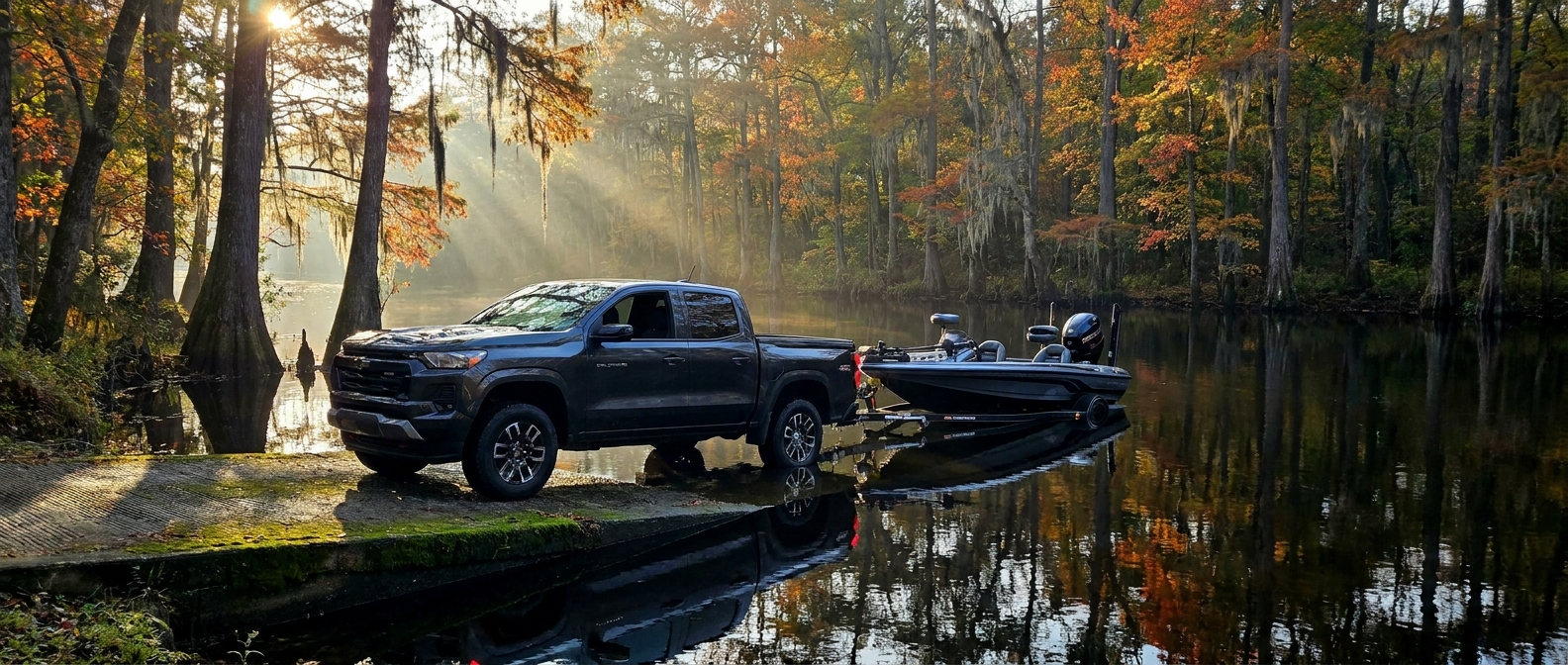
2026 Chevrolet Colorado backing a fishing boat trailer down a Waccamaw River boat ramp near Conway SC on an autumn morning

October is the best month on the Waccamaw, and we say that with some confidence. The heat finally breaks, crappie move to center stage in the cypress cuts, largemouth feed hard before winter, and blue cats stay active through the night. We wrote this guide to walk you through exactly how to configure your 2026 Colorado, so you roll up to Pitch Landing or Bucksville Landing with a properly hitched trailer, a bed that doesn't swallow your tackle, and a truck that backs down a sandy ramp without drama.

The 2026 Colorado is a legitimate fishing truck for this river. Tow the boat in, back it down, fish all day, and reload without chaos. That's the goal.

The single most important prep step: confirm whether your Colorado already has the Advanced Trailering Package. Without it, Chevrolet rates the Colorado at 3,500 pounds of towing capacity. With it, that number climbs to 7,700 pounds (properly equipped, always verify your door-jamb label). For most bass boats and aluminum jon boats on the Waccamaw, you're well within the base 3,500-pound rating, but a larger fiberglass rig changes that math fast.

What Do You Need Before You Start?

You'll want everything gathered before you load a single rod, because skipping the checklist phase is how anglers end up at Pitch Landing without a 7-pin adapter. Pull these together the night before and you're set. The list is short, so run it top to bottom.

ItemSpec / DetailWhere to Confirm
Towing capacity (base)3,500 lbs (no package)Door-jamb label on your specific truck
Towing capacity (w/ Advanced Trailering Package)Up to 7,700 lbs, properly equippedDoor-jamb label; Chevrolet lists this as the max for the platform
Payload capacity (WT/LT 2WD)Up to 1,710 lbsDoor-jamb label
Payload capacity (Trail Boss / Z71 4WD)Up to 1,590 lbsDoor-jamb label
Bed length (all 2026 Colorado trims)61.7 inches (at floor)Chevrolet specs
Width between wheel wells45.5 inchesChevrolet specs
Cargo volume41.9 cubic feetChevrolet specs
Fuel tank capacity21.4 gallonsChevrolet specs
EPA fuel economy (2WD, combined)21 MPGfueleconomy.gov
EPA fuel economy (4WD, combined)19 MPGfueleconomy.gov
Trailer hitch receiverStandard on Trail Boss / Z71 / ZR2; available via package on WT / LTChevrolet option sheet
7-pin trailer connectorIncluded with Advanced Trailering PackageChevrolet

Get your boat's loaded trailer weight from the registration or the manufacturer's tag. You want that number, not the boat's dry weight, because that's what you're comparing against your door-jamb rating. Everything else in this guide assumes you've done that check.

Setting Up the Colorado for a Full Waccamaw Fishing Trip

Think of this as the spine of the day, six steps in order, from the night before you leave Conway to the moment you're on the water. Work them in sequence and nothing catches you off guard at the ramp. We've laid them out the way we'd prep our own rig.

Step 1: Decide your trim and package configuration.

If you already own a 2026 Colorado, check for the Advanced Trailering Package. It adds the 7-pin wiring harness, a heavy-duty hitch receiver, and trailer sway control calibrated for loaded rigs. The Trail Boss and Z71 come standard with 4WD, which matters at Bucksville Landing and Pitch Landing, both Horry County public ramps on the Waccamaw, and both can get slick from silt and river mud after rain. If you're shopping, the WT and LT in 2WD handle most lighter aluminum boats fine, though any fiberglass rig over 2,500 pounds loaded warrants the package and, frankly, 4WD for the ramp.

The current Colorado inventory at Palmetto Chevrolet shows which trucks are package-equipped. We can pull the window sticker and confirm exactly what's on a given unit before you commit.

Step 2: Hitch the trailer the evening before, not in the dark at 5 a.m.

The 2026 Colorado's available hitch guidance camera helps line up the ball, but it still takes a minute the first time. Hook up at home in daylight. Confirm the ball mount height, since the trailer tongue should run level to the ground when loaded, which usually means the ball sits somewhere between 12 and 18 inches off the ground depending on your coupler height. Plug in the 7-pin connector and test every running light and brake light while someone stands behind the trailer. That part isn't optional. A trailer with a dead brake light gets you pulled over on US-501 heading back through Conway.

Step 3: Load the bed in weight order, heaviest forward.

The 61.7-inch Colorado bed holds 41.9 cubic feet. You've got real capacity there, but it fills fast when you're fishing all weekend. Keep the heaviest gear directly behind the cab (cooler, generator if you run one, batteries) and lighter gear toward the tailgate. Tongue weight from the trailer should sit at roughly 10 to 15 percent of total trailer weight, so the rear of the truck is already carrying load. Putting your heavy cooler over the rear axle area keeps the truck from getting nose-light on the highway.

The available StowFlex tailgate on LT and above has a built-in mid-position that Chevrolet rates at 500 pounds. It doubles as a step and a tackle-sorting station at the ramp. If you haven't used it yet, practice at home. It opens six ways, and the cypress-tree shadows at Pitch Landing at 5:30 a.m. are not the time to figure out the cable release.

The step anglers most often miss: Tie-downs. The 2026 Colorado offers up to 17 available anchor points in the bed. Loose rods, net handles, and tackle bags sliding into each other on US-501 do real damage to gear. Run at least two ratchet straps across your load even for a 20-minute drive to the landing. The bed's 45.5-inch width between the wheel wells fits a standard marine cooler with room for rods along the sides. Measure your cooler before you buy it.

Our service team can install bed liners, tonneau covers, and tie-down anchor upgrades if your current setup isn't quite right for this kind of hauling.

Step 4: Fill the fuel tank the night before.

The EPA rates the 2026 Colorado's 4WD builds at 19 MPG combined (17 city / 22 highway, per fueleconomy.gov). The 21.4-gallon tank gives you a real-world highway range around 400 miles. Conway to Bucksville Landing is about 15 minutes. But running down river toward Georgetown, trailering back up US-501 through beach-season traffic in late afternoon, and an air-conditioned cab on a warm October day will nudge fuel consumption up. Fill it the night before. A full tank also adds predictable weight over the rear axle, which is right where you want it when the trailer is attached.

Step 5: Check trailer brake controller settings if you're running a rig over 2,500 pounds.

The Advanced Trailering Package includes a factory-integrated trailer brake controller. Calibrate it in a straight, empty parking lot before you load the boat. Make a 10-mph stop and note whether the trailer pushes or pulls. Nudge the gain up one notch if the trailer pushes (brakes not engaging hard enough), down one if it pulls hard left or right (over-engaging). Spend five minutes on this. The Waccamaw River runs through low country with long straight sections of SC-544 and US-501 that turn into stop-and-go during morning shifts. Loaded trailer brakes that haven't been dialed in make that miserable.

Step 6: Know your ramp before you get there.

Horry County Parks and Recreation manages several public boat landings on the Waccamaw River, and knowing yours ahead of time saves you a fumble in the dark. Pitch Landing (100 Pitch Landing Road, Conway) offers two concrete lanes with floating docks and a spacious unpaved parking area. No launch fee, ADA accessible, and comfortable for a truck-and-trailer setup. Bucksville Landing (500 Landing Rd, Conway) is also county-managed with two launching lanes, a courtesy dock, and six trailer parking spaces. Both put you on the blackwater Waccamaw with access to the cuts and cypress fingers where the fall bite runs hardest.

October is genuine prime time here. The river's bass are feeding aggressively as water temperatures cool, crappie are stacking up in the deeper cypress structure, and blue catfish stay active on cut bait into the evening. The Waccamaw runs dark, a tannin-stained blackwater from the surrounding soil, so plan on electronics over naked-eye fish-finding in the cuts. Knowing the ramp you're using is a real advantage. Back the truck in, drop the boat, and move the rig to the parking area before the morning crowd arrives.

Local ramp tip: Bucksville Landing sits in a residential area with limited turnaround space. If you're running a longer rig, say a 17-foot bass boat on a tandem-axle trailer, use Pitch Landing instead. The parking area there handles longer combinations without a multi-point turn in the dark.

Before You Go: A Quick-Reference Recap

Print this or screenshot it before you pull out of the driveway, because everything you need to confirm the morning of your trip lives right here. Run each line, check each box, and you'll hit the ramp with nothing left to second-guess. Keep it on your phone.

TaskDone?
Trailer loaded tongue weight verified against door-jamb label
All trailer lights tested (running, brake, turn)
Bed loaded heaviest-forward, all gear strapped down
StowFlex tailgate mid-position tested at home
Trailer brake controller calibrated (if applicable)
Fuel tank full
Ramp address in GPS (Pitch Landing: 100 Pitch Landing Rd, Conway, SC; Bucksville: 500 Landing Rd, Conway, SC)
SC freshwater fishing license confirmed (required west of US-17 on the Waccamaw)

Need more towing capacity for a larger rig? The Silverado 1500 steps up to a full-size platform if your boat is stretching the Colorado's envelope. Our team can walk you through where the line falls for your specific trailer.

Here's one straight note on the tradeoff. The 2026 Colorado's 5-foot-2 bed is the only bed option. It's right-sized for a weekend fishing load, but if you're hauling a serious amount of gear plus a generator plus a full cooler, you will feel the constraint. Know that going in. For a typical Waccamaw River weekend trip, a bass boat, two anglers, and weekend gear, it's genuinely enough space.

Schedule a Pre-Trip Truck Inspection

The Colorado is ready for the Waccamaw. Our team at Palmetto Chevrolet in Conway is here when you have questions about packages, bed accessories, or finding the right truck for your setup.

Frequently Asked Questions

Does the 2026 Chevrolet Colorado need the Advanced Trailering Package to tow a fishing boat?

It depends on your boat's loaded trailer weight. Without the Advanced Trailering Package, Chevrolet rates the 2026 Colorado at 3,500 pounds of towing capacity. With the package, that rating climbs to up to 7,700 pounds when properly equipped. Most aluminum jon boats and lighter bass rigs come in well under 3,500 pounds loaded, so the base Colorado handles them fine. A larger fiberglass bass boat or a heavier aluminum rig can push past that limit, which is when the package becomes essential. Always check your door-jamb label for the exact rating on your specific truck.

Which Horry County boat ramps on the Waccamaw River work best for a truck-and-trailer?

Pitch Landing at 100 Pitch Landing Road in Conway is the most accommodating for truck-and-trailer combinations. It has two concrete ramps with floating docks, no launch fee, ADA access, and a spacious unpaved parking area. Bucksville Landing at 500 Landing Rd in Conway is also county-managed with two lanes and a courtesy dock, though the surrounding residential area limits turnaround space for longer trailer setups. Both are managed by Horry County Parks and Recreation and put you directly on the Waccamaw River.
Palmetto Chevrolet

1122 4th Ave, Conway, SC 29526

(843) 248-4283

Recommended Posts

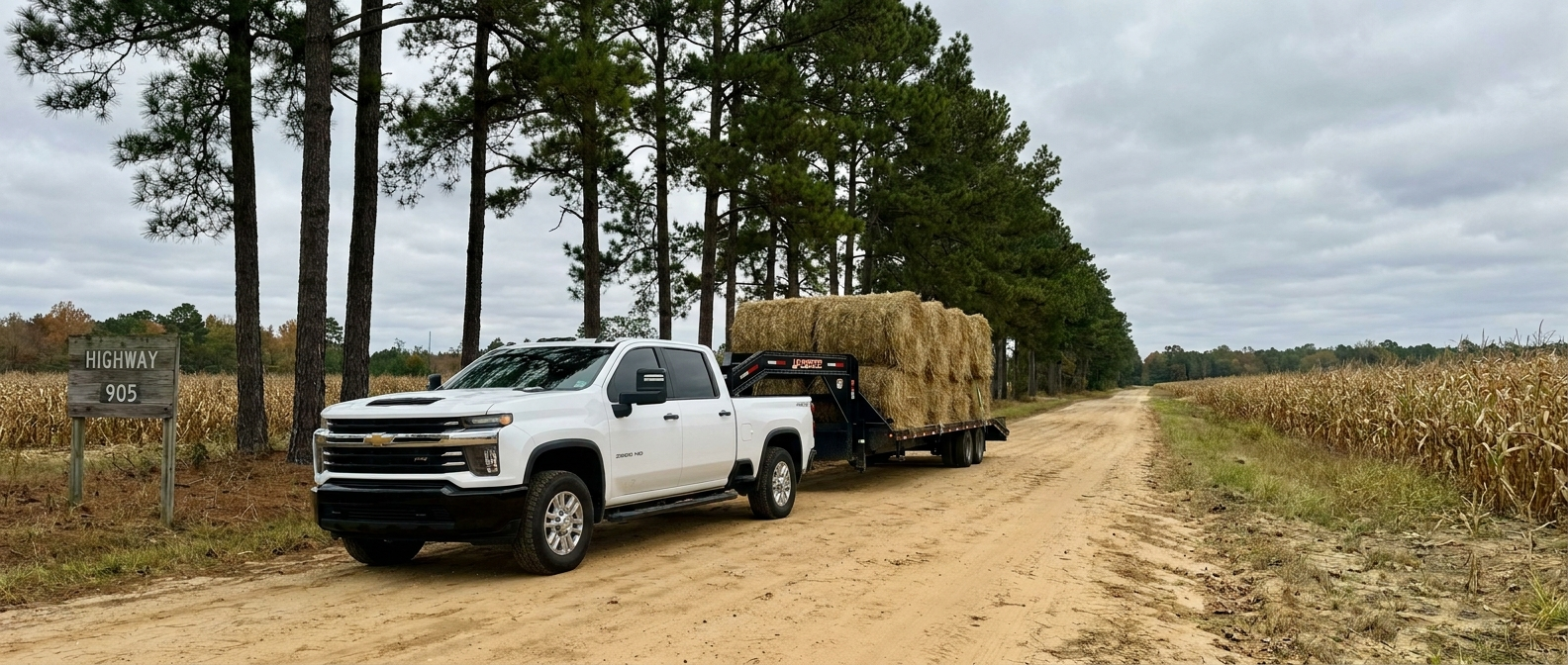
2026 Chevrolet Silverado HD towing a flatbed trailer on a Horry County SC rural road near Aynor

3 Silverado HD Configs Compared for Heavy Work Near Aynor | Palmetto Chevrolet

If you haul for a living around Horry County, you've probably had the same conversation with yourself more than once. Do I need the 2500 HD or the 3500 HD, and is the Duramax diesel actually worth it? Those are three distinct trucks in terms of what they can legally carry and tow, and the wrong pick costs you money in two directions. Too little truck means you're over-capacity on a regular Tuesday. Too much truck means you're paying a premium for ratings you never touch. We work through this with contractors, farmers, and fleet buyers at Palmetto Chevrolet all the time. Below, we break down how the three most common 2026 Silverado HD configurations line up for the work being done west of the Grand Strand. The short version Gas 2500 HD: Best for contractors and service trades hauling heavy beds but pulling trailers under roughly 10,000 lbs. Simpler, lower upfront, and the gas V8 handles flat Horry County terrain without strain. Diesel 2500 HD: The most versatile workhorse. Unlocks up to 22,420 lbs of towing capacity and delivers noticeably better fuel returns under sustained load for buyers covering real distance daily. Diesel 3500 HD: The answer when you're pulling a gooseneck with equipment, running a dually, or routinely loading the bed past what a 2500 can carry. Up to 36,000 lbs of towing and up to 7,442 lbs of payload. Not overkill if your work demands it. 2026 change worth knowing: The integrated trailer brake controller is now standard on every trim, not a package add-on. Browse our 2026 Silverado 2500 HD inventory at Palmetto Chevrolet to see current trim availability. How Do These Three Configurations Compare? The engines carry over unchanged between the 2500 HD and 3500 HD, which surprises plenty of buyers, so what sets the two platforms apart is the chassis, the axle ratings, the suspension, and whether you can run dual rear wheels. Chevrolet lists the same 6.6L V8 gas and 6.6L Duramax turbo-diesel across both platforms. The 3500 just has more structural capacity to put those engines to work. Configuration Engine Max Towing (properly equipped) Max Payload (properly equipped) Rear Wheel Config Best For 2026 Silverado 2500 HD 6.6L V8 Gas (401 hp / 464 lb-ft) Up to 19,080 lbs Up to 3,689 lbs Single rear wheel Contractors: bed loads, lighter trailers 2026 Silverado 2500 HD 6.6L Duramax Diesel (470 hp / 975 lb-ft) Up to 22,420 lbs Up to 3,615 lbs Single rear wheel Daily tow haulers, long-run work 2026 Silverado 3500 HD 6.6L Duramax Diesel (470 hp / 975 lb-ft) Up to 36,000 lbs Up to 7,442 lbs SRW or Dually (DRW) Gooseneck, fifth-wheel, heavy equipment *All figures are Chevrolet-published maximums, properly equipped. Always verify against your specific truck's door-jamb label.* A useful way to think about it is straightforward. The 2500 HD is tuned for the person who needs a genuinely capable work truck that still drives reasonably well empty. The 3500 HD is tuned for the job first and the commute second. Its stiffer rear suspension earns its place when you're running loaded down SC-501. Empty, it rides hard. What Does Your Actual Horry County Workload Call For? Your workload answer usually points to the 2500 HD for most Horry County trades, with the 3500 HD held in reserve for the genuinely heavy jobs, since plenty of buyers eye the 3500's numbers and assume bigger always wins. The reality sits a notch short of that. The work near Aynor and through Horry County splits pretty cleanly into a few categories. You've got construction and trades, agriculture and timber, and then service fleets covering the commercial corridors along US-501. Horry County's terrain is flat, and that matters more than you'd think. You're not fighting mountain grades every day, so the diesel's torque advantage comes down to what you can pull on a long summer haul without cooking the engine. Flat land helps. See the 2026 Silverado 3500 HD if you run a gooseneck often or need the dually option. If you're a contractor hauling lumber, gravel, or equipment in the bed: The gas 2500 HD is a legitimate call. Chevrolet lists up to 3,689 lbs of maximum payload on the gas 2500 HD, which covers a loaded bed of material for a residential job. You skip the DEF fluid and diesel maintenance, and the 6.6L gas V8's 401 hp and 464 lb-ft of torque is no shortage for flat-terrain bed hauling. If you're pulling a trailer regularly: The diesel 2500 HD changes the equation. Chevrolet's Duramax produces 975 lb-ft of torque (more than twice the gas output). The torque arrives low in the RPM range, right where you feel it pulling a loaded enclosed trailer out of a job site. Diesel engines run more efficiently under sustained load than under light throttle, so buyers who cover serious daily mileage tend to see better fuel returns despite the higher upfront cost. If you need a gooseneck or fifth-wheel hitch and are moving heavy equipment: The 3500 HD diesel is the truck. There's no workaround. Chevrolet lists up to 36,000 lbs of maximum towing on the 3500 HD diesel dually, and up to 7,442 lbs of maximum payload. The 3500 also offers dual rear wheels, which increases lateral stability when you're running loaded. Call that a physics feature, not a comfort one. Explore commercial fleet options through our Work Truck Solutions portal if you're outfitting more than one vehicle. For 2026, Chevrolet made the integrated trailer brake controller standard on every Silverado HD trim, from the base WT up. That's a meaningful change. Every 2026 Silverado HD you look at comes with in-dash trailer brake gain control and manual override included. Palmetto Chevrolet team note: The gas 2500 HD actually delivers slightly higher maximum payload than the diesel 2500 HD because the diesel engine block is physically heavier. If your work is primarily bed-load hauling rather than towing, that's worth factoring into your trim decision. Get Pre-Approved for Your Work Truck Picking the Right Silverado HD for the Way You Actually Work Picking right comes down to one honest tradeoff, since the diesel adds genuine capability alongside real cost and real maintenance considerations, so it earns its keep for the consistent heavy-tow buyer and loses that argument for anyone running errands around Conway with a nearly empty bed three days out of five. Think DEF fluid, diesel fuel availability, and a higher upfront outlay. The 3500 HD's stiffer suspension is the right call when you're loaded. Empty, the truck rides harder than the 2500 HD. Call it a mechanical reality rather than a complaint, because the 3500's rear spring pack is rated for more weight and behaves accordingly when the bed is empty. Loaded, that's exactly what you want. Match the rating to your real load, and the pick-by-need framework below falls out cleanly for Aynor-area buyers. You're a landscaper, plumber, or electrician pulling a trailer under 12,000 lbs: Gas 2500 HD handles it. No DEF, simpler service, and the numbers support it. You're in agriculture or timber hauling equipment trailers day in and day out: Diesel 2500 HD. The 975 lb-ft of torque and up to 22,420 lbs of capacity give you room to grow without stepping into a 3500. You're running a dump trailer, gooseneck, or moving construction equipment between job sites: Diesel 3500 HD. Full stop. The payload, the chassis ratings, and the dually option exist precisely for this use case. You're building out a commercial fleet: Talk to us through our Work Truck Solutions portal. Fleet configuration and vocational builds follow different logic than a single-truck purchase, and we have the resources to match. The Cool Springs Industrial Park corridor on SC-319 near Aynor has been growing, and we're seeing more commercial vehicle decisions tied to that corridor. Whether you're fitting out a single truck or weighing multiple units, the starting point stays the same. Size the truck to your real load, not your theoretical maximum. See the Silverado 3500 HD Chassis Cab for commercial upfit and vocational applications. Frequently Asked Questions Is the 2026 Silverado 2500 HD enough for most Horry County contractors, or do I need the 3500? For the majority of residential and light commercial contractors working near Aynor and Conway, the 2026 Silverado 2500 HD handles the work. Chevrolet lists up to 3,689 lbs of maximum payload (gas) and up to 22,420 lbs of maximum towing (diesel, properly equipped). If your heaviest regular haul is a loaded equipment trailer under 20,000 lbs and a full bed of materials, the 2500 HD is rated for it. The 3500 HD makes sense when you're consistently running a gooseneck trailer with heavy equipment, need a dually for lateral stability, or regularly approach the 2500's payload ceiling. What's new on the 2026 Silverado HD compared to the previous year? The most impactful update for work buyers is that the integrated trailer brake controller is now standard on every 2026 Silverado HD trim, from the base WT to the High Country. Previously, this was a package-dependent feature. Every 2026 Silverado HD now ships with in-dash gain control and manual override for electric trailer brakes at no additional package cost. Upper trims also gain a 13.4-inch touchscreen with Google built-in and a 12.3-inch digital instrument cluster configurable to display towing data. Value Your Current Work Truck Palmetto Chevrolet 1122 4th Ave, Conway, SC 29526 (843) 248-4283

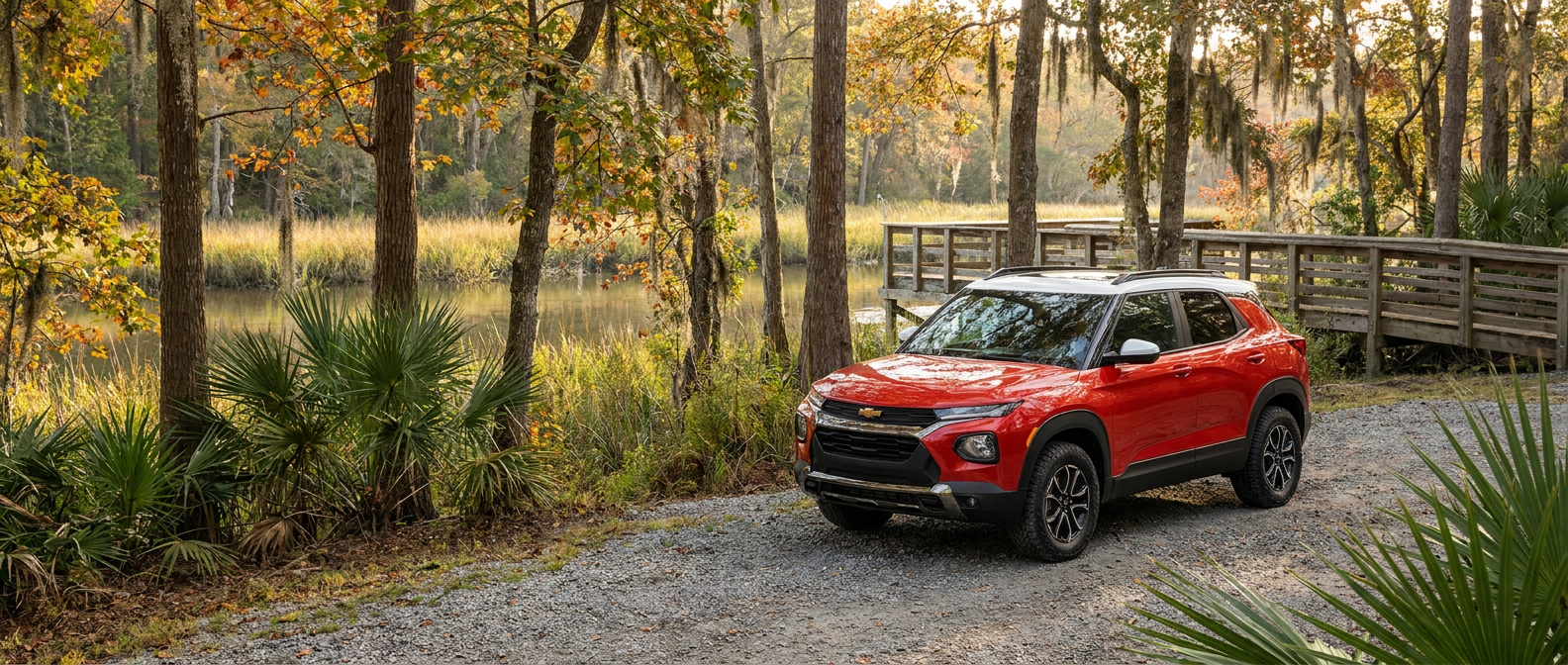
2026 Chevrolet Trailblazer ACTIV parked near a Waccamaw River access point in Horry County, SC

Why the Chevy Trailblazer Fits Horry County Life | Palmetto Chevrolet

In this article Why Does This Vehicle Fit Horry County So Well? The ACTIV Trim Is the One for This County What the Trailblazer Carries, and How Safety Tech That Makes the Grand Strand Commute Less Stressful Horry County doesn't ask much of a vehicle. It just asks a lot of different things from the same one, on the same Tuesday. Downtown Conway parking, where a full-size SUV turns into a math problem. The grind up US-501 toward Myrtle Beach when summer traffic stacks up and fuel economy starts to matter. A rutted access road into the Waccamaw National Wildlife Refuge on a Saturday morning, because you felt like it. And enough cargo room to come home with kayak paddles, a cooler, and a bag of farm stand produce without rearranging your life. The 2026 Chevy Trailblazer handles all of that. We think it fits this county specifically, not just SUV buyers in general, and the specs are where that shows up. The 2026 Trailblazer's 37.3-foot turning circle and 174.1-inch length make it genuinely easy to park in downtown Conway, while its 31 mpg highway rating (1.3L FWD, EPA-estimated) and up to 54.4 cubic feet of cargo space cover the full range of Horry County daily life. Browse the 2026 Trailblazer at Palmetto Chevrolet Why Does This Vehicle Fit Horry County So Well? Most small SUVs are designed to work fine everywhere and nowhere in particular, so the fit tends to read generic on paper. The Trailblazer earns its place here because its actual numbers, length and turning circle and cargo and range, line up with the specific friction points of driving in this county. Local Condition or Use Trailblazer Feature Why It Matters Here Tight downtown Conway parking and historic district streets 174.1-in length, 37.3-ft turning circle (Chevrolet) Maneuvers into spots that defeat longer crossovers; fits standard parallel spots with room to breathe Stop-and-go US-501 beach traffic in summer and fall 1.3L Turbo, EPA-rated 29 city/31 hwy mpg (FWD) Turbo torque handles the creep-and-surge without burning extra fuel the way larger engines do Waccamaw National Wildlife Refuge trail access roads ACTIV trim: off-road suspension tuning, functional skid plate, 8.0-in ground clearance (AWD) Handles packed-dirt and gravel access roads without scraping; skid plate protects the undercarriage Beach gear, kayak paddles, farm market hauls 25.3 cu ft behind rear seats; 54.4 cu ft seats down; 8.5-ft load floor (front seat folded flat) Chevrolet engineers a fold-flat front passenger seat. Almost nothing else in this class does that School-year CCU and Conway commuting Standard wireless Apple CarPlay and Android Auto, 11-in touchscreen Navigation and calls handled before you even pull out of the lot Hurricane-season preparedness kit in the cargo area 13.2-gal tank; ~435-mile highway range (1.3L FWD, per EPA ratings) Enough range to run inland without a fuel stop in low-supply conditions The ACTIV Trim Is the One for This County Look at all four trims if you want, LS through RS, and the RS is a sharp pick for anyone whose driving stays mostly on pavement. For Horry County, though, where the pavement ends without warning and a few gravel causeways sit between you and the good spots, the ACTIV is the build we keep pointing people toward. The ACTIV comes standard with the stronger 1.3-liter turbocharged three-cylinder (155 hp, 174 lb-ft of torque, per Chevrolet). That pull matters on the on-ramps from SC-544 where traffic gaps close fast. See what ACTIV trims are in stock right now Pair that engine with off-road suspension tuning and a functional skid plate, so when you drop off a paved road to reach a boat landing or a wildlife refuge trailhead, the undercarriage is covered. Literally. Ground clearance on the AWD ACTIV sits at 8.0 inches, per Chevrolet specs. The FWD version comes in at 7.5 inches. Both are a genuine step up from the base LS and LT trims. And the 17-inch wheels on the ACTIV use thicker tire sidewalls than the 19-inch RS setup, which soaks up more of the rough pavement and bridge expansion joints you meet on back county roads around here. One tradeoff is worth naming up front. The Trailblazer is a subcompact SUV. It seats five, but five adults on a longer run will feel the size. It isn't the vehicle for towing a boat to the Waccamaw River landing (Chevrolet rates it at 1,000 lb maximum when properly equipped. Verify your door-jamb label, and a fishing boat with a trailer clears that quickly). If that's your primary need, a Chevy Equinox is the more honest answer. What the Trailblazer does instead is cover everything else in the county better and more efficiently than a larger vehicle would. Local detail: The Conway Riverwalk parking on 2nd Avenue fills up fast during fall festivals and farmers market weekends. The Trailblazer's 37.3-foot turning circle (Chevrolet) means it fits into the perpendicular spots along the waterfront that longer crossovers end up circling past, a small thing until you've done it six times. What the Trailblazer Carries, and How Fold the rear seats: 54.4 cubic feet, enough for a weekend's worth of camping gear headed to the Waccamaw National Wildlife Refuge trailheads Fold the front passenger seat flat too: 8.5-foot load floor, which is how you fit surfboard bags, fishing rods, or a piece of furniture from downtown Conway's antique row inside the cabin with the tailgate closed Standard reversible cargo floor liner: sand from the beach, dirt from the refuge. Flip it over and you're clean again 25.3 cubic feet with all seats up: enough for a full grocery run or the gear for a family day at a Horry County park without making anyone hold something in their lap The fold-flat front passenger seat is the feature worth dwelling on with buyers who think this vehicle is too small. A fold-flat front passenger seat is a real differentiator in the class. Most compact SUVs don't offer it. Chevrolet does here, and it changes what the Trailblazer can actually carry. Safety Tech That Makes the Grand Strand Commute Less Stressful Every 2026 Trailblazer comes standard with Chevy Safety Assist, a package of six active safety features that includes Forward Collision Alert, Automatic Emergency Braking, Lane Keep Assist with Lane Departure Warning, Following Distance Indicator, and Intelligent Beam Headlamps. On a corridor like US-501 or Highway 17, where traffic density picks up sharply during peak tourist months, those systems are working in the background every time you drive. Visit us on 4th Ave in Conway to see the full 2026 Trailblazer lineup in person The 11-inch infotainment screen and standard wireless device connection mean you're not fumbling with cables when you're trying to pull up navigation before merging onto SC-22 (Veterans Highway) northbound toward North Myrtle Beach. A small vehicle, carrying a grown-up safety list. That's what sums up the package. Explore Financing Options for the Trailblazer Palmetto Chevrolet 1122 4th Ave, Conway, SC 29526 (843) 248-4283

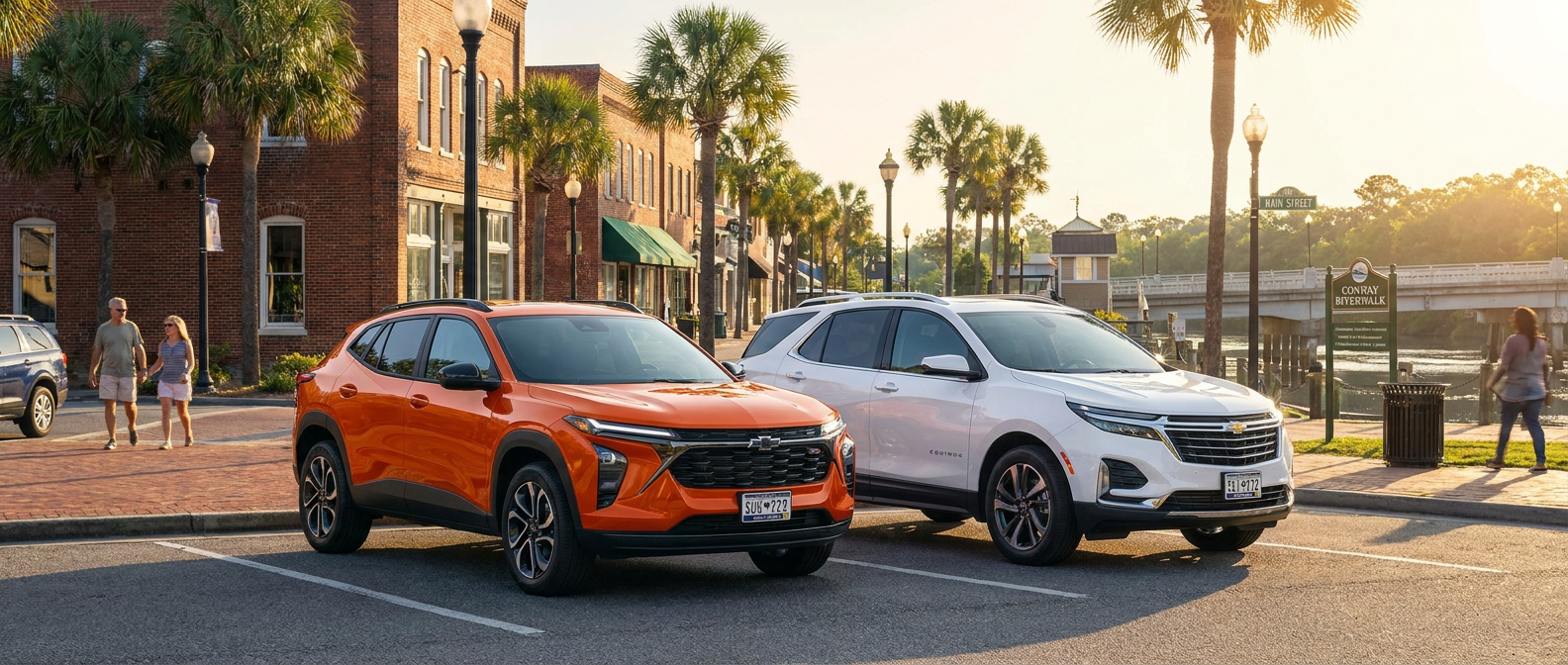
2026 Chevrolet Trax and 2026 Chevrolet Equinox parked side by side in Conway, SC

Chevy Trax vs. Equinox for First-Time SUV Buyers in Conway, SC

In this article What's the Real Difference Between the Trax and the Equinox? Do You Actually Need All-Wheel Drive in Conway? The Practical Question: Space and Comfort for Real Conway Life So Which One Should You Pick? If you've narrowed your first SUV down to the 2026 Trax or the 2026 Equinox, the short answer is that the Trax is the smarter pick for most Conway first-timers. The Equinox earns its higher entry point only when rear passenger room and available all-wheel drive are genuine priorities in your life right now. The short version The 2026 Trax starts significantly lower and returns an EPA-rated 30 mpg combined. 3 mpg better than the FWD Equinox and meaningful on a US-501 daily commute. The 2026 Equinox carries nearly 4.2 more cubic feet of cargo with all five seats up (29.8 vs. 25.6 cu ft) and offers a noticeably roomier back seat (39.9 vs. 38.7 inches of rear legroom). The Trax is FWD only. The Equinox offers available AWD. On Conway's flat coastal roads and mild winters, that gap matters far less than it would in the Carolina mountains. Both vehicles include Chevy Safety Assist. Six active safety technologies. On every single trim. Neither makes you pay up for the basics. Buy the Trax if you're commuting solo or with one passenger and budget is the priority. Buy the Equinox if you regularly carry three or four adults or want the flexibility of AWD for occasional mountain trips. Take a look at our current 2026 Equinox inventory if you'd like to see available trims and compare what's actually in stock before you read another word. Then come back, because the numbers below might shift your thinking about which one you need. What's the Real Difference Between the Trax and the Equinox? The core difference comes down to size class, with the Trax built as a subcompact and the Equinox as a compact, so the sharper contrast shows up less in the four-inch length gap, 178.6 vs. 183.2 inches, and more in where you'll actually spend your time, the back seat and the cargo hold. The gap is real but modest. Spec 2026 Trax 2026 Equinox FWD Engine 1.2L Turbo 3-cyl, 137 hp 1.5L Turbo 4-cyl, 175 hp EPA Combined MPG 30 mpg 27 mpg Cargo (seats up) 25.6 cu ft 29.8 cu ft Cargo (seats folded) 54.1 cu ft 63.5 cu ft Rear Legroom 38.7 in 39.9 in AWD Available No Yes Overall Length 178.6 in 183.2 in Chevy Safety Assist Standard, all trims Standard, all trims Towing Capacity Not rated for towing Up to 1,500 lbs (AWD, properly equipped) The Trax surprises you with 54.1 cubic feet of max cargo once you fold the rear seat, which lands close to the Equinox's 63.5. The gap you'll actually feel day to day is the 25.6 vs. 29.8 cu ft you get with passengers in the back, so the Equinox hands you roughly one more large rolling suitcase of usable space behind active rear seats. For a family, that counts. For a CCU student hauling a bike or moving boxes twice a year, it counts for a lot less. The single deciding factor: do you regularly carry three or four adult passengers? If yes, the Equinox's rear legroom and extra cargo depth with seats up makes daily life noticeably more comfortable. If you're usually carrying one passenger or fewer, the Trax delivers comparable room with a meaningful fuel economy advantage. Do You Actually Need All-Wheel Drive in Conway? For the kind of driving Conway serves up, no, you don't really need all-wheel drive, and outside of regular mountain trips, AWD ranks among the most common upsells in this segment and among the least necessary across the flat coastal terrain of Horry County. We'll be direct about that. The Trax is front-wheel drive exclusively, and Chevrolet doesn't offer an AWD version at any trim level. The Equinox does offer AWD, starting at the LT trim, with a bump to a 203 lb-ft, 8-speed automatic setup that the EPA rates at 25/29/26 mpg for city, highway, and combined. So you're trading one mpg combined for AWD capability and more torque. Whether that trade earns its keep depends entirely on how you drive. So where does AWD actually earn its place around here? Barely, once you look at the terrain. Conway sits at roughly 25 feet above sea level on predominantly flat coastal plain, and the corridors we all drive, US-501 to Myrtle Beach, SC-544, SC-22, also called Veterans Highway, simply don't demand it. Horry County winters rarely produce sustained freezing conditions. If you're planning regular trips to the Blue Ridge Parkway or weekends in the Upstate, AWD on the Equinox turns into a legitimate feature. For a first-time buyer whose world is the Grand Strand and Horry County, it's a nice-to-have rather than a need. The Trax's FWD paired with its 30 mpg combined EPA rating is the more practical equation for most daily driving here. On a 35-mile round-trip to Myrtle Beach along US-501, that 3 mpg advantage keeps adding up, and you'll feel it across a year of commuting. Around here, the math favors the Trax. The Practical Question: Space and Comfort for Real Conway Life The Equinox's back seat really earns its keep when you're regularly moving people, because Chevrolet lists 39.9 inches of rear legroom in the 2026 Equinox versus 38.7 inches in the Trax, a gap that reshapes how an adult rides on a longer haul. A 1.2-inch gap doesn't sound dramatic, but paired with the wider shoulder room, it's the difference between a comfortable rear seat for an average adult and one that starts to feel snug on the Myrtle Beach run. The Trax answers back with a surprisingly flexible cargo setup. Fold the 60/40 split rear seat and Chevrolet lists 54.1 cubic feet, which is more than you'd expect from a vehicle this size and enough for two large suitcases, a stroller, or a full CCU move-in haul. The Equinox's 63.5 cu ft folded wins, no question. The gap narrows once you load up. Both come with an 11-inch touchscreen available, standard on higher Trax trims and on the Equinox LT, plus wireless Apple CarPlay and Android Auto, and Google Built-In available. For a first car, you're well covered. Worth knowing: the 2026 Equinox ACTIV trim adds all-terrain capable tires and a lifted stance. It pulls its weight if Conway Riverwalk access or light unpaved boat ramp use is part of your regular routine (think gravel ramps and rutted approaches). The base Trax LS doesn't have that. It's genuine capability for anyone who leaves the pavement now and then. Trax Equinox Pros Cons Lower entry point FWD only. No AWD option ever 30 mpg combined (EPA) 137 hp can feel modest merging on US-501 Surprisingly large max cargo (54.1 cu ft) Tighter rear legroom (38.7 in) Smaller footprint. Easier parking at the Riverwalk or downtown Conway Slightly less cargo with seats up (25.6 cu ft) Chevy Safety Assist on every trim Not rated for towing Equinox Pros Cons AWD available (genuinely useful for mountain trips) Higher starting point More rear legroom (39.9 in) and shoulder room Slightly lower fuel economy (27 mpg combined FWD) More cargo with seats up (29.8 cu ft) Larger footprint (less nimble in tight spots) Tows up to 1,500 lbs when properly equipped (AWD) AWD adds cost; overkill for coastal SC flatlands ACTIV trim offers light off-road capability Bigger budget commitment for a first vehicle Browse our full new SUV inventory to compare what's actually available in Conway right now. Trim levels and availability shift over time, and seeing what's on the lot often settles the question faster than any spec sheet can. So Which One Should You Pick? Our answer here comes by buyer type, and we'll give it to you straight, because the right pick depends on which life you lead day to day, with the Trax making sense for a solo commuter on a tight budget and the Equinox earning the step up for anyone regularly filling the back seat or wanting AWD for mountain trips. Buy the Trax if: you're a first-time buyer on a practical budget, commuting alone or with one regular passenger along US-501 or around Horry County, living near downtown Conway where parking runs tighter, and fuel economy really matters to your monthly math. The EPA's 30 mpg combined rating is one of the better numbers in this segment. The Trax won't embarrass you on the highway, it just asks you to plan your merge a half-second earlier. Its 137 horsepower is adequate and grounded without pretending to be sporty, and for what you pay at the entry point, the trade is fair. Buy the Equinox if: you regularly carry three or four adults, you're planning beach weekends with a loaded back seat, you want the peace of mind of available AWD for occasional mountain drives on I-26 toward Asheville, or you want a vehicle with a little more room to grow with you over the next five years. The 175-hp 1.5L turbo merges onto US-501 with noticeably more confidence, and 39.9 inches of rear legroom keeps your back-seat passengers from folding themselves in. At its entry point, the Equinox LT is a genuine compact SUV with a compact SUV's feature set, not a subcompact wearing a bigger badge. The honest tradeoff: the Equinox costs more to buy and more to fill up. If those differences don't materially affect your life, the Equinox is the better long-term vehicle. And if they do, as they will for anyone shopping on a tight first-car budget, the Trax is a solid first SUV, not a compromise. Frequently Asked Questions Is the 2026 Chevy Trax big enough for a road trip? For one or two people, yes. Comfortably. The Trax offers 54.1 cubic feet of cargo space with the rear seat folded, which handles two large suitcases and travel bags without a problem. With all five seats in use, that drops to 25.6 cubic feet, which is tighter for a fully loaded four-person trip. If you're planning regular road trips with three or more passengers plus luggage, the Equinox's extra rear legroom and 29.8 cubic feet of cargo with seats up will make those trips more comfortable. For weekend runs from Conway to the Upstate or a solo drive up the coast, the Trax handles it without complaint. Does the 2026 Chevy Equinox really need AWD in South Carolina? For most driving in the Conway and Grand Strand area, no. Horry County roads are flat, winters are mild, and AWD adds cost without adding much capability on the routes most people drive daily. Where AWD on the Equinox genuinely earns its keep is on occasional trips toward the Upstate. I-26 into the mountains, unpaved rural roads, or light off-road use. The Equinox ACTIV trim pairs AWD with all-terrain tires, which is a real combination for anyone who goes off the paved road regularly. But if your driving is primarily coastal-SC flatland commuting, front-wheel drive on either the Trax or the Equinox LT FWD is the practical choice. --- Get Pre-Approved for Financing Palmetto Chevrolet 1122 4th Ave, Conway, SC 29526 (843) 248-4283