




Blog

2026 Chevrolet Trax parked in a metered street space near the Myrtle Beach Boardwalk on a sunny fall afternoon

The 2026 Chevy Trax and Downtown Myrtle Beach Parking: A Surprisingly Good Match

In this article Why Does Vehicle Size Actually Matter Near the Myrtle Beach Boardwalk? The Trax's Real Advantage: It Fits Where Bigger SUVs Make You Think Twice Size Comparison: The Trax Against What You Might Already Be Driving The Bottom Line for Grand Strand Drivers Finding a spot on the numbered avenues near Ocean Boulevard during a busy weekend is hard work. The metered stalls along those side streets aren't short, but they sure feel short when you're muscling a full-size SUV into one with traffic stacking up behind you. The 2026 Chevrolet Trax is 178.6 inches long. That's shorter than a Honda Civic. And it fits. The 2026 Trax measures 178.6 inches long and 71.7 inches wide (without mirrors), making it one of the most manageable subcompacts you can buy for navigating metered stalls and parking garages near the Myrtle Beach Boardwalk. That's the short version. The rest of this post breaks down why those numbers matter in this specific stretch of the Grand Strand, what the Trax does well here, and where it falls short. Browse the 2026 Trax on our lot if you want to see what's in stock while you read. Why Does Vehicle Size Actually Matter Near the Myrtle Beach Boardwalk? Vehicle size matters here because downtown Myrtle Beach's parking geometry is a real constraint and not a marketing talking point, so a smaller footprint opens up metered stalls and garage rows a larger SUV can only fight for, though on a wide-open lot that edge mostly disappears. The Pavilion Parking Garage on Kings Highway sits between 8th and 9th Avenue North and handles the bulk of covered parking for the Boardwalk, the SkyWheel, and Plyler Park. Street stalls on the numbered avenues and on Ocean Boulevard are standard-width metered spaces. And as a Post and Courier report from October 2026 confirmed, the downtown parking stock is strained now that the new Long Bay Theatre is drawing sellout crowds to the Arts and Innovation District near Main and Broadway. Smaller footprint means more options. Here is how the 2026 Trax's verified dimensions match the parking conditions you run into on the Grand Strand. Local Condition / Use The Trax Feature That Handles It Why It Helps Here Standard metered stalls on the numbered avenues 178.6-in length (about 14 ft 11 in) Fits a standard 18-20 ft stall with clearance front and rear Multi-level garages like the Pavilion structure 71.7-in width without mirrors, 61.4-in height Clears standard 7-ft garage clearances; narrower than many midsize rivals Tight side-street parallel parking on Ocean Blvd Electric rack-and-pinion power steering with a compact wheelbase (106.3 in) Tight, responsive steering reduces the number of steering-wheel corrections mid-maneuver Weaving through pedestrian-heavy Boardwalk traffic Curb weight of 2,983-3,040 lbs; subcompact proportions Light vehicle responds quickly to small steering inputs in stop-and-go Carrying beach gear for a family of four Up to 54.1 cu ft of cargo with rear seats folded; 25.6 cu ft with seats up Room for chairs, cooler, and bags without renting a truck The October-February off-season commute from Conway EPA-rated 28 city / 32 highway MPG A 30-mile round trip on US-501 costs noticeably less fuel than a V6 SUV The Trax's Real Advantage: It Fits Where Bigger SUVs Make You Think Twice The Trax earns its edge downtown by fitting where bigger SUVs make you think twice, riding a 106.3-inch wheelbase that Chevrolet lists as consistent across all five trim levels and pairing it with electric power steering, so you slot into rows a Traverse or Tahoe would need a spotter for, even if it won't swallow what those two will. The advantage you notice first isn't cargo or tech. It's the relief of skipping a three-point turn to back out of a tight row. See the Traverse if you're comparing larger family haulers, or check out the Trailblazer for a midpoint between the Trax and something with more towing. The Trax has one real tradeoff worth stating plainly. The Trax is FWD only, and Chevrolet publishes no AWD option for any 2026 trim. On the asphalt streets of downtown Myrtle Beach, that doesn't matter at all. But if your week runs back through Horry County on unpaved roads, or you regularly haul a trailer, something bigger with available AWD is the smarter call. "The 2026 Chevy Trax has a 1.2L Turbo 3-cylinder engine with 137 horsepower and 162 lb.-ft. of torque.". Chevrolet.com, 2026 Trax official product page All 162 lb-ft of torque arrives at just 2,500 rpm. Low-end pull matters when you're inching forward in a garage queue, accelerating out of a metered spot into moving Boardwalk traffic, or merging back onto Kings Highway from one of the numbered avenues at a gap that closes fast. A local timing note worth knowing. The City of Myrtle Beach announced that parking at City-owned spaces east of Kings Highway from 21st Avenue North to 6th Avenue South is free from October 1, 2026 through February 28, 2027. If you're visiting or commuting into downtown during the off-season, a vehicle that already parks easily just got meaningfully cheaper to park. Size Comparison: The Trax Against What You Might Already Be Driving The size difference only lands when you set it beside something you already drive, and here the gap is concrete: Chevrolet puts the 2026 Equinox at 14 inches longer than the Trax, roughly the difference between threading a gap and driving on past, though on a wide suburban lot you'd never feel it. The Trax is also narrower than a Toyota RAV4 and sits 61.4 inches tall. At that height, most standard garage clearances are a non-issue. Cargo is the part that surprises people. At 25.6 cubic feet of cargo space behind the rear seat, the 2026 Trax actually holds more rear-seat cargo than several vehicles a full class above it. Fold the seats and the EPA-verified 54.1 cubic feet is enough for a weekend's worth of beach gear. Is it class-leading on fuel? No, and it isn't spectacular by hybrid standards either. But the EPA-rated 30 mpg combined is a real daily-use benefit if you're commuting in from Conway on US-501, and it means routine Grand Strand driving costs less than it would in something larger. See what Trax trims are currently in stock at Palmetto Chevrolet before heading to the lot. Get Pre-Approved for Financing The Bottom Line for Grand Strand Drivers The 2026 Trax isn't the answer to every need, and for an off-pavement buyer the missing AWD is a plain limit, yet for a Conway or Myrtle Beach daily driver who wants to work the Boardwalk district without dreading the parking, it fits the job well. A growing family will outgrow its back seat. But the dimensions are specific. The streets are specific. Those two things line up in a way worth knowing before you buy something bigger out of habit rather than need. Come take a look in person. Our team at Palmetto Chevrolet in Conway, just up US-501, stocks the full Trax lineup and can walk you through which trim makes sense for how you actually use it on the Grand Strand. Value Your Trade-In Palmetto Chevrolet 1122 4th Ave, Conway, SC 29526 (843) 248-4283

2026 Chevrolet Equinox EV on Highway 544 in Horry County, South Carolina

Can the Equinox EV Handle Your SC-544 Commute Without Range Stress?

Yes, and the math works out better for Grand Strand commuters than for almost anyone else in the country. SC-544 is a flat, four-lane run between Conway and the Surfside Beach area, roughly 14 miles each way. The 2026 Chevrolet Equinox EV carries an EPA-estimated 319 miles of range on front-wheel-drive models. Drive that commute back and forth every weekday and you'd go nearly two weeks before the battery even asks a question. The commute itself poses little challenge. The planning question is knowing how Grand Strand summers, beach-season stop-and-go, and the charging options along your actual corridor affect that number, and that's what this guide covers. Browse the 2026 Equinox EV at Palmetto Chevrolet and then come back, because the spec sheet leaves out what matters most here. How Far Will It Really Go on a Grand Strand Commute? The EPA's 319-mile rating for front-wheel-drive models holds up as a solid figure, but it comes from controlled lab conditions rather than August humidity on SC-544 with the A/C running full-blast, so your day-to-day number sits a little lower, and a local commuter can plan around the gap pretty easily. Below is the picture for real driving. Driving Scenario EPA / Source Realistic Range Estimate What Shapes It Here FWD. Mixed daily commute, mild temps 319 mi (EPA) 280-300 mi Flat terrain, short segments, regenerative braking in traffic FWD. Sustained highway at 70-75 mph ~260 mi (independent 75-mph tests) 240-265 mi Beach-season 544 cruise speeds, wind drag FWD. Extreme summer heat, heavy A/C ~270-285 mi (10-15% heat penalty) 270-285 mi SC summer consistently exceeds 95F; battery cooling + A/C load AWD. Mixed daily commute 307 mi (EPA) 265-285 mi Slight efficiency trade for all-weather grip FWD. Cold winter morning (rare here) ~215-230 mi (sub-freezing conditions) Rarely applicable Grand Strand winters stay mild; this scenario is uncommon A few things work strongly in your favor on this commute. SC-544 is as flat as pavement gets. No grades drain the pack the way mountain corridors do. Stop-and-go in Socastee actually lets the regenerative braking put miles back. And our Grand Strand winters stay mild enough that cold-weather range loss (which can hit 25-35% in freezing temps, per real-world testing data) just isn't a frequent worry here. Summer is where you feel it. Running the A/C hard while sitting in beach-season traffic on 544 costs about the efficiency of adding ten miles to every trip. A Lowcountry August will trim your range. There's no workaround. If you need more cargo room, the Blazer EV is the next step up Where Do You Charge Along the 544 Corridor? Charging comes up as a fair question before anyone commits to an EV commute, and the practical answer has two halves. On a normal workday you probably won't need a public charger at all, and when you do need one, good options sit close by. Charging Location Type Speed Notes Home (240V Level 2, 11.5 kW) Level 2 ~34-38 mi/hr added Best option. Plug in each night, wake up full City of Conway Public Parking Lot, 400 Laurel St Level 2 (J1772) ~34-38 mi/hr added Free public charger near downtown Conway Coastal Carolina University, 115 E Chanticleer Dr Level 2 ~34-38 mi/hr added On-campus charger, accessible during campus hours Circle K, 1700 US-501, Conway DC Fast (50 kW CCS) ~50-60 mi per 20 min Good for a top-up before a longer run Tanger Outlets, Kings Rd, Myrtle Beach Level 2 (ChargePoint) ~34-38 mi/hr added Charge while you shop; near the beach end of the corridor Coastal Grand Mall area, Myrtle Beach DC Fast (Tesla / CCS) ~77 mi per 10 min at peak Near the eastern end of SC-544; fastest local option For your 544 commute specifically, home charging carries the load. The Equinox EV's onboard 11.5 kW Level 2 charger refills about 34-38 miles of range per hour on a 240V circuit, so a full overnight adds well over 300 miles before you back out of the driveway. A Conway-to-Socastee-to-Myrtle-Beach round trip burns 28-30 miles. You'll start full every morning. Home charging runs on a 240V circuit. The car's onboard unit supplies it overnight. Our service team can walk you through what a home charger installation involves for your specific setup Charging caution for summer: The Equinox EV's Ultium battery management system handles SC heat well, but you'll protect long-term battery health by charging to 80% on a regular basis and saving 100% charges for longer driving days. Parking in shade during peak afternoon heat reduces battery cooling demand and helps the pack stay efficient. Worth doing for anyone parking outdoors at a Myrtle Beach or Socastee worksite. [ ] Ask your electrician about a dedicated 240V / 48A circuit for Level 2 home charging [ ] Download the myChevrolet app to schedule overnight charging and pre-cool the cabin while still plugged in [ ] Set your daily charge limit to 80% for routine commutes; override to 100% only before longer trips [ ] Identify one DCFC stop near your work end of 544 (Circle K Conway or Coastal Grand Mall) for occasional top-ups [ ] Check the ChargePoint app or PlugShare before any unfamiliar detour, the Grand Strand has 250-plus public stations across the area Plan It This Way: Making the 544 Commute Work as an EV Owner See what's available in our new inventory, then weigh this, because the SC-544 corridor ranks among the better EV commutes in the Carolinas, with flat terrain, short mileage, beach-season stop-and-go that regenerative braking loves, and mild winters that spare the battery the beating a Charlotte or Asheville commute would hand it. Set it up the way we would if one of us drove it daily. Install a 240V Level 2 charger at home. One upgrade like that turns every morning into a full tank. Set the daily limit to 80% (right around 255 miles of usable range for FWD). Treat the public chargers at the City of Conway lot or CCU as a backup, not a routine. The DC fast charger at Circle K on US-501 is your rainy-day option for a longer drive or a night you forgot to plug in. Summer beach traffic is the main variable here. When SC-544 backs up heading toward Socastee and Surfside on a Friday afternoon, your efficiency stays close to city-driving numbers, which actually helps range. The A/C load at 95-plus degrees is the factor that trims it. There's still no range problem for a 30-mile round trip. Knowing it matters because it changes the feel of the range display, and we don't want that catching you off-guard on your first August commute. Skip the one-size assumption if your workday includes a lot of jobsite driving beyond the main commute. Loading in Socastee, running to Conway Medical Center, looping back out toward Carolina Forest. Add those miles to your daily tally before assuming you're covered. The math still works for most patterns. Run your real routes first. Explore Financing Options for the Equinox EV The bottom line is simple enough. A 14-mile flat highway with overnight home charging behind it sits just about at the ideal EV scenario. We're not saying that to sell you on it. We're saying it because the numbers for this specific commute come out genuinely favorable, and you should know that going in. Frequently Asked Questions Does the 2026 Equinox EV's 319-mile range hold up on hot South Carolina days? Mostly yes, with a modest adjustment. The EPA rates the front-wheel-drive 2026 Equinox EV at 319 miles, but sustained A/C use in extreme heat (above 95 degrees Fahrenheit) can trim that by about 10-15%, putting real-world summer range closer to 270-285 miles. For a 28-to-30-mile SC-544 round trip, you've still got far more than enough on a single overnight charge. Do I need to charge at work, or is home charging enough? Home charging covers the SC-544 commute on its own. The Equinox EV's 11.5 kW Level 2 onboard charger adds around 34-38 miles of range per hour on a 240V circuit. A standard overnight session easily refills a full commute's worth of miles and then some. Workplace charging helps as an option. Public Level 2 stations sit at Coastal Carolina University and the City of Conway public lot, though you'll treat them as backup, not a daily requirement. What's the fastest way to add range near the 544 corridor if I need it? The Circle K at 1700 US-501 in Conway runs a 50 kW DC fast charger. At that speed, you can add roughly 50-60 miles in about 20 minutes while grabbing coffee. For faster charging, the Coastal Grand Mall area in Myrtle Beach has higher-speed DC fast charging that can add approximately 77 miles in 10 minutes, per Chevrolet's published charging specs. Either station covers a quick top-up between Conway and the beach end of the corridor. By the Palmetto Chevrolet Team | October 2026 See What Your Current Vehicle Is Worth Palmetto Chevrolet 1122 4th Ave, Conway, SC 29526 (843) 248-4283

2027 Chevrolet Traverse with rear hatch open and beach gear loaded, parked at Myrtle Beach State Park maritime forest, South Carolina

3 Chevy SUVs That Actually Work for a Myrtle Beach State Park Trip

In this article How the Three Pickss Compare The Traverse Fits the Most Real-World Park Trips The Tahoe Is Right When You Are Pulling Something The Trailblazer Handles the Low-Gear Trip Better Than Anything Else in the Lineup Pros and Cons for Each Park-Ready Pick The Traverse Is Still the Best All-Around Answer The 2027 Traverse wins this ranking outright. The Traverse seats up to eight, maxes out at 97.6 cubic feet of cargo with both rear rows folded (Chevrolet-listed), and tows up to 5,000 pounds, properly equipped. For most Conway and Grand Strand families making the run down US-501 East to the park, you're set for the whole trip in a single load. That said, the park itself changes the conversation in ways a generic beach-SUV list never mentions. Myrtle Beach State Park sits off US-17 (South Kings Highway) between Myrtle Beach and Surfside Beach. Day-use parking fills fast on summer weekends and holidays, with the park sometimes reaching capacity before 10 a.m. The campground accommodates RVs up to 30 feet in length and a maximum of two vehicles per site. Bus, RV, and trailer parking is not permitted in the reserved day-use spots. The two nature trails (Yaupon and Sculptured Oak) run through flat maritime forest, so this isn't a ground-clearance conversation. It is a cargo, towing, and parkability conversation. We ranked three Chevy SUVs on exactly those factors, and here's how the lineup sorts out. How the Three Pickss Compare Rank Model Best For Standout Spec 1 2027 Traverse Families with full gear loads 97.6 cu ft max cargo, seats 7 or 8 2 2027 Tahoe Towing a camper or boat to the campground Up to 8,400 lbs tow capacity (properly equipped) 3 2027 Trailblazer Couples and small groups, day trips Up to 29 city / 33 hwy MPG (EPA-est., 1.3L) The Traverse Fits the Most Real-World Park Trips Chevrolet lists the 2027 Traverse at 97.6 cubic feet of maximum cargo with both rear rows folded. That fits beach chairs, a soft cooler, a canopy, pier fishing gear, and day packs for the Yaupon Nature Trail without a second vehicle. The Traverse carries one real tradeoff. It's a long crossover (204.5 inches), and reserved parking at Myrtle Beach State Park fills by mid-morning on peak weekends. Get there early or book a reserved spot online before you leave Conway. That constraint is real. Where the Traverse earns its ranking anyway is the math. It's EPA-rated at 22 MPG combined with front-wheel drive (Chevrolet), which makes the 30-to-40-minute drive from Conway down US-501 East reasonable. The 2027 model runs a 2.5-liter turbocharged four-cylinder making 328 horsepower paired to an eight-speed automatic. Towing capacity reaches 5,000 pounds, properly equipped, enough for a small camper or a kayak trailer for the families who camp at the park's 278 sites rather than just day-tripping. The Z71 trim adds AWD as standard and sits up 70.6 inches, a bit taller than the base, which matters more for loading gear than for the park's flat trails. Our team's read on the Grand Strand gear load is simple. When you need all three rows used, plus room to fish the 700-foot pier, plus beach chairs for everyone, stepping down to a smaller SUV for the sake of MPG is the kind of call you second-guess at the trailhead. The Traverse doesn't force that tradeoff. The Tahoe Is Right When You Are Pulling Something The 2027 Tahoe takes over the moment a camper trailer enters the picture, towing up to 8,400 pounds with the 5.3L EcoTec3 V8 in rear-wheel drive and the Max Trailering Package (Chevrolet-listed), though you'll pay for that capability in both footprint and fuel. Most small-to-midsize travel trailers run well under that ceiling, so the Tahoe handles the load with genuine margin. The campground has 138 full-hookup sites. They're built for exactly this kind of setup. The tradeoffs are straightforward. At 211.3 inches long and rated at 15 city / 20 highway MPG on the 5.3L V8 in rear-wheel drive (EPA estimates), the Tahoe is a commitment in both footprint and fuel. Day-use visitors pulling a trailer still need to park in campground or non-reserved areas, since the park's guaranteed-parking system restricts trailer parking from its reserved day-use spots. Plan the entry for campers, not day-trippers. For families making the park a camping run rather than a day trip, the Tahoe's 122.7 cubic feet of max cargo and up to nine-passenger seating make it the only Chevy SUV in the lineup built for the full extended-family weekend. The available 3.0L Duramax turbo-diesel is rated at 22 city / 26 highway MPG in two-wheel drive (EPA-estimated, Chevrolet-stated for 2027) and can cover an estimated 624 miles of highway range on a single 24-gallon tank. That isn't a trivial number for families driving in from further than Conway. The Trailblazer Handles the Low-Gear Trip Better Than Anything Else in the Lineup The 2027 Trailblazer is the right tool when the trip is two people, a rod case, a soft-sided cooler, and a pair of folding chairs, earning up to 29 city / 33 highway MPG (EPA-rated) with the 1.3-liter turbo three-cylinder, though it gives up the cargo and towing the bigger two handle easily. That high MPG makes the Conway-to-park run on US-17 genuinely cheap. At 174.1 inches it's short enough that parking stays simple even when the lots start filling and large SUVs are circling. The tradeoff is firm. The Trailblazer maxes out at 54.4 cubic feet of cargo with the rear seat folded and tows only 1,000 pounds, which rules out any trailer and limits gear to what two people can actually carry. No third row means no third row. For Coastal Carolina University students or Conway couples who want the park's quieter maritime beach over the main strip, the Trailblazer checks every box on this specific kind of trip. It just doesn't scale. Before you buy: Check the engine before you fall for the MPG. The Trailblazer's higher figures (29 city / 33 highway) come from the 1.3-liter turbo. The base 1.2-liter makes 137 horsepower and delivers modestly lower estimates. If fuel economy is driving your decision, confirm which engine is in the specific vehicle before you sign anything. Pros and Cons for Each Park-Ready Pick Pros Cons Traverse: 97.6 cu ft cargo handles a full family load At 204.5 inches, arrive early for day-use parking Traverse: 5,000-lb tow rating covers small camper or kayak trailer EPA-est. 22 MPG combined (FWD) is solid but not best-in-class Tahoe: 8,400-lb tow rating handles serious travel trailers 211-inch length and 15/20 MPG city/hwy are real commitments Tahoe: Up to 9 passengers and 122.7 cu ft max cargo Day-use reserved spots restrict trailer parking Trailblazer: Up to 29/33 MPG; easy to park anywhere 54.4 cu ft max cargo, no towing for campers or boats Trailblazer: Right-sized and affordable for smaller groups No third row limits how many can come along Explore Financing Options The Traverse Is Still the Best All-Around Answer Step back from the three and the 2027 Traverse still threads the gap better than either bracket, giving you 97.6 cubic feet of cargo, seating for up to eight, 22 MPG combined (FWD, EPA-estimated), and a 5,000-pound tow rating for the families who camp rather than just day-trip. The Tahoe tows more than a state park weekend asks for. A Trailblazer gains efficiency but runs out of room fast. Our team's read on the Grand Strand market is that the park's gear load (fishing, trails, beach day) is the scenario the Traverse was built around, whether or not anyone said so explicitly. If your current vehicle is ready to be replaced, start with what you're trading in. Browse our current inventory at Palmetto Chevrolet in Conway and we'll match you with the trim that fits how your family actually uses Myrtle Beach State Park. By the Palmetto Chevrolet Team | October 2026 Value Your Trade-In Today Palmetto Chevrolet 1122 4th Ave, Conway, SC 29526 (843) 248-4283

2026 Chevrolet Blazer RS driving on a South Carolina coastal highway near Myrtle Beach

The Conway-to-Myrtle Beach Commute: How to Drive It Well in a 2026 Blazer

In this article The Commuter Do's and Don'ts on US-501 in a Blazer The One Thing That Changes a Commute This Congested One More Reason This SUV Fits the Grand Strand Year-Round Keep the Safety Technology Working for You Run US-501 between Conway and Myrtle Beach on a regular basis and you already know this road has two personalities. Off-season weekday mornings stay manageable. A Friday afternoon in July, when Coastal Carolina lets out and tourist traffic backs up from Carolina Forest Boulevard to the Waccamaw River bridge, is a different story entirely. Ask whether the 2026 Blazer is right for that commute and the honest answer is yes, with one tradeoff worth naming up front. It isn't the cargo-hauling champion of its class. What it is, is a well-matched daily driver for a corridor that punishes inattention and loads your AC harder than almost anywhere in the Southeast. Browse available 2026 Blazer trims on our lot and see what's in stock right now at Palmetto Chevrolet. The Commuter Do's and Don'ts on US-501 in a Blazer Situation Do Don't Stop-and-go approaching Carolina Forest Blvd Let Forward Collision Alert (standard on every trim) give you the buffer cue Tail the car ahead through each light cycle Afternoon thunderstorm rolls in off the Atlantic Drop speed, switch to the interior lane, use the standard rear cross-traffic alert when merging Run the same following distance you use in dry conditions Swapping to SC-22 (Veterans Highway) to skip the 501 backup Use the following-distance indicator to settle into a highway gap Accelerate hard through the interchange to make up time Long AC-on slog in summer heat Use dual-zone climate control so the driver stays cool without freezing a passenger Max the single-zone blower and fight over the vents Merging onto SC-31 from Veterans Highway Check the Side Blind Zone Alert before lane changes in fast-moving traffic Rely only on mirrors in a wide merge lane The One Thing That Changes a Commute This Congested Standard Chevy Safety Assist is what changes a commute this congested, and it's one reason our team steers coastal drivers toward the Blazer well before the sportier styling comes up, because the gear that keeps you out of trouble on 501 ships on every trim instead of hiding in an option package. Every single 2026 Blazer trim ships with Forward Collision Alert, Automatic Emergency Braking, Front Pedestrian Braking, Lane Keep Assist, a Following Distance Indicator, Side Blind Zone Alert, and Rear Cross-Traffic Alert as part of the standard package. No option package needed. On a road like US-501, where SCDOT traffic counts have documented busy segments carrying more than 50,000 vehicles per day and where the stretch at Carolina Forest Boulevard is a documented crash hotspot, that Following Distance Indicator earns its keep every single commute. It shows you the gap to the car ahead in seconds of travel time (not feet, not car-lengths), which is exactly the feedback you want when traffic compresses without warning. The Blazer's 30.5 cubic feet of cargo space behind the rear seat trails a few rivals in the segment. A weekly Costco run or an equipment haul is where you'd feel it. For a commuter who needs a comfortable, well-equipped daily driver on a congested coastal route, though, it's a non-issue. We'll name that tradeoff plainly because every pick carries one. The Chevy Equinox is worth a look if max cargo utility is your primary goal. The Traverse steps up further if you need three rows. Quick note on fuel economy: The EPA rates the FWD 2026 Blazer with the 2.0-liter turbo at 22 city / 29 highway / 25 combined. In real Grand Strand stop-and-go with the AC running hard through a South Carolina summer, expect the city number to be the one that governs your tank. The figure stays competitive for a midsize SUV, and the nine-speed automatic keeps the engine in a comfortable rev range through slow-moving traffic. One More Reason This SUV Fits the Grand Strand Year-Round The Blazer fits the Grand Strand year-round largely because its climate system is built for weather that hammers a cabin, and summers here are genuinely tough on any vehicle's AC, with average highs in the upper 80s, humidity running through the upper 60s percent range, and afternoon thunderstorms that can appear fast and soak the road in minutes. The 2026 Blazer's standard dual-zone automatic climate control lets driver and passenger set independent temperatures, which matters on a 35-minute commute home when one person just walked off a job site and the other didn't. Dual-zone isn't a luxury feature on the Grand Strand. It earns its place as a practical one. The Blazer EV is another option worth knowing about if you're thinking about ditching the gas bill for a shorter, predictable commute route. Schedule Your Pre-Commute Vehicle Check Keep the Safety Technology Working for You The Chevy Safety Assist suite is only as effective as the sensors behind it, and coastal humidity, salt air, and the frequent afternoon thunderstorms we see across Horry County can degrade sensor visibility if your cameras and lenses aren't kept clean. On the crash side, the mechanically identical 2026 Blazer earned an overall 5-star NHTSA safety rating, and that hardware is worth protecting with a periodic service check. Our service team checks sensor lens condition, tire pressure, and brake function as part of any routine visit. Keep those items current and the standard safety suite keeps doing its job, every mile of that 501 slog. Explore Financing Options Palmetto Chevrolet 1122 4th Ave, Conway, SC 29526 (843) 248-4283

2026 Chevy Colorado and 2026 Chevy Silverado 1500 parked at a Horry County boat ramp in South Carolina

How to Pick the Right Chevy Truck for Horry County Driving

In this article What Actually Matters When Choosing Between These Two Trucks? Towing on the Waccamaw and the Intracoastal: Does the Colorado Actually Do the Job? Bed Size: The One Spec That Changes Everything for Tradespeople How the Engine Lineup Shapes Your Choice Match the Truck to How You Actually Drive in Horry County Going back and forth between the 2026 Colorado and the 2026 Silverado 1500? You're in good company, and the straight answer isn't "get the bigger one." Three things decide it. What you're towing, what you're hauling in the bed, and how much of your week you spend on US-501 in beach-season traffic. Get those three right and the choice makes itself. The short version Towing a boat to the Waccamaw or the Intracoastal: the 2026 Colorado covers most Horry County rigs at up to 7,700 lbs properly equipped. More than enough for the center consoles and bass boats common here. Towing a camper, horse trailer, or equipment trailer over 8,000 lbs: step up to the Silverado 1500, which reaches 13,300 lbs with the right engine and package. Daily driver who also needs a truck a few times a month: the Colorado's narrower body and shorter overall length make it genuinely easier to live with in parking lots, downtown Conway, and on the beach roads. Full-time tradesperson or contractor hauling heavy payload: the Silverado 1500's payload ceiling (up to 2,260 lbs with the TurboMax engine, per Chevrolet) beats the Colorado's 1,710-lb max. That gap matters when you're stacking lumber or block. Want multiple engine choices now or later: only the Silverado 1500 offers four powertrains; the Colorado runs one engine across every trim. What Actually Matters When Choosing Between These Two Trucks? Neither truck is tougher in a way that settles this, since both are Chevys, both are capable, and both will run the roads between Conway and the beach without drama, so the decision really turns on four variables. Tow rating, payload capacity, bed size, and daily footprint. Compare them side by side below. Factor 2026 Colorado 2026 Silverado 1500 What It Means for You Max tow (properly equipped) 7,700 lbs 13,300 lbs Colorado handles most Horry County boats; Silverado handles big fifth-wheels and horse trailers Max payload ~1,710 lbs (WT/LT 2WD) Up to 2,260 lbs (TurboMax) Silverado wins for heavy jobsite loads; Colorado is fine for lighter contractor work Bed length 5 ft (61.7 in) Up to 98 in (standard or long bed) A full sheet of plywood does not lie flat in a Colorado's 5-ft bed Engine choices One (2.7L TurboMax) Four (TurboMax, 5.3L V8, 6.2L V8, Duramax diesel) Silverado lets you buy the powertrain that matches your load; Colorado keeps it simple Body width ~75-78 in ~81 in Colorado is meaningfully narrower. That's real in a full parking lot or a tight job-site lane Best fuel economy ~19 city / 24 hwy (EPA est., 2WD) 23 city / 28 hwy (Duramax diesel, EPA est.) Diesel Silverado leads; gas Silverados generally trail the Colorado Specs sourced from Chevrolet and EPA estimates. All tow and payload figures require proper equipment; always verify the door-jamb label on the specific truck. Towing on the Waccamaw and the Intracoastal: Does the Colorado Actually Do the Job? For most Horry County boaters the Colorado genuinely does the job, and the longer version is worth walking through before you rule it out on size alone. The Bucksville boat ramp on the Waccamaw River and the SC 544 ramp in Socastee serve everything from 14-ft aluminum johnboats to 24-ft center consoles. A typical 20-ft center console with a trailer and fuel runs somewhere in the 4,500-6,000-lb range. The 2026 Colorado, properly equipped with the Advanced Trailering Package, is rated to 7,700 lbs. Real margin. Our commercial truck team can walk through the trailering package specifics for any configuration you're considering. Where the Colorado does reach its limit is with larger performance boats (anything pushing 7,000 lbs wet), bigger pontoons, or any travel trailer with serious dry weight. For those loads, the Silverado 1500 makes a lot more sense. The 5.3L V8 configuration reaches 11,300 lbs, and the Duramax diesel and 6.2L V8 both touch 13,300 lbs when properly equipped with the Max Trailering Package. A completely different class of capability. Trailering caveat (always): Chevrolet's published tow ratings are for the specific truck as optioned. Two Silverados parked side by side can carry meaningfully different ratings depending on engine, cab, bed, axle, and package. Check the door-jamb label on the actual truck, not just the brochure number. The 2026 Colorado's 7,700-lb tow rating covers the majority of recreational boats launched at Horry County ramps, the payload gap, not the tow rating, is what pushes most local contractors toward the Silverado 1500. Bed Size: The One Spec That Changes Everything for Tradespeople Bed length is the spec that splits these two trucks for anyone hauling building material, and the split is physical rather than a matter of opinion. The Colorado comes only as a crew cab with a 5-ft bed, 61.7 inches of cargo floor. A standard sheet of OSB or plywood is 96 inches long. It won't lie flat. Full stop. See What Your Current Truck Is Worth If you're a contractor loading drywall, lumber, or long pipe runs, that's a genuine limitation. Haul short loads and it rarely bites. Run long material every week and it becomes a daily headache. The Silverado 1500 offers a standard bed (just under 79.5 in) or a long bed (98 in), and you can configure it as a Regular Cab or Double Cab to get that extra bed length. A sheet of plywood rides flat in the standard bed. The Silverado 1500's payload advantage is worth saying plainly. Chevrolet lists the TurboMax Silverado at up to 2,260 lbs of maximum payload capacity, compared to around 1,710 lbs for a Colorado WT or LT in 2WD. Load a full pallet of concrete blocks (typically around 2,000 lbs), and you've exceeded the Colorado's rated capacity. You haven't exceeded the Silverado's. For homebuilders, landscapers, and masonry contractors working across Horry County, that difference matters on the job. For drivers who mostly carry two passengers and a cooler or a tool bag, and pull a boat on weekends, the Colorado's 5-ft bed is perfectly workable. How the Engine Lineup Shapes Your Choice The engine question answers itself on the Colorado and opens wide on the Silverado, which is really the whole distinction between them. The Colorado runs one engine across all six trims, the 2.7L TurboMax turbocharged four-cylinder, producing 310 hp and 430 lb-ft of torque in its High-Output tune. Strong numbers for a midsize truck. Simple, and no wrong choice. The Silverado 1500 gives you four. The same 2.7L TurboMax is the entry option (310 hp, rated to 9,500 lbs of towing, highest payload in the lineup). Step up to the 5.3L EcoTec3 V8 for 355 hp and 11,300-lb towing. The 6.2L V8 tops out at 420 hp and up to 13,200 lbs. And the 3.0L Duramax turbo-diesel, at 305 hp and 495 lb-ft of torque, reaches 13,300 lbs while delivering an EPA-estimated 23 city / 28 highway mpg in 2WD, the best fuel economy in the lineup by a significant margin. The diesel figure is worth sitting with. Put serious miles on a Silverado (think a contractor running US-501 and SC-544 routes daily) and the Duramax pays back at the pump in a way the gas engines don't. The Colorado's TurboMax returns an EPA-estimated 19 city / 24 highway in 2WD. The diesel Silverado edges it on the highway. Match the Truck to How You Actually Drive in Horry County Match the footprint to your week and the pick gets easy, because beach season on US-501 between Conway and Myrtle Beach is its own category of driving. The driving is slower, tighter at intersections, and parking lots at Grand Strand destinations get congested fast. The Colorado's narrower body (roughly 75-78 inches wide versus 81 inches for the Silverado) is a genuine advantage in that environment. You'll slot it into a parking space more easily, and the shorter overall length makes turning around in a full lot less of a production. If most of your miles are commuter and errand miles with the occasional boat haul on a Saturday, and you rarely need to carry full-sheet building materials, the Colorado is the truck we'd point you toward. No compromise there, just the right tool. If your livelihood depends on hauling serious payload five days a week, or you're regularly pulling a camper, a horse trailer, or a loaded equipment trailer that pushes the 10,000-lb range, the Silverado 1500 earns its footprint. Need to go heavier? Our Silverado 2500 HD is worth a look for towing regularly at or above the Silverado 1500's ceiling. We keep both trucks on the lot at Palmetto Chevrolet in Conway. Come in and we'll pull both up, let you climb in, and talk through exactly what you're towing and hauling. No guesswork, just the right fit. Frequently Asked Questions Is the 2026 Chevy Colorado powerful enough to tow a boat in Horry County? For most boats launched at Horry County ramps, including 20-ft center consoles and bass boats that run in the 4,500-6,000-lb range when loaded with trailer and fuel. Yes. The 2026 Colorado is rated at up to 7,700 lbs of towing capacity when properly equipped with the Advanced Trailering Package on WT, LT, Trail Boss, and Z71 trims. That leaves real margin for the boats most Grand Strand anglers and recreational boaters run. If you're towing a larger performance boat or a pontoon pushing 7,000 lbs, the 2026 Silverado 1500 gives you more headroom, with ratings that reach 9,500 lbs on the TurboMax engine and 13,300 lbs on the diesel or 6.2L V8 when properly equipped. Always verify the specific tow rating on the door-jamb label of the truck you're buying. What is the biggest practical difference between the 2026 Colorado and the 2026 Silverado 1500 for daily use? Bed length and payload capacity. The 2026 Colorado comes only in a crew cab with a 5-ft (61.7-in) bed. A standard sheet of plywood or OSB is 96 inches long and won't lie flat. If you carry long building materials regularly, you need a Silverado 1500 with a standard or long bed. On payload, Chevrolet rates the Silverado 1500 TurboMax configuration at up to 2,260 lbs, compared to around 1,710 lbs for the Colorado WT or LT in 2WD, a gap that matters for contractors loading heavy materials. For everyday driving, the Colorado's narrower body and shorter length are real advantages in congested parking and beach-town traffic. Get Pre-Approved for Financing Palmetto Chevrolet 1122 4th Ave, Conway, SC 29526 (843) 248-4283

2026 Chevrolet Silverado 1500 Work Truck with tool chest in bed at a Conway, SC job site

Hauling Tools for the Job Around Conway: Which Chevy Truck Actually Fits Your Load?

In this article Will My Tools Actually Fit? The Numbers by Truck How to Load Your Tools So the Truck Works for You Loading Up: A Step-by-Step Approach for Your Conway Job Day Job Done: Matching the Right Truck to Your Conway Trade Let me give you the straight answer. If you're a solo tradesperson running light-to-medium service gear around Horry County, the 2026 Chevrolet Colorado gets the job done and fits in places a full-size truck can't. If you're loading a full contractor chest plus power tools and materials, the 2026 Silverado 1500's extra bed width and much higher payload capacity earn every inch. And if you're pouring concrete or pulling a fully loaded trailer to job sites near downtown Conway, the Silverado 2500 HD is the honest pick. Let's match your real load to the right truck. Horry County's construction activity keeps climbing. A new ready-mix concrete plant is coming online on Mount Pisgah Cemetery Road in Conway this year. The pace of local contractor and trades work is only picking up with it. Plumbers, HVAC techs, electricians, and framers around here all run into the same question before they commit to a truck, which one actually fits the load. We break it down below with verified specs so you can see exactly what fits. Will My Tools Actually Fit? The Numbers by Truck Whether your tools actually fit comes down to two numbers working in tandem rather than one headline figure, so weigh payload and bed dimensions together before you settle on a truck, because a bed that's long enough can still be too narrow for your chest. Payload tells you the weight limit, and the bed dimensions tell you whether your chest clears the wheel wells. Here's how all three trucks stack up on the specs that decide real daily utility for a tradesperson, per Chevrolet's published figures. Load / Spec 2026 Colorado 2026 Silverado 1500 (Std. Bed) 2026 Silverado 2500 HD (Std. Bed) Bed floor length 61.7 in. (5 ft. 2 in.) 79.4 in. (6 ft. 7 in.) 82.3 in. (6 ft. 10 in.) Bed width at floor 58.8 in. 71.4 in. 71.4 in. Width between wheel wells 45.5 in. 50.6 in. (approx.) ~50 in. Cargo volume 41.9 cu. ft. 71.7 cu. ft. ~70 cu. ft. Max payload (properly equipped) Up to 1,710 lbs Up to 2,260 lbs Up to 3,759 lbs Tailgate load rating 500 lbs (mid-position) N/A (Multi-Flex available) N/A Tie-downs (standard) Bed cleats 12 standard 12 standard What those numbers mean for tools: A standard 48-inch wide contractor chest fits across the Colorado's bed floor (58.8 in. at floor), but it clears the wheel wells with only about 3 inches of breathing room on each side (45.5 in. between housings). On the Silverado 1500 or 2500 HD, that same chest slides in with room to walk alongside it. Chevrolet lists the 2026 Silverado 1500 maximum payload at up to 2,260 lbs when properly configured with the 2.7L TurboMax engine. Here's the part that runs counter to instinct. The lighter TurboMax four-cylinder holds that top-payload slot over the 5.3L V8, because payload is a function of the truck's curb weight relative to its GVWR. It comes down to curb weight. A typical loaded 48-inch steel job-site chest with tools runs 400 to 600 lbs. Add two crew members, a compressor, and a stack of conduit, and you can push 1,400 to 1,600 lbs without trying hard. The Colorado's 1,710-lb ceiling (WT trim, 2WD) still covers that load. Tip into regular material hauls or a full pipe-and-fitting run, though, and the Silverado 1500's extra 550-plus pounds of headroom starts earning its keep. How to Load Your Tools So the Truck Works for You Loading well is half spec and half technique, so knowing the payload cap only gets you started, while the way you stack and strap your gear decides whether the truck handles right from the first stop to the last of the day. Here's how we tell our customers to think about it. The Silverado 1500's Durabed includes 12 standard tie-down points, which means you can run straps across a chest from several angles instead of improvising with the bed rail alone. If your build has the Multi-Flex Tailgate, it gives you a step position and a work-surface position that help when you're loading heavy items up off the ground. On the Silverado 2500 HD, the standard 6.6L V8 gas engine produces 401 hp and 464 lb-ft of torque, per Chevrolet's published specs. That engine isn't really about daily tool runs. It shines in the trades where the truck itself is part of the job, like concrete delivery staging, pulling a trailer loaded with HVAC equipment, or hauling materials a half-ton legitimately can't touch. The 2500 HD's payload ceiling of up to 3,759 lbs (Regular Cab WT, 2WD, per Chevrolet) means you can load the truck hard and still keep margin. Load it right, every time: Payload includes driver and passengers, not just cargo. If your truck shows a 1,710-lb payload label (check the door-jamb sticker, which is the authoritative figure for your specific truck), subtract your own weight and any crew before you work out what goes in the bed. Trust the door-jamb label for your real number, and leave the max advertised figure out of the math. Skip the uncovered toolbox if you work the coast. Humid salt air speeds up rust on tool steel and chews at the exposed metal hardware on toolbox latches. A locking crossbed aluminum box or a gasketed chest keeps the moisture out. The bed on any of these trucks will outlast its accessories. Protect the tools themselves. Loading Up: A Step-by-Step Approach for Your Conway Job Day Check the door-jamb label first. Your specific truck's actual payload rating is printed on the driver-side door jamb. Always use that number, not the class maximum. Weigh your loaded chest before your first run. A bathroom scale under each corner (add the four readings) gives you a real number in five minutes. Load heaviest items low and forward. Keeping weight over the rear axle and low in the bed improves handling. A chest slides forward; bags and hoses fill in behind it. Run straps at opposing angles. Two straps crossed over a chest resist both rearward shift during braking and lateral shift in a turn. Use the Durabed tie-downs, not the bed rail. Account for every person in the cab. Two crew members at an average of 175 lbs each is 350 lbs toward your payload before the first tool goes in. Re-check after your first loaded stop. Straps settle. Thirty seconds after the first stop is worth more than a five-minute re-tie at the end of the day. Job Done: Matching the Right Truck to Your Conway Trade Matching the truck to the trade is mostly a question of load and space, and the 2026 Colorado is a capable, maneuverable tool hauler for a solo tradesperson or a two-person crew running service gear, though you trade away bed width to get its tidy footprint. It fits in residential driveways off US-501 and tight commercial lots in downtown Conway without drama. The real tradeoff is bed width. That 45.5-inch opening between the wheel wells is the number to check your chest against. Measure before you buy. The Silverado 1500 is the workhorse choice for the widest range of Horry County trades. Its bed is meaningfully wider, its payload ceiling is 550-plus lbs higher, and its 12 tie-down points mean your tools stay put from Conway to Myrtle Beach and back. If you haul heavy nearly every day, the Silverado 1500 WT with the 2.7L TurboMax is the configuration our team looks at first for straight payload performance. The Silverado 2500 HD is for the trade where the material itself drives the weight: masonry, concrete, roofing, HVAC equipment, and anything that needs a trailer. With Horry County's construction sector growing and a new concrete plant coming to Conway this year, our 2500 HD customers are often the contractors coordinating material runs rather than service calls. Chevrolet lists the 2026 Silverado 1500 at up to 2,260 lbs of payload when properly configured with the 2.7L TurboMax engine. That counterintuitive edge over the V8 trims comes from curb weight: the lighter engine raises the available payload margin. If you want to explore commercial and fleet configurations beyond what we've covered here, our Work Truck Solutions page is the right place to start. By the Palmetto Chevrolet Team | October 2026 Get a Value on Your Current Work Truck Palmetto Chevrolet 1122 4th Ave, Conway, SC 29526 (843) 248-4283
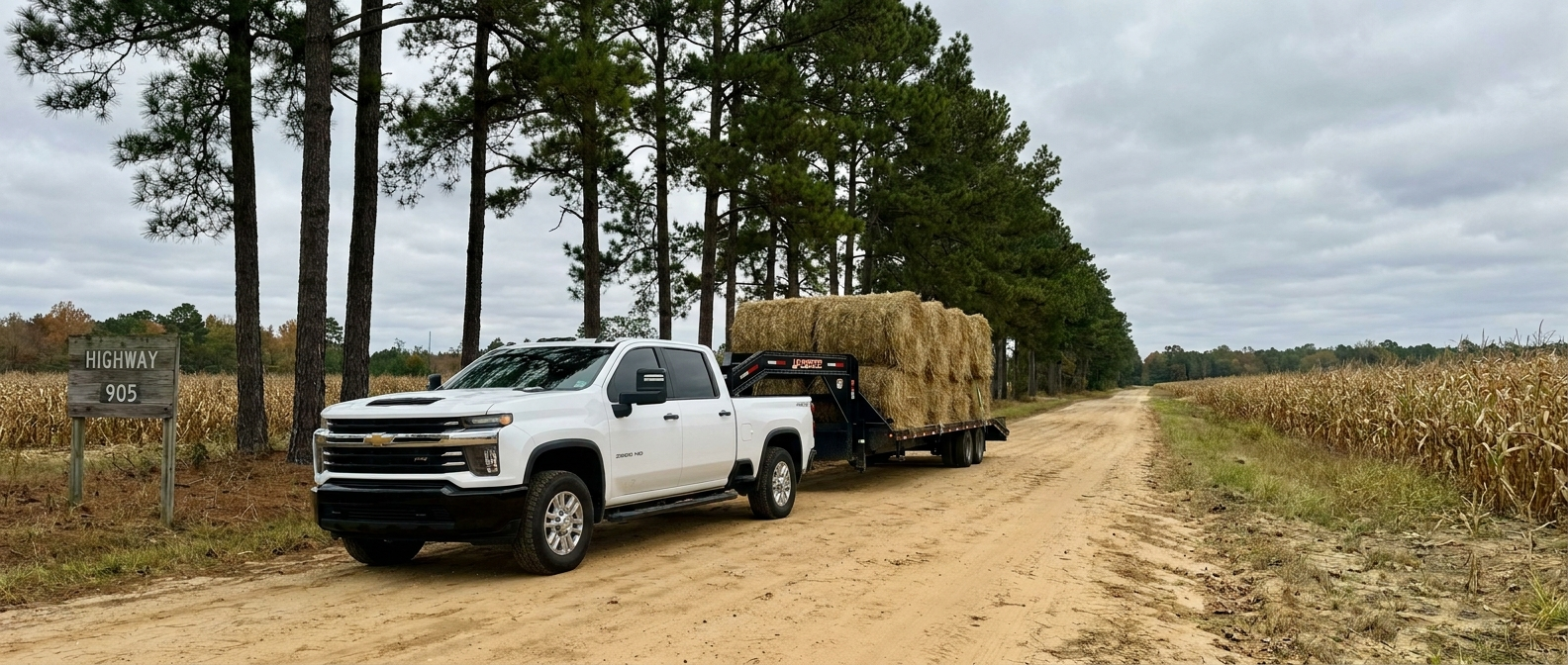
2026 Chevrolet Silverado HD towing a flatbed trailer on a Horry County SC rural road near Aynor

3 Silverado HD Configs Compared for Heavy Work Near Aynor | Palmetto Chevrolet

If you haul for a living around Horry County, you've probably had the same conversation with yourself more than once. Do I need the 2500 HD or the 3500 HD, and is the Duramax diesel actually worth it? Those are three distinct trucks in terms of what they can legally carry and tow, and the wrong pick costs you money in two directions. Too little truck means you're over-capacity on a regular Tuesday. Too much truck means you're paying a premium for ratings you never touch. We work through this with contractors, farmers, and fleet buyers at Palmetto Chevrolet all the time. Below, we break down how the three most common 2026 Silverado HD configurations line up for the work being done west of the Grand Strand. The short version Gas 2500 HD: Best for contractors and service trades hauling heavy beds but pulling trailers under roughly 10,000 lbs. Simpler, lower upfront, and the gas V8 handles flat Horry County terrain without strain. Diesel 2500 HD: The most versatile workhorse. Unlocks up to 22,420 lbs of towing capacity and delivers noticeably better fuel returns under sustained load for buyers covering real distance daily. Diesel 3500 HD: The answer when you're pulling a gooseneck with equipment, running a dually, or routinely loading the bed past what a 2500 can carry. Up to 36,000 lbs of towing and up to 7,442 lbs of payload. Not overkill if your work demands it. 2026 change worth knowing: The integrated trailer brake controller is now standard on every trim, not a package add-on. Browse our 2026 Silverado 2500 HD inventory at Palmetto Chevrolet to see current trim availability. How Do These Three Configurations Compare? The engines carry over unchanged between the 2500 HD and 3500 HD, which surprises plenty of buyers, so what sets the two platforms apart is the chassis, the axle ratings, the suspension, and whether you can run dual rear wheels. Chevrolet lists the same 6.6L V8 gas and 6.6L Duramax turbo-diesel across both platforms. The 3500 just has more structural capacity to put those engines to work. Configuration Engine Max Towing (properly equipped) Max Payload (properly equipped) Rear Wheel Config Best For 2026 Silverado 2500 HD 6.6L V8 Gas (401 hp / 464 lb-ft) Up to 19,080 lbs Up to 3,689 lbs Single rear wheel Contractors: bed loads, lighter trailers 2026 Silverado 2500 HD 6.6L Duramax Diesel (470 hp / 975 lb-ft) Up to 22,420 lbs Up to 3,615 lbs Single rear wheel Daily tow haulers, long-run work 2026 Silverado 3500 HD 6.6L Duramax Diesel (470 hp / 975 lb-ft) Up to 36,000 lbs Up to 7,442 lbs SRW or Dually (DRW) Gooseneck, fifth-wheel, heavy equipment *All figures are Chevrolet-published maximums, properly equipped. Always verify against your specific truck's door-jamb label.* A useful way to think about it is straightforward. The 2500 HD is tuned for the person who needs a genuinely capable work truck that still drives reasonably well empty. The 3500 HD is tuned for the job first and the commute second. Its stiffer rear suspension earns its place when you're running loaded down SC-501. Empty, it rides hard. What Does Your Actual Horry County Workload Call For? Your workload answer usually points to the 2500 HD for most Horry County trades, with the 3500 HD held in reserve for the genuinely heavy jobs, since plenty of buyers eye the 3500's numbers and assume bigger always wins. The reality sits a notch short of that. The work near Aynor and through Horry County splits pretty cleanly into a few categories. You've got construction and trades, agriculture and timber, and then service fleets covering the commercial corridors along US-501. Horry County's terrain is flat, and that matters more than you'd think. You're not fighting mountain grades every day, so the diesel's torque advantage comes down to what you can pull on a long summer haul without cooking the engine. Flat land helps. See the 2026 Silverado 3500 HD if you run a gooseneck often or need the dually option. If you're a contractor hauling lumber, gravel, or equipment in the bed: The gas 2500 HD is a legitimate call. Chevrolet lists up to 3,689 lbs of maximum payload on the gas 2500 HD, which covers a loaded bed of material for a residential job. You skip the DEF fluid and diesel maintenance, and the 6.6L gas V8's 401 hp and 464 lb-ft of torque is no shortage for flat-terrain bed hauling. If you're pulling a trailer regularly: The diesel 2500 HD changes the equation. Chevrolet's Duramax produces 975 lb-ft of torque (more than twice the gas output). The torque arrives low in the RPM range, right where you feel it pulling a loaded enclosed trailer out of a job site. Diesel engines run more efficiently under sustained load than under light throttle, so buyers who cover serious daily mileage tend to see better fuel returns despite the higher upfront cost. If you need a gooseneck or fifth-wheel hitch and are moving heavy equipment: The 3500 HD diesel is the truck. There's no workaround. Chevrolet lists up to 36,000 lbs of maximum towing on the 3500 HD diesel dually, and up to 7,442 lbs of maximum payload. The 3500 also offers dual rear wheels, which increases lateral stability when you're running loaded. Call that a physics feature, not a comfort one. Explore commercial fleet options through our Work Truck Solutions portal if you're outfitting more than one vehicle. For 2026, Chevrolet made the integrated trailer brake controller standard on every Silverado HD trim, from the base WT up. That's a meaningful change. Every 2026 Silverado HD you look at comes with in-dash trailer brake gain control and manual override included. Palmetto Chevrolet team note: The gas 2500 HD actually delivers slightly higher maximum payload than the diesel 2500 HD because the diesel engine block is physically heavier. If your work is primarily bed-load hauling rather than towing, that's worth factoring into your trim decision. Get Pre-Approved for Your Work Truck Picking the Right Silverado HD for the Way You Actually Work Picking right comes down to one honest tradeoff, since the diesel adds genuine capability alongside real cost and real maintenance considerations, so it earns its keep for the consistent heavy-tow buyer and loses that argument for anyone running errands around Conway with a nearly empty bed three days out of five. Think DEF fluid, diesel fuel availability, and a higher upfront outlay. The 3500 HD's stiffer suspension is the right call when you're loaded. Empty, the truck rides harder than the 2500 HD. Call it a mechanical reality rather than a complaint, because the 3500's rear spring pack is rated for more weight and behaves accordingly when the bed is empty. Loaded, that's exactly what you want. Match the rating to your real load, and the pick-by-need framework below falls out cleanly for Aynor-area buyers. You're a landscaper, plumber, or electrician pulling a trailer under 12,000 lbs: Gas 2500 HD handles it. No DEF, simpler service, and the numbers support it. You're in agriculture or timber hauling equipment trailers day in and day out: Diesel 2500 HD. The 975 lb-ft of torque and up to 22,420 lbs of capacity give you room to grow without stepping into a 3500. You're running a dump trailer, gooseneck, or moving construction equipment between job sites: Diesel 3500 HD. Full stop. The payload, the chassis ratings, and the dually option exist precisely for this use case. You're building out a commercial fleet: Talk to us through our Work Truck Solutions portal. Fleet configuration and vocational builds follow different logic than a single-truck purchase, and we have the resources to match. The Cool Springs Industrial Park corridor on SC-319 near Aynor has been growing, and we're seeing more commercial vehicle decisions tied to that corridor. Whether you're fitting out a single truck or weighing multiple units, the starting point stays the same. Size the truck to your real load, not your theoretical maximum. See the Silverado 3500 HD Chassis Cab for commercial upfit and vocational applications. Frequently Asked Questions Is the 2026 Silverado 2500 HD enough for most Horry County contractors, or do I need the 3500? For the majority of residential and light commercial contractors working near Aynor and Conway, the 2026 Silverado 2500 HD handles the work. Chevrolet lists up to 3,689 lbs of maximum payload (gas) and up to 22,420 lbs of maximum towing (diesel, properly equipped). If your heaviest regular haul is a loaded equipment trailer under 20,000 lbs and a full bed of materials, the 2500 HD is rated for it. The 3500 HD makes sense when you're consistently running a gooseneck trailer with heavy equipment, need a dually for lateral stability, or regularly approach the 2500's payload ceiling. What's new on the 2026 Silverado HD compared to the previous year? The most impactful update for work buyers is that the integrated trailer brake controller is now standard on every 2026 Silverado HD trim, from the base WT to the High Country. Previously, this was a package-dependent feature. Every 2026 Silverado HD now ships with in-dash gain control and manual override for electric trailer brakes at no additional package cost. Upper trims also gain a 13.4-inch touchscreen with Google built-in and a 12.3-inch digital instrument cluster configurable to display towing data. Value Your Current Work Truck Palmetto Chevrolet 1122 4th Ave, Conway, SC 29526 (843) 248-4283
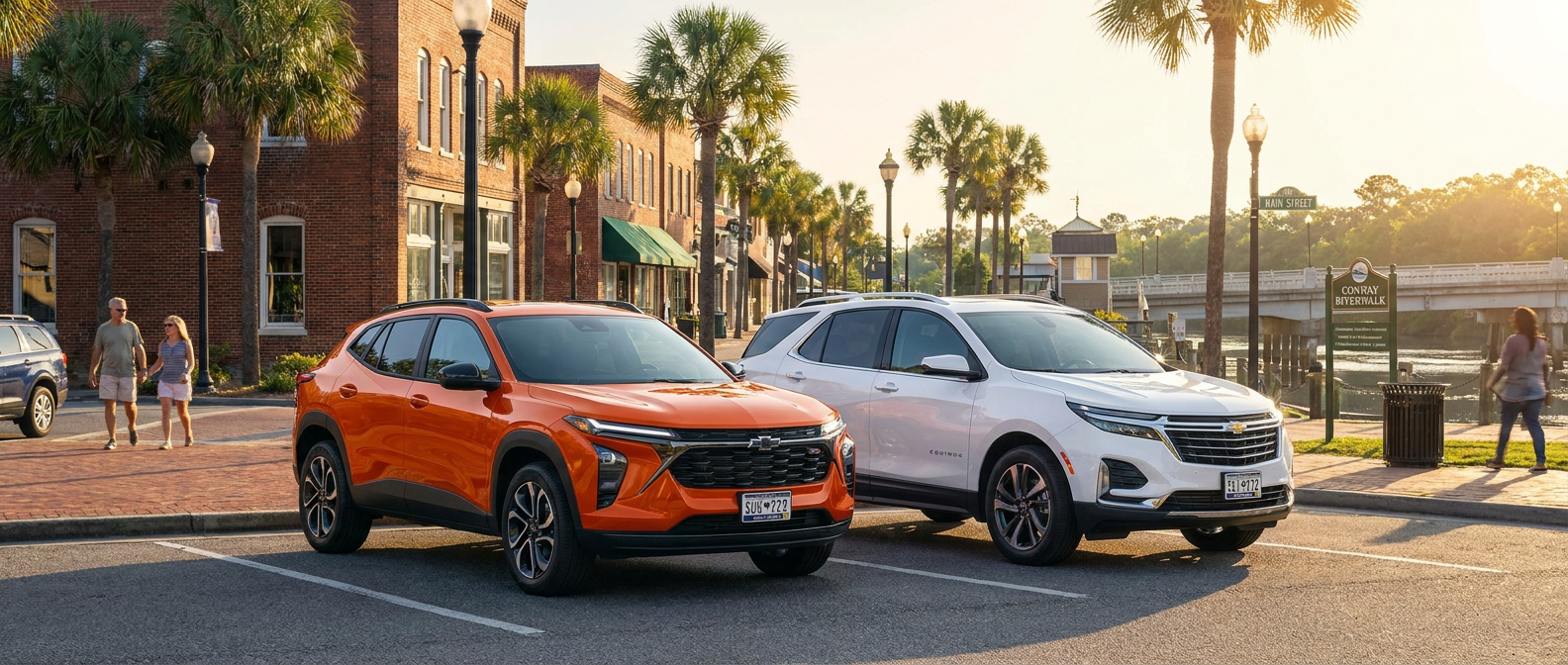
2026 Chevrolet Trax and 2026 Chevrolet Equinox parked side by side in Conway, SC

Chevy Trax vs. Equinox for First-Time SUV Buyers in Conway, SC

In this article What's the Real Difference Between the Trax and the Equinox? Do You Actually Need All-Wheel Drive in Conway? The Practical Question: Space and Comfort for Real Conway Life So Which One Should You Pick? If you've narrowed your first SUV down to the 2026 Trax or the 2026 Equinox, the short answer is that the Trax is the smarter pick for most Conway first-timers. The Equinox earns its higher entry point only when rear passenger room and available all-wheel drive are genuine priorities in your life right now. The short version The 2026 Trax starts significantly lower and returns an EPA-rated 30 mpg combined. 3 mpg better than the FWD Equinox and meaningful on a US-501 daily commute. The 2026 Equinox carries nearly 4.2 more cubic feet of cargo with all five seats up (29.8 vs. 25.6 cu ft) and offers a noticeably roomier back seat (39.9 vs. 38.7 inches of rear legroom). The Trax is FWD only. The Equinox offers available AWD. On Conway's flat coastal roads and mild winters, that gap matters far less than it would in the Carolina mountains. Both vehicles include Chevy Safety Assist. Six active safety technologies. On every single trim. Neither makes you pay up for the basics. Buy the Trax if you're commuting solo or with one passenger and budget is the priority. Buy the Equinox if you regularly carry three or four adults or want the flexibility of AWD for occasional mountain trips. Take a look at our current 2026 Equinox inventory if you'd like to see available trims and compare what's actually in stock before you read another word. Then come back, because the numbers below might shift your thinking about which one you need. What's the Real Difference Between the Trax and the Equinox? The core difference comes down to size class, with the Trax built as a subcompact and the Equinox as a compact, so the sharper contrast shows up less in the four-inch length gap, 178.6 vs. 183.2 inches, and more in where you'll actually spend your time, the back seat and the cargo hold. The gap is real but modest. Spec 2026 Trax 2026 Equinox FWD Engine 1.2L Turbo 3-cyl, 137 hp 1.5L Turbo 4-cyl, 175 hp EPA Combined MPG 30 mpg 27 mpg Cargo (seats up) 25.6 cu ft 29.8 cu ft Cargo (seats folded) 54.1 cu ft 63.5 cu ft Rear Legroom 38.7 in 39.9 in AWD Available No Yes Overall Length 178.6 in 183.2 in Chevy Safety Assist Standard, all trims Standard, all trims Towing Capacity Not rated for towing Up to 1,500 lbs (AWD, properly equipped) The Trax surprises you with 54.1 cubic feet of max cargo once you fold the rear seat, which lands close to the Equinox's 63.5. The gap you'll actually feel day to day is the 25.6 vs. 29.8 cu ft you get with passengers in the back, so the Equinox hands you roughly one more large rolling suitcase of usable space behind active rear seats. For a family, that counts. For a CCU student hauling a bike or moving boxes twice a year, it counts for a lot less. The single deciding factor: do you regularly carry three or four adult passengers? If yes, the Equinox's rear legroom and extra cargo depth with seats up makes daily life noticeably more comfortable. If you're usually carrying one passenger or fewer, the Trax delivers comparable room with a meaningful fuel economy advantage. Do You Actually Need All-Wheel Drive in Conway? For the kind of driving Conway serves up, no, you don't really need all-wheel drive, and outside of regular mountain trips, AWD ranks among the most common upsells in this segment and among the least necessary across the flat coastal terrain of Horry County. We'll be direct about that. The Trax is front-wheel drive exclusively, and Chevrolet doesn't offer an AWD version at any trim level. The Equinox does offer AWD, starting at the LT trim, with a bump to a 203 lb-ft, 8-speed automatic setup that the EPA rates at 25/29/26 mpg for city, highway, and combined. So you're trading one mpg combined for AWD capability and more torque. Whether that trade earns its keep depends entirely on how you drive. So where does AWD actually earn its place around here? Barely, once you look at the terrain. Conway sits at roughly 25 feet above sea level on predominantly flat coastal plain, and the corridors we all drive, US-501 to Myrtle Beach, SC-544, SC-22, also called Veterans Highway, simply don't demand it. Horry County winters rarely produce sustained freezing conditions. If you're planning regular trips to the Blue Ridge Parkway or weekends in the Upstate, AWD on the Equinox turns into a legitimate feature. For a first-time buyer whose world is the Grand Strand and Horry County, it's a nice-to-have rather than a need. The Trax's FWD paired with its 30 mpg combined EPA rating is the more practical equation for most daily driving here. On a 35-mile round-trip to Myrtle Beach along US-501, that 3 mpg advantage keeps adding up, and you'll feel it across a year of commuting. Around here, the math favors the Trax. The Practical Question: Space and Comfort for Real Conway Life The Equinox's back seat really earns its keep when you're regularly moving people, because Chevrolet lists 39.9 inches of rear legroom in the 2026 Equinox versus 38.7 inches in the Trax, a gap that reshapes how an adult rides on a longer haul. A 1.2-inch gap doesn't sound dramatic, but paired with the wider shoulder room, it's the difference between a comfortable rear seat for an average adult and one that starts to feel snug on the Myrtle Beach run. The Trax answers back with a surprisingly flexible cargo setup. Fold the 60/40 split rear seat and Chevrolet lists 54.1 cubic feet, which is more than you'd expect from a vehicle this size and enough for two large suitcases, a stroller, or a full CCU move-in haul. The Equinox's 63.5 cu ft folded wins, no question. The gap narrows once you load up. Both come with an 11-inch touchscreen available, standard on higher Trax trims and on the Equinox LT, plus wireless Apple CarPlay and Android Auto, and Google Built-In available. For a first car, you're well covered. Worth knowing: the 2026 Equinox ACTIV trim adds all-terrain capable tires and a lifted stance. It pulls its weight if Conway Riverwalk access or light unpaved boat ramp use is part of your regular routine (think gravel ramps and rutted approaches). The base Trax LS doesn't have that. It's genuine capability for anyone who leaves the pavement now and then. Trax Equinox Pros Cons Lower entry point FWD only. No AWD option ever 30 mpg combined (EPA) 137 hp can feel modest merging on US-501 Surprisingly large max cargo (54.1 cu ft) Tighter rear legroom (38.7 in) Smaller footprint. Easier parking at the Riverwalk or downtown Conway Slightly less cargo with seats up (25.6 cu ft) Chevy Safety Assist on every trim Not rated for towing Equinox Pros Cons AWD available (genuinely useful for mountain trips) Higher starting point More rear legroom (39.9 in) and shoulder room Slightly lower fuel economy (27 mpg combined FWD) More cargo with seats up (29.8 cu ft) Larger footprint (less nimble in tight spots) Tows up to 1,500 lbs when properly equipped (AWD) AWD adds cost; overkill for coastal SC flatlands ACTIV trim offers light off-road capability Bigger budget commitment for a first vehicle Browse our full new SUV inventory to compare what's actually available in Conway right now. Trim levels and availability shift over time, and seeing what's on the lot often settles the question faster than any spec sheet can. So Which One Should You Pick? Our answer here comes by buyer type, and we'll give it to you straight, because the right pick depends on which life you lead day to day, with the Trax making sense for a solo commuter on a tight budget and the Equinox earning the step up for anyone regularly filling the back seat or wanting AWD for mountain trips. Buy the Trax if: you're a first-time buyer on a practical budget, commuting alone or with one regular passenger along US-501 or around Horry County, living near downtown Conway where parking runs tighter, and fuel economy really matters to your monthly math. The EPA's 30 mpg combined rating is one of the better numbers in this segment. The Trax won't embarrass you on the highway, it just asks you to plan your merge a half-second earlier. Its 137 horsepower is adequate and grounded without pretending to be sporty, and for what you pay at the entry point, the trade is fair. Buy the Equinox if: you regularly carry three or four adults, you're planning beach weekends with a loaded back seat, you want the peace of mind of available AWD for occasional mountain drives on I-26 toward Asheville, or you want a vehicle with a little more room to grow with you over the next five years. The 175-hp 1.5L turbo merges onto US-501 with noticeably more confidence, and 39.9 inches of rear legroom keeps your back-seat passengers from folding themselves in. At its entry point, the Equinox LT is a genuine compact SUV with a compact SUV's feature set, not a subcompact wearing a bigger badge. The honest tradeoff: the Equinox costs more to buy and more to fill up. If those differences don't materially affect your life, the Equinox is the better long-term vehicle. And if they do, as they will for anyone shopping on a tight first-car budget, the Trax is a solid first SUV, not a compromise. Frequently Asked Questions Is the 2026 Chevy Trax big enough for a road trip? For one or two people, yes. Comfortably. The Trax offers 54.1 cubic feet of cargo space with the rear seat folded, which handles two large suitcases and travel bags without a problem. With all five seats in use, that drops to 25.6 cubic feet, which is tighter for a fully loaded four-person trip. If you're planning regular road trips with three or more passengers plus luggage, the Equinox's extra rear legroom and 29.8 cubic feet of cargo with seats up will make those trips more comfortable. For weekend runs from Conway to the Upstate or a solo drive up the coast, the Trax handles it without complaint. Does the 2026 Chevy Equinox really need AWD in South Carolina? For most driving in the Conway and Grand Strand area, no. Horry County roads are flat, winters are mild, and AWD adds cost without adding much capability on the routes most people drive daily. Where AWD on the Equinox genuinely earns its keep is on occasional trips toward the Upstate. I-26 into the mountains, unpaved rural roads, or light off-road use. The Equinox ACTIV trim pairs AWD with all-terrain tires, which is a real combination for anyone who goes off the paved road regularly. But if your driving is primarily coastal-SC flatland commuting, front-wheel drive on either the Trax or the Equinox LT FWD is the practical choice. --- Get Pre-Approved for Financing Palmetto Chevrolet 1122 4th Ave, Conway, SC 29526 (843) 248-4283
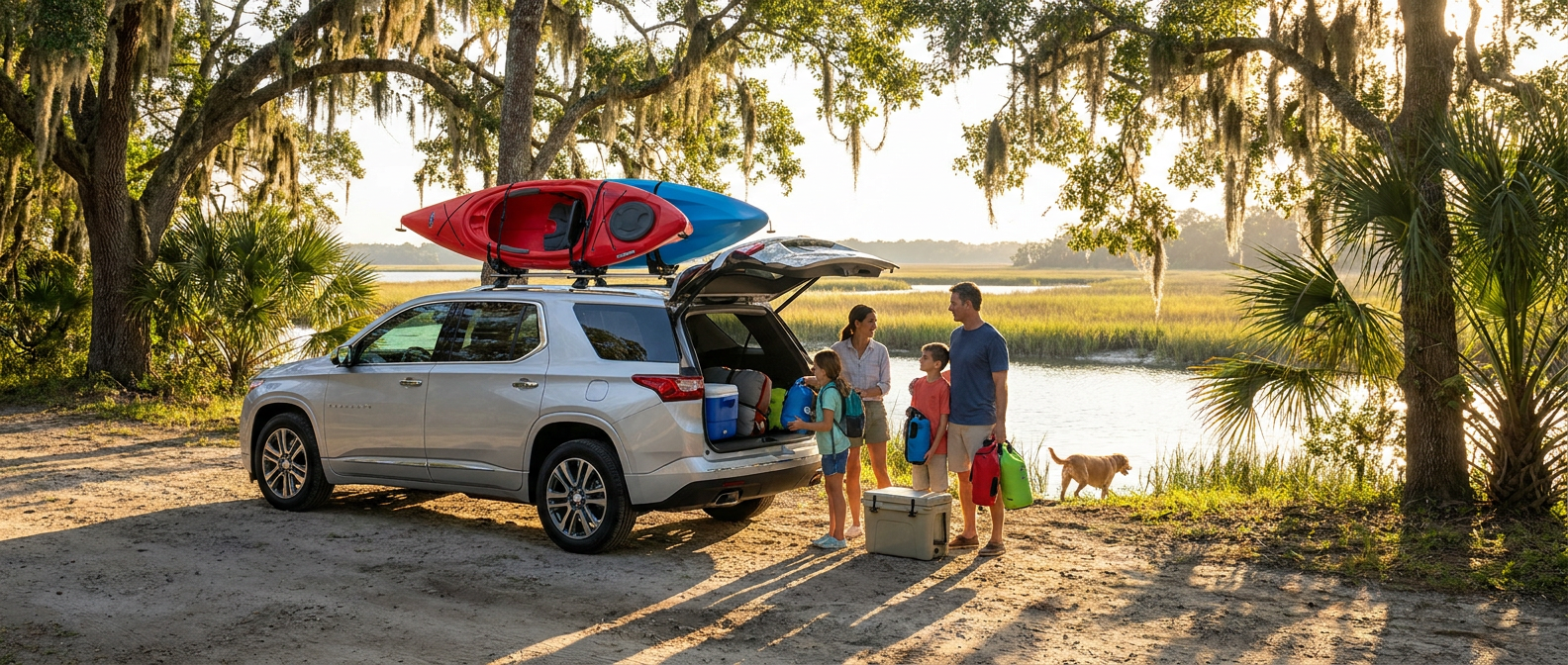
2026 Chevrolet Traverse parked near the Intracoastal Waterway in Socastee SC with family gear

Best Chevy SUVs for Families Near Socastee, SC

In this article What's the Plan at a Glance? The Recreational Park Sets the Gear Test The Swing Bridge and the Drive Down SC-544 On the Water: When Towing Decides the Vehicle Matching the SUV to Your Family Socastee Recreational Park in the morning for disc golf and the playground, then down to the Intracoastal Waterway for an afternoon on the water. Pick the right Chevy SUV and you won't need a second trip. Match the vehicle to your family's size and gear load, and the day runs. The Traverse is the natural anchor for this conversation, but it's not the only answer. Families of five with no boat in tow run a different calculus than a family of seven hauling a jon boat down SC-544. We see that split play out right here on our lot in Conway, and what follows is how we'd sort it out. What's the Plan at a Glance? Stop What to Do Best Time Parking Notes Socastee Recreational Park Disc golf, playgrounds, soccer fields, nature trails (91.5 acres) Morning, before midday heat Large paved lot, easy with a big SUV Socastee Swing Bridge area Watch the 1935 swing bridge open, grab a bite nearby Late morning Street parking; compact SUVs have the edge Island Adventure Watersports (Intracoastal Waterway) Kayak, paddleboard, jet ski rentals, guided tours Midday into afternoon Trailer-friendly lot if you're towing Waccamaw National Wildlife Refuge (nearby) Birdwatching, hiking, quiet nature trails Morning or late afternoon Gravel lots; clearance is not an issue The Recreational Park Sets the Gear Test Socastee Recreational Park runs 91.5 acres of active family space, so you're not packing light, and the Traverse answers that gear test better than anything else in this lineup, though it asks you to trade a little fuel economy for the room. The 2026 Traverse carries 22.9 cubic feet behind its third row with all seven or eight seats occupied, and that number climbs to 98 cubic feet with both rear rows folded flat. Chevrolet rates it best-in-class for max cargo volume in the three-row midsize segment. Pull in with a full set of disc golf bags, a stroller, a cooler, and everyone's shoes, and it all still fits. The Smart Slide second-row seats are the feature families with car seats actually notice. You don't have to uninstall anything to get a kid into the third row. That matters when you're loading three kids at a park. Nobody wants a parking-lot pit stop. One honest tradeoff shows up at the pump. The EPA rates the 2026 Traverse at 20 city and 26 highway mpg on FWD trims. For a big three-row SUV that's respectable, though it won't match the two-row options below. Drive this from Conway on US-501 every weekend, and that gap adds up over a year. Insider note: The park's gravel sections near the nature trail access are no issue for any of these SUVs. Ground clearance isn't a concern here. What varies instead is parking lot length, and the Traverse at 204 inches long fits standard spaces without drama. The Swing Bridge and the Drive Down SC-544 The 2026 Equinox earns its place on this route for families of five who don't need three rows and don't want to wrestle with parking near the Socastee Swing Bridge area, and at 183.2 inches long it slots into tighter street spots easily, though it gives up the third row to do it. Fuel economy lands at 26 city and 29 highway mpg on FWD trims, a noticeable difference from the Traverse's numbers on a SC-544 or US-501 run. The Socastee Swing Bridge dates to 1935. Cargo runs 29.8 cubic feet behind the rear seats, expanding to 63.5 when folded. Two adults, two kids, and a full day's worth of beach and park gear all fit. Five seats, 40 inches of rear legroom, and no third row. If you don't need that third row, its absence isn't a weakness. Next step: Before you head down, double-check the Socastee Swing Bridge schedule. The bridge swings on a regular rotation and can briefly slow traffic on SC-544. Build in ten minutes and you won't feel it. On the Water: When Towing Decides the Vehicle The Intracoastal Waterway at Socastee is where the Tahoe's numbers start doing serious work, because the 2026 Tahoe is rated at up to 8,400 pounds of towing capacity properly equipped with the 5.3L V8 and Max Trailering Package, a reach the Traverse can't match (verify the door-jamb label for your specific build). A small jon boat, a pontoon, a ski boat all sit inside that range. The gap is real. Chevrolet rates the 2026 Traverse at up to 5,000 pounds properly equipped, enough for a smaller fishing boat or a light camper that won't strain it. The Tahoe brings 122.7 cubic feet of maximum cargo space and seating for up to nine, which sounds generous until you're carpooling with another family to the water access point and nobody wants to take two vehicles. Under the hood sits a 5.3L EcoTec3 V8 producing 355 horsepower, with an available 6.2L at 420 horsepower for buyers who tow heavier rigs consistently. The diesel option (3.0L Duramax inline-six, 305 horsepower, 495 pound-feet of torque) is worth a conversation if you cover long stretches of US-501 often, since it delivers up to 28 highway mpg. Explore Financing Options Matching the SUV to Your Family From where we sit at Palmetto Chevrolet, the Traverse is the right answer for most three-row family buyers near Socastee, big where it counts, approachable to drive, and happy to tow a modest boat or camper on its 5,000-pound rating, though a heavier load points you toward the Tahoe. The Tahoe is the move when you're towing something heavier or genuinely need nine seats. The Equinox is what a family of four or five should drive when they don't need a third row. Why pay for space and fuel cost you won't use? The 2026 Trailblazer is worth a mention too. Five seats, 54.4 cubic feet of max cargo, and an EPA-estimated 31 mpg combined on the 1.3L FWD trim. If your family is done with car seats, the kids are older, and you're mostly running to Socastee Recreational Park and back, the Trailblazer is genuinely efficient and easy to park. It won't tow the boat. Draw the line right there. Vehicle Family Size Tow Rating Max Cargo Best For 2026 Trailblazer Up to 5 1,000 lbs 54.4 cu ft Smaller active families, fuel-conscious 2026 Equinox Up to 5 1,500 lbs (AWD) 63.5 cu ft Families of 4-5, daily driving 2026 Traverse Up to 8 5,000 lbs 98 cu ft Three-row families, light to mid towing 2026 Tahoe Up to 9 8,400 lbs 122.7 cu ft Large families, heavy towing All towing figures are for properly equipped vehicles. Verify the door-jamb label for your specific build before towing. Socastee is worth the trip. The park is real, the waterway is right there, and the drive down SC-544 from Conway is a straightforward fifteen minutes. Show up in the right vehicle and you won't spend the day rearranging gear or wishing you'd brought more room. Value Your Trade-In Palmetto Chevrolet 1122 4th Ave, Conway, SC 29526 (843) 248-4283
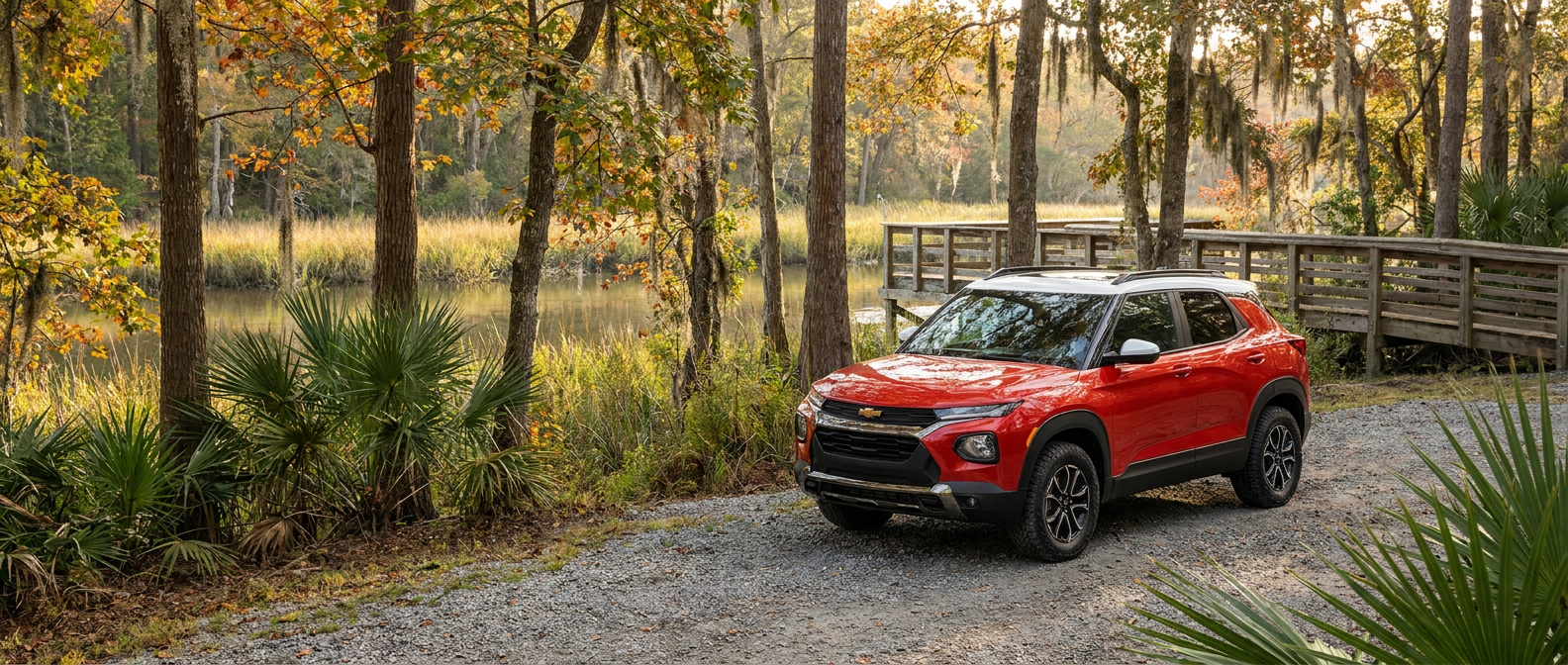
2026 Chevrolet Trailblazer ACTIV parked near a Waccamaw River access point in Horry County, SC

Why the Chevy Trailblazer Fits Horry County Life | Palmetto Chevrolet

In this article Why Does This Vehicle Fit Horry County So Well? The ACTIV Trim Is the One for This County What the Trailblazer Carries, and How Safety Tech That Makes the Grand Strand Commute Less Stressful Horry County doesn't ask much of a vehicle. It just asks a lot of different things from the same one, on the same Tuesday. Downtown Conway parking, where a full-size SUV turns into a math problem. The grind up US-501 toward Myrtle Beach when summer traffic stacks up and fuel economy starts to matter. A rutted access road into the Waccamaw National Wildlife Refuge on a Saturday morning, because you felt like it. And enough cargo room to come home with kayak paddles, a cooler, and a bag of farm stand produce without rearranging your life. The 2026 Chevy Trailblazer handles all of that. We think it fits this county specifically, not just SUV buyers in general, and the specs are where that shows up. The 2026 Trailblazer's 37.3-foot turning circle and 174.1-inch length make it genuinely easy to park in downtown Conway, while its 31 mpg highway rating (1.3L FWD, EPA-estimated) and up to 54.4 cubic feet of cargo space cover the full range of Horry County daily life. Browse the 2026 Trailblazer at Palmetto Chevrolet Why Does This Vehicle Fit Horry County So Well? Most small SUVs are designed to work fine everywhere and nowhere in particular, so the fit tends to read generic on paper. The Trailblazer earns its place here because its actual numbers, length and turning circle and cargo and range, line up with the specific friction points of driving in this county. Local Condition or Use Trailblazer Feature Why It Matters Here Tight downtown Conway parking and historic district streets 174.1-in length, 37.3-ft turning circle (Chevrolet) Maneuvers into spots that defeat longer crossovers; fits standard parallel spots with room to breathe Stop-and-go US-501 beach traffic in summer and fall 1.3L Turbo, EPA-rated 29 city/31 hwy mpg (FWD) Turbo torque handles the creep-and-surge without burning extra fuel the way larger engines do Waccamaw National Wildlife Refuge trail access roads ACTIV trim: off-road suspension tuning, functional skid plate, 8.0-in ground clearance (AWD) Handles packed-dirt and gravel access roads without scraping; skid plate protects the undercarriage Beach gear, kayak paddles, farm market hauls 25.3 cu ft behind rear seats; 54.4 cu ft seats down; 8.5-ft load floor (front seat folded flat) Chevrolet engineers a fold-flat front passenger seat. Almost nothing else in this class does that School-year CCU and Conway commuting Standard wireless Apple CarPlay and Android Auto, 11-in touchscreen Navigation and calls handled before you even pull out of the lot Hurricane-season preparedness kit in the cargo area 13.2-gal tank; ~435-mile highway range (1.3L FWD, per EPA ratings) Enough range to run inland without a fuel stop in low-supply conditions The ACTIV Trim Is the One for This County Look at all four trims if you want, LS through RS, and the RS is a sharp pick for anyone whose driving stays mostly on pavement. For Horry County, though, where the pavement ends without warning and a few gravel causeways sit between you and the good spots, the ACTIV is the build we keep pointing people toward. The ACTIV comes standard with the stronger 1.3-liter turbocharged three-cylinder (155 hp, 174 lb-ft of torque, per Chevrolet). That pull matters on the on-ramps from SC-544 where traffic gaps close fast. See what ACTIV trims are in stock right now Pair that engine with off-road suspension tuning and a functional skid plate, so when you drop off a paved road to reach a boat landing or a wildlife refuge trailhead, the undercarriage is covered. Literally. Ground clearance on the AWD ACTIV sits at 8.0 inches, per Chevrolet specs. The FWD version comes in at 7.5 inches. Both are a genuine step up from the base LS and LT trims. And the 17-inch wheels on the ACTIV use thicker tire sidewalls than the 19-inch RS setup, which soaks up more of the rough pavement and bridge expansion joints you meet on back county roads around here. One tradeoff is worth naming up front. The Trailblazer is a subcompact SUV. It seats five, but five adults on a longer run will feel the size. It isn't the vehicle for towing a boat to the Waccamaw River landing (Chevrolet rates it at 1,000 lb maximum when properly equipped. Verify your door-jamb label, and a fishing boat with a trailer clears that quickly). If that's your primary need, a Chevy Equinox is the more honest answer. What the Trailblazer does instead is cover everything else in the county better and more efficiently than a larger vehicle would. Local detail: The Conway Riverwalk parking on 2nd Avenue fills up fast during fall festivals and farmers market weekends. The Trailblazer's 37.3-foot turning circle (Chevrolet) means it fits into the perpendicular spots along the waterfront that longer crossovers end up circling past, a small thing until you've done it six times. What the Trailblazer Carries, and How Fold the rear seats: 54.4 cubic feet, enough for a weekend's worth of camping gear headed to the Waccamaw National Wildlife Refuge trailheads Fold the front passenger seat flat too: 8.5-foot load floor, which is how you fit surfboard bags, fishing rods, or a piece of furniture from downtown Conway's antique row inside the cabin with the tailgate closed Standard reversible cargo floor liner: sand from the beach, dirt from the refuge. Flip it over and you're clean again 25.3 cubic feet with all seats up: enough for a full grocery run or the gear for a family day at a Horry County park without making anyone hold something in their lap The fold-flat front passenger seat is the feature worth dwelling on with buyers who think this vehicle is too small. A fold-flat front passenger seat is a real differentiator in the class. Most compact SUVs don't offer it. Chevrolet does here, and it changes what the Trailblazer can actually carry. Safety Tech That Makes the Grand Strand Commute Less Stressful Every 2026 Trailblazer comes standard with Chevy Safety Assist, a package of six active safety features that includes Forward Collision Alert, Automatic Emergency Braking, Lane Keep Assist with Lane Departure Warning, Following Distance Indicator, and Intelligent Beam Headlamps. On a corridor like US-501 or Highway 17, where traffic density picks up sharply during peak tourist months, those systems are working in the background every time you drive. Visit us on 4th Ave in Conway to see the full 2026 Trailblazer lineup in person The 11-inch infotainment screen and standard wireless device connection mean you're not fumbling with cables when you're trying to pull up navigation before merging onto SC-22 (Veterans Highway) northbound toward North Myrtle Beach. A small vehicle, carrying a grown-up safety list. That's what sums up the package. Explore Financing Options for the Trailblazer Palmetto Chevrolet 1122 4th Ave, Conway, SC 29526 (843) 248-4283
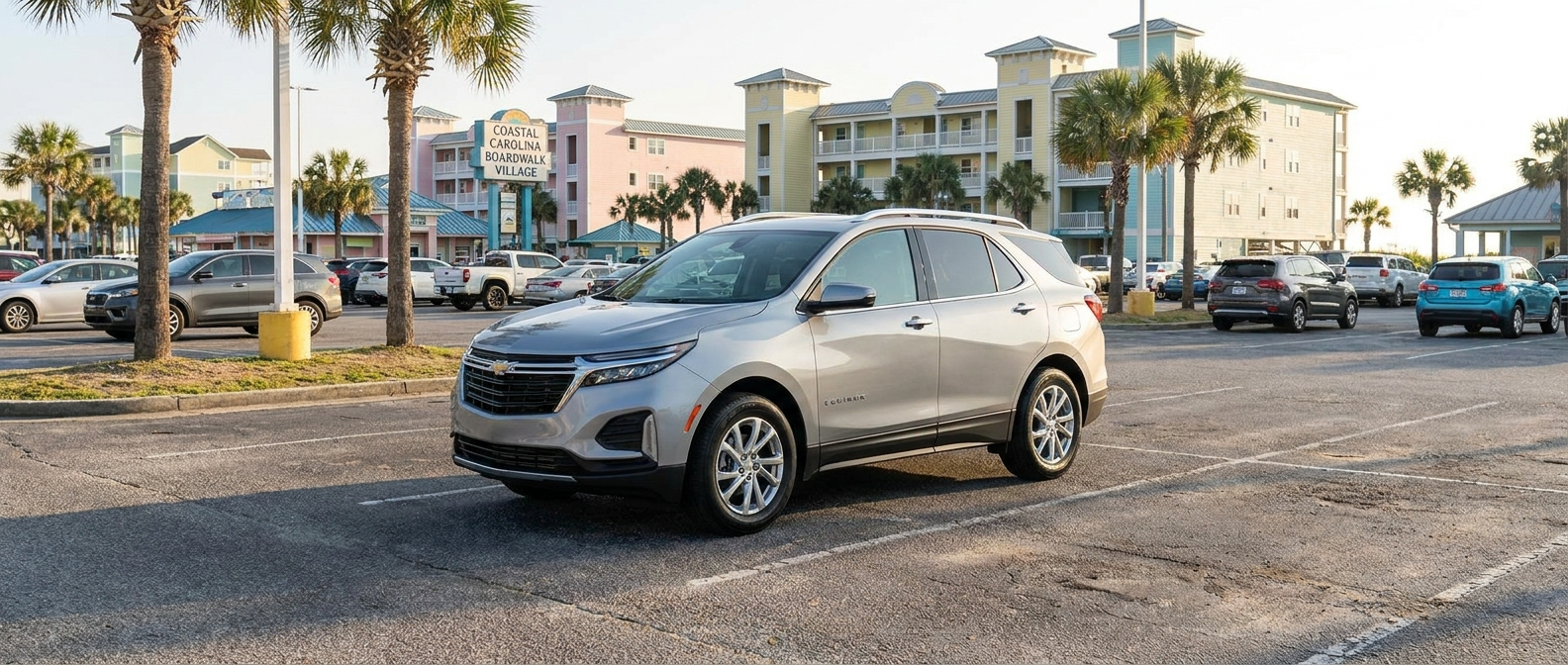
2026 Chevrolet Equinox parked at a coastal South Carolina entertainment complex on a sunny afternoon

Best Chevy Models for a Broadway at the Beach Trip

So which Chevy earns this trip? The truth is it depends less on the destination than on the four things Broadway actually tests your vehicle on. You've got a 30-to-40-minute run down US-501 or SC-22 from Conway, a massive free parking lot that turns into a slow-moving puzzle on a Saturday night, a family or a group of friends to haul, and a South Carolina summer that doesn't apologize for the heat. Pick the right Chevy and none of that is a problem. Pick the wrong one and you're circling the lot in a truck that's bigger than the parking space, or sweating out a low-fuel light on the way home. What's Actually Going On With That Drive? The drive runs short and the lot is genuinely huge, so on paper this is an easy trip, but both the road and the lot change character the moment you show up on a busy summer evening when everyone else had the same idea. Broadway at the Beach sits on 350 acres in Myrtle Beach, with more than 5,000 free parking spaces across the perimeter lots around 23-acre Lake Broadway. There's room to spare right up until a summer Friday evening slows traffic around Celebrity Circle to a crawl and leaves everyone hunting the same row. Situation You'll Face Likely Cause What to Think About US-501 stop-and-go from Conway Peak-season traffic and tourist volume Fuel economy matters; poor city MPG burns your budget Tight lot entry lanes at Broadway High visitor turnover, curb lanes blocked Shorter, narrower vehicles navigate faster Circling for a spot at 7 p.m. Breakers-style evening "going out" peak traffic Maneuverability beats raw size here Fitting the whole crew plus bags Large groups or families with strollers, chairs, coolers Cargo volume and third-row access matter Long summer days, humid heat Horry County's hot, humid coastal climate AC performance and interior comfort are real factors Which road you take matters too. SC-22, the Conway Bypass (Veterans Highway), is a four-lane freeway that runs from US-501 near Conway straight to US-17 near Myrtle Beach. That route skirts the congestion on US-501 itself and cuts a more predictable path into the Strand. Knowing which road to take, and having a vehicle that handles the crawl when you hit the lot, is half the battle. The Most Likely Fit: Match Your Group to the Right Model The 2026 Equinox is the one that suits a four-or-five-person beach day out of Conway, and in our experience it's usually the right call, even if it won't thrill anyone chasing outright pace off a merge. No, it isn't the flashiest pick. But the EPA rates it at 27 mpg combined for front-wheel-drive models, and at 183.2 inches long it fits a standard parking space with room to open the doors without elbowing the car next to you. That combination matters in a lot full of beach visitors who aren't parking carefully. Cargo runs 29.8 cubic feet behind the rear seat and opens to 63.5 cubic feet with the 60/40 rear seat folded down, which covers a stroller, a cooler, a bag of towels, and someone's souvenir from the candy shop without any creative packing. There's one tradeoff worth naming up front. The Equinox's 1.5L turbo makes 175 horsepower, and it earns its fuel numbers by not rushing. If you push it hard on a merge, the CVT on front-wheel-drive models takes a moment to find its stride. At normal US-501 traffic speeds that's a non-issue, but on a hot day with five people aboard, it shows. Plan for it. The 2026 Trax is the answer if you're going as a couple or a small group and fuel economy is the top priority. The EPA rates it at 28 city and 32 highway on all five trim levels. At 178.6 inches long, it's shorter than the Equinox and noticeably easier to slot into a tight Broadway parking space on the first try. Cargo is 25.6 cubic feet behind the rear seat, expanding to 54.1 with the seat folded. Plenty for a day out. Not for a full family haul. One limitation worth flagging is that the Trax has no all-wheel-drive option on any trim. Not a problem for a beach-town parking lot or US-501 in October, but worth knowing if your trip plans extend beyond the Strand. The 2026 Traverse is the right call when you're moving a group of seven or eight. With the available second-row bench it seats up to eight, handles up to 97.6 cubic feet of cargo, and puts 328 horsepower from a 2.5L turbo four-cylinder under your right foot. The EPA rates it at 20 city and 26 highway for front-wheel-drive models. Make no mistake, it's a bigger vehicle, full stop. In Broadway's perimeter lots, that means aiming for the outer rows where there's more space and less circulation traffic. On group trips, the Equinox or Trax simply run out of seats. The Traverse earns its keep. One thing our team notices on the lot. The 2026 Traverse's 328-horsepower engine means it merges confidently when SC-22 opens up, but its EPA 20-mpg city rating means the stop-and-go through Broadway's parking lot entrance adds up across a summer of trips. FWD is the better choice for a beach-run Traverse if you don't need AWD for the rest of the year. Print-and-Go Checklist Before You Head to Broadway Check fuel before you leave Conway (US-501 gas stops add time at peak hours) Use SC-22 (Veterans Highway) from Conway to skip the US-501 tourist crawl into downtown Arrive before 6 p.m. or after 9 p.m. to avoid the evening peak around Broadway's lot entries Target the outer west perimeter lots for easier parking in a larger vehicle like the Traverse Fold the rear seats before you leave if you're hauling chairs, a cooler, or stroller Confirm your AC is up to a full South Carolina summer afternoon before a long outing Set a Google Maps pin where you parked (Broadway's perimeter lots are large enough to lose your spot) DIY vs. Bringing It to Our Service Team Scheduling a service check before a heavy-use summer season makes sense, and while the drive from Conway to Broadway is short, the repeated summer runs on US-501 and SC-22 plus the family hauls are what quietly wear on a few systems. Tire pressure drops faster on hot pavement, and underinflation raises your fuel cost on every run. Horry County's coastal humidity and pollen load the cabin air filters faster than inland driving. And the AC works harder in that humidity and heat, especially with a full vehicle. All three you can check yourself in the driveway, where tire pressure takes two minutes with a gauge and the cabin filter is usually within reach without tools. But if your AC is blowing warm, or your fuel economy has dropped noticeably from what the EPA rates for your model, that's a service visit rather than a quick fix. We see that most often after a long summer of short trips, where the AC runs hard and the engine never gets a proper warm-up cycle. Bring it in and our team will tell you exactly what it needs. Schedule a Pre-Trip Service Check If you're taking a Traverse, get the tire pressures set to the door-jamb label spec before you load seven people. On a vehicle that size, load matters. Frequently Asked Questions Which Chevy is best for a day trip to Broadway at the Beach with a small family? For a family of four or five, the 2026 Equinox is our first recommendation. The EPA rates it at 27 mpg combined (FWD), it seats five, and at 183.2 inches long it fits a standard Broadway parking space without drama. Cargo runs 29.8 cubic feet behind the rear seat, expanding to 63.5 with the seat folded, which comfortably covers a stroller, cooler, and a full day's worth of gear for the family. Is parking at Broadway at the Beach difficult in a larger Chevy like the Traverse? Broadway at the Beach has more than 5,000 free parking spaces across its perimeter lots, so finding a spot is rarely impossible. In a 2026 Traverse (which seats up to eight), the practical tip is to head for the outer lots rather than circling the inner rows. Evening traffic peaks around the lot entries starting around 6-7 p.m. during summer; arriving before or after that window makes maneuvering a larger vehicle considerably easier. What should I check on my Chevy before heading to Broadway? Focus on three items: tire pressure (use the door-jamb spec and check it before loading), cabin air filter (coastal humidity loads it faster), and AC function (confirm it's blowing cold on a hot day). These checks take minutes in the driveway and prevent surprises on the drive or in the lot. FAQ ### Which Chevy is best for a day trip to Broadway at the Beach with a small family? For a family of four or five, the 2026 Equinox is our first recommendation. The EPA rates it at 27 mpg combined (FWD), it seats five, and at 183.2 inches long it fits a standard Broadway parking space without drama. Cargo runs 29.8 cubic feet behind the rear seat, expanding to 63.5 with the seat folded, which comfortably covers a stroller, cooler, and a full day's worth of gear for the family. ### Is parking at Broadway at the Beach difficult in a larger Chevy like the Traverse? Broadway at the Beach has more than 5,000 free parking spaces across its perimeter lots, so finding a spot is rarely impossible. In a 2026 Traverse (which seats up to eight), the practical tip is to head for the outer lots rather than circling the inner rows. Evening traffic peaks around the lot entries starting around 6-7 p.m. during summer; arriving before or after that window makes maneuvering a larger vehicle considerably easier. ### What should I check on my Chevy before heading to Broadway? Focus on three items: tire pressure (use the door-jamb spec and check it before loading), cabin air filter (coastal humidity loads it faster), and AC function (confirm it's blowing cold on a hot day). These checks take minutes in the driveway and prevent surprises on the drive or in the lot. See What Your Current Chevy Is Worth Palmetto Chevrolet 1122 4th Ave, Conway, SC 29526 (843) 248-4283
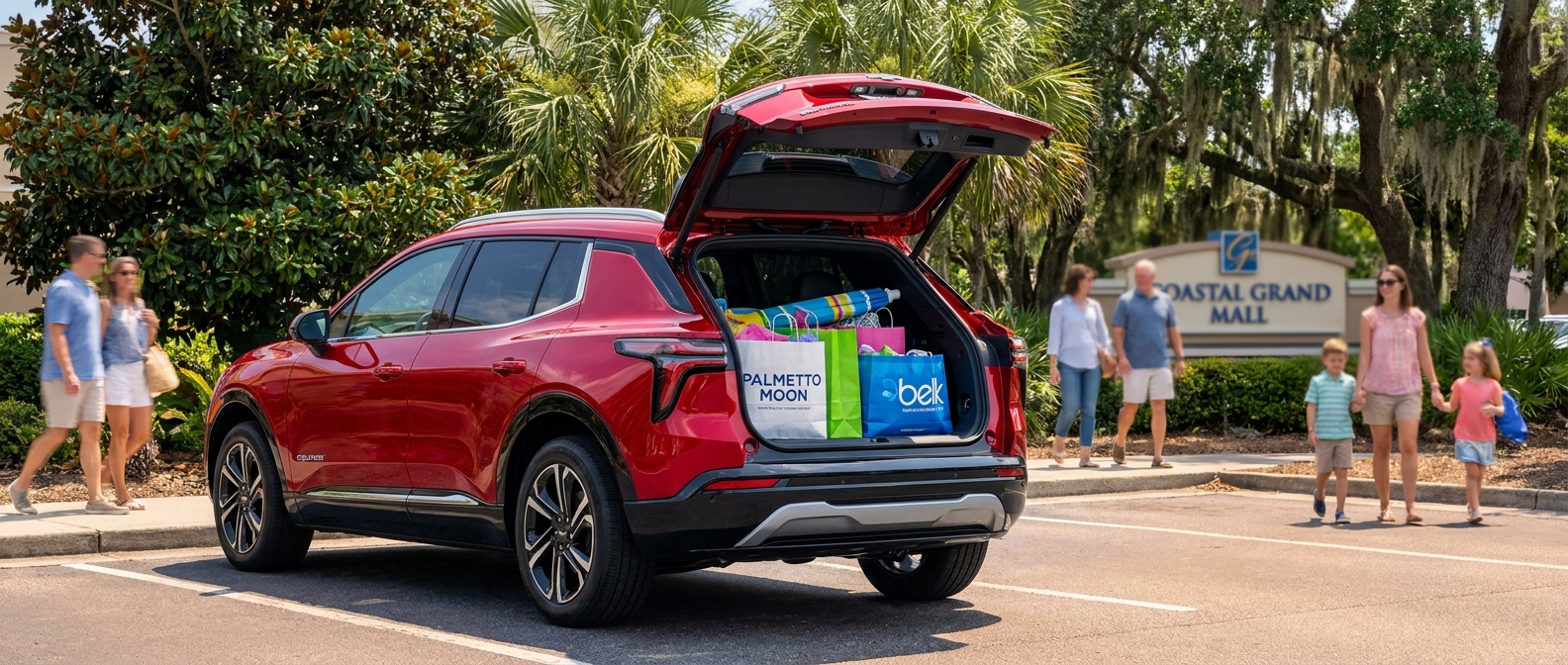
2026 Chevrolet Equinox with cargo hatch open and shopping bags inside in a large sunny mall parking lot

Best Chevy for Shopping at Coastal Grand Mall | Palmetto Chevrolet

A belief worth testing before a Coastal Grand Mall run goes like this. "I need something big enough to handle a real Coastal Grand Mall haul." The instinct makes sense. More stores, more bags, more people, so more vehicle, right? Not quite. The *best* Chevy for a Coastal Grand run leans far more on what you're hauling, how many seats you need, and what US-501 looks like on the drive home than it does on raw size. Sizing up just to size up can work against you in that lot on a busy fall Saturday. Which Chevy actually fits? The 2026 Chevrolet Equinox is where we'd steer most Conway-area shoppers, but that's one recommendation among several good ones. Let's work through the myths and realities so you can pick the one that fits your trip. The short version Myth: You always need the biggest SUV for a serious mall shopping run. Reality: Coastal Grand's 6,000-plus-space lot and single-level layout reward a vehicle sized for its specific job, not just maximum volume. The 2026 Chevrolet Trax (EPA-rated 28 city / 32 highway) is the sharpest choice for solo and two-person errand runs where US-501 stop-and-go fuel economy matters. The 2026 Equinox delivers 29.8 cubic feet of cargo space behind the rear seats and expands to 63.5 with the 60/40 seat folded. Plenty for a serious family haul without the footprint of a three-row. The 2026 Chevrolet Traverse is the correct call when you need three rows of seats and serious cargo volume (up to 98 cubic feet), but it's the most deliberate parking choice in a crowded holiday lot. Honest tradeoff: more seats and cargo volume genuinely cost you parking agility on peak-season days. We'll tell you where each vehicle earns its keep. Is "Bigger Always Better" Actually True for a Mall Shopping Run? The short answer is no, though a bigger SUV does earn its room once the people and bags genuinely fill it, and the parking math at Coastal Grand explains why sizing up for its own sake can backfire on a busy Saturday. The mall sits at 2000 Coastal Grand Circle just off US Highway 17, with over 6,000 parking spaces across a predominantly single-level surface lot. Nobody would call it a cramped urban garage. But it fills fast in tourist season and during fall sales weekends, and longer vehicles compete for the same standard-width spaces as everything else on the lot. The Myth What's Actually True "A big SUV handles any haul better" Cargo volume is only useful if it's sized to what you're actually carrying. Chevrolet lists the 2026 Equinox at 29.8 cu ft behind the rear seats. Enough for a full day of bags from 170-plus stores. "More vehicle means more room for the family" The 2026 Traverse seats up to eight and carries 98 cu ft of max cargo. Genuinely useful for big groups. For a couple or family of four, the Equinox's 104.3 cu ft of passenger volume already feels spacious. "The Trax is too small for a real shopping trip" Chevrolet lists the 2026 Trax at 25.6 cu ft behind the rear seats and 54.1 cu ft with seats folded. That's a solid haul for one or two shoppers, in a 178.6-inch footprint that maneuvers with ease in a crowded lot. "You'll waste a lot of gas on the US-501 run" The EPA rates the 2026 Trax at 28 city / 32 highway, and the 2026 Equinox earns up to 26 highway. The Traverse (EPA-rated 20 city / 26 highway FWD) covers the run efficiently for its class. "A three-row SUV is always worth it" Worth it if the third row is occupied. The Traverse's 22.9 cu ft behind the third row is tight for a full-family haul; fold that row and you get 56.6 cu ft. Three rows make sense when three rows are actually used. "EPA estimates are determined by the U.S. Environmental Protection Agency using standardized testing procedures. Your actual fuel economy will vary based on how you drive and maintain your vehicle, driving conditions, and other factors.". U.S. Environmental Protection Agency What the Right Chevy Actually Means for a Grand Strand Shopping Day The 2026 Trax is the overlooked pick here, and it earns that billing on two fronts, since at 178.6 inches long with an EPA rating of 28 city / 32 highway it handles the Conway-to-Myrtle-Beach corridor on US-501 efficiently and slides into any standard parking space at Coastal Grand without a fuss. On a Saturday afternoon in October when the lot is full of visiting families, that compact footprint is a genuine advantage. The catch is real for bigger groups. If you're shopping for a family of five and everyone's along for the trip, the 25.6 cubic feet of cargo space behind the rear seats fills up fast once the kids are buckled in. Call it a two-or-three-person vehicle rather than a family-of-five hauler. The 2026 Chevrolet Traverse sits at the other end of the spectrum, and it earns its place when the situation calls for it. Chevrolet lists maximum cargo volume at 98 cubic feet with all rows folded. More cargo than a typical mall haul will ever fill. The 328-horsepower turbocharged engine makes the US-501 corridor feel easy, and towing capacity reaches 5,000 pounds with the included trailering equipment (when properly equipped. Verify the door-jamb label). The Traverse is a large vehicle in a standard parking stall. On a slow Tuesday that poses no problem. On a packed holiday Saturday when every family on the Grand Strand decides to shop at Coastal Grand simultaneously, patience and a bit of extra maneuvering come with it. If your group fills three rows regularly, that's a fair trade. If it's usually four people with occasional guests, the Equinox handles it with less friction. The 2026 Equinox threads the needle for most Conway-area families: 63.5 cubic feet of cargo with seats folded, a 183.2-inch footprint that fits a standard space cleanly, and an EPA-rated 26 highway mpg to make the US-501 run back to Conway cost-effective. "When properly equipped. Before you buy, confirm actual trailering capability with your dealer using the door-jamb label and trailer weight.". Chevrolet (capability caveat, all Traverse towing claims) Explore Financing Options So What Should You Actually Drive to Coastal Grand? The right answer depends on who's riding along and how often, so here's how we'd frame it for a Conway-area buyer deciding today, weighing fuel economy and parking ease against the pull of the biggest badge on the lot. You're a solo shopper or a couple on a focused errand run. Take the Trax. The EPA's 28 city / 32 highway rating is the most fuel-efficient option in the lineup for this exact kind of trip. The 54.1 cubic feet of folded cargo space is enough for a serious haul when your back seat isn't occupied. Park anywhere in the lot without thinking about it twice, most days. You're a family of four or five with a mix of passengers and bags. The Equinox is the sensible call. The 60/40 split-folding rear seat lets you carry three passengers and still expand one cargo side for a big bag haul. Chevrolet lists the overall footprint at 183.2 inches. Compact enough to maneuver in a full lot without the deliberateness a three-row demands. You're hauling the whole extended family. Think six, seven, or eight people, or you're making a major holiday shopping run that genuinely fills a vehicle. The Traverse is right. Three rows, 98 cubic feet of max cargo, and a powertrain capable of pulling a boat trailer when the day calls for it. Plan to give yourself a few extra minutes to find the right spot at the Coastal Grand lot on peak days. Budget for that, and little else. One thing that catches buyers off guard. The US-501 corridor between Conway and the Coastal Grand area sees real tourist-season congestion, above all on fall weekend afternoons. A vehicle with better city fuel economy pays off during the idling, and that stretch serves up plenty of it on peak afternoons. The Trax and Equinox earn their city ratings here. The Traverse earns its keep in a different way. When you've got the passengers to fill it, nothing else on our lot handles the return trip with that much cargo and that many comfortable seats. Whatever you're driving over to Coastal Grand, we can help you find the right fit before the trip. Frequently Asked Questions Does the 2026 Chevrolet Trax have enough cargo space for a full day of mall shopping? Yes, for one or two shoppers. Chevrolet lists the 2026 Trax at 25.6 cubic feet of cargo space behind the rear seats and 54.1 cubic feet with the rear seat folded. For a focused shopping run with one or two people, that covers a full day at a mall like Coastal Grand. If you're bringing three or more passengers and need cargo room for all of them, the 2026 Equinox (29.8 cubic feet seats up, 63.5 folded) is the better match. How far is Palmetto Chevrolet in Conway from Coastal Grand Mall in Myrtle Beach? Palmetto Chevrolet's located in Conway, South Carolina, on 4th Avenue. Roughly 30 to 40 minutes from Coastal Grand Mall via US-501 East, depending on traffic. The US-501 corridor is the main artery between Conway and Myrtle Beach and sees meaningful congestion during peak tourist weekends, which is one reason fuel economy in city and stop-and-go driving matters for this particular run. See What Your Current Vehicle Is Worth Palmetto Chevrolet 1122 4th Ave, Conway, SC 29526 (843) 248-4283

Contact Us

Fill out this form below and we'll contact you shortly
*Required Fields