





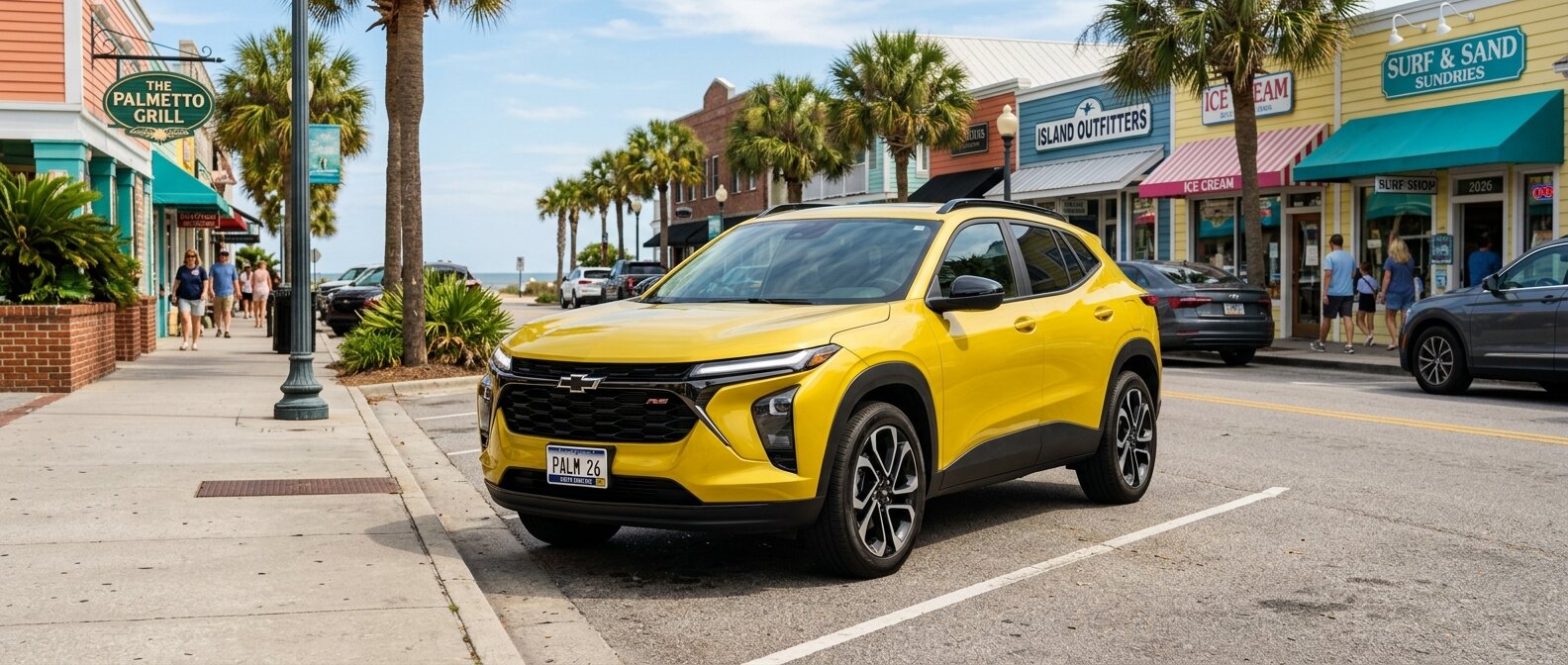
US-501 between Conway and Myrtle Beach is one of the most congested corridors in Horry County. The South Carolina Department of Transportation recorded more than 63,800 vehicles per day on the segment near Carolina Bays Parkway (2023 SCDOT annual daily traffic count), and the widening project that kept crews busy through 2026 means the delays haven’t cleared. A summer run toward the beach that should take ten minutes can stretch past forty. If that’s your daily reality, the vehicle you pick has to fit tight commercial-strip parking, handle repeated stop-and-start cycles without burning fuel it doesn’t need to, and stay honest about where it earns its keep.
The 2026 Chevy Trax is a strong fit for that first pair of demands. Being front-wheel drive only, it asks you to plan a few seconds ahead on a highway merge with a full load, a real characteristic worth knowing before you buy. For the stop-and-go grind of US-501 and the Myrtle Beach grid, though, its dimensions, fuel-saving technology, and standard safety suite make it a truly capable daily tool. We’ll walk you through configuring it so it works the way Chevrolet designed it to.
See the 2026 Trax on our lot at Palmetto Chevrolet
What You Need Before You Start
Pull these specs up before you adjust any settings, because knowing what’s fixed across the lineup saves you second-guessing later. Every 2026 Trax shares the same powertrain across all five trims, which keeps this guide straightforward no matter which one you bought.
| Item | Spec or Setting | Source |
|---|---|---|
| Engine | 1.2L ECOTEC Turbo 3-cyl, 137 hp / 162 lb-ft | Chevrolet |
| Transmission | 6-speed automatic | Chevrolet |
| EPA city fuel economy | 28 MPG (all trims) | EPA |
| Overall length | 178.6 inches | Chevrolet |
| Cargo behind rear seats | 25.6 cu ft | Chevrolet |
| Max cargo (seats folded) | 54.1 cu ft | Chevrolet |
| Rear legroom | 38.7 inches | Chevrolet |
| Fuel tank | 13.2 gallons | Chevrolet |
| Automatic Stop/Start | Standard, every trim | Vehicle infotainment settings |
| Chevy Safety Assist (6 features) | Standard, every trim | Chevrolet |
| Forward Collision Alert sensitivity | Adjustable: Far / Medium / Near | Steering-wheel controls |
| Wireless Apple CarPlay / Android Auto | Standard, every trim | Infotainment pairing menu |
One plain-language note on power belongs here. The 1.2-liter three-cylinder is tuned to make its torque low in the rev range, which makes it pull cleanly from a dead stop. Stop-and-go traffic rewards exactly that. It isn’t the engine you want for a loaded four-lane merge at highway speed. Know the difference and drive accordingly.
Configuring Your Trax for the US-501 Corridor
Give yourself about ten minutes the first time through these six steps, and run them before your first serious beach day so the settings are dialed in when traffic actually hits.
Step 1. Leave Automatic Stop/Start on. Chevrolet installs Stop/Start as standard on every 2026 Trax. The system shuts the engine off when you brake to a stop and restarts it the instant your foot lifts. On a corridor packed with cross-street intersections, like the stretch of US-501 between Conway and SC-544, you can sit through several light cycles per mile. All that idle time is a direct fuel cost. The button on the center console lets you disable Stop/Start for a given drive, and it’s tempting to jab it out of habit because the restart takes a beat to feel familiar. Give it two or three commutes. Once the behavior feels normal, the fuel savings are real and they add up.
Step 2. Tune the Forward Collision Alert before your first congested run. A step up to the Equinox gives you more engine displacement, but the Trax’s standard Chevy Safety Assist suite handles city safety well. The Forward Collision Alert is the one setting worth personalizing. In heavy stop-and-go traffic, the default sensitivity can fire alerts during normal gap closures, and over time that trains you to tune the system out. Use the steering-wheel controls to set it to “Far.” Now the system reads developing situations earlier, so alerts arrive with more lead time and feel proportionate. Medium or Near are fine on open roads. Far is the right choice for US-501.
Step 3. Connect your phone once and let it run. Wireless Apple CarPlay and Android Auto come standard on every 2026 Trax. Pair your phone through the infotainment menu on your first drive, and the connection is automatic every trip after that. On the Grand Strand this matters for one reason, live traffic routing. On a heavy summer afternoon, SC-22 (Veterans Highway) and SC-544 toward Surfside can both move faster than US-501. Google Maps and Apple Maps will show you which in real time. The navigation is only as good as the data it’s pulling, so a connected phone isn’t optional for this kind of driving.
Step 4. Load cargo for sightlines, not just volume. The Trax carries 25.6 cubic feet of cargo behind the rear seats, enough for two beach chairs, a soft-sided cooler, and two bags without stacking. Fold the 60/40 rear seat and you’re at 54.1 cubic feet, which is generous for this vehicle class. The practical discipline for beach-town driving is simple. Stop before the cargo line reaches the rear window. Load smart. The Trax has a standard rear vision camera, and it’s useful, but clear sightlines through the back glass still beat camera-only reliance when you’re backing out of a tight angled spot in a crowded surface lot.
Step 5. Trust the footprint on parking. At 178.6 inches long, the Trax is built for exactly the kind of parking stock that fills Horry County commercial strips. Its turning radius is tight by SUV standards. Downtown Conway side streets, the surface lots along the Myrtle Beach Boardwalk, and the cramped rows near Coastal Carolina University’s campus-adjacent retail are all manageable in this vehicle. They’re a lot less manageable in a Traverse or a Tahoe. If you’ve got a 2RS or ACTIV trim with the Driver Confidence Package, rear park assist and blind-spot monitoring are available. On LS and LT trims, the rear camera and your mirrors do the same work. Use them both.
Step 6. Check tire pressure before any long slow-roll session. Your door-jamb sticker lists the manufacturer’s recommended tire pressure for your exact build (check that sticker, not a generic number). Coastal South Carolina heat affects inflation, so this one’s worth a habit. An underinflated tire builds heat through sidewall flexion, which is the primary mechanical reason tires fail during sustained low-speed driving. Two minutes with a gauge before a beach-day run costs nothing.
Schedule a service visit for a tire-pressure check and full inspection
Print-and-Go Recap
- [ ] Automatic Stop/Start: enabled (resist the console disable button)
- [ ] Forward Collision Alert: set to “Far” via steering-wheel controls
- [ ] Phone paired wirelessly (Apple CarPlay or Android Auto)
- [ ] Live traffic navigation active before entering US-501
- [ ] Cargo loaded with clear sightline through rear glass
- [ ] Tire pressure verified against door-jamb sticker
- [ ] Rear park assist / blind-spot monitoring (2RS/ACTIV trims): active in vehicle settings
- [ ] Fuel level confirmed (EPA city rating: 28 MPG; tank: 13.2 gallons)
Where the Trax Earns Its Place on the Grand Strand
The 2026 Trax answers a specific question well, and the question is which new SUV makes the most practical daily driver for a Conway-to-Myrtle Beach commute or a compact family’s beach-town errands. It’s got a compact footprint, stop-and-go fuel tech, a six-feature safety suite standard at every trim level, and cargo that handles real beach gear. The EPA rates it at 28 MPG city, and that holds up in the driving conditions US-501 actually produces.
If your driving skews more highway than grid, the Trailblazer is worth a test drive alongside it. It’s got more power on the on-ramps and a slightly larger footprint. If you’re moving a family of five regularly, the Equinox steps up in rear-passenger room and adds AWD as an option the Trax doesn’t offer. Know the trip before you pick the vehicle.
Which trip are you actually driving? Answer that first, because for the commuter, the CCU student, or the small family running beach errands out of Conway, the Trax is a practical, well-matched fit. Come drive it down 4th Avenue and see how it feels.
Frequently Asked Questions
Does the 2026 Chevy Trax get good gas mileage in stop-and-go traffic?
The EPA rates the 2026 Trax at 28 MPG city across all five trims. Chevrolet’s Automatic Stop/Start (standard on every trim) cuts the engine at red lights and restarts when you lift off the brake, which directly supports that city rating during the repeated stop-and-go cycles that US-501 between Conway and Myrtle Beach produces.
Is the 2026 Chevy Trax easy to park in Myrtle Beach?
At 178.6 inches in overall length per Chevrolet’s specification, the 2026 Trax is one of the more compact SUVs available new. That footprint fits the angled surface lots near the Myrtle Beach Boardwalk and the side streets of downtown Conway with considerably more margin than a midsize or full-size SUV. By the Palmetto Chevrolet Team | September 2026


