





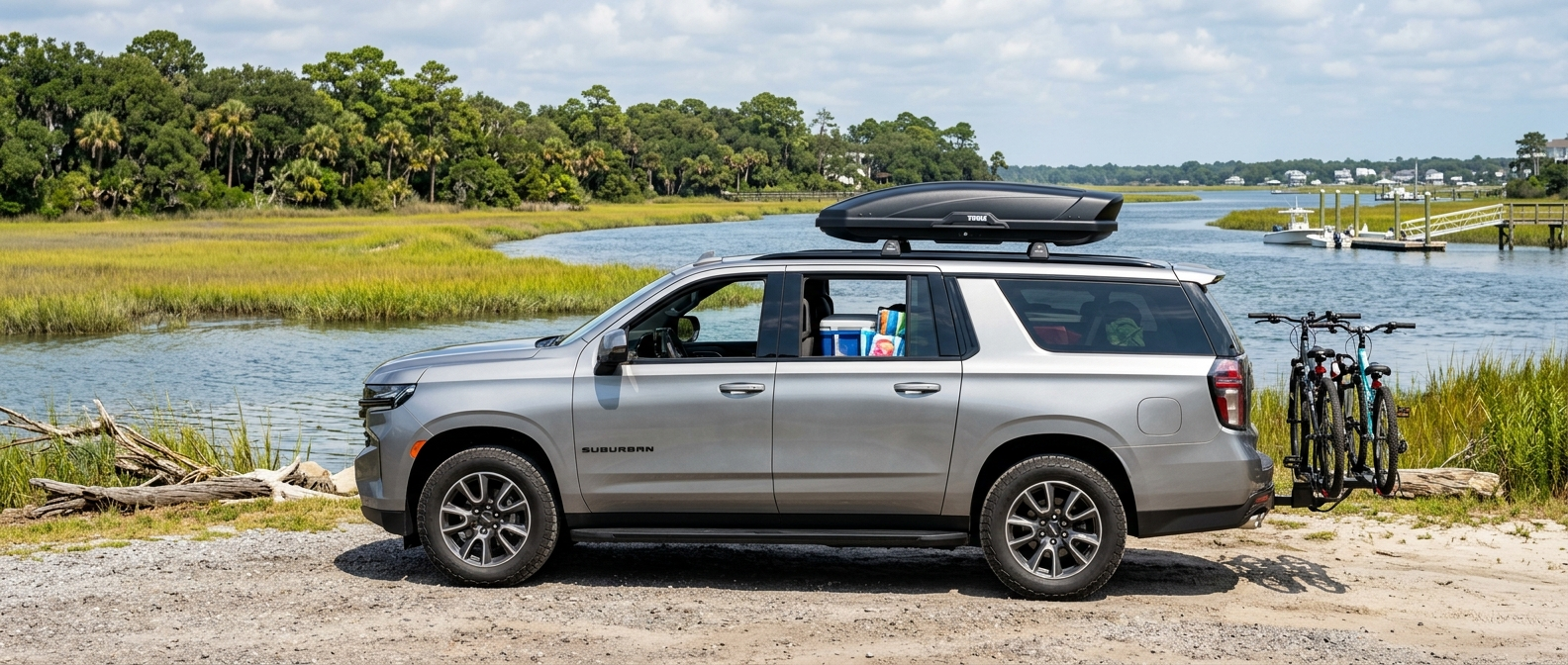
The drive down US-17 from Conway to Charleston looks simple on a map. About 98 miles, roughly two hours door-to-door on a clear day. Then you load seven kids, two adults, a stroller, a cooler, and a week of luggage into the Suburban, and the vehicle that felt enormous in the driveway turns out to carry a few hidden decisions that decide whether this trip runs comfortable or cramped. The bottom line is simple. The 2026 Chevrolet Suburban can genuinely handle a large family on this exact run, but only if you’ve made the right configuration calls before you leave Horry County.
Browse our Suburban inventory at Palmetto Chevrolet and come back to this, because the choices below are the ones worth understanding first.
What’s Actually Going on When the Suburban Feels Tight?
Large-family road-trip frustration with a Suburban usually traces back to three decisions that look minor at the dealership and feel major somewhere around Georgetown on the way south. The table below maps the symptom you feel to the decision that caused it, and what to do about it.
| What the family notices | What’s actually happening | What to do before the trip |
|---|---|---|
| No room for luggage with all seats up | Third row is occupied; cargo bay behind it is only 41.5 cu ft | Evaluate who’s riding and whether row 3 can fold; 93.8 cu ft opens the moment that row goes flat |
| Middle-row passengers can’t reach their bags | Captain’s chairs selected; the pass-through aisle is there but items sit forward | Load a soft bag under row 2 or use the underseat storage on LT and above |
| Fuel stops feel more frequent than expected | V8 running at 15 mpg city / 20 mpg highway (EPA) hits harder in stop-and-go on US-17 entering Charleston | Plan a Georgetown stop; consider whether the diesel makes sense for how often you do this drive |
| Row 3 adults are grumpy after 90 minutes | The Suburban’s third row seats three, but legroom depends on row 2 position | Slide row 2 forward for road trips; adults fit, but tall teenagers need that adjustment made consciously |
| “We only fit 7” confusion | Captain’s chairs in the second row seat 7; a bench seats 8, with certain trims reaching 9 with a front bench | Know your configuration before you sign |
The Real Cargo Math Behind 41.5 Cubic Feet
The cargo number that matters is 41.5 cubic feet, the figure Chevrolet lists behind the third row of the 2026 Suburban, and while that’s genuinely impressive for a three-row vehicle, it’s still about the footprint of a large chest freezer. It still beats what most competitors offer with their third row folded down, but a family of six with real luggage for a multi-day Charleston trip fills it fast. Space runs short.
Fold the third row flat and you get 93.8 cubic feet. That’s the number that changes this vehicle from “we’ll make it work” to “we have room for everything.” The catch is obvious. Fold the row and two passengers lose their seats. For families of five or fewer, this is an easy call. For families of seven or eight, you’re hauling a cargo carrier or a small trailer, or you’re staying very disciplined about what goes in the truck. You pick seats or gear.
Schedule a pre-trip service check at Palmetto Chevrolet if you’re adding a rooftop carrier or trailer hitch. Our service team can confirm your setup is torque-spec’d and ready before you head south.
Engine Choice Matters More on This Route Than Most Families Realize
The standard 5.3L EcoTec3 V8 delivers 355 horsepower and 383 lb-ft of torque. You’ll see the EPA rate it at 15 mpg city and 20 mpg highway in rear-wheel drive.
They’re solid numbers for a vehicle this size, and more than sufficient for a family run to Charleston. The available 6.2L EcoTec3 V8 bumps output to 420 horsepower and 460 lb-ft, the right call if you’re towing a camper or a boat along with the family. The Suburban is rated to tow up to 8,200 lbs properly equipped, so verify your specific configuration against the door-jamb label before hooking up.
The engine worth a second look for families who run this drive often is the Duramax 3.0L turbodiesel, rated at 305 horsepower, 495 lb-ft of torque, and EPA-estimated fuel economy of 21 mpg city and 26 mpg highway in rear-wheel drive. Chevrolet rates the diesel at up to 728 miles of estimated highway range per tank. For a family running Conway to Charleston and back on a regular basis, that efficiency gap is real, and it compounds across a season of trips. The savings add up.
The tradeoff is real. The diesel isn’t on the LS base trim, so you’ll move up to LT or higher to get it, which means spending more upfront to save on fuel over time. Whether that math works for you depends on how often your family makes this kind of run. Your call.
The Chevrolet Tahoe is worth a look if your family is five or fewer. It shares the same powertrains and gives up about 15 inches of length, which makes parking in Charleston’s historic district considerably less stressful.
Schedule Your Pre-Trip Service Appointment
Bench or Captain’s Chairs: The Decision That Changes Everything
Captain’s chairs win for road-trip comfort and a second-row bench wins for raw headcount, so that single choice shapes how everyone rides down US-17 more than almost any other box you check on the order sheet, and it deserves a decision before you fall for a trim or a color. Second-row captain’s chairs give you a wide center aisle that makes getting to the third row genuinely easy. Your kids can move without climbing over each other. You seat seven passengers total in that configuration. A second-row bench bumps capacity to eight. Certain trims can spec a front bench to reach nine (a specific LS configuration decision).
For road trips, captain’s chairs tend to win on comfort and sanity. Each second-row passenger gets their own armrest and some personal space, and on a two-hour run down US-17, that space earns its keep. The bench configuration makes more sense if you’re regularly maxing out headcount and don’t care as much about row-to-row access. It counts.
If your family is six or under, compare the Chevrolet Traverse before committing to the Suburban’s footprint. It seats seven or eight, parks more easily in downtown Charleston, and still gives you three rows of real space.
DIY Pre-Trip Checks vs. Letting Our Team Handle It
The Suburban doesn’t need anything special for a run like this one, but a few quick checks before you leave Conway will keep the Arthur Ravenel Jr. Bridge entrance and everything south of it incident-free, and the smart move is to split them into what you can do yourself and what we should look at.
Check the driveway items first, then let our team catch the rest before you’re loaded and rolling.
Handle these yourself:
- Tire pressure (including the spare). A full load plus the coastal heat of a South Carolina September will put more thermal load on your tires than an empty truck on a cool morning. Chevrolet specifies cold inflation pressure on the door-jamb label. Use that number, not the “max” stamped on the sidewall.
- Fuel level. If you’re in a gas V8, plan your fill before Georgetown rather than hoping something opens conveniently between there and downtown Charleston.
- Cargo restraint. Unsecured items in a Suburban with 40-plus cubic feet of open cargo bay shift under braking. A cargo net or a low cargo barrier behind the third row is a small investment worth making.
Let us handle these:
- Any deferred oil change or tire rotation. A fresh oil change before a long summer trip is the simplest thing to do and easy to skip.
- Brake inspection if you’ve been pulling a boat or camper this season. Towing puts real thermal stress on brake components, and brakes that feel fine around Conway feel different after the grades and stop-and-go of I-526 approaching Charleston.
- Hitch and receiver check if you’re adding cargo to the trailer. Tongue weight limits for the 2026 Suburban run roughly 10 percent of your total towing capacity. On an 8,200-lb setup, that’s about 820 lbs of tongue weight maximum. It’s easy to exceed with a loaded camper and not easy to know without checking.
Frequently Asked Questions
Does the 2026 Suburban have enough cargo room for a large family road trip?
With all three rows in use, the 2026 Suburban offers 41.5 cubic feet of cargo space behind the third row, which is considerable for a fully loaded three-row vehicle, though it will fill quickly for a family of six or more with multi-day luggage. Fold the third row flat and cargo volume jumps to 93.8 cubic feet. For families who need all seats occupied, a rooftop carrier or small cargo trailer is worth planning before you hit US-17 south toward Charleston.
Is the Suburban diesel worth it for the drive from Conway to Charleston?
The Duramax 3.0L turbodiesel is available on the LT trim and above and delivers EPA-estimated fuel economy of 21 mpg city and 26 mpg highway in rear-wheel drive. That’s noticeably better than the standard 5.3L V8’s 15 city / 20 highway ratings. On a single round trip to Charleston and back that difference is modest, but for families doing this run frequently through the year, the diesel’s efficiency and its estimated 728-mile highway range per tank make a real cumulative case. The tradeoff is that you’re committing to a higher trim level to access the engine.


