





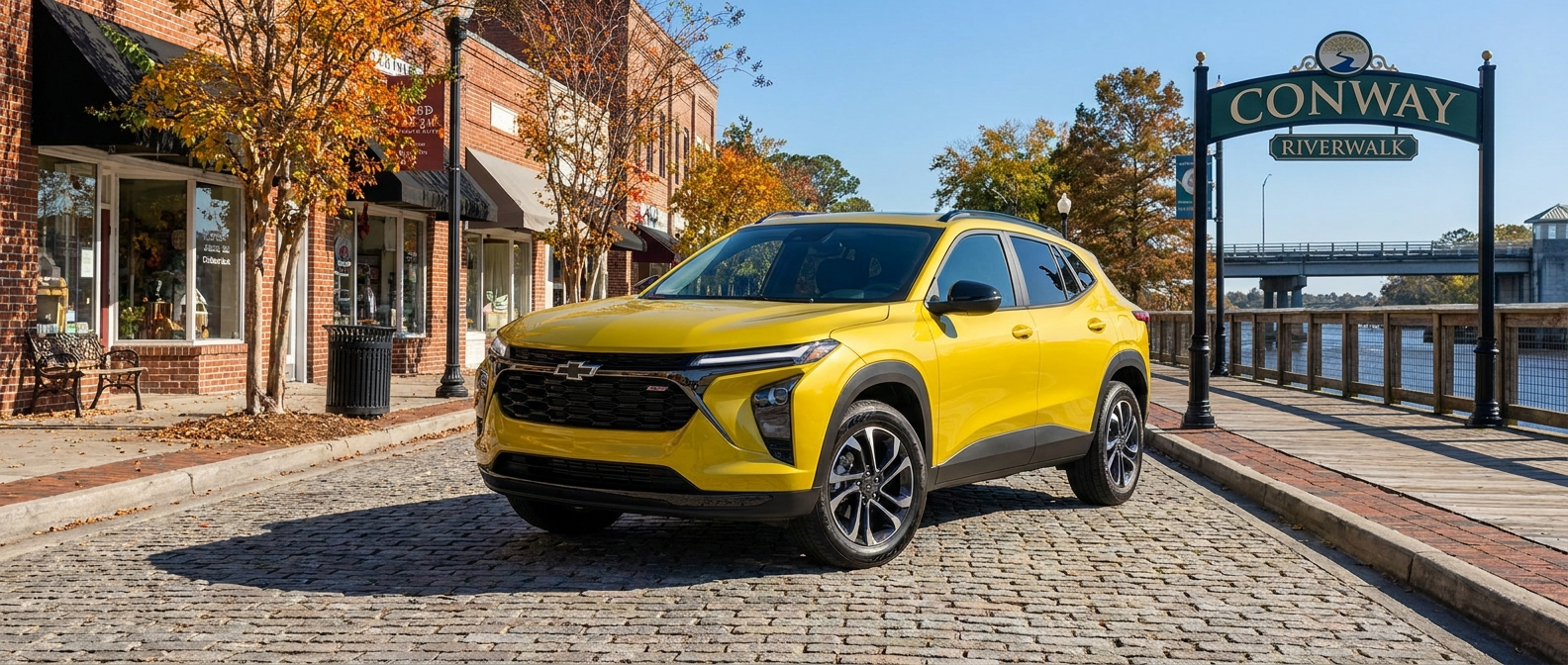
Shopping a used Chevy Trax near downtown Conway and wondering which years earn their keep? Here’s our take: target a 2020-2022 for the tightest budget or a 2024-2025 if you can stretch a little, and skip 2015 through 2019 unless the recall history has been fully documented and cleared. The Trax story splits cleanly into two generations, and knowing where that line falls saves you real money and a few headaches.
- Sweet spot on a budget: 2020, 2021, or 2022, the cleanest years of the first generation, well past the recall-heavy early years
- Sweet spot if you can stretch: 2024 or 2025, a full redesign with a roomier interior, wireless CarPlay, and modern safety tech
- Years to watch carefully: 2015 through 2019. NHTSA logged multiple recall campaigns for lower control arms, airbags, and electrical issues across this window
- No-AWD reality check: every Trax ever built is front-wheel drive only; for Conway’s mild winters and summer beach runs on US-501, that’s a genuine non-issue
- Local fit: at 178.6 inches long, the Trax slots into downtown Conway’s tighter street parking and the Coastal Carolina University corridor without the drama a midsize SUV brings
Browse our used Chevy Trax inventory at Palmetto Chevrolet
Which Model Years Are the Sweet Spot for a Used Trax?
For a budget-minded buyer, we’d point you at the 2020-2022 window first, since Chevrolet had ironed out the most serious first-generation problems by then, and a buyer who can stretch a bit is better served by the 2024 redesign. NHTSA data backs the budget call. The 2022 model year logged just 9 owner complaints on record, the lowest of any Trax model year in the database. No accident there. By 2020, the control arm welding campaigns that swept through the 2015-2019 Trax population were behind the design, and the late first-generation cars benefited from a platform refined over several years. It shows in the numbers.
The 2021 and 2022 models also added Apple CarPlay and Android Auto as standard features, which matters if you’re daily-driving the US-501 corridor and need hands-free navigation through beach-season traffic. The 2022 stands out as the final year of the first generation, with no rushed mid-cycle changes from Chevrolet, and the powertrain (a 1.4-liter turbocharged four-cylinder in Gen 1) had built a solid real-world track record by then. The platform was proven.
Then there’s the 2024. Chevrolet skipped the 2023 model year entirely and came back with a ground-up redesign. The second-generation Trax grew by nearly a foot in overall length, added 3 inches of rear legroom (now 38.7 inches per Chevrolet’s published specs), and swapped in a new 1.2-liter turbocharged three-cylinder making 137 horsepower and 162 lb-ft of torque, paired with a six-speed automatic. Wireless Apple CarPlay and Android Auto are standard across all trims. The EPA rates it at 28 city and 32 highway. That’s the car that showed up on the lot and made people forget there had ever been an older Trax.
| Model Year | Generation | Key Strengths | Cargo (seats up) | EPA Combined |
|---|---|---|---|---|
| 2020 | Gen 1 | Post-recall cleanup, budget sweet spot | ~18.7 cu ft | ~26 mpg |
| 2021 | Gen 1 | CarPlay/Android Auto standard, proven platform | ~18.7 cu ft | ~26 mpg |
| 2022 | Gen 1 | Final Gen 1 year, lowest NHTSA complaint count (9) | ~18.7 cu ft | ~26 mpg |
| 2024 | Gen 2 | Full redesign, roomier, wireless tech, modern safety | 25.6 cu ft | 30 mpg |
| 2025 | Gen 2 | Same strong second-gen platform, slightly more used availability | 25.6 cu ft | 30 mpg |
See new Trax models at Palmetto Chevrolet for comparison
Which Trax Years Should You Watch Out For?
The years to approach with caution are 2015 through 2019, and all five carry documented NHTSA recall history worth a careful look before you hand over a check, though you shouldn’t write them all off if the paperwork checks out clean.
Per NHTSA recall campaign 19V652000, the 2015-2018 Chevrolet Trax was subject to a front lower control arm recall. An improperly welded joint in the control arm could partially separate from the vehicle, affecting steering and handling. Campaign 19V312000 extended that coverage to the 2017-2019 models, so the 2017 and 2018 Trax each fell under both campaigns. When you’re checking VIN history, that detail matters. Two separate recall campaigns on one component mean two separate paperwork trails to verify. Check both.
The 2015 and 2016 model years also logged the highest per-model recall counts in the generation, and they’re the pair to scrutinize hardest. NHTSA data shows 7 recall campaigns for the 2015 Trax and 5 for the 2016, covering issues from front airbag deployment failures (campaign 16V651000) to seat belt pretensioner problems. The 2016 drew 171 NHTSA complaints in total. The 2019, despite not carrying the same volume of recalls, logged 133 NHTSA owner complaints, the second-highest complaint count across all Trax model years.
None of this makes every 2015-2019 Trax a lemon. Recalls get repaired. But it does mean you’ll want solid documentation on any example from those years. Always check nhtsa.gov/recalls with the vehicle’s VIN before you commit.
The 2019 is a genuinely awkward one to frame. Some sources call it a decent late Gen-1 buy, while the NHTSA complaint volume (133 filed) tells a more cautious story. If you’re looking at a 2019, confirm both control arm campaigns (19V312000 and a related airbag control module recall, 18V774000) have been addressed. A clean repair history for those two items changes the picture considerably. Worth the digging.
Explore financing options for a used Trax at Palmetto Chevrolet
What Downtown Conway Drivers Actually Need to Know About the Trax
The spec that shapes every Trax decision around here is drivetrain, because the Chevy Trax is front-wheel drive only across every single model year and every trim, and for Conway you’re not actually giving up a thing that matters.
A fair question before you commit is whether you’re exposed without all-wheel drive, and buyers relocating from colder states raise it with us on the lot. For Conway, the answer is no.
South Carolina winters on the Grand Strand are mild, and US-501’s biggest challenges are summer beach traffic backups (where fuel economy matters far more than traction) and the occasional thunderstorm in hurricane season. The Trax’s EPA ratings of 28 city and 32 highway on the second-generation model are genuinely useful on that corridor, and you’ll feel it in beach-season stop-and-go.
The other local reality is parking. Downtown Conway’s historic streets and the Riverwalk area aren’t built for a midsize SUV. The Trax’s 178.6-inch overall length (Chevrolet’s published spec for the second generation) tucks into parallel parking slots that a Blazer or an Equinox will leave you sweating through. If you’re also running the SC-544 corridor to Coastal Carolina University for work, classes, or evening events, a smaller footprint is a practical advantage, not a compromise.
The honest downside? The Trax has no towing capacity. None. If you’re the person who hauls a small boat out to the Waccamaw River on weekends, this isn’t your vehicle. A midsize SUV like the Chevy Equinox or Trailblazer would serve that lifestyle better. The Trax is built for commuting, parking, and eating up the 501 with the least amount of fuel cost, and it does those jobs very well.
Which Year Is Right for Which Conway Buyer?
The right year comes down to your budget and whether AWD or towing is ever in play, and in our experience on the lot, the choice tends to sort into four clear camps, each one matching a Conway driver who’s shopping for something different.
You want a 2022 if the budget stays tight, the newer styling doesn’t pull at you, and you want the strongest used-market value with the cleanest first-generation track record. The 38.7-inch rear legroom figure belongs to the second generation, so keep in mind that the first gen ran a smaller cabin if you’re regularly carrying passengers.
You want a 2024 or 2025 if you’ll pay a modest premium for the redesigned interior, the standard wireless tech, and the 25.6 cubic feet of cargo space behind the rear seat (which the EPA-rated second generation delivers per Chevrolet’s published spec). Young professionals doing Myrtle Beach runs on weekends will feel the difference in cabin quality. The 11-inch touchscreen available on upper trims is a legitimate step up from the first generation.
You want to look carefully at any 2015-2019 only when the VIN check on nhtsa.gov confirms all open recalls are completed, you’ve got maintenance records, and the price reflects the extra due diligence it asks for. We’re not telling you to walk away from every one of them. We’re telling you not to buy one without homework.
You should skip the Trax entirely if AWD is non-negotiable or towing is part of your routine. That’s no knock on the vehicle. For the right situation, the Trax is the right call.
Frequently Asked Questions
Is the Chevy Trax available with all-wheel drive?
No. Every Chevy Trax, across all model years and all generations, is front-wheel drive only. For most Conway and Grand Strand buyers, that’s a practical non-issue given South Carolina’s mild winters and flat terrain, but it’s a firm limitation worth knowing before you shop.
What changed with the 2024 Chevy Trax redesign?
Chevrolet skipped the 2023 model year and returned for 2024 with a fully redesigned second-generation Trax. The new model is nearly a foot longer than the outgoing first generation, offers 38.7 inches of rear legroom (per Chevrolet’s published specs), and added a new 1.2-liter turbocharged three-cylinder engine rated by the EPA at 28 city and 32 highway mpg. Wireless Apple CarPlay and Android Auto are standard on all trims in the second generation.
What recalls should I check on a used Chevy Trax before buying?
The most significant recall activity in the Trax’s history covers the 2015-2019 model years. NHTSA recall campaign 19V652000 addressed a front lower control arm welding issue on 2015-2018 Trax vehicles, and campaign 19V312000 covered the same component on 2017-2019 models. A separate airbag/seat belt pretensioner recall (16V651000) covered 2015 and 2016 models. Always run the VIN through nhtsa.gov/recalls to confirm all applicable campaigns have been completed before purchasing any used Trax from those years.


