





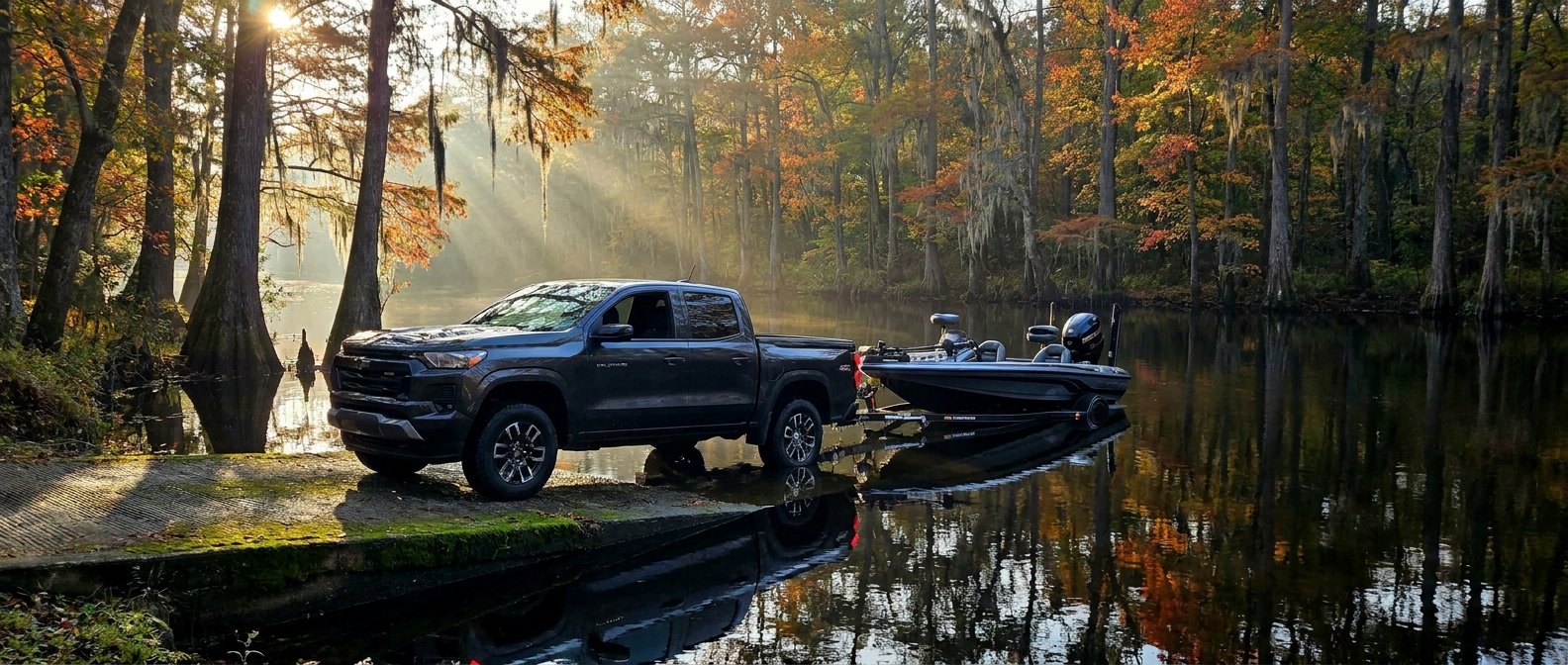
October is the best month on the Waccamaw, and we say that with some confidence. The heat finally breaks, crappie move to center stage in the cypress cuts, largemouth feed hard before winter, and blue cats stay active through the night. We wrote this guide to walk you through exactly how to configure your 2026 Colorado, so you roll up to Pitch Landing or Bucksville Landing with a properly hitched trailer, a bed that doesn’t swallow your tackle, and a truck that backs down a sandy ramp without drama.
The 2026 Colorado is a legitimate fishing truck for this river. Tow the boat in, back it down, fish all day, and reload without chaos. That’s the goal.
What Do You Need Before You Start?
You’ll want everything gathered before you load a single rod, because skipping the checklist phase is how anglers end up at Pitch Landing without a 7-pin adapter. Pull these together the night before and you’re set. The list is short, so run it top to bottom.
| Item | Spec / Detail | Where to Confirm |
|---|---|---|
| Towing capacity (base) | 3,500 lbs (no package) | Door-jamb label on your specific truck |
| Towing capacity (w/ Advanced Trailering Package) | Up to 7,700 lbs, properly equipped | Door-jamb label; Chevrolet lists this as the max for the platform |
| Payload capacity (WT/LT 2WD) | Up to 1,710 lbs | Door-jamb label |
| Payload capacity (Trail Boss / Z71 4WD) | Up to 1,590 lbs | Door-jamb label |
| Bed length (all 2026 Colorado trims) | 61.7 inches (at floor) | Chevrolet specs |
| Width between wheel wells | 45.5 inches | Chevrolet specs |
| Cargo volume | 41.9 cubic feet | Chevrolet specs |
| Fuel tank capacity | 21.4 gallons | Chevrolet specs |
| EPA fuel economy (2WD, combined) | 21 MPG | fueleconomy.gov |
| EPA fuel economy (4WD, combined) | 19 MPG | fueleconomy.gov |
| Trailer hitch receiver | Standard on Trail Boss / Z71 / ZR2; available via package on WT / LT | Chevrolet option sheet |
| 7-pin trailer connector | Included with Advanced Trailering Package | Chevrolet |
Get your boat’s loaded trailer weight from the registration or the manufacturer’s tag. You want that number, not the boat’s dry weight, because that’s what you’re comparing against your door-jamb rating. Everything else in this guide assumes you’ve done that check.
Setting Up the Colorado for a Full Waccamaw Fishing Trip
Think of this as the spine of the day, six steps in order, from the night before you leave Conway to the moment you’re on the water. Work them in sequence and nothing catches you off guard at the ramp. We’ve laid them out the way we’d prep our own rig.
Step 1: Decide your trim and package configuration.
If you already own a 2026 Colorado, check for the Advanced Trailering Package. It adds the 7-pin wiring harness, a heavy-duty hitch receiver, and trailer sway control calibrated for loaded rigs. The Trail Boss and Z71 come standard with 4WD, which matters at Bucksville Landing and Pitch Landing, both Horry County public ramps on the Waccamaw, and both can get slick from silt and river mud after rain. If you’re shopping, the WT and LT in 2WD handle most lighter aluminum boats fine, though any fiberglass rig over 2,500 pounds loaded warrants the package and, frankly, 4WD for the ramp.
The current Colorado inventory at Palmetto Chevrolet shows which trucks are package-equipped. We can pull the window sticker and confirm exactly what’s on a given unit before you commit.
Step 2: Hitch the trailer the evening before, not in the dark at 5 a.m.
The 2026 Colorado’s available hitch guidance camera helps line up the ball, but it still takes a minute the first time. Hook up at home in daylight. Confirm the ball mount height, since the trailer tongue should run level to the ground when loaded, which usually means the ball sits somewhere between 12 and 18 inches off the ground depending on your coupler height. Plug in the 7-pin connector and test every running light and brake light while someone stands behind the trailer. That part isn’t optional. A trailer with a dead brake light gets you pulled over on US-501 heading back through Conway.
Step 3: Load the bed in weight order, heaviest forward.
The 61.7-inch Colorado bed holds 41.9 cubic feet. You’ve got real capacity there, but it fills fast when you’re fishing all weekend. Keep the heaviest gear directly behind the cab (cooler, generator if you run one, batteries) and lighter gear toward the tailgate. Tongue weight from the trailer should sit at roughly 10 to 15 percent of total trailer weight, so the rear of the truck is already carrying load. Putting your heavy cooler over the rear axle area keeps the truck from getting nose-light on the highway.
The available StowFlex tailgate on LT and above has a built-in mid-position that Chevrolet rates at 500 pounds. It doubles as a step and a tackle-sorting station at the ramp. If you haven’t used it yet, practice at home. It opens six ways, and the cypress-tree shadows at Pitch Landing at 5:30 a.m. are not the time to figure out the cable release.
Our service team can install bed liners, tonneau covers, and tie-down anchor upgrades if your current setup isn’t quite right for this kind of hauling.
Step 4: Fill the fuel tank the night before.
The EPA rates the 2026 Colorado’s 4WD builds at 19 MPG combined (17 city / 22 highway, per fueleconomy.gov). The 21.4-gallon tank gives you a real-world highway range around 400 miles. Conway to Bucksville Landing is about 15 minutes. But running down river toward Georgetown, trailering back up US-501 through beach-season traffic in late afternoon, and an air-conditioned cab on a warm October day will nudge fuel consumption up. Fill it the night before. A full tank also adds predictable weight over the rear axle, which is right where you want it when the trailer is attached.
Step 5: Check trailer brake controller settings if you’re running a rig over 2,500 pounds.
The Advanced Trailering Package includes a factory-integrated trailer brake controller. Calibrate it in a straight, empty parking lot before you load the boat. Make a 10-mph stop and note whether the trailer pushes or pulls. Nudge the gain up one notch if the trailer pushes (brakes not engaging hard enough), down one if it pulls hard left or right (over-engaging). Spend five minutes on this. The Waccamaw River runs through low country with long straight sections of SC-544 and US-501 that turn into stop-and-go during morning shifts. Loaded trailer brakes that haven’t been dialed in make that miserable.
Step 6: Know your ramp before you get there.
Horry County Parks and Recreation manages several public boat landings on the Waccamaw River, and knowing yours ahead of time saves you a fumble in the dark. Pitch Landing (100 Pitch Landing Road, Conway) offers two concrete lanes with floating docks and a spacious unpaved parking area. No launch fee, ADA accessible, and comfortable for a truck-and-trailer setup. Bucksville Landing (500 Landing Rd, Conway) is also county-managed with two launching lanes, a courtesy dock, and six trailer parking spaces. Both put you on the blackwater Waccamaw with access to the cuts and cypress fingers where the fall bite runs hardest.
October is genuine prime time here. The river’s bass are feeding aggressively as water temperatures cool, crappie are stacking up in the deeper cypress structure, and blue catfish stay active on cut bait into the evening. The Waccamaw runs dark, a tannin-stained blackwater from the surrounding soil, so plan on electronics over naked-eye fish-finding in the cuts. Knowing the ramp you’re using is a real advantage. Back the truck in, drop the boat, and move the rig to the parking area before the morning crowd arrives.
Before You Go: A Quick-Reference Recap
Print this or screenshot it before you pull out of the driveway, because everything you need to confirm the morning of your trip lives right here. Run each line, check each box, and you’ll hit the ramp with nothing left to second-guess. Keep it on your phone.
| Task | Done? |
|---|---|
| Trailer loaded tongue weight verified against door-jamb label | |
| All trailer lights tested (running, brake, turn) | |
| Bed loaded heaviest-forward, all gear strapped down | |
| StowFlex tailgate mid-position tested at home | |
| Trailer brake controller calibrated (if applicable) | |
| Fuel tank full | |
| Ramp address in GPS (Pitch Landing: 100 Pitch Landing Rd, Conway, SC; Bucksville: 500 Landing Rd, Conway, SC) | |
| SC freshwater fishing license confirmed (required west of US-17 on the Waccamaw) |
Need more towing capacity for a larger rig? The Silverado 1500 steps up to a full-size platform if your boat is stretching the Colorado’s envelope. Our team can walk you through where the line falls for your specific trailer.
Here’s one straight note on the tradeoff. The 2026 Colorado’s 5-foot-2 bed is the only bed option. It’s right-sized for a weekend fishing load, but if you’re hauling a serious amount of gear plus a generator plus a full cooler, you will feel the constraint. Know that going in. For a typical Waccamaw River weekend trip, a bass boat, two anglers, and weekend gear, it’s genuinely enough space.
Schedule a Pre-Trip Truck Inspection
The Colorado is ready for the Waccamaw. Our team at Palmetto Chevrolet in Conway is here when you have questions about packages, bed accessories, or finding the right truck for your setup.
Frequently Asked Questions
Does the 2026 Chevrolet Colorado need the Advanced Trailering Package to tow a fishing boat?
It depends on your boat’s loaded trailer weight. Without the Advanced Trailering Package, Chevrolet rates the 2026 Colorado at 3,500 pounds of towing capacity. With the package, that rating climbs to up to 7,700 pounds when properly equipped. Most aluminum jon boats and lighter bass rigs come in well under 3,500 pounds loaded, so the base Colorado handles them fine. A larger fiberglass bass boat or a heavier aluminum rig can push past that limit, which is when the package becomes essential. Always check your door-jamb label for the exact rating on your specific truck.
Which Horry County boat ramps on the Waccamaw River work best for a truck-and-trailer?
Pitch Landing at 100 Pitch Landing Road in Conway is the most accommodating for truck-and-trailer combinations. It has two concrete ramps with floating docks, no launch fee, ADA access, and a spacious unpaved parking area. Bucksville Landing at 500 Landing Rd in Conway is also county-managed with two lanes and a courtesy dock, though the surrounding residential area limits turnaround space for longer trailer setups. Both are managed by Horry County Parks and Recreation and put you directly on the Waccamaw River.


