





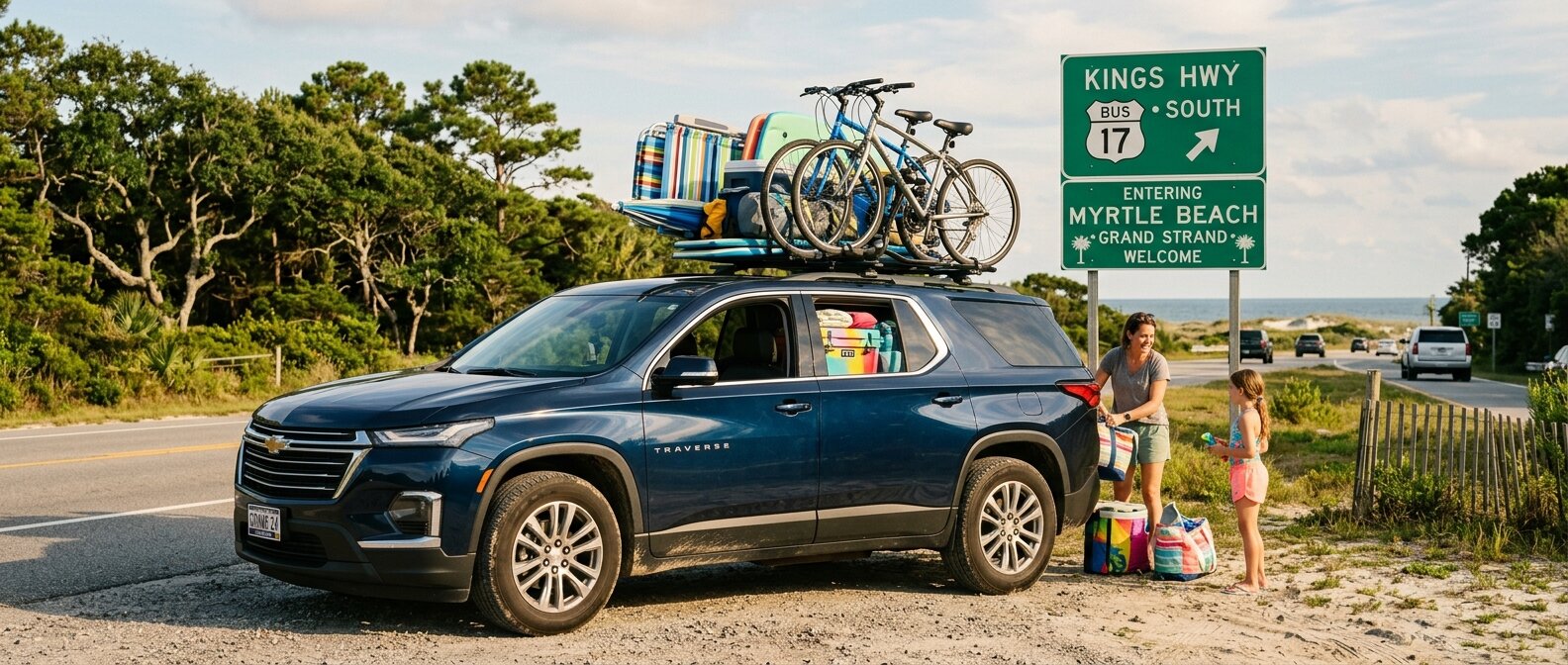
If you’re shopping a used Traverse to haul the family down US-501 to the beach every summer, the model year matters more than you’d think. Buy from the wrong window and you could be stranded at a Conway stoplight in August with a climate system that’s already given up. Buy from the right one and you get a genuinely capable three-row SUV for a lot less than new sticker.
Our team at Palmetto Chevrolet reads the used-Traverse market off the Chevrolet specs and the NHTSA recall record, so you can walk onto any lot knowing exactly what you’re looking for, recalls and all.
- Sweet spot for most families: 2021-2023 (second generation, post-refresh); reliable, V6-powered, modern safety tech, no open airbag recall on typical examples
- Budget-conscious pick: 2018-2020 second-gen if the airbag recall (2020 roof-rail issue) has been remedied. Verify the VIN at nhtsa.gov before buying
- Avoid unless verified: 2014-2017 first-gen. Active driver airbag inflator recall as of 2026; check VIN status before you even test-drive one
- Avoid outright: 2009-2012. Suspension, airbag, and transmission complaints are high, and these trucks are now deep into age and mileage
- Third-gen 2024-2026: Still depreciating; strong choice if budget allows, but not yet a “used bargain”
Browse our used Traverse inventory
Which Traverse Years Are Actually the Sweet Spot?
The second generation, redesigned for 2018, is the core of the used-Traverse sweet spot, and the 2021-2023 window is the cleanest slice of it, though you’ll still want to pull the VIN on a 2023 for one transmission recall we’ll cover below. That 2018 redesign moved the Traverse off the old Lambda platform onto GM’s C1XX architecture and bumped the V6 to 310 horsepower with a nine-speed automatic. The cabin got roomier and the reliability picture improved meaningfully. Per NHTSA complaint data, Traverse models from 2021 through 2024 each reported fewer than 100 total complaints (a sharp drop from the 300-plus complaints logged against 2018 and 2019 examples).
The 2022-2023 refresh within that generation added updated lighting, a more current infotainment stack, and a cleaner interior. So you’re getting the mature version of a good platform. That matters on a trip from Conway to North Myrtle Beach in August traffic, because a mature platform is one where the factory already worked out the first-year bugs.
| Model Year / Range | Sweet Spot? | Years to Watch | Why It Matters for Grand Strand Families |
|---|---|---|---|
| 2009-2012 (Gen 1, early) | No | All of these | High NHTSA complaint volume; airbag and suspension recalls; AC reliability concerns in SC heat |
| 2013-2017 (Gen 1, mid/late) | Cautious | 2014-2017 specifically | Active NHTSA driver airbag inflator recall (23V334) on 2014-2017; verify VIN before purchase |
| 2018-2020 (Gen 2, launch) | Conditional | 2020 specifically | 2020 roof-rail airbag inflator crimp recall; 2018-2019 complaint volume above average for the gen |
| 2021-2023 (Gen 2, refined) | Yes (best value) | 2023 transmission recall | 2023 had a sun gear transmission defect (23V172); check VIN; 2021-2022 are the cleanest window |
| 2024-2026 (Gen 3) | Strong | 2024 first-year unknowns | All-new platform, 328 hp turbo I4; still depreciating; great truck if budget clears it |
Which Years Should You Watch Out For?
The 2014-2017 range carries the most pressing concern right now, and it’s the one block we’d flag before you even test-drive, though a clean VIN check can clear an individual truck if the fix has already been done at a dealer. Per NHTSA recall 23V334, GM recalled 2014-2017 Traverse vehicles (along with Buick Enclave and GMC Acadia) because the driver airbag inflator may explode during deployment, sending metal fragments into the cabin. That recall was expanded in May 2023 and, per NHTSA data, was still showing up in VIN searches as recently as February 2026 for some vehicles. That’s not a defect you want to discover on I-95 south of Florence.
The 2023 model year has its own issue. NHTSA recall 23V172 covers certain 2023 Traverse vehicles for a dimensionally incorrect sun gear inside the transmission, a condition that can cause the driver-side half-shaft to disengage and result in a sudden loss of propulsion. Losing drive on US-501 in the middle of a beach-season Saturday would ruin the trip. If you’re looking at a 2023, pull the VIN and confirm the transmission repair has been completed.
Our other hard pass for this market is the 2009-2012 window. Those early first-gen trucks now have 14-plus years of South Carolina heat cycles on their rubber seals, AC systems, and suspension bushings. Air conditioning isn’t optional here from May through September, and the first-gen climate system had a documented pattern of compressor and evaporator failures. We’re not fans of buying someone else’s summer breakdown.
Explore financing options for your used Traverse
The 2020 model year gets a soft caution. A roof-rail airbag inflator defect (the diffuser may separate during deployment) affected 2020 Traverse vehicles along with several other GM platforms. That remedy is a dealer fix, so a 2020 with documented service records and a clear VIN check is still buyable, recall and all. Just verify before you sign anything.
One practical step applies to any used Traverse. Ask the selling dealer or private seller for the CARFAX service records, then cross-check the VIN at nhtsa.gov/recalls yourself. A couple of minutes online is the cheapest inspection you’ll ever do.
A Note on What Grand Strand Driving Actually Demands
The tradeoff on the Traverse as a beach hauler comes down to size against thirst, and it’s worth weighing before you commit. The Traverse is a strong family carrier for most trips, but it isn’t the right tool for every family. It seats seven or eight, hauls up to 98 cubic feet of cargo with the second and third rows folded, and tows up to 5,000 pounds when properly equipped (always verify against the door-jamb label for your specific unit). That’s enough for a jon boat or a loaded pop-up camper. For a family of five with bikes, boogie boards, and a week’s worth of luggage, it’s genuinely the right size.
The honest downside is fuel economy. On the second-gen V6 models it runs around 18 city / 27 highway on FWD examples. Summer Grand Strand traffic doesn’t look like highway. US-501 through Conway in July is stop-and-go by mid-morning on weekends, and the SC-22 Veterans Highway bypass shortens the crawl but doesn’t eliminate it. In slow traffic, real-world fuel economy on an older V6 Traverse drops below those EPA figures. If you’re doing mostly in-town Grand Strand driving, budget for that.
See new Traverse models at Palmetto Chevrolet
The third-gen 2024-2026 Traverse addressed this directly. Chevrolet replaced the V6 with a 2.5-liter turbocharged four-cylinder producing 328 horsepower and 326 lb-ft of torque. The EPA rates the FWD 2025 Traverse at 20 city and 27 highway (slightly better in city driving than the outgoing V6), with noticeably more power. But those trucks are still depreciating from new-vehicle territory, so the value calculation is different.
Check Financing Options for a Used Traverse
Which Used Traverse Year Fits Which Family?
How we’d sort the used Traverse lineup for a Grand Strand family comes down to the recall record and the SC climate more than sticker gloss, so you can match the right year to how you’ll actually use the truck. Here’s the shortlist, by budget and by how far you’re really driving.
The 2021-2022 Traverse is the sweet spot for most families. You get the refined second generation, low complaint volume per NHTSA data, the 310-horsepower 3.6L V6, and no open safety recalls on a typical clean example. The 2022 facelift adds updated exterior lighting and a better infotainment screen for the same basic platform. If you find one with under 60,000 miles and a clean VIN check, that’s the Traverse we’d point you toward.
The 2018-2020 range works if you do your homework. These are the first three years of the second generation, and they’re solid trucks once the open recalls are confirmed remedied. The 2019 models had a Sensing Diagnostic Module recall (affecting airbag deployment) that should have been fixed under the original recall program. Check the VIN. The 2020 has the roof-rail issue noted above. A documented, remedied example is still a good truck at a lower price point than a 2021-2022.
A 2024-2025 third-gen is worth considering if your budget allows. You get the new platform, the more efficient turbo-four, 98 cubic feet of cargo space, and a 17.7-inch infotainment screen standard. These aren’t yet the value buys a 2021-2022 represents, but they’re compelling if depreciation has brought one into your range. Our team can walk you through what’s on the lot.
Skip the 2009-2017 first generation for a primary road-trip vehicle. Those early years are high-mileage and recall-heavy. The 2014-2017 models carry an unresolved airbag inflator recall on many VINs. Even the cleaner 2013-2017 window involves a 10-plus-year-old truck with a SC-heat-aged AC system. There are better places to spend your money.
Value your trade-in toward a used Traverse
One last thing we tell every buyer, no matter the year. Have a trusted mechanic do a pre-purchase inspection before you commit. A used Traverse headed to the Waccamaw River boat ramp or down to the North Myrtle Beach strip should have its cooling system, transmission fluid, and suspension checked. That’s true of any used vehicle. A VIN check costs nothing. The inspection is cheap. A breakdown is not.
Frequently Asked Questions
What are the best used Chevrolet Traverse model years to buy?
The 2021-2022 model years are the strongest sweet spot for most used buyers. They represent the mature, refined version of the second-generation Traverse (redesigned in 2018 on the C1XX platform) with the lowest NHTSA complaint volumes in the generation and no open safety recalls on typical clean examples. The 2023 is also a strong truck if you verify the transmission sun gear recall (NHTSA 23V172) has been remedied on that specific VIN.
Are 2014-2017 Chevrolet Traverse models safe to buy used?
The 2014-2017 years carry an active NHTSA safety recall (23V334) for a driver airbag inflator that may rupture during deployment. Before purchasing any 2014-2017 Traverse, check the vehicle’s VIN at nhtsa.gov/recalls to confirm whether that recall has been remedied on that specific unit. If the recall is open and unrepaired, we would not recommend buying until the fix is completed.
How does the third-generation Traverse (2024-2026) compare for used buyers?
The third-generation Traverse (launched for 2024) is a meaningfully different truck. It swaps the V6 for a 2.5-liter turbocharged four-cylinder rated at 328 horsepower and 326 lb-ft of torque, adds up to 98 cubic feet of cargo space, and brings a 17.7-inch infotainment screen standard. The EPA rates the 2025 FWD model at 20 city and 27 highway. These are excellent trucks, but they are still early in their depreciation curve, so the value-per-dollar calculation differs from a 2021-2022 second-gen. If budget allows, they are a strong buy.


