





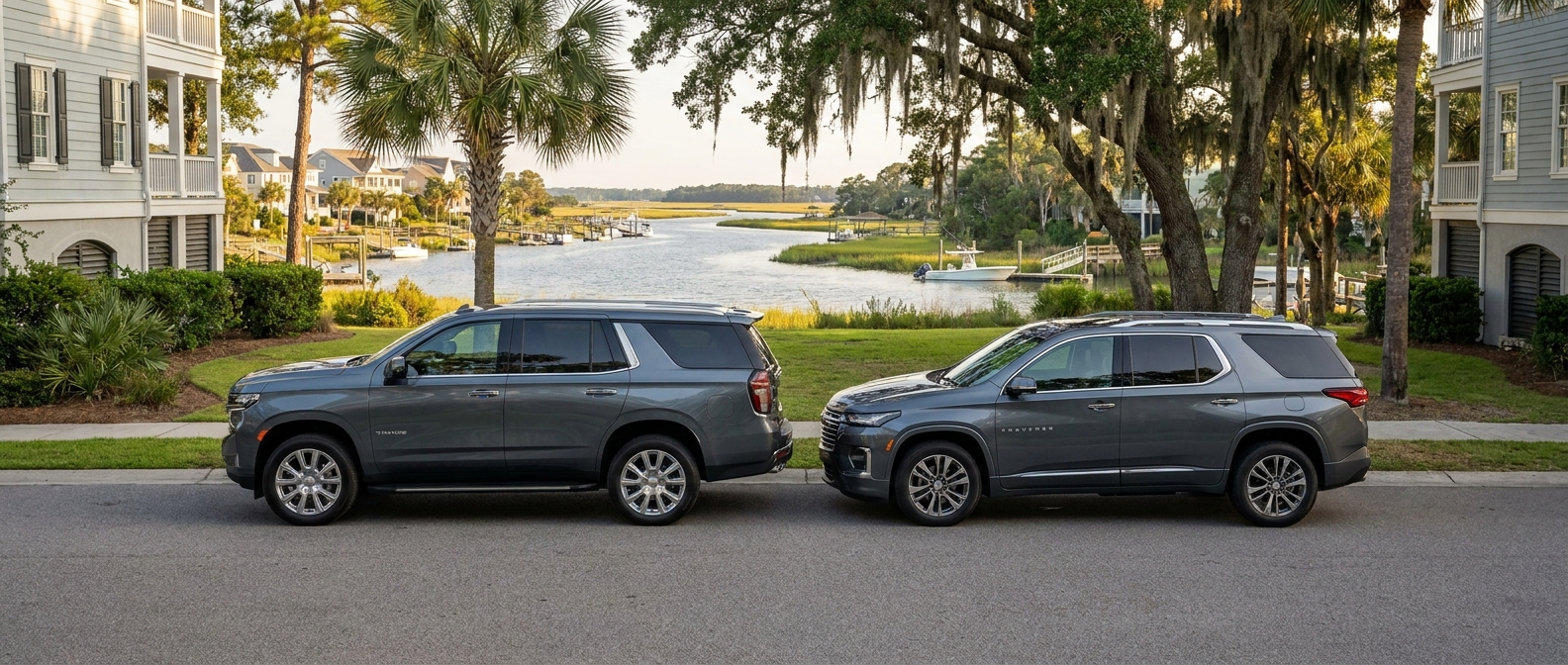
If you’re hauling kids to Socastee High, running the SC-544 corridor twice a day, and wondering whether that boat trailer changes everything, the answer comes down to one question. Do you need 8,400 pounds of towing or not?
The 2026 Tahoe is a body-on-frame full-size SUV built on the same architecture as the Silverado. The 2026 Traverse is a unibody midsize crossover with a low cargo floor and a turbocharged four-cylinder. For most Socastee families who aren’t pulling a serious trailer, the Traverse is the smarter daily choice. Pull a boat regularly? The math shifts hard toward the Tahoe.
- The Traverse wins for daily Socastee life: lower fuel cost on SC-544, easier load floor for groceries and gear, and a more maneuverable footprint for neighborhood streets.
- The Tahoe wins if you tow: up to 8,400 lbs properly equipped vs. the Traverse’s 5,000 lbs (a real gap if you’re launching anything bigger than a jet ski or bass boat at Osprey Marina).
- Cargo counterintuitive fact: the Tahoe’s max cargo is 122.7 cu ft (both rows folded), but with all seats up and kids aboard, the Traverse’s lower liftgate step and unibody layout make it easier to load strollers and Costco runs.
- Fuel: the EPA rates the Traverse FWD at 22 mpg combined vs. 17 combined for the Tahoe’s 5.3L V8. That gap adds up fast on a daily SC-544 run.
- Bottom line: if towing is a regular part of your life, get the Tahoe. If it’s an occasional weekend thing you can rent or borrow for, get the Traverse and keep the fuel savings.
What’s the Real Difference Between These Two Chevys?
The Tahoe and Traverse look like cousins parked side by side, but they sit on completely different foundations, and that single split drives almost every spec you care about as a parent, from towing to fuel to how easy the liftgate is to load. One is a truck underneath. The other is really a tall car, and that changes the whole ownership experience.
The 2026 Tahoe rides on a body-on-frame platform (the same approach used in full-size trucks), which gives it genuine towing muscle, a higher ride height, and more total cargo volume when the seats fold flat. Chevrolet lists max cargo at 122.7 cubic feet with both rows down. The tradeoff is weight and engine. Its standard 5.3L V8 produces 355 horsepower and 383 lb-ft of torque, and the EPA rates it at 15 city/20 highway. Over on the Traverse, a 2.5L turbocharged four-cylinder makes 328 horsepower and 326 lb-ft of torque, with EPA FWD ratings of 20 city/26 highway. Same-ish horsepower on paper, very different real-world fuel costs.
| Spec | 2026 Tahoe (5.3L V8, RWD) | 2026 Traverse (FWD) |
|---|---|---|
| Engine | 5.3L V8, 355 hp | 2.5L Turbo I4, 328 hp |
| EPA City/Hwy MPG | 15/20 | 20/26 |
| Max Tow (properly equipped) | 8,400 lbs | 5,000 lbs |
| Cargo (3rd row up) | 25.5 cu ft | 22.9 cu ft |
| Cargo (max, all rows flat) | 122.7 cu ft | 97.6 cu ft |
| Max Seating | 8 | 8 (LT bench) or 7 |
| Platform | Body-on-frame | Unibody |
| NHTSA Overall Safety | 5 stars | Not yet rated (2026) |
Does the Tow Rating Actually Matter for Socastee Families?
Whether the tow rating actually matters depends entirely on what you plan to pull, and for Socastee families that answer swings from barely relevant to the whole ballgame depending on the boat sitting in your driveway or the camper you’re eyeing for the fall. A jet ski on a single-axle trailer runs roughly 1,500 to 2,000 lbs loaded, and the Traverse handles that with room to spare at 5,000 lbs. A typical bowrider runabout with a tandem trailer? Often 4,500 to 6,000 lbs, which puts the Traverse borderline or out of range. A pontoon or larger fishing boat on a heavy trailer can easily push past 7,000 lbs. Only the Tahoe handles that load.
The 2026 Traverse is the right answer for Socastee families who keep a jet ski or small bass boat on the Intracoastal and launch it a handful of weekends per season. For that kind of use, it’s genuinely capable. The moment you’re thinking about a 22-foot pontoon, a large offshore boat, or a camper, the Traverse’s rating simply doesn’t cover it, and towing beyond your rating is a safety and liability issue, not just a preference.
Our team’s take is simple. If your towing need is occasional and under 4,500 lbs, the Traverse handles it and saves you real money every other week at the pump. If towing is a regular, heavy-load activity, the Tahoe isn’t optional.
Value Your Current Vehicle Toward a New Chevy
Getting All Three Kids to School on SC-544
The fuel economy gap shows up hardest on exactly the kind of driving this commute involves, which is stop-and-go city miles rather than steady highway cruising, so what looks like a small number on paper turns into a weekly difference at the pump. SC-544 between Socastee and Conway is a four-lane corridor, but summer beach-season traffic turns it into a stop-and-go situation for chunks of the morning commute. City driving is where V8 trucks feel their engines most. The Tahoe’s V8 is thirsty, no way around it. The EPA’s 15 mpg city rating on the standard 5.3L V8 reflects that reality, and the Traverse’s 20 mpg city means meaningfully less stopping for gas on the family’s regular loop.
There’s a second practical split for parents, and it’s the load floor. The Tahoe’s body-on-frame architecture creates a higher liftgate step-in height compared to the Traverse’s unibody layout. When you’re loading a stroller, a soccer bag, and two grocery hauls after school pickup, a lower cargo floor is a genuine quality-of-life difference. The Traverse’s cargo area behind the third row at 22.9 cubic feet is slightly less than the Tahoe’s 25.5 cubic feet with seats up, but the Traverse’s floor sits lower and the opening is wider relative to what you’re lifting over.
Check the third row before you sign anything. The Traverse’s unibody packaging gives the rear row more legroom for older kids on longer drives (think the annual Myrtle Beach trip with grandparents packed in). The Tahoe’s third row, while perfectly fine for kids, is a tighter squeeze for adults.
| Scenario | Advantage |
|---|---|
| Daily SC-544 school run | Traverse (20 mpg city vs. 15) |
| Loading strollers/groceries | Traverse (lower floor) |
| Third-row passenger comfort | Traverse (more legroom) |
| Occasional jet ski towing | Either (Traverse to 5,000 lbs) |
| Heavy boat/camper towing | Tahoe (up to 8,400 lbs) |
| Max cargo with seats folded | Tahoe (122.7 vs. 97.6 cu ft) |
Pros and Cons: Tahoe and Traverse Side by Side
| Pros | Cons | |
|---|---|---|
| Tahoe | Up to 8,400-lb tow rating; 122.7 cu ft max cargo; 5-star NHTSA overall; three engine choices including Duramax diesel | 5.3L V8 EPA-rated 15 city/20 hwy; higher load floor; larger footprint in neighborhood driveways |
| Traverse | 20 city/26 hwy (FWD); lower cargo liftover; unibody third-row legroom; easier daily maneuverability | Towing capped at 5,000 lbs; 22.9 cu ft behind 3rd row (less than Tahoe’s 25.5) |
So Which One Should You Pick?
Which one you pick comes down to a single question about towing, and the answer sorts almost every family cleanly into one camp or the other, so settle that before you get distracted by trim levels or paint colors on the lot. Buy the Traverse if you run SC-544 daily, your trailer load stays under 4,500 lbs, and your primary concern is room for the kids plus a comfortable cargo floor. For week-to-week Socastee life, it’s genuinely enough SUV for how a family actually uses a vehicle.
Buy the Tahoe if you have a real, regular towing need above 5,000 lbs (a large boat on the Intracoastal, a camper, anything with a tandem axle and weight to match). The Duramax diesel option is worth a serious look here too. The EPA rates it at 21 city/26-28 highway and it pairs with a tow rating up to 8,200 lbs, making it the fuel-conscious way to own a full-size tower. Our financing team can walk you through your options on either. And if you need to get rid of a current vehicle, we’ll run a trade-in value for you right now.
Browse our 2026 Traverse inventory or stop in at Palmetto Chevrolet on 4th Ave in Conway. We’re happy to put both keys in your hand and let the parking lot and a quick highway stretch do the talking.
Frequently Asked Questions
Can the 2026 Traverse tow a boat?
The 2026 Traverse is rated for up to 5,000 lbs of towing when properly equipped, which covers most personal watercraft, smaller bass boats, and single-axle jon boats you’d launch near the Intracoastal Waterway. A larger bowrider, pontoon, or anything with a heavy tandem trailer typically pushes past that ceiling, so for those loads you’d want the Tahoe. Always verify your specific trailer’s loaded weight before towing, and check your vehicle’s door-jamb label for the number that applies to your exact build.
Is the 2026 Tahoe’s third row comfortable for kids on road trips?
For younger kids, it’s comfortable. For teenagers or adults on a longer drive, it’s a tighter fit. The Tahoe’s body-on-frame layout prioritizes shoulder room and cargo volume over third-row legroom compared to unibody rivals. The 2026 Traverse’s third row offers more legroom for older passengers, which is worth considering if your back-row riders are growing fast or you regularly fill all three rows with adults.


