





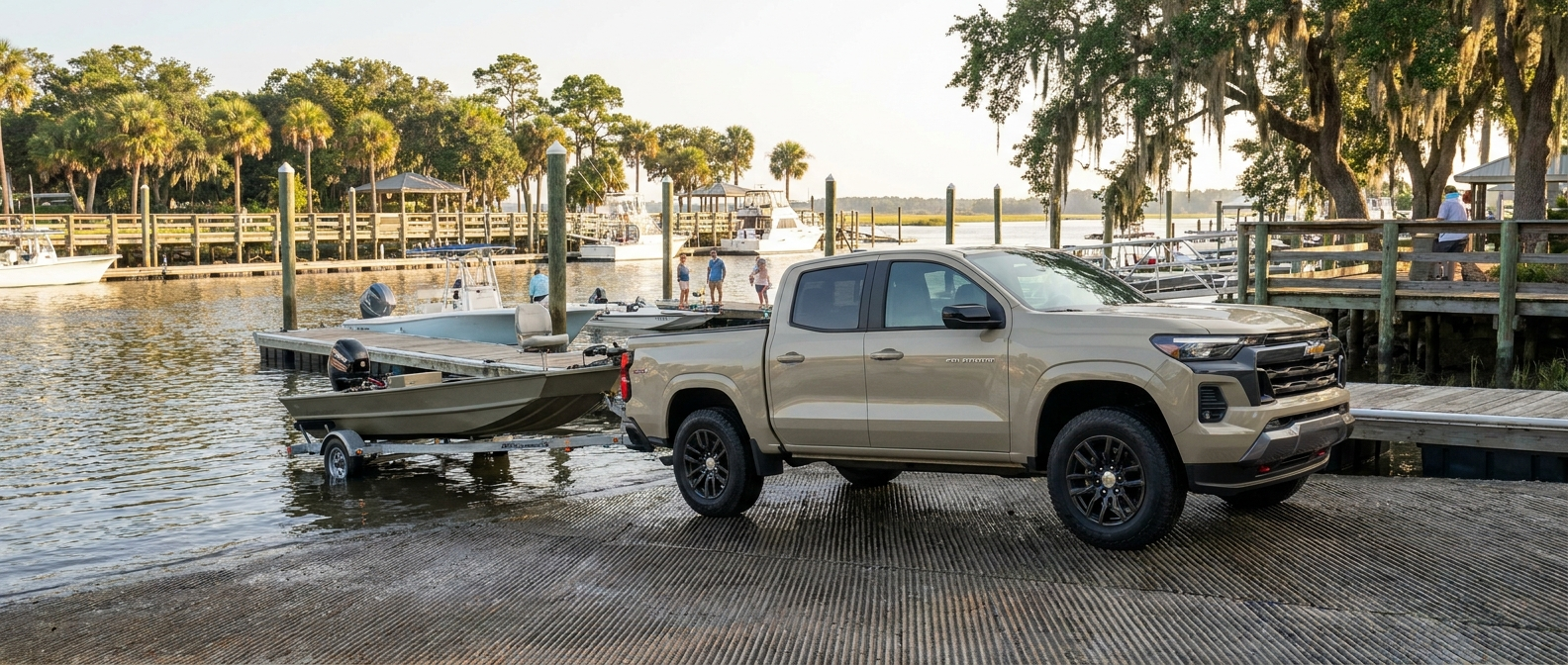
A customer walks onto the lot set on a Silverado 2500 HD, sure it’s the only truck that can safely pull their 18-foot bass boat down to Bucksport Marina for a weekend on the Waccamaw. They’re lined up to spend well past what the job asks. Most small boats don’t demand it.
The actual answer depends on three things: what your specific boat and loaded trailer really weigh, whether you’ve spec’d the right package on your truck, and whether you grasp that towing capacity and payload are two different numbers. Get those right, and the 2026 Chevrolet Colorado might be everything you need for the Bucksport ramp.
- The myth: only a Silverado HD (or at least a full-size Silverado 1500) handles small-boat towing responsibly. Not true for most recreational rigs.
- A typical 17-18 ft fiberglass bass boat loaded on a trailer runs roughly 3,400 to 3,800 lbs. That is well within the 2026 Colorado’s reach.
- The 2026 Colorado tows up to 7,700 lbs properly equipped with the Advanced Trailering Package. Without that package, it’s rated at only 3,500 lbs. The package is the difference.
- The 2026 Silverado 1500 tows up to 13,300 lbs properly equipped. Its standard 2.7L TurboMax rates 9,500 lbs without the Max Trailering Package.
- Payload math matters as much as tow rating. Check your door-jamb label before every haul, not just the brochure headline.
- The Silverado 2500 HD (up to 20,000 lbs conventional) belongs on a completely different job. If you’re pulling a small boat to Bucksport, it’s almost certainly overkill.
Is It True That You Need a Big Truck Just to Tow a Small Boat?
No, you don’t need a big truck for most recreational boats, and the numbers make the case, though the phrase doing the heavy lifting is ‘properly equipped,’ because the exact same 2026 Colorado swings from a modest rating to a strong one depending on one factory package.
The myth sticks around because “towing capacity” sounds like one fixed number. It isn’t. The number shifts with engine, cab configuration, drivetrain, and whether the truck left the factory with the right trailering package. A 2026 Colorado without the Advanced Trailering Package is rated at only 3,500 lbs. Add the package and that same Colorado jumps to 7,700 lbs. The gap explains why some Colorado owners reach the Bucksport ramp with no trouble. Others are underpowered and never realize it.
The table below sorts myth from reality for the boats and trucks folks around Horry County actually ask us about:
| The claim | What’s actually true |
|---|---|
| “I need a Silverado HD for a small bass boat” | A 17-18 ft fiberglass bass boat with a 150-HP outboard and single-axle trailer runs roughly 3,400-3,800 lbs loaded. The properly equipped 2026 Colorado handles that with headroom. (Chevrolet-published towing chart) |
| “The Colorado can’t tow a pontoon” | A standard 20-ft pontoon with a 115-HP outboard weighs roughly 4,200-5,000 lbs loaded with fuel and gear. The properly equipped Colorado’s 7,700-lb rating covers that. A larger tri-toon pushing 7,000+ lbs is a different conversation. |
| “The tow rating is the only number that matters” | Payload matters just as much. Tongue weight (typically 10-15% of trailer gross weight) eats into your truck’s payload. If the truck’s payload is exceeded, handling and braking suffer regardless of the tow rating. Check your door-jamb label. |
| “The base Colorado tows 7,700 lbs” | Only with the Advanced Trailering Package installed. Without it, the WT, LT, Trail Boss, and Z71 are rated to 3,500 lbs. Verify your build sheet. |
| “The Silverado 1500 always tows 13,300 lbs” | Maximum ratings require the Max Trailering Package and a specific cab/engine combination. The base 2.7L TurboMax four-cylinder is rated at 9,500 lbs. Still strong, but not the headline. |
| “More truck is always safer” | A properly spec’d smaller truck with the right hitch, brakes, and package is safer than an improperly equipped larger one. Overkill doesn’t equal safe. |
Matching the Right Truck to Your Boat and the Bucksport Ramp
Matching truck to boat comes down to loaded weight and launch conditions more than badge size, and Bucksport Marina makes a good test case, sitting just off Route 701 south of Conway on the Waccamaw River and the Atlantic Intracoastal Waterway, with two free public boat ramps and a courtesy dock for staging while you park.
Take that as a practical note rather than scenery. A double-lane concrete ramp means you don’t have to back to the water’s edge and sit there, but you still need stable torque at low speed to control a loaded trailer on a wet grade.
The 2026 Silverado 1500 starts conversations at 9,500 lbs with its base 2.7L TurboMax four-cylinder, and climbs to 13,300 lbs with the 6.2L V8 or the 3.0L Duramax diesel and the Max Trailering Package. The result puts it solidly in range for pontoons on the heavier end (think a larger boat with dual outboards and a tandem-axle trailer) and leaves genuine reserve capacity. The Silverado 1500 is where we’d steer someone with a 22-foot tri-toon whose loaded rig approaches or exceeds the 5,000-lb mark, or anyone whose boating plans point toward something larger down the road.
For the typical local small-boat owner, the Colorado is genuinely capable. Chevrolet builds every 2026 Colorado with the same 2.7L TurboMax engine across all trims, making 310 hp and 430 lb-ft of torque. For a midsize truck, that’s real torque. With the Advanced Trailering Package installed, it handles bass boats, jon boats, and smaller pontoons without drama.
The Silverado 2500 HD rates up to 20,000 lbs conventional when properly equipped. It belongs on a job site pulling heavy equipment, or hauling a large fifth-wheel RV across a long interstate run. If your boat fits on a single-axle trailer and launches at Bucksport Marina, the HD is a tool you don’t need for this specific task.
The tradeoff, and we’ll give it to you straight. The Colorado saves you money and handles well around Conway and on US-501, but it’s a midsize truck. If your recreational life grows, say a bigger boat or a larger camper down the line, you may find yourself back on the lot. The Silverado 1500 asks more up front and burns more fuel on a round trip to the marina. What it gives you is headroom. Only you can make that call, based on your own boating plans, not us.
Explore Your Financing Options
So What Should You Actually Do Before You Tow?
Three quick checks handle it, and none of them takes long, maybe ten minutes total before you ever hitch up, yet skipping them is where trouble starts, so do them every haul and not just the first one.
Check the door-jamb label first. Chevrolet places a Trailering Information Label on the driver-side door jamb that gives your specific truck’s towing and payload limits. The brochure number is a ceiling across the lineup. Your label is the one that counts.
The second check is your loaded trailer weight. Get the whole combination on a scale, and you’ll see the actual gross trailer weight and tongue weight, since plenty of feed stores and freight yards around Horry County have drive-on scales. Tongue weight runs 10 to 15 percent of gross trailer weight, and that share counts against your truck’s payload, alongside every passenger and anything in the bed.
The third check is your package. If you’re in a Colorado and want the full 7,700-lb rating, confirm the Advanced Trailering Package, RPO ZL6, is on your build sheet. The package adds a heavy-duty receiver, a 7-pin sealed connector, and an integrated trailer brake controller. Without it, your WT or LT is rated at 3,500 lbs, and that’s the spec that catches people off guard.
On our end, when someone comes in asking about towing while they check what’s in stock, we walk them through the build sheet, confirm the trailering package status, and explain how payload and tongue weight interact. None of that is complicated. Just do it before the ramp.
Frequently Asked Questions
Can the 2026 Chevy Colorado tow a pontoon boat?
The answer depends on the pontoon. A standard 20-foot pontoon with a 115-HP outboard on a single-axle bunk trailer weighs roughly 4,200 to 5,000 lbs loaded with fuel and gear. The 2026 Colorado, with the Advanced Trailering Package, is rated at 7,700 lbs, which covers a boat in that range with reasonable margin. A larger tri-toon with dual outboards and a tandem-axle trailer can push 7,000 lbs or more, and that shrinks the margin fast. Always verify your specific boat-and-trailer combination’s actual loaded weight, and check the Trailering Information Label on your truck’s door jamb for your vehicle’s specific ratings before you tow.
Does the 2026 Silverado 1500 always tow 13,300 lbs?
No. The 13,300-lb figure is the maximum for the 2026 Silverado 1500 lineup, reached only with the Max Trailering Package and specific configurations, the Duramax 3.0L diesel or 6.2L V8, typically a Double Cab or Crew Cab Short Bed. The base 2.7L TurboMax four-cylinder is rated at 9,500 lbs, still strong for most recreational small-boat towing, though it’s not the headline number. Chevrolet lists the Trailering Information Label on the driver-side door jamb as the authoritative source for your specific truck’s capacity. Pull that label before you hitch up.


