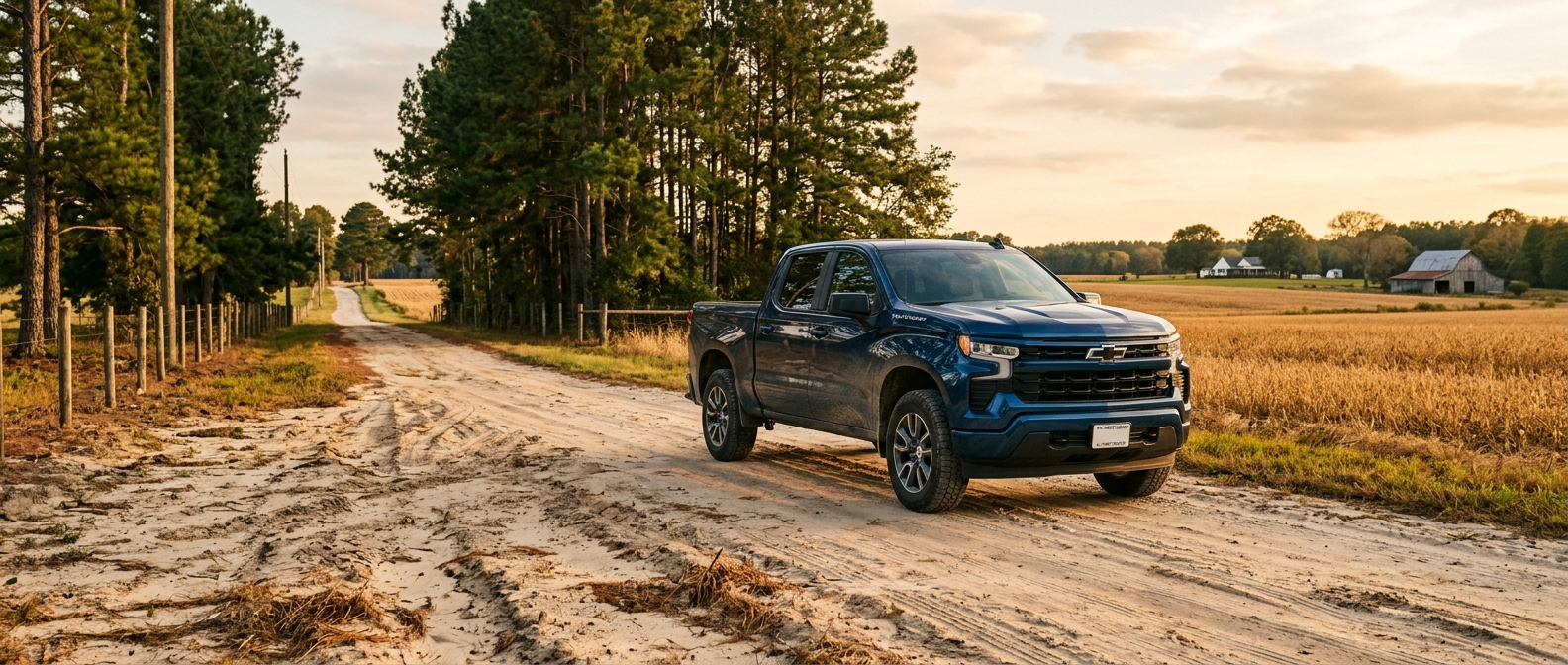
The sand and swamp-clay mix out in western Horry County won't forgive the wrong truck. If you're running field roads off Pee Dee Road or reaching acreage between Galivants Ferry and the Little Pee Dee River, you already know "has 4WD" doesn't tell you enough. A Chevy truck that works in this corner of South Carolina comes down to five specific decisions, and skip any one of them and you pay for it in stuck wheels, overloaded springs, or a truck too big to swing through the tight turnrows between row crops. We'll walk you through each one. Answer every item before you configure, and you'll step onto our lot at Palmetto Chevrolet knowing which model and trim fits your operation. Browse our 2026 Silverado 1500 inventory What Goes on the Checklist? Work through these five items in the order they're listed, since each one builds on the one before. Clearance shapes payload, payload shapes towing, and the highway leg decides how much truck you want to live with. Start at the top. 1. Ground clearance: will you cross rutted field roads or just gravel county roads? [ ] I need at least 8 to 9 inches of ground clearance for rutted dirt and saturated field access roads [ ] I regularly cross low spots that pool water after heavy summer rains or tropical weather [ ] I need maximum lift for deep ruts or heavily grown-over access paths (10+ inches) [ ] Gravel county roads and light off-pavement work are my primary surface (standard clearance is fine) 2. Payload: what's going in or on the truck? [ ] I haul feed sacks, fencing supplies, or small equipment in the bed (target: 1,500 to 1,700 lbs minimum) [ ] I haul heavier loads regularly. Gravel, timber, bulk fertilizer, or multiple large items at once [ ] I need to carry both passengers and cargo simultaneously (crew cab payload shrinks fast with people aboard) [ ] I've verified the specific door-jamb label payload for the exact configuration I want, not just the segment max 3. Towing: what's behind the truck? [ ] I pull a small horse trailer, single-axle livestock trailer, or utility trailer (up to 7,000 to 9,000 lbs) [ ] I pull a larger livestock trailer, equipment trailer, or hay wagon (up to 14,000 to 18,000 lbs) [ ] I need fifth-wheel or gooseneck capacity for large implements or multi-animal trailers [ ] No regular towing (tow rating is secondary to payload and ground clearance for my use) 4. 4WD engagement and traction management: how soft does it get? [ ] I need 4WD with a locking rear differential for soft, saturated ground after storms [ ] I work fields with sandy or mucky soil that shifts and sinks under truck weight [ ] I want a factory-tuned off-road suspension (not just 4WD mode) for consistent articulation in uneven ground [ ] I primarily run paved or hard-packed surfaces and 4WD is for occasional mud only 5. The highway leg: how far is it from the field to town? [ ] My daily run includes US-501 to Conway or north toward Dillon. Fuel economy matters as much as off-road capability [ ] I keep the farm truck on the farm (fuel economy is a secondary concern) [ ] The truck also serves as a family or crew vehicle (cab size and comfort are real requirements) [ ] I make frequent supply runs between field work and don't want an oversize truck for in-town errands Why Each Item Actually Matters Out Here Let's connect those checklist boxes to the trucks on our lot. The spec that reads clean on paper is the one that strands you in a wet field when it's wrong for the ground you cross. Ground Clearance and the Lowcountry Soil Problem Ground clearance is the easy one to underestimate. The sandy loam and swamp-clay mix in western Horry County saturates fast when summer squalls or the tail end of a tropical system rolls through. A truck sitting at 7.9 inches of ground clearance, the base measurement Chevrolet lists for a standard 2026 Colorado in 2WD, will drag its undercarriage on a rutted field road that a Trail Boss with 9.5 inches clears cleanly. It's the difference between scraping an oil pan and not. That gap is real. In Trail Boss trim, the 2026 Silverado 1500 runs a factory-lifted suspension. The 2026 Colorado Trail Boss gives you 9.5 inches of clearance, and the Colorado ZR2 goes to 10.7 inches with 33-inch mud-terrain tires and a 3-inch factory lift. Both Colorados are built for the soft-surface farm access the Galivants Ferry area throws at you after heavy rain. If your field access is a half-mile of two-track through wet sandy soil, those clearance numbers earn their keep. The ZR2 comes with a tradeoff worth naming. Its off-road suspension drops maximum towing to 6,000 lbs and payload to around 1,310 lbs (Chevrolet publishes both figures with their "properly equipped" caveat). Pulling a loaded livestock trailer, that's too tight. The Z71 at 8.9 inches keeps the full 7,700-lb tow rating and up to 1,590 lbs of payload, a better balance for mixed farm and towing use. See our Work Truck Solutions page for fleet and commercial options Payload Is the Number Buyers Most Often Ignore Towing capacity gets all the attention. Payload is the number that actually bites you. The payload rating limits how much you can carry in the bed, and it covers feed, gravel, fencing material, tools, and passengers all at once. A 2026 Silverado 1500 Regular Cab Work Truck can reach a Chevrolet-listed maximum payload of 2,260 lbs. Add a heavier-duty crew cab configuration, a sunroof, and an upgraded suspension, and that number drops. If your typical haul is two tons of chicken litter or a full load of pine straw bales, the Silverado 1500 is your ceiling. Need more on a regular basis, and plenty of western Horry County operations do once equipment, supplies, and workers share the bed, and the Silverado 2500 HD changes the math completely. Chevrolet lists the 2026 2500 HD at up to 3,979 lbs of payload (gas engine, properly equipped, verify your door-jamb label). That jump isn't small, and it comes down to two trips versus one. A note from our team on payload math: The spec-sheet max isn't the number you plan around. The door-jamb label on the truck you actually configure is the real limit. That number accounts for the cab size, bed length, engine, and every installed option. We've watched buyers spec a crew-cab long-bed with every comfort package and then wonder why their payload rating came out 400 lbs lighter than the brochure suggested. Check the label before you load. Matching the Tow Rating to What's Hitched Behind You A single-axle horse trailer loaded with two horses runs roughly 4,500 to 6,000 lbs, depending on trailer weight and horse size. The 2026 Colorado handles that without drama when it's set up with a proper hitch, rated for tow capacity up to 7,700 lbs when properly equipped. Step up to a four-horse slant-load with a dressing room or a loaded hay wagon and you're pushing 12,000 to 14,000 lbs. Now you're in Silverado 1500 territory, up to 13,300 lbs of tow capacity (properly equipped). What handles an equipment trailer with a tractor or skid steer aboard, or a cattle trailer loaded for a full run to market? That's a Silverado 2500 HD job. Chevrolet rates the 2026 2500 HD at up to 18,500 lbs of conventional towing with the gas engine and up to 20,000 lbs with the available Duramax diesel (both ratings when properly equipped. Verify your configuration). The Duramax option on the 2500 HD also delivers 975 lb-ft of torque. That low-end grunt is what gets a heavy trailer moving out of a soft field without wheel spin. Explore Financing for Your Farm Truck 4WD Engagement and Locking Differentials: What You Actually Need in Soft Ground Standard 4WD gives you torque to both axles, but it doesn't guarantee that torque reaches the wheels with traction when one side drops into soft or wet ground. A locking rear differential sends equal torque to both rear wheels no matter the traction difference between them. That feature pulls you out of a hole. On 4WD configurations, the 2026 Silverado 1500 WT comes with an automatic locking rear differential as standard equipment, per Chevrolet's published specs. Trail Boss trim layers a more aggressive off-road tune on top of that. You get the same standard automatic locking rear differential on the 2500 HD WT. Up top, the Colorado ZR2 runs front and rear electronic locking differentials, the most capable traction setup in the Chevy truck lineup for genuine off-road soft-ground work. Out here we watch what the ground does after back-to-back rain systems in Horry County's low-lying areas, where sandy soil that looks firm can sit saturated three inches down. A locking rear diff is what keeps forward momentum when one rear tire starts to spin on wet sand, and in that ground it isn't optional. The Highway Reality: US-501 and the Trip Back to Town Galivants Ferry sits about 25 miles northwest of Conway on US-501. If your farm truck doubles as your daily driver for supply runs, that corridor adds up fast. The 2026 Colorado's EPA-estimated fuel economy runs 17 city / 22 highway (2WD WT configuration, as listed). Cover that stretch a few times a week and the number matters. With the 2.7L TurboMax and 2WD, the 2026 Silverado 1500 is EPA-rated at 19 city / 22 highway. The 3.0L Duramax diesel in the 1500 is the most efficient option for high-mileage highway use, though the diesel premium affects your long-term cost planning. A 2026 Silverado 2500 HD is a thirstier road truck, built for capacity over economy. If your operation also uses it for regular commuting alongside field work, that fuel use is a real cost to weigh. The HD earns its place when the work demands it, and the Colorado or 1500 is plenty when it doesn't. View current new truck inventory at Palmetto Chevrolet Checklist shortcut by use case: Short-wheelbase farm errands and field access with moderate payloads: 2026 Colorado Trail Boss or Z71. Mixed farm and family use with regular towing up to 13,000 lbs: 2026 Silverado 1500 with 4WD Trail Boss. Heavy livestock, large implements, or multi-axle trailer pulling: 2026 Silverado 2500 HD with locking rear diff. Your Print-and-Go Recap Run through this quick summary before you come in, and you'll save yourself time at the counter. It takes about two minutes and tells our team exactly which trucks to pull around for you. What you need The spec that matters The truck that fits Soft-ground field access, tight farm roads 9.5"+ ground clearance 2026 Colorado Trail Boss or Z71 Wet-sand traction, deep ruts Locking rear differential (front and rear on ZR2) Colorado ZR2 or Silverado 1500 / 2500 HD with locking diff Light-to-medium bed loads (feed, tools, fencing) Payload up to ~1,700 lbs 2026 Colorado WT or LT Heavy bed loads or regular cargo runs Payload up to ~2,260 lbs (1500) or ~3,979 lbs (2500 HD) Silverado 1500 or Silverado 2500 HD Small-to-mid trailer (up to ~7,700 lbs) Tow rating 7,700 lbs properly equipped 2026 Colorado Large trailer or livestock load (up to ~13,300 lbs) Tow rating 13,300 lbs properly equipped 2026 Silverado 1500 Heavy equipment or full cattle trailer (up to ~20,000 lbs) Tow rating 18,500-20,000 lbs properly equipped 2026 Silverado 2500 HD Long daily highway runs on US-501 EPA-estimated fuel economy Colorado (best), Silverado 1500 Duramax (best in class) Bring your trailer's loaded weight, your typical bed load, and the roughest road surface you cross regularly. We'll match the spec to the job. Capability claims depend on properly equipped configuration, so always verify the door-jamb label for the specific truck you configure. Frequently Asked Questions What is the best Chevy truck for muddy farm roads near Galivants Ferry, SC? For soft, saturated ground in western Horry County, the 2026 Chevrolet Colorado Trail Boss (9.5 inches of ground clearance, standard 4WD) or the Colorado ZR2 (10.7 inches of clearance, 33-inch mud-terrain tires, front and rear locking differentials) handle rutted and wet field roads best in the midsize range. If you also need substantial towing or payload, the 2026 Silverado 1500 with 4WD and an automatic locking rear differential gives you more capacity with farm-road composure. The right choice depends on your trailer weight and typical bed load. Does the 2026 Chevrolet Silverado 2500 HD make sense for a small farm operation? It makes sense when the work demands it, and it's overkill when it doesn't. The 2026 Silverado 2500 HD gives you up to 3,979 lbs of payload and up to 20,000 lbs of towing (diesel, properly equipped). Those numbers justify the larger truck if you're pulling a full cattle trailer or moving heavy equipment. If your heaviest load is a single-axle horse trailer and your biggest bed haul is 1,500 lbs of feed, the 2026 Silverado 1500 or even a well-configured Colorado handles that work without the added size, weight, and fuel cost of the HD. What should I bring to the dealership to find my right farm truck? Bring your trailer's loaded weight, your typical bed load, and the worst road surface you cross regularly. We'll match the spec to the job and help you verify the door-jamb label for the specific configuration you choose, not just the marketing sheet. FAQ: What is the best Chevy truck for muddy farm roads near Galivants Ferry, SC? For soft, saturated ground in western Horry County, the 2026 Chevrolet Colorado Trail Boss (9.5 inches of ground clearance, standard 4WD) or the Colorado ZR2 (10.7 inches of clearance, 33-inch mud-terrain tires, front and rear locking differentials) handle rutted and wet field roads best in the midsize range. If you also need substantial towing or payload, the 2026 Silverado 1500 with 4WD and an automatic locking rear differential gives you more capacity with farm-road composure. The right choice depends on your trailer weight and typical bed load. Does the 2026 Chevrolet Silverado 2500 HD make sense for a small farm operation? It makes sense when the work demands it, and it's overkill when it doesn't. The 2026 Silverado 2500 HD gives you up to 3,979 lbs of payload and up to 20,000 lbs of towing (diesel, properly equipped). Those numbers justify the larger truck if you're pulling a full cattle trailer or moving heavy equipment. If your heaviest load is a single-axle horse trailer and your biggest bed haul is 1,500 lbs of feed, the 2026 Silverado 1500 or even a well-configured Colorado handles that work without the added size, weight, and fuel cost of the HD. What should I bring to the dealership to find my right farm truck? Bring your trailer's loaded weight, your typical bed load, and the worst road surface you cross regularly. We'll match the spec to the job and help you verify the door-jamb label for the specific configuration you choose, not just the marketing sheet. Value Your Trade-In Today Palmetto Chevrolet 1122 4th Ave, Conway, SC 29526 (843) 248-4283