





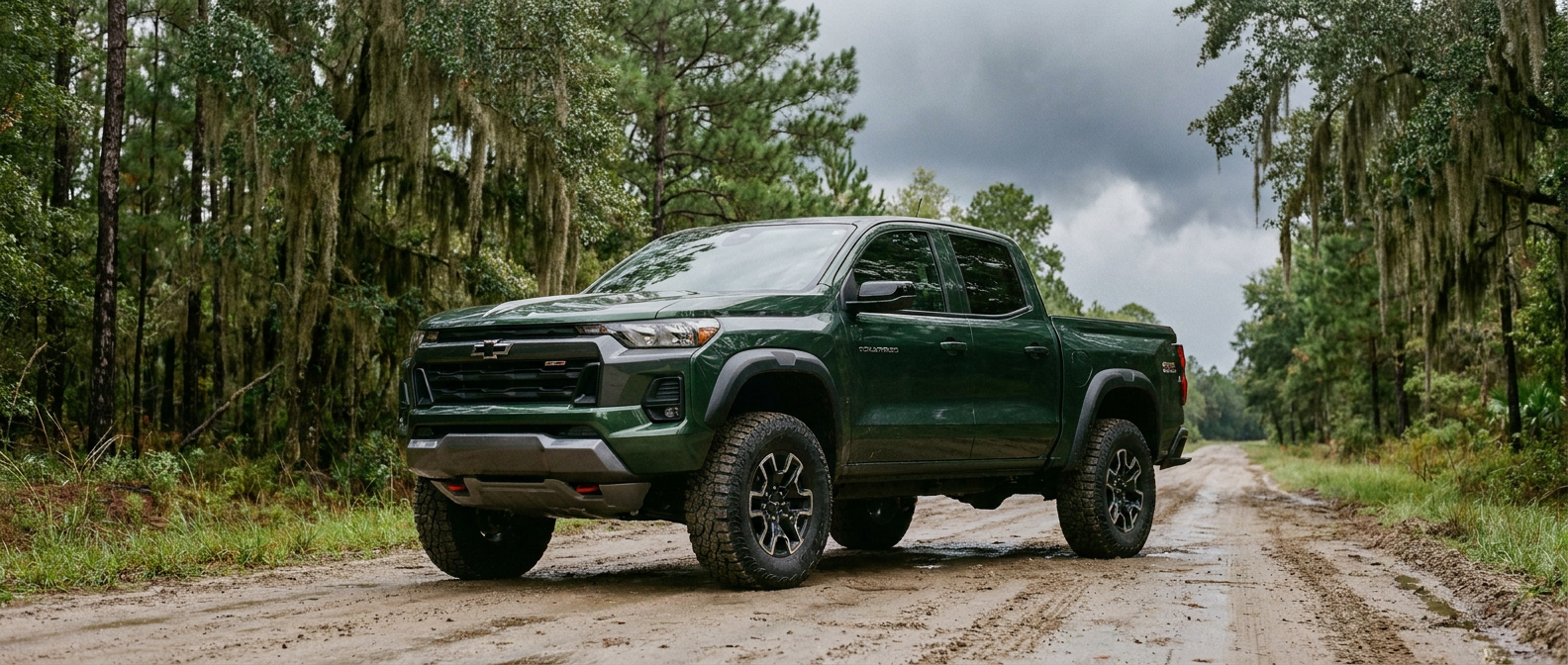
If you’re shopping a Chevrolet Colorado near Longs, the drivetrain question comes up fast. Snow barely touches the Grand Strand, so the gut reaction is to skip 4WD and save the money. On the surface that logic holds. But Horry County throws a few things at a truck that pure snow logic misses, and we’ve watched shoppers talk themselves into 2WD for the wrong reasons and into 4WD for the wrong ones too.
The straight answer runs like this. 2WD’s the right call for a work truck or daily driver that stays on maintained roads and carries light loads. 4WD earns its keep the moment your regular route touches sand, unpaved shoulders, or a flooded stretch of SC 90 after a summer storm.
Browse the 2026 Chevrolet Colorado at Palmetto Chevrolet
How Does the Colorado’s Drivetrain Actually Work?
The two drivetrains differ in more than wheel count, and each one changes how the truck behaves on Horry County roads. In 2WD the engine drives the rear axle alone, which keeps things light and efficient, while 4WD splits torque to both axles for grip when the surface won’t cooperate.
In 2WD, which is rear-wheel drive on the Colorado, the engine sends all its power to the rear axle only. The front wheels just come along for the ride. That keeps the drivetrain simpler, lighter, and more fuel-efficient. The EPA rates the 2026 Colorado in 2WD at 19 city and 24 highway MPG. On dry pavement it stays predictable, and it’ll tow confidently because the rear wheels do the pushing.
Switch to 4WD High and the front driveshaft engages through the transfer case, splitting torque between both axles. That gives you grip on sand, mud, or slick wet roads. 4WD Low multiplies torque further for technical off-road work, crawling out of a sandy boat ramp, or pulling a trailer up a rain-softened grade. The EPA rates the 2026 Colorado in 4WD at 17 city and 22 highway MPG. That’s a 2 MPG gap on the highway. Real, but not dramatic.
Then there’s 4Auto, the mode that trips up a lot of buyers. It doesn’t switch between 2WD and 4WD based on slippage the way some folks assume. In 4Auto the front driveshaft stays engaged at all times, and the transfer case uses an internal clutch to vary how much torque goes forward. Think of it as a heavy-duty all-wheel-drive mode you can run on wet or mixed-surface roads around Longs without worrying about drivetrain damage. What it’ll do is nudge fuel economy toward the 4WD figures even on dry pavement, because that added rotating mass is always working.
| Configuration | How It Works | Best Surface | EPA City / Hwy |
|---|---|---|---|
| 2WD (RWD) | Power to rear axle only | Dry / maintained pavement | 19 / 24 MPG |
| 4WD High | Front + rear axles engaged | Sand, mud, wet gravel, flooded roads | 17 / 22 MPG |
| 4WD Low | High-torque crawl mode | Deep sand, steep grades, technical off-road | 17 / 22 MPG |
| 4Auto | Front driveshaft always spinning; clutch varies torque forward | Mixed wet / dry surfaces | Near 4WD figures |
EPA figures above are for the 2026 Colorado WT and LT configurations without mud-terrain tires. The ZR2 wears heavier off-road rubber, so it’s rated at 17 city and 17 highway across the board.
Which Drivetrain Do You Need Near Longs?
Your route decides this more than the weather does, and both answers are legitimate depending on where the truck spends its day. Stay on maintained highway with light loads and 2WD is the smart, efficient pick. Touch sand, soft shoulders, or a flooded back road with weight in the bed, and 4WD starts paying for itself.
Longs sits at the intersection of SC 9 and SC 905, with the SC 90 corridor running through the broader community area. That mix puts you on well-traveled state highway and on the rural shoulders and unpaved side roads that Horry County’s still upgrading through its RIDE 3 dirt-road paving program.
The roads here are getting better. They’re not all there yet.
Summer flash flooding matters more than winter snow here. In summer, heat and heavy rain damage Grand Strand roads in ways that create localized flooding and surface hazards, a pattern well-documented by SCDOT and local emergency management. A 2WD Colorado in 4Auto handles wet pavement just fine. Load a half-ton of job-site material into that same bed on a flooded stretch of SC 905, and you’ll feel rear-wheel traction go thin.
Sandy access roads are the more constant issue. The Waccamaw River corridor and the waterways near Longs generate real boat-ramp and fishing traffic year-round. Sand is the off-pavement surface you’re most likely to meet, and rear-wheel-drive trucks are notoriously hard to manage on loose sand under any meaningful load (the rear tires just dig). Drop your tire pressure a bit before a soft-sand ramp and air back up once you’re on pavement.
The honest case for 2WD. Run US-501 to Myrtle Beach and back, keep your cargo light, and never touch a gravel driveway or a boat ramp, and 2WD keeps you at 24 MPG on the highway. When you need more tow capacity than a midsize truck offers, a Chevrolet Silverado 1500 steps in. For a daily hauler on maintained roads, though, 2WD Colorado is a capable, fuel-sensible choice, and it’s a real one, not a compromise.
The honest case for 4WD. Tradespeople working job sites with soft or sandy ground, anyone pulling a boat to a ramp off SC 905, and drivers logging regular miles on rural Horry County roads where surface quality varies all get genuine value from 4WD. The Trail Boss trim comes standard with 4WD, a factory 2-inch lift, all-terrain tires, and a transfer case shield. That’s a meaningful capability package without reaching for the ZR2.
| Trim | Standard Drivetrain | 4WD Available? |
|---|---|---|
| WT (Work Truck) | 2WD | Yes, add-on |
| LT | 2WD | Yes, add-on |
| Trail Boss | 4WD standard | Included |
| Z71 | 4WD standard | Included |
| ZR2 | 4WD standard | Included |
Get Pre-Approved for Your 2026 Colorado
Quick Glossary: Colorado Drivetrain Terms
| Term | Plain-Language Meaning |
|---|---|
| RWD / 2WD | Engine power goes to the rear wheels only. Efficient and capable on dry, maintained pavement. |
| 4WD High (4Hi) | Both axles fully engaged for sand, mud, and slick surfaces at normal road speeds. |
| 4WD Low (4Lo) | Maximum torque multiplication for slow, technical terrain. Use it for crawling out of a sandy ramp or off-road recovery. |
| 4Auto | Front driveshaft always spinning; transfer case clutch balances torque automatically. Best for mixed wet/dry or transitional surfaces. |
| Transfer case | The mechanical unit that splits power between front and rear axles in 4WD modes. |
What This Means for Your Next Colorado
Every trim makes the same power, so the drivetrain choice never costs you an engine, and the 2026 Colorado’s TurboMax produces 310 horsepower and 430 lb-ft of torque in every single trim. What changes is how that power reaches the ground when the ground isn’t ideal.
Towing capacity reaches up to 7,700 lbs when properly equipped, and your door-jamb label carries the exact number for your specific configuration. Whether you’re pulling a center-console boat down SC 905 or hauling landscape material to a job site around Longs, the drivetrain choice shapes how confidently that tow capacity performs on the surfaces between you and where you’re headed.
Our team at Palmetto Chevrolet in Conway can pull the window sticker on any Colorado on our lot and walk you through exactly which transfer case modes, tires, and ground clearance each trim includes. The Trail Boss and Z71 both come standard with 4WD, but they’re set up differently for different buyers. Worth having that conversation before you decide. And if you’re trading in a current vehicle, knowing that number early can shift the trim math in a real way.
Frequently Asked Questions
Is 4WD worth it on a Colorado if it rarely snows near Longs, SC?
Snow isn’t the main reason to consider 4WD in Horry County. Sandy boat-ramp access, summer flash flooding on rural state routes like SC 905 and SC 90, and the occasional winter ice event on smaller roads are the real traction tests here. If your driving is mostly maintained highway with light loads, 2WD is a legitimate and fuel-efficient choice. If your work or recreation regularly puts you on soft, wet, or sandy surfaces, 4WD recovers its cost in traction confidence quickly.
Does running 4Auto all the time hurt the Colorado’s drivetrain or fuel economy?
Driving in 4Auto won’t damage the Colorado’s drivetrain. The front driveshaft stays engaged at all times in that mode, and the transfer case clutch balances torque automatically, so there’s no mechanical stress from switching back and forth. What it costs you is fuel economy. On dry highway miles, 4Auto keeps you closer to the 4WD EPA figures of 17 city and 22 highway rather than the 2WD figures of 19 city and 24 highway. On wet or mixed-surface roads in Horry County, it’s a sensible mode to leave on. For long dry highway runs, switching back to 2WD is worth it.


