





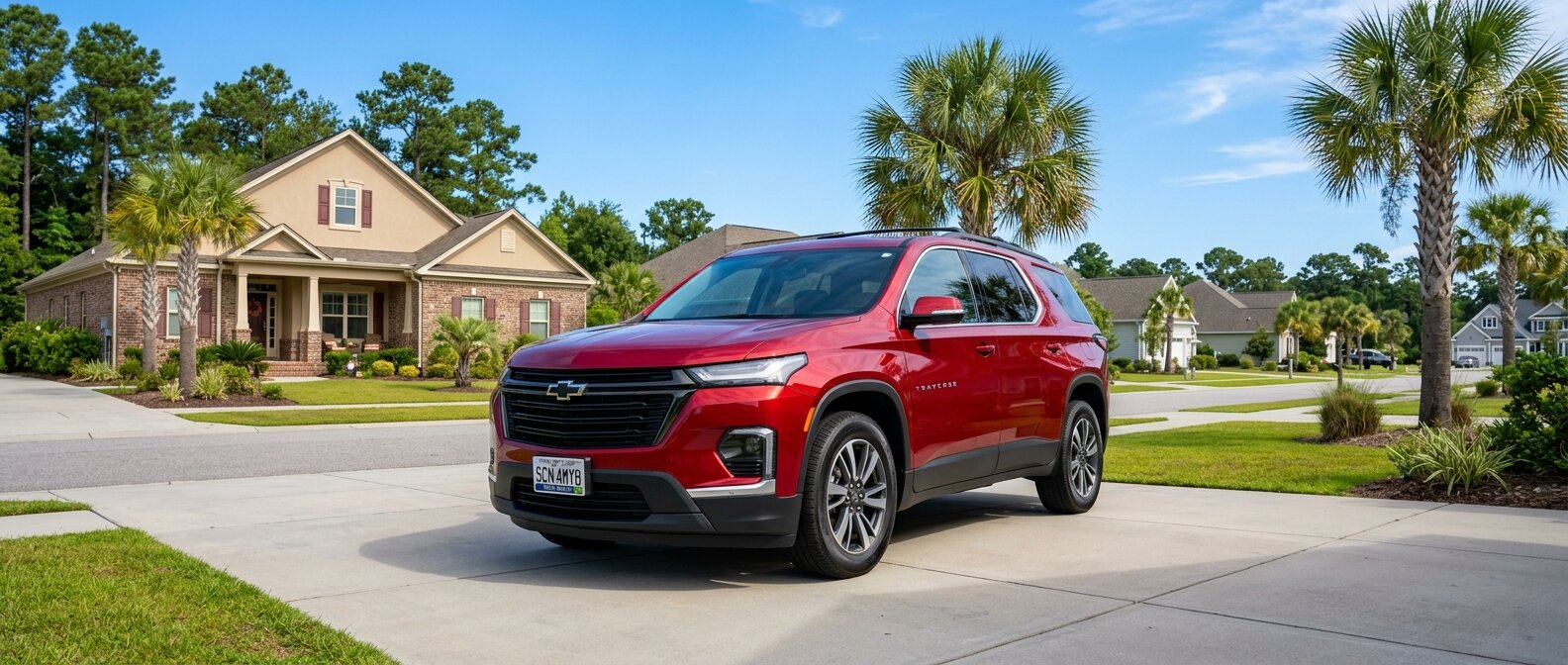
For busy families near Carolina Forest, the 2026 Chevrolet Traverse is built for exactly this commute. Think suburban grid driving between Carolina Forest Boulevard and US-501, summer afternoon thunderstorms that show up without warning, and a back seat full of kids in car seats. NHTSA awarded it a 5-star overall safety rating, Chevrolet lists standard Chevy Safety Assist across every trim, and the interior seats up to eight. It fits the life. But there are real tradeoffs you’ll want to weigh before you commit.
Browse the 2026 Traverse on our lot to see current trim availability.
The Do’s and Don’ts Table: Traverse Driving for Carolina Forest Conditions
Carolina Forest Boulevard tells you a lot about what a family SUV needs here, narrowing from five lanes near US-501 down to two lanes near the elementary school. Add the Grand Strand tourist traffic surging on US-501 through summer, plus afternoon storms that can drop an inch of rain in twenty minutes, and you get a specific set of demands, so here’s what works and what to watch on a family SUV.
| Situation | Do | Don’t |
|---|---|---|
| Carolina Forest Blvd school-zone merge | Use blind-spot monitoring and rear cross-traffic alert actively every pickup | Rely on mirrors alone when traffic compresses to two lanes |
| US-501 tourist corridor backup | Engage adaptive cruise control to hold a consistent gap in stop-and-go | Tailgate; Buckle to Drive won’t shift into gear if your belt isn’t on, so get settled before you’re moving |
| Grand Strand afternoon thunderstorm | Slow down well before standing water; Chevrolet lists standard automatic emergency braking that works at lower speeds | Brake hard and late; the AEB assists but doesn’t substitute for leaving a longer gap in wet conditions |
| Beach gear and sports equipment loads | Load the 98 cubic feet of maximum cargo space behind the front seats, folding rows 2 and 3 | Exceed the door-jamb rated payload; verify your specific configuration’s label |
| Towing a boat or small trailer to the Waccamaw | Use the available trailer package on properly equipped models; Chevrolet lists a maximum tow rating of 5,000 pounds when properly equipped | Guess at the rating. Check the door-jamb label and your hitch’s tongue-weight limit before you hook up |
The One Technique That Actually Changes the School Run
The one technique that changes the school run is working the whole visibility stack, not just the backup camera, and on Carolina Forest Boulevard that habit earns its keep at every pickup when the lanes compress and other SUVs block your sightlines.
Carolina Forest Boulevard compresses from its five-lane section near US-501 to two lanes near Carolina Forest Elementary School. The Traverse’s standard rear cross-traffic alert and blind-spot monitoring matter here more than they do in open parking lots, because you’re often reversing or merging in tight queues with other SUVs blocking sightlines.
- Before you park for pickup, adjust the side mirrors so you can see the lane behind you without moving your head. You’ll use them more than you expect.
- When you reverse out of the pickup line, let the rear cross-traffic alert do its job. It’ll fire before the obstacle enters the camera’s close-range view.
- In wet conditions, you’ll want an extra car length of following distance. The EPA rates the FWD 2026 Traverse at 20 city and 26 highway mpg, which tells you the engine is pulling a real amount of weight. Stopping distance grows in rain.
- Use Teen Driver if there’s a new driver in your house taking the Traverse to school. Chevrolet lists the Teen Driver system as standard, and it produces an in-vehicle report card of speed, distance, and safety-alert events.
We won’t dress up the drawback. The 2026 Traverse did not earn an IIHS Top Safety Pick designation under the IIHS’s tightened 2026 criteria, which raised the bar specifically for rear-seat protection and crash-avoidance performance. NHTSA still gave it a full 5-star overall rating, with 5 stars in both the frontal and side crash tests. That combination is genuinely good. But if rear-seat crash protection is your family’s top consideration, that’s a real factor to weigh, and we won’t gloss over it.
Check out the Equinox if a smaller footprint fits your driveway better
See the Tahoe for families who want truck-based platform capability
Keeping the Traverse Ready for Grand Strand Conditions
The Gulf Coast heat and salt air that define the Grand Strand are real factors for any vehicle, and the Traverse is no exception, so it’ll stay a reliable daily driver here as long as you keep up with a few climate-specific maintenance items. None of it is complicated.
Check the cabin air filters and keep them current, since they clog faster in a humid subtropical climate. Watch tire pressure monthly, because heat expands the air and low pressure stresses the sidewalls on a vehicle this size. Get your wiper blades inspected before hurricane season brings those heavy afternoon storms. Small habits like these add up fast, and they’ll save you headaches over a Grand Strand summer.
A Traverse that’s kept up for coastal conditions stays a dependable daily tool for Carolina Forest life. It’ll serve for years.
Schedule a Service Appointment
By the Palmetto Chevrolet Team | September 2026
The 2026 Traverse fits the Carolina Forest daily routine. It’s sized for a real Grand Strand family, carries NHTSA’s 5-star overall rating, and brings enough active safety tech to handle both the school pickup and the US-501 merge. The tradeoff (no IIHS TSP under 2026’s tightened rear-seat criteria) is worth knowing. Come drive it and decide for yourself.


