





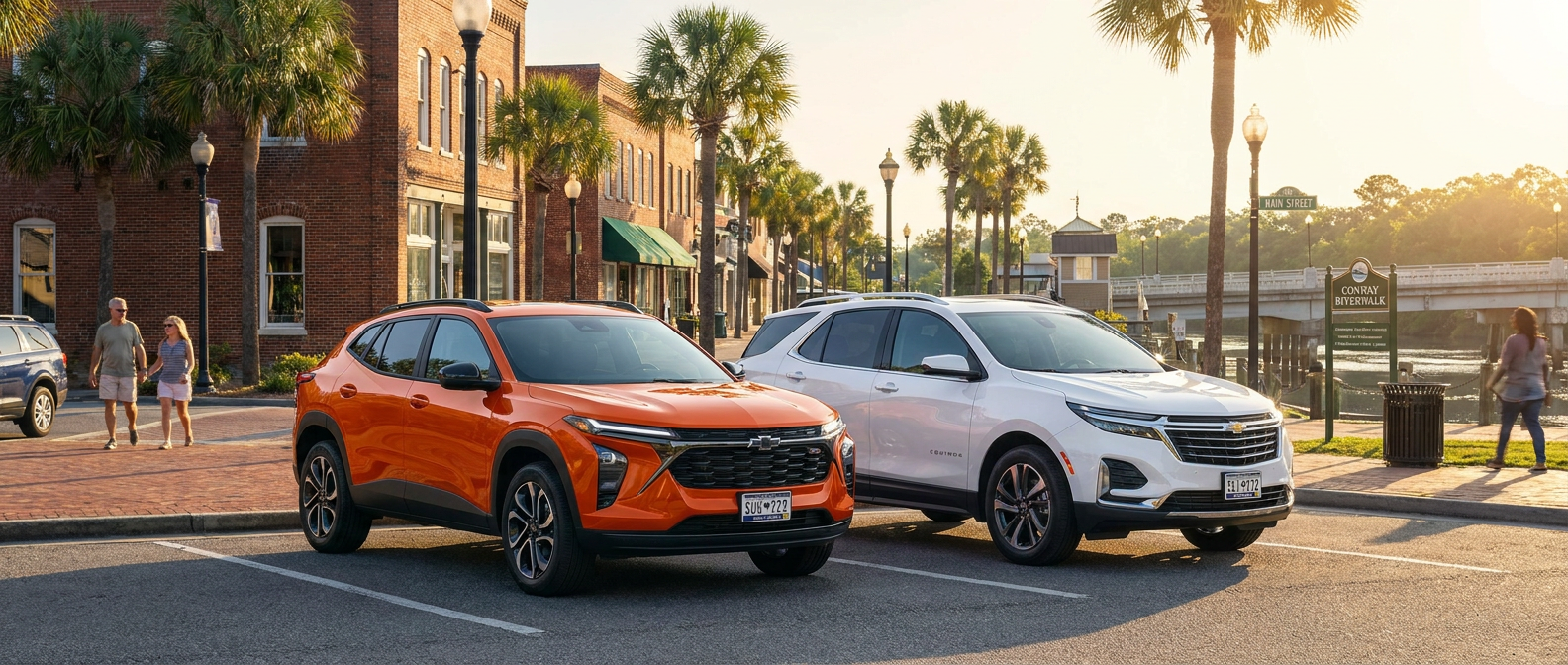
If you’ve narrowed your first SUV down to the 2026 Trax or the 2026 Equinox, the short answer is that the Trax is the smarter pick for most Conway first-timers. The Equinox earns its higher entry point only when rear passenger room and available all-wheel drive are genuine priorities in your life right now.
- The 2026 Trax starts significantly lower and returns an EPA-rated 30 mpg combined. 3 mpg better than the FWD Equinox and meaningful on a US-501 daily commute.
- The 2026 Equinox carries nearly 4.2 more cubic feet of cargo with all five seats up (29.8 vs. 25.6 cu ft) and offers a noticeably roomier back seat (39.9 vs. 38.7 inches of rear legroom).
- The Trax is FWD only. The Equinox offers available AWD. On Conway’s flat coastal roads and mild winters, that gap matters far less than it would in the Carolina mountains.
- Both vehicles include Chevy Safety Assist. Six active safety technologies. On every single trim. Neither makes you pay up for the basics.
- Buy the Trax if you’re commuting solo or with one passenger and budget is the priority. Buy the Equinox if you regularly carry three or four adults or want the flexibility of AWD for occasional mountain trips.
Take a look at our current 2026 Equinox inventory if you’d like to see available trims and compare what’s actually in stock before you read another word. Then come back, because the numbers below might shift your thinking about which one you need.
What’s the Real Difference Between the Trax and the Equinox?
The core difference comes down to size class, with the Trax built as a subcompact and the Equinox as a compact, so the sharper contrast shows up less in the four-inch length gap, 178.6 vs. 183.2 inches, and more in where you’ll actually spend your time, the back seat and the cargo hold. The gap is real but modest.
| Spec | 2026 Trax | 2026 Equinox FWD |
|---|---|---|
| Engine | 1.2L Turbo 3-cyl, 137 hp | 1.5L Turbo 4-cyl, 175 hp |
| EPA Combined MPG | 30 mpg | 27 mpg |
| Cargo (seats up) | 25.6 cu ft | 29.8 cu ft |
| Cargo (seats folded) | 54.1 cu ft | 63.5 cu ft |
| Rear Legroom | 38.7 in | 39.9 in |
| AWD Available | No | Yes |
| Overall Length | 178.6 in | 183.2 in |
| Chevy Safety Assist | Standard, all trims | Standard, all trims |
| Towing Capacity | Not rated for towing | Up to 1,500 lbs (AWD, properly equipped) |
The Trax surprises you with 54.1 cubic feet of max cargo once you fold the rear seat, which lands close to the Equinox’s 63.5. The gap you’ll actually feel day to day is the 25.6 vs. 29.8 cu ft you get with passengers in the back, so the Equinox hands you roughly one more large rolling suitcase of usable space behind active rear seats. For a family, that counts. For a CCU student hauling a bike or moving boxes twice a year, it counts for a lot less.
Do You Actually Need All-Wheel Drive in Conway?
For the kind of driving Conway serves up, no, you don’t really need all-wheel drive, and outside of regular mountain trips, AWD ranks among the most common upsells in this segment and among the least necessary across the flat coastal terrain of Horry County. We’ll be direct about that.
The Trax is front-wheel drive exclusively, and Chevrolet doesn’t offer an AWD version at any trim level. The Equinox does offer AWD, starting at the LT trim, with a bump to a 203 lb-ft, 8-speed automatic setup that the EPA rates at 25/29/26 mpg for city, highway, and combined. So you’re trading one mpg combined for AWD capability and more torque. Whether that trade earns its keep depends entirely on how you drive.
So where does AWD actually earn its place around here? Barely, once you look at the terrain. Conway sits at roughly 25 feet above sea level on predominantly flat coastal plain, and the corridors we all drive, US-501 to Myrtle Beach, SC-544, SC-22, also called Veterans Highway, simply don’t demand it. Horry County winters rarely produce sustained freezing conditions. If you’re planning regular trips to the Blue Ridge Parkway or weekends in the Upstate, AWD on the Equinox turns into a legitimate feature. For a first-time buyer whose world is the Grand Strand and Horry County, it’s a nice-to-have rather than a need.
The Trax’s FWD paired with its 30 mpg combined EPA rating is the more practical equation for most daily driving here. On a 35-mile round-trip to Myrtle Beach along US-501, that 3 mpg advantage keeps adding up, and you’ll feel it across a year of commuting. Around here, the math favors the Trax.
The Practical Question: Space and Comfort for Real Conway Life
The Equinox’s back seat really earns its keep when you’re regularly moving people, because Chevrolet lists 39.9 inches of rear legroom in the 2026 Equinox versus 38.7 inches in the Trax, a gap that reshapes how an adult rides on a longer haul. A 1.2-inch gap doesn’t sound dramatic, but paired with the wider shoulder room, it’s the difference between a comfortable rear seat for an average adult and one that starts to feel snug on the Myrtle Beach run.
The Trax answers back with a surprisingly flexible cargo setup. Fold the 60/40 split rear seat and Chevrolet lists 54.1 cubic feet, which is more than you’d expect from a vehicle this size and enough for two large suitcases, a stroller, or a full CCU move-in haul. The Equinox’s 63.5 cu ft folded wins, no question. The gap narrows once you load up.
Both come with an 11-inch touchscreen available, standard on higher Trax trims and on the Equinox LT, plus wireless Apple CarPlay and Android Auto, and Google Built-In available. For a first car, you’re well covered.
| Trax | Equinox | |
|---|---|---|
| Pros | Cons | |
| Lower entry point | FWD only. No AWD option ever | |
| 30 mpg combined (EPA) | 137 hp can feel modest merging on US-501 | |
| Surprisingly large max cargo (54.1 cu ft) | Tighter rear legroom (38.7 in) | |
| Smaller footprint. Easier parking at the Riverwalk or downtown Conway | Slightly less cargo with seats up (25.6 cu ft) | |
| Chevy Safety Assist on every trim | Not rated for towing |
| Equinox | ||
|---|---|---|
| Pros | Cons | |
| AWD available (genuinely useful for mountain trips) | Higher starting point | |
| More rear legroom (39.9 in) and shoulder room | Slightly lower fuel economy (27 mpg combined FWD) | |
| More cargo with seats up (29.8 cu ft) | Larger footprint (less nimble in tight spots) | |
| Tows up to 1,500 lbs when properly equipped (AWD) | AWD adds cost; overkill for coastal SC flatlands | |
| ACTIV trim offers light off-road capability | Bigger budget commitment for a first vehicle |
Browse our full new SUV inventory to compare what’s actually available in Conway right now. Trim levels and availability shift over time, and seeing what’s on the lot often settles the question faster than any spec sheet can.
So Which One Should You Pick?
Our answer here comes by buyer type, and we’ll give it to you straight, because the right pick depends on which life you lead day to day, with the Trax making sense for a solo commuter on a tight budget and the Equinox earning the step up for anyone regularly filling the back seat or wanting AWD for mountain trips.
Buy the Trax if: you’re a first-time buyer on a practical budget, commuting alone or with one regular passenger along US-501 or around Horry County, living near downtown Conway where parking runs tighter, and fuel economy really matters to your monthly math. The EPA’s 30 mpg combined rating is one of the better numbers in this segment. The Trax won’t embarrass you on the highway, it just asks you to plan your merge a half-second earlier. Its 137 horsepower is adequate and grounded without pretending to be sporty, and for what you pay at the entry point, the trade is fair.
Buy the Equinox if: you regularly carry three or four adults, you’re planning beach weekends with a loaded back seat, you want the peace of mind of available AWD for occasional mountain drives on I-26 toward Asheville, or you want a vehicle with a little more room to grow with you over the next five years. The 175-hp 1.5L turbo merges onto US-501 with noticeably more confidence, and 39.9 inches of rear legroom keeps your back-seat passengers from folding themselves in. At its entry point, the Equinox LT is a genuine compact SUV with a compact SUV’s feature set, not a subcompact wearing a bigger badge.
The honest tradeoff: the Equinox costs more to buy and more to fill up. If those differences don’t materially affect your life, the Equinox is the better long-term vehicle. And if they do, as they will for anyone shopping on a tight first-car budget, the Trax is a solid first SUV, not a compromise.
Frequently Asked Questions
Is the 2026 Chevy Trax big enough for a road trip?
For one or two people, yes. Comfortably. The Trax offers 54.1 cubic feet of cargo space with the rear seat folded, which handles two large suitcases and travel bags without a problem. With all five seats in use, that drops to 25.6 cubic feet, which is tighter for a fully loaded four-person trip. If you’re planning regular road trips with three or more passengers plus luggage, the Equinox’s extra rear legroom and 29.8 cubic feet of cargo with seats up will make those trips more comfortable. For weekend runs from Conway to the Upstate or a solo drive up the coast, the Trax handles it without complaint.
Does the 2026 Chevy Equinox really need AWD in South Carolina?
For most driving in the Conway and Grand Strand area, no. Horry County roads are flat, winters are mild, and AWD adds cost without adding much capability on the routes most people drive daily. Where AWD on the Equinox genuinely earns its keep is on occasional trips toward the Upstate. I-26 into the mountains, unpaved rural roads, or light off-road use. The Equinox ACTIV trim pairs AWD with all-terrain tires, which is a real combination for anyone who goes off the paved road regularly. But if your driving is primarily coastal-SC flatland commuting, front-wheel drive on either the Trax or the Equinox LT FWD is the practical choice. —


