





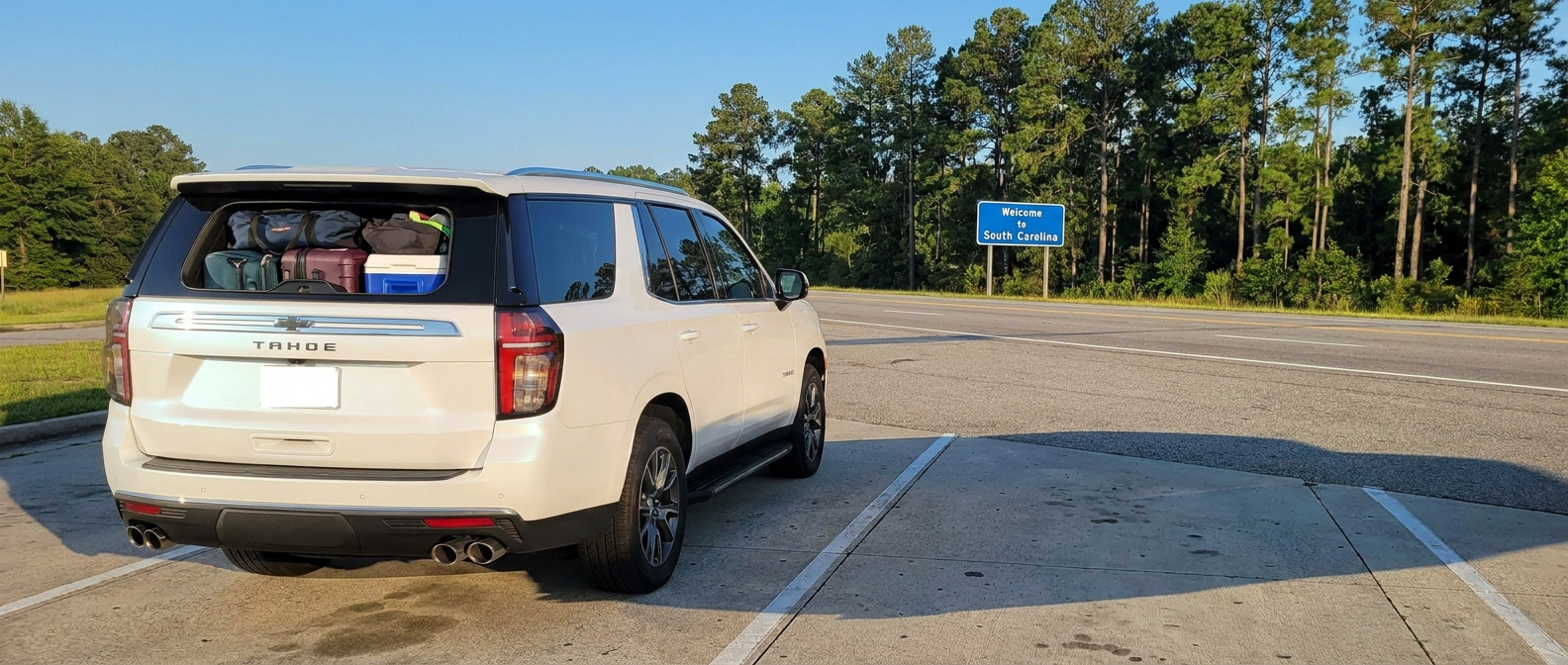
You can build a case for almost any three-row SUV on a short errand. The drive from Conway to Columbia, SC asks more of it, though. You’re looking at roughly 125 to 135 miles along US-378 through the flat Pee Dee corridor, a two-to-three-hour run in late-summer heat, and very likely a full cabin with kids, gear, or a trailer in tow. The question worth asking isn’t whether the Tahoe is comfortable. It’s whether the specific things it does differently from a crossover actually matter on this drive. We think they do. Let’s break it down.
Get a closer look at what’s available on our lot: browse our current Tahoe inventory.
How Does the Tahoe’s Engine Lineup Actually Work for a Highway Run?
The Tahoe gives you three engines for one trip, and they’re genuinely not interchangeable, so the choice matters more on a pure highway run like US-378 than it does on your daily loop around Conway, where any of them would feel fine. Pick with the drive in mind.
| Engine | Horsepower / Torque | EPA Highway MPG | Max Tow (properly equipped) | Best for This Trip |
|---|---|---|---|---|
| 5.3L V8 (standard) | 355 hp / 383 lb-ft | 20 mpg | 8,400 lbs | Towing a boat or camper on US-378 |
| 6.2L V8 (upper trims) | 420 hp / 460 lb-ft | 20 mpg | 8,200 lbs | Performance feel, same fuel use as 5.3L |
| 3.0L Duramax diesel | 305 hp / 495 lb-ft | 26 mpg | 8,200 lbs | Unloaded family run, maximum range |
The EPA rates the 3.0L Duramax turbo-diesel at 20 city / 26 highway. On a highway-heavy run like US-378, that’s the most efficient engine Chevrolet puts in a full-size SUV, and it’s the only diesel available in this class from any domestic brand. Now the tradeoff. If you’re towing a Grand Strand boat trailer and want the absolute highest ceiling, the 5.3L V8 with the Max Trailering Package is the stronger call at 8,400 lbs properly equipped. (Always verify your door-jamb label for your specific configuration.) The 6.2L V8 returns identical highway fuel economy to the 5.3L but demands premium fuel, so for most Horry County families the base V8 hits the sweet spot unless you’re stepping into an upper trim for other reasons.
All three engines pair with a 10-speed automatic. The shift points are smooth enough that passengers in the rear rows won’t feel the transmission hunting on the long flat miles between here and the Midlands.
Which Setup Do You Actually Need for Columbia Runs?
Which setup you need comes down to two things, what you’re hauling and how often you make this trip, and the answer swings hard depending on whether there’s a trailer behind you or just a full family inside the cabin. Tow, and the whole calculation changes.
If you’re towing anything from a Jet Ski trailer to a small camper on the US-378 corridor, the 5.3L with the Max Trailering Package is a different category than a crossover. The package adds an integrated trailer brake controller, trailer sway control, and a camera-assisted hitch guidance system. Chevrolet rates it for up to 8,400 lbs properly equipped. That covers a 22-foot travel trailer with room to spare for most Grand Strand families. A typical three-row crossover simply does not get you there.
For families running Columbia unloaded, the LT and RST trims are where the trip-specific tech lives. Both gain the diesel option, access to available Super Cruise hands-free highway driving, and the Suburban-style cabin depth that makes the third row a genuine seat for adults. Super Cruise uses LiDAR-mapped roads and a driver attention system to handle steering, acceleration, and braking on compatible highway segments. It also works while towing. On a repetitive two-hour highway corridor in September heat, that matters.
The Z71 trim adds off-road capability and steps up to the 6.2L V8 as standard. Reasonable if you’re occasionally heading to the Upstate or pulling heavier loads. Our finance team can walk you through the trim tradeoffs against your actual use case. And if you’re hauling the full crew regularly, the Chevy Traverse is worth a serious look as the more fuel-efficient alternative for unloaded family trips.
Road-Trip Terms Worth Knowing
| Term | What It Means for You |
|---|---|
| Max Trailering Package | Optional package that unlocks the Tahoe’s 8,400-lb tow ceiling; adds trailer brake controller, upgraded cooling, hitch guidance camera |
| Super Cruise | GM’s hands-free highway system; steers, accelerates, and brakes on compatible mapped roads (confirm US-378 segment compatibility via the GM map) |
| Tri-zone climate | Three independently controlled climate zones: driver, front passenger, and rear cabin |
| IRS (Independent Rear Suspension) | The current-gen Tahoe’s rear design; lowered the cargo floor vs. the old solid-axle setup, which is why third-row legroom reaches 34.9 inches |
What This Means for Your Next Vehicle
The Tahoe is a genuine tradeoff, and we’ll give it to you straight: it’s larger to park in downtown Columbia, it drinks more fuel than a compact crossover on the 5.3L, and it asks more of you up front, so it won’t be the right answer for every family heading to the Midlands. For a family making two or three Columbia runs a year with nothing in tow, a well-equipped Chevy Traverse likely covers the trip for less, and we won’t pretend otherwise.
But for anyone who also tows a Grand Strand boat on the weekends, needs genuine adult-livable third-row space (Chevrolet lists 34.9 inches of third-row legroom, made possible by the independent rear suspension), or wants Super Cruise for the monotony of a flat US-378 corridor, the Tahoe earns the difference. NHTSA’s testing gives the 2026 Tahoe an overall five-star safety rating, including five-star scores in both the side-barrier and side-pole crash tests. None of that is about showroom polish. It comes down to whether the tool fits the job when the job actually demands it.
When you’re ready to spec one out or want to talk through which engine makes sense for your Columbia run, we’re here.
Explore Financing for a 2026 Tahoe
Frequently Asked Questions
Is the diesel Tahoe worth it for the Conway-to-Columbia drive?
If you’re making that run unloaded with a full family, the 3.0L Duramax makes a real efficiency argument. The EPA rates it at 26 mpg highway, compared to 20 mpg for the 5.3L V8. On a 125-to-135-mile highway stretch, that gap adds up over time, and the diesel’s 495 lb-ft of torque delivers relaxed, effortless passing on US-378 without the engine needing to hunt for a lower gear. There’s a caveat worth flagging. Diesel trims start at the LT level and above, and diesel fuel access in rural South Carolina between Conway and Columbia is thinner than regular unleaded. Plan your fill-up before you leave Horry County.
Does the 2026 Tahoe have enough cargo space for a real family road trip?
Yes, and it’s one of the cleaner advantages the Tahoe holds over crossover alternatives. Chevrolet lists 25.5 cubic feet behind the third row, enough for several full-size rolling bags, expanding to a maximum of 122.9 cubic feet with both rows folded flat. The current generation’s independent rear suspension dropped the cargo floor relative to older solid-axle Tahoes, so you’re sliding luggage in flat rather than lifting over a raised liftgate sill. For a full-family Columbia run with a stroller, a cooler, and two rows of passengers, the space holds without compromise.


