





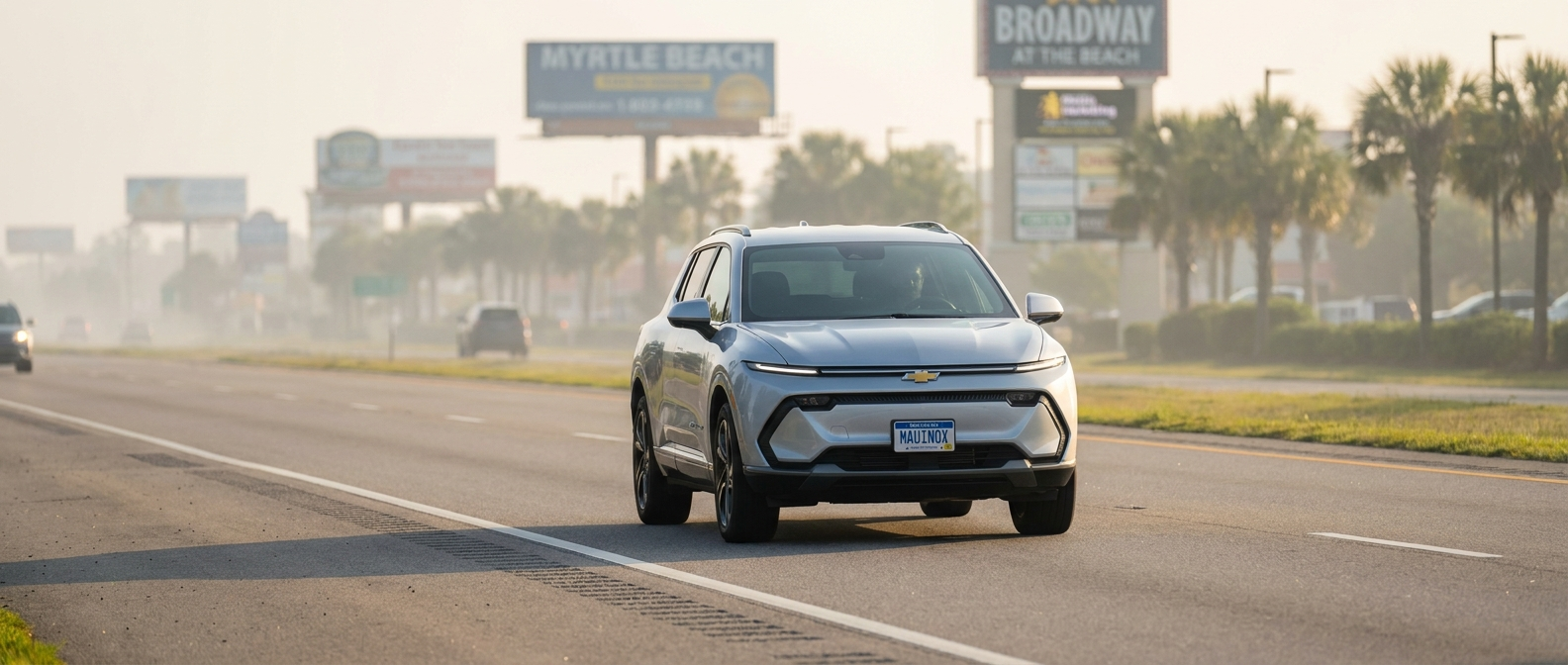
If you drive the Conway-to-Myrtle Beach stretch every workday, you already know how US-501 behaves. The EPA rates the front-wheel-drive 2026 Chevrolet Equinox at 26 city and 29 highway mpg, and the city number is the one that counts when you’re stuck at the Carolina Forest Boulevard intersection watching the light cycle twice before you clear it. Chevrolet built the Equinox for exactly this kind of daily grind. It isn’t the flashiest compact SUV on our lot, and it doesn’t try to be. Instead, it’s quietly well-suited to a hospital worker’s reality. Think a repeatable, low-stress commute, safety tech that actually steps in during stop-and-go traffic, a cabin that doesn’t make a 35-to-40-minute run feel punishing, and fuel economy that keeps the fill-up light from nagging you across a four-day shift rotation.
Browse the 2026 Equinox at Palmetto Chevrolet
What Do the Specs Actually Mean for a Daily Commuter?
Window-sticker numbers are fine as far as they go, but they only tell half the story until you map them onto the Conway-to-82nd-Parkway run, so let’s translate the 2026 Equinox spec sheet into what you’ll actually feel from the driver’s seat on a stop-and-go morning down US-501 toward the coast.
| Spec | 2026 Equinox FWD | 2026 Equinox AWD | What It Means on Your Commute |
|---|---|---|---|
| Engine | 1.5L turbo I-4 | 1.5L turbo I-4 | Single engine across all trims; no powertrain guesswork |
| Horsepower | 175 hp @ 5,600 rpm | 175 hp @ 5,600 rpm | Adequate for merging; not sporty |
| Torque | 184 lb-ft | 203 lb-ft | Turbo delivers torque early (useful at 0-35 mph) |
| Transmission | CVT | 8-speed automatic | CVT smooths stop-and-go; 8-speed on AWD sharpens response |
| EPA City / Hwy / Combined | 26 / 29 / 27 mpg | 25 / 29 / 26 mpg | Honest 26-27 mpg in Grand Strand traffic is realistic |
| Cargo (seats up) | 29.8 cu ft | 29.8 cu ft | Room for scrubs bag, lunch bag, and gym bag all at once |
| Ground Clearance | 8.05 in | 8.05 in | Clears flooded crossings after a heavy storm |
| Adaptive Cruise Control | Standard | Standard | Holds following distance; brakes automatically in traffic |
The torque peak at 2,000 rpm is the spec that earns its keep on US-501. Turbo boost builds early in the power band, so the Equinox pulls cleanly from a standstill when the light finally clears, and you’re not revving the engine to find the power. It feels comfortable, and it’s easier on fuel in city driving than a naturally aspirated engine would be.
For all that composure, there’s a tradeoff worth naming. At 175 horsepower, the Equinox is adequate and no more. Merging from SC-544 onto US-501 into a gap that’s tighter than ideal means planning the move a beat early. The Equinox is not a quick car. What it is, is composed and efficient, and for a daily 35-mile round trip to Grand Strand Medical Center, that’s the trade you want. Composed and efficient wins.
The Safety Tech Is Standard Across Every Trim (and That Matters in Grand Strand Traffic)
Compare the Equinox EV if charging fits your routine
Every 2026 Equinox trim carries the real safety equipment, so the common assumption that you have to climb to a higher trim to get it doesn’t hold here. Chevrolet’s Safety Assist package is standard on LT, RS, and ACTIV alike, no upgrade needed. The six features in that suite include Forward Collision Warning, Automatic Emergency Braking, Lane Departure Warning, Lane Departure Steering Assist, Blind Spot Intervention, and Rear Cross-Traffic Braking Alert.
In real terms on a Grand Strand commute, Blind Spot Intervention is the one that gets used the most. US-501 sees enough aggressive lane changers (especially in summer when tourist volumes spike) that a system able to apply individual brake pressure and nudge your vehicle away from an encroaching car earns its keep on every drive.
The Adaptive Cruise Control earns its own mention. Using forward radar, it holds a set following distance from the car ahead and accelerates and decelerates automatically, so you’re not working the pedal constantly. On a stop-and-go corridor like 501 near the Carolina Forest Boulevard interchange, that feature alone can pull the fatigue out of the drive home after a 12-hour shift.
Keep your Equinox’s safety systems maintained at Palmetto Chevrolet Service
Three Features Commuters Actually Use Every Week
A handful of features on the 2026 Equinox stand out for the Conway-to-82nd-Parkway run, and they aren’t the ones that photograph well so much as the ones that show up on a plain Tuesday in August rather than a Saturday at the beach. Here is the short version.
- 11.3-inch touchscreen with Google Built-In runs Google Maps natively, so real-time traffic rerouting from 501 to SC-22 or SC-544 happens on the screen without fiddling with your phone
- Wireless Apple CarPlay and Android Auto on every trim, no cable needed, which matters when you’re running out of the hospital parking deck with bags in both hands
- Heated front seats and heated steering wheel standard on every trim (less relevant in August, genuinely useful in January when the Grand Strand has a cold snap)
- 29.8 cubic feet of cargo space behind the second row, which handles a full work bag, a gym bag, and a week’s worth of grocery runs without rearranging anything
- Dual-zone automatic climate control, so you and your passenger don’t negotiate the temperature at 6 a.m.
Explore Financing Options for the 2026 Equinox
Who the 2026 Equinox Actually Fits
The 2026 Equinox makes the commuter case cleanly for a specific kind of driver, and it falls short for others, so it helps to know which side of that line your daily 82nd Parkway run puts you on before you commit to one over a roomier or all-electric alternative.
You’ll be well matched if your world is one or two occupants on most days, you care more about monthly fill-up costs than towing a boat, and you want safety tech that works without a top-trim purchase. Healthcare workers, educators commuting from Conway toward the coast, and anyone logging 10,000-plus miles a year on the US-501 corridor will find its combination of 27 combined mpg, low-drama cabin, and standard safety systems a genuinely good match for that specific drive.
The Equinox gives ground in a few places, too. If you need third-row seating for a carpool, the Chevrolet Traverse adds that capacity. If you’re towing anything meaningful on the weekends, the 1,500-pound maximum tow rating (AWD with Trailering Package) is a realistic ceiling. And if the stop-and-go on 501 has you thinking about ditching gas entirely, the Equinox EV is worth a look for a commute this defined and repeatable.
For the daily 35-to-40-minute Conway-to-Grand Strand Medical Center run, though, the 2026 gas Equinox is hard to argue with. You get good fuel economy for the real-world 501 grind, safety systems that don’t demand a premium trim, and a cabin that doesn’t feel like a compromise. We’ve got the LT, RS, and ACTIV on the lot on 4th Avenue in Conway if you want to sit in one and feel the space and the screen before you decide.
Frequently Asked Questions
Is the 2026 Equinox fuel economy realistic for the Conway to Myrtle Beach commute on US-501?
The EPA rates the front-wheel-drive 2026 Equinox at 26 city / 29 highway / 27 combined mpg. On US-501, which has significant stop-and-go especially near the Carolina Forest Boulevard interchange, real-world results will trend toward the 26 city figure rather than the 29 highway number. That’s still a solid return for a compact SUV in genuine commuter traffic, and drivers who can use SC-22 (Veterans Highway) for part of the run will see numbers closer to the highway rating. The AWD model rates 25 city / 29 highway / 26 combined.
Does the 2026 Equinox come with safety features like Adaptive Cruise Control as standard, or do you have to upgrade?
Adaptive Cruise Control, along with the full six-feature Chevy Safety Assist suite covering Automatic Emergency Braking, Lane Departure Warning, Lane Departure Steering Assist, Blind Spot Intervention, and Rear Cross-Traffic Braking Alert, is standard on every 2026 Equinox trim including the base LT. You don’t need to buy a higher trim to get meaningful active safety coverage. An available Safety and Technology Package adds HD Surround Vision and Rear Pedestrian Alert for buyers who want more.
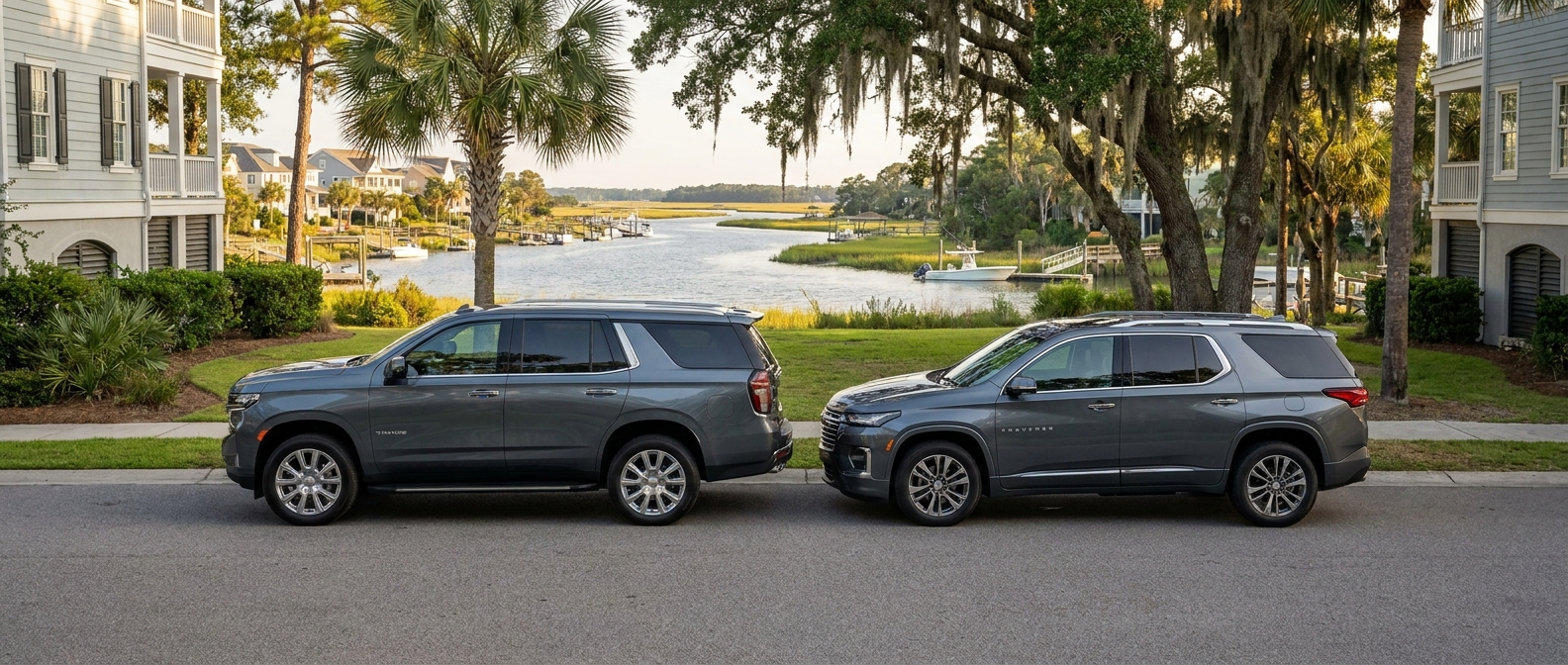
If you’re hauling kids to Socastee High, running the SC-544 corridor twice a day, and wondering whether that boat trailer changes everything, the answer comes down to one question. Do you need 8,400 pounds of towing or not?
The 2026 Tahoe is a body-on-frame full-size SUV built on the same architecture as the Silverado. The 2026 Traverse is a unibody midsize crossover with a low cargo floor and a turbocharged four-cylinder. For most Socastee families who aren’t pulling a serious trailer, the Traverse is the smarter daily choice. Pull a boat regularly? The math shifts hard toward the Tahoe.
- The Traverse wins for daily Socastee life: lower fuel cost on SC-544, easier load floor for groceries and gear, and a more maneuverable footprint for neighborhood streets.
- The Tahoe wins if you tow: up to 8,400 lbs properly equipped vs. the Traverse’s 5,000 lbs (a real gap if you’re launching anything bigger than a jet ski or bass boat at Osprey Marina).
- Cargo counterintuitive fact: the Tahoe’s max cargo is 122.7 cu ft (both rows folded), but with all seats up and kids aboard, the Traverse’s lower liftgate step and unibody layout make it easier to load strollers and Costco runs.
- Fuel: the EPA rates the Traverse FWD at 22 mpg combined vs. 17 combined for the Tahoe’s 5.3L V8. That gap adds up fast on a daily SC-544 run.
- Bottom line: if towing is a regular part of your life, get the Tahoe. If it’s an occasional weekend thing you can rent or borrow for, get the Traverse and keep the fuel savings.
What’s the Real Difference Between These Two Chevys?
The Tahoe and Traverse look like cousins parked side by side, but they sit on completely different foundations, and that single split drives almost every spec you care about as a parent, from towing to fuel to how easy the liftgate is to load. One is a truck underneath. The other is really a tall car, and that changes the whole ownership experience.
The 2026 Tahoe rides on a body-on-frame platform (the same approach used in full-size trucks), which gives it genuine towing muscle, a higher ride height, and more total cargo volume when the seats fold flat. Chevrolet lists max cargo at 122.7 cubic feet with both rows down. The tradeoff is weight and engine. Its standard 5.3L V8 produces 355 horsepower and 383 lb-ft of torque, and the EPA rates it at 15 city/20 highway. Over on the Traverse, a 2.5L turbocharged four-cylinder makes 328 horsepower and 326 lb-ft of torque, with EPA FWD ratings of 20 city/26 highway. Same-ish horsepower on paper, very different real-world fuel costs.
| Spec | 2026 Tahoe (5.3L V8, RWD) | 2026 Traverse (FWD) |
|---|---|---|
| Engine | 5.3L V8, 355 hp | 2.5L Turbo I4, 328 hp |
| EPA City/Hwy MPG | 15/20 | 20/26 |
| Max Tow (properly equipped) | 8,400 lbs | 5,000 lbs |
| Cargo (3rd row up) | 25.5 cu ft | 22.9 cu ft |
| Cargo (max, all rows flat) | 122.7 cu ft | 97.6 cu ft |
| Max Seating | 8 | 8 (LT bench) or 7 |
| Platform | Body-on-frame | Unibody |
| NHTSA Overall Safety | 5 stars | Not yet rated (2026) |
Does the Tow Rating Actually Matter for Socastee Families?
Whether the tow rating actually matters depends entirely on what you plan to pull, and for Socastee families that answer swings from barely relevant to the whole ballgame depending on the boat sitting in your driveway or the camper you’re eyeing for the fall. A jet ski on a single-axle trailer runs roughly 1,500 to 2,000 lbs loaded, and the Traverse handles that with room to spare at 5,000 lbs. A typical bowrider runabout with a tandem trailer? Often 4,500 to 6,000 lbs, which puts the Traverse borderline or out of range. A pontoon or larger fishing boat on a heavy trailer can easily push past 7,000 lbs. Only the Tahoe handles that load.
The 2026 Traverse is the right answer for Socastee families who keep a jet ski or small bass boat on the Intracoastal and launch it a handful of weekends per season. For that kind of use, it’s genuinely capable. The moment you’re thinking about a 22-foot pontoon, a large offshore boat, or a camper, the Traverse’s rating simply doesn’t cover it, and towing beyond your rating is a safety and liability issue, not just a preference.
Our team’s take is simple. If your towing need is occasional and under 4,500 lbs, the Traverse handles it and saves you real money every other week at the pump. If towing is a regular, heavy-load activity, the Tahoe isn’t optional.
Value Your Current Vehicle Toward a New Chevy
Getting All Three Kids to School on SC-544
The fuel economy gap shows up hardest on exactly the kind of driving this commute involves, which is stop-and-go city miles rather than steady highway cruising, so what looks like a small number on paper turns into a weekly difference at the pump. SC-544 between Socastee and Conway is a four-lane corridor, but summer beach-season traffic turns it into a stop-and-go situation for chunks of the morning commute. City driving is where V8 trucks feel their engines most. The Tahoe’s V8 is thirsty, no way around it. The EPA’s 15 mpg city rating on the standard 5.3L V8 reflects that reality, and the Traverse’s 20 mpg city means meaningfully less stopping for gas on the family’s regular loop.
There’s a second practical split for parents, and it’s the load floor. The Tahoe’s body-on-frame architecture creates a higher liftgate step-in height compared to the Traverse’s unibody layout. When you’re loading a stroller, a soccer bag, and two grocery hauls after school pickup, a lower cargo floor is a genuine quality-of-life difference. The Traverse’s cargo area behind the third row at 22.9 cubic feet is slightly less than the Tahoe’s 25.5 cubic feet with seats up, but the Traverse’s floor sits lower and the opening is wider relative to what you’re lifting over.
Check the third row before you sign anything. The Traverse’s unibody packaging gives the rear row more legroom for older kids on longer drives (think the annual Myrtle Beach trip with grandparents packed in). The Tahoe’s third row, while perfectly fine for kids, is a tighter squeeze for adults.
| Scenario | Advantage |
|---|---|
| Daily SC-544 school run | Traverse (20 mpg city vs. 15) |
| Loading strollers/groceries | Traverse (lower floor) |
| Third-row passenger comfort | Traverse (more legroom) |
| Occasional jet ski towing | Either (Traverse to 5,000 lbs) |
| Heavy boat/camper towing | Tahoe (up to 8,400 lbs) |
| Max cargo with seats folded | Tahoe (122.7 vs. 97.6 cu ft) |
Pros and Cons: Tahoe and Traverse Side by Side
| Pros | Cons | |
|---|---|---|
| Tahoe | Up to 8,400-lb tow rating; 122.7 cu ft max cargo; 5-star NHTSA overall; three engine choices including Duramax diesel | 5.3L V8 EPA-rated 15 city/20 hwy; higher load floor; larger footprint in neighborhood driveways |
| Traverse | 20 city/26 hwy (FWD); lower cargo liftover; unibody third-row legroom; easier daily maneuverability | Towing capped at 5,000 lbs; 22.9 cu ft behind 3rd row (less than Tahoe’s 25.5) |
So Which One Should You Pick?
Which one you pick comes down to a single question about towing, and the answer sorts almost every family cleanly into one camp or the other, so settle that before you get distracted by trim levels or paint colors on the lot. Buy the Traverse if you run SC-544 daily, your trailer load stays under 4,500 lbs, and your primary concern is room for the kids plus a comfortable cargo floor. For week-to-week Socastee life, it’s genuinely enough SUV for how a family actually uses a vehicle.
Buy the Tahoe if you have a real, regular towing need above 5,000 lbs (a large boat on the Intracoastal, a camper, anything with a tandem axle and weight to match). The Duramax diesel option is worth a serious look here too. The EPA rates it at 21 city/26-28 highway and it pairs with a tow rating up to 8,200 lbs, making it the fuel-conscious way to own a full-size tower. Our financing team can walk you through your options on either. And if you need to get rid of a current vehicle, we’ll run a trade-in value for you right now.
Browse our 2026 Traverse inventory or stop in at Palmetto Chevrolet on 4th Ave in Conway. We’re happy to put both keys in your hand and let the parking lot and a quick highway stretch do the talking.
Frequently Asked Questions
Can the 2026 Traverse tow a boat?
The 2026 Traverse is rated for up to 5,000 lbs of towing when properly equipped, which covers most personal watercraft, smaller bass boats, and single-axle jon boats you’d launch near the Intracoastal Waterway. A larger bowrider, pontoon, or anything with a heavy tandem trailer typically pushes past that ceiling, so for those loads you’d want the Tahoe. Always verify your specific trailer’s loaded weight before towing, and check your vehicle’s door-jamb label for the number that applies to your exact build.
Is the 2026 Tahoe’s third row comfortable for kids on road trips?
For younger kids, it’s comfortable. For teenagers or adults on a longer drive, it’s a tighter fit. The Tahoe’s body-on-frame layout prioritizes shoulder room and cargo volume over third-row legroom compared to unibody rivals. The 2026 Traverse’s third row offers more legroom for older passengers, which is worth considering if your back-row riders are growing fast or you regularly fill all three rows with adults.
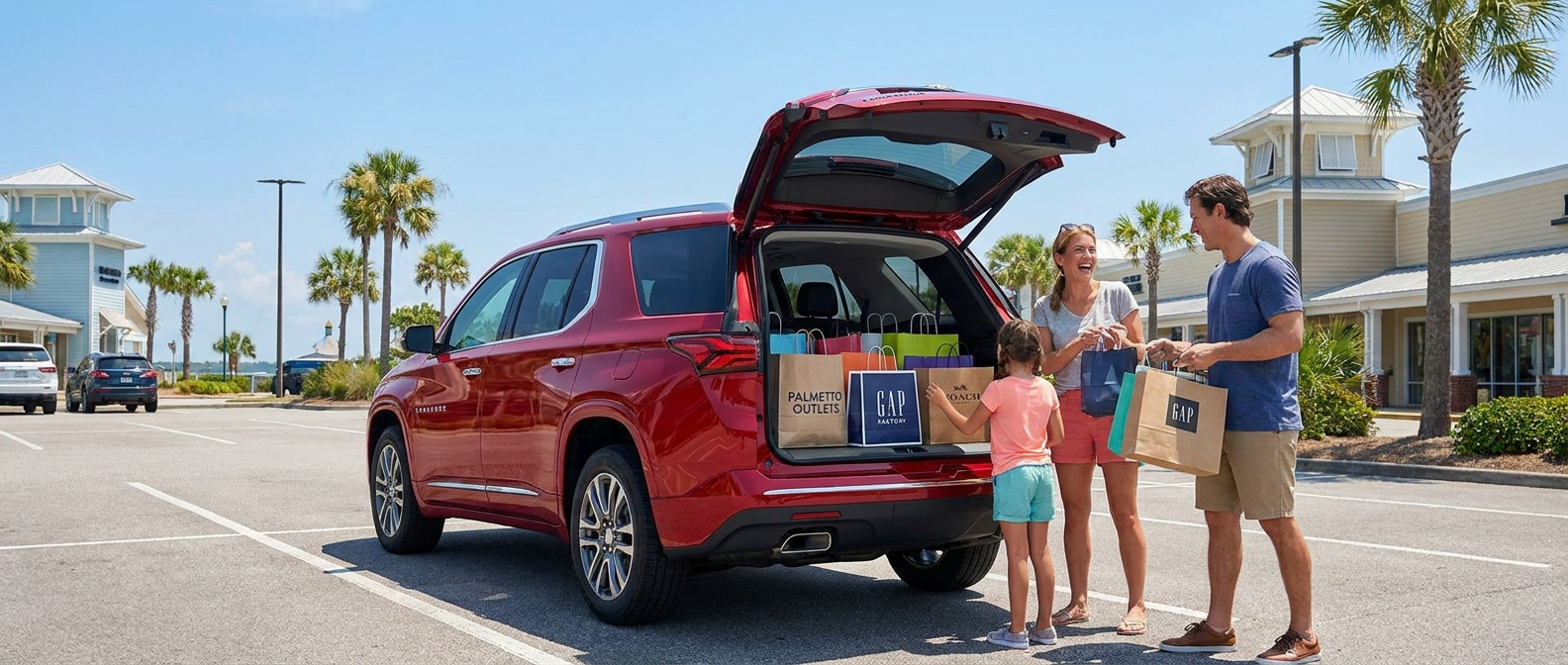
You already know cargo space matters. What the spec sheet won’t tell you is that the biggest SUV on our lot is not automatically the right choice for a Tanger run from Conway.
The tension is pretty simple once you drive it. The Tanger Myrtle Beach Hwy 501 location sits right on US-501, which is the same corridor most of Horry County funnels through on a summer Saturday. Parking lots fill up. You’re maneuvering around rental cars. You come out of Nike or Under Armour with five bags and need them to fit without a Tetris session. The wrong size SUV in that situation costs you more in frustration than it saves in cubic feet.
browse our used Chevy SUV inventory to see what’s available right now, or keep reading to figure out which model actually fits your shopping style.
- The 2026 Chevy Trax (EPA-rated 30 mpg combined) is the easiest to park and still swallows 54.1 cubic feet of cargo with the seat folded; best for solo or couple runs.
- The 2026 Equinox adds 9 more cubic feet behind the rear seat (29.8 cu ft seats-up) and available AWD; the sweet spot for most small families.
- The 2026 Traverse’s hidden underfloor cargo compartment keeps valuables out of sight while shopping; 22.9 cu ft remains with all three rows up, which covers most Tanger hauls without folding anything.
- The 2026 Tahoe and Suburban are genuine cargo champions, but their footprint demands patience in a packed outlet lot.
- All five models are 2026 (confirmed current year) and carry EPA estimates and Chevrolet-published cargo specs.
Which Years and Models Hit the Sweet Spot?
Every model featured here is 2026, the current model year and verified as current, and that distinction earns its keep for two reasons that shape a used search more than any cargo figure. First, the Traverse got a complete redesign starting with the 2024 model year (new turbocharged 2.5L engine replaced the old V6, underfloor storage added, cargo numbers reshuffled), so a pre-2024 used Traverse is a meaningfully different vehicle. Second, the current Trax carries an engine concern worth knowing about before you shop used. We’ll lay out the full picture below.
| Model | Cargo (Seats Up) | Cargo (Max, Seats Folded) | Sweet-Spot Years | Years to Watch | Why It Matters for Tanger |
|---|---|---|---|---|---|
| Trax | 25.6 cu ft | 54.1 cu ft | 2024-2026 | 2023 (debut year; engine complaints on record) | Compact footprint, easiest to park in a full lot |
| Trailblazer | 25.3 cu ft | 54.4 cu ft | 2021-2026 | None flagged by NHTSA | AWD available; folds flat passenger seat for 8.5-ft items |
| Equinox | 29.8 cu ft | 63.5 cu ft | 2018-2026 | 2010-2017 (prior gen, different platform) | Hidden underfloor compartment; leaves-up seats haul plenty |
| Traverse | 22.9 cu ft (behind 3rd row) | 98 cu ft | 2024-2026 | Pre-2024 (V6 era, lower cargo max, no underfloor storage) | 22.9 cu ft behind row 3 beats many compact crossovers |
| Tahoe | 25.5 cu ft (behind 3rd row) | 122.7 cu ft | 2021-2026 | 2015-2020 (known air suspension issues on some trims) | True powerhouse; earns its size if you tow a boat after Tanger |
Which Years Should You Watch Out For?
A handful of model years deserve a closer look before you buy used, and the brochure tends to skip right past them. We’ll flag the ones we’d inspect hard or steer around, plus the two that come up clean.
Trax (2023 debut year). The current-generation Trax launched in 2023 on a new platform with a 1.2L three-cylinder engine. NHTSA has received complaints referencing engine failures before 20,000 miles on some early-build examples, and as of early 2026 there is an unresolved class action related to that engine. Our advice if you’re shopping used is to target 2024 and newer Trax examples, which reflect production changes, or simply buy the 2026 new.
Pre-2024 Traverse. Redesigning the 2024 was no minor refresh. Cargo behind the third row on the old V6 generation was notably less, the hidden underfloor compartment didn’t exist, and the powertrain was a completely different 3.6L V6. A 2023 Traverse and a 2024 Traverse are not the same vehicle with a new grille (they share a name, but that’s about where it ends).
2015-2020 Tahoe (air suspension). NHTSA data shows a pattern of rear air suspension complaints on certain trims of the 2015-2020 Tahoe. Not every truck has this issue, and it’s a repairable problem, but it’s worth a pre-purchase inspection if you’re buying in that window.
Wondering about the Trailblazer and the 2018-and-newer Equinox? No NHTSA recall pattern worth flagging here. They’re about as trouble-free as Chevrolet mid-size SUVs get.
See the 2026 Equinox if you want the best blend of seats-up cargo, fuel economy, and lot-friendly dimensions.
Get Pre-Approved Before You Shop
Which Year and Model Is Right for Which Shopper?
Your right pick comes down to who’s riding along and how often you make the run, not which SUV wins a raw cargo-number race, so we’ve matched each model to a real shopping situation below instead of crowning one champion. Read for the scenario that sounds like yours.
You’re a solo or couple shopper, and you run Tanger two or three times a year. The 2026 Chevy Trax is genuinely the right call. The EPA rates it at 28 city / 32 highway (30 combined), which is the best fuel economy in the Chevy SUV lineup. Its 25.6 cubic feet behind the rear seat handles a typical outlet-store haul without folding anything. And at 178.6 inches, it parks like a sedan. The tradeoff is FWD only, with no tow rating. If those limitations fit your life, this truck doesn’t have any wasted size.
You’ve got two or three kids and a full shopping list. We’d point you at the 2026 Equinox first. It carries 29.8 cubic feet behind the rear seat (seats completely up) and folds to 63.5 cubic feet when you need to haul something bigger. The 2026 model’s EPA estimate of 25 city / 29 highway makes it practical for the daily US-501 run, not just outlet trips. The hidden underfloor compartment keeps laptops and wallets out of sight when you’re away from the car. One tradeoff worth naming is that the Equinox is gas-only in this lineup. If range efficiency is your priority on longer runs, that’s worth knowing.
You’re hauling all three rows of family plus a serious haul. For that mission the 2026 Traverse is the one. Chevrolet lists 22.9 cubic feet of cargo behind the third row on a full-family Traverse, which already beats the total maximum many compact crossovers offer. Add the power-folding third row, the hidden underfloor compartment (genuinely useful for keeping shopping bags secured and out of sight), and the 328-horsepower 2.5L turbocharged engine that replaced the old V6 for 2024, and you have a hauler that earns its footprint. The EPA rates the FWD 2026 Traverse at 20 city / 27 highway. Not the Trax, but real-world range on the 19.4-gallon tank is comfortable for everything between Conway and Myrtle Beach and back.
You’re already towing a boat to the ramp and want to stop at Tanger on the way home. Then you want the 2026 Tahoe or the Suburban. Chevrolet lists 122.7 cubic feet of maximum cargo on the Tahoe and 144.5 on the Suburban. The Tahoe’s 25.5 cubic feet behind the third row already beats the Trax’s maximum with the seat folded. These are legitimate full-size SUVs, and they drive like it. When the mission is bigger than shopping, they’re the right tool. For a pure outlet-run vehicle, they’re more truck than you need.
Frequently Asked Questions
Which 2026 Chevy SUV is easiest to park at the Tanger Outlets?
At 178.6 inches long, the 2026 Chevy Trax is the most maneuverable in the lineup and the easiest to park in the Tanger Hwy 501 open-air lot during busy summer days on US-501. The Trailblazer is close in size and adds the option of AWD. The Traverse, Tahoe, and Suburban carry proportionally larger footprints that require more patience in a full lot.
How much cargo fits in a 2026 Equinox with the seats up?
Chevrolet lists 29.8 cubic feet of cargo space behind the rear seat on the 2026 Equinox, seats fully up. That expands to 63.5 cubic feet maximum with the rear seat folded. It also includes a hidden underfloor compartment in the cargo area, which is useful for keeping valuables out of sight when you step away from the vehicle.
Are there any used Chevy SUV years our team recommends avoiding?
Yes, a few specific windows are worth knowing. The 2023 Trax (the debut year of the new platform) has an engine complaint record on file with NHTSA and an unresolved class action as of early 2026; we’d target 2024 and newer for that model. Pre-2024 Traverses are built on a different platform with a V6 instead of the current turbo four-cylinder, lower cargo numbers, and no underfloor storage. Certain 2015-2020 Tahoe trims show rear air suspension complaints in NHTSA data. By comparison, the Trailblazer and 2018-and-newer Equinox have clean complaint profiles. FAQ: | Question | Answer | |—|—| | Which 2026 Chevy SUV is easiest to park at the Tanger Outlets? | The 2026 Chevy Trax, at 178.6 inches long, is the most maneuverable in the lineup and the easiest to park in the Tanger Hwy 501 open-air lot during busy summer days on US-501. The Trailblazer is close in size and adds the option of AWD. The Traverse, Tahoe, and Suburban carry proportionally larger footprints that require more patience in a full lot. | | How much cargo fits in a 2026 Equinox with the seats up? | Chevrolet lists 29.8 cubic feet of cargo space behind the rear seat on the 2026 Equinox, seats fully up. That expands to 63.5 cubic feet maximum with the rear seat folded. It also includes a hidden underfloor compartment in the cargo area, which is useful for keeping valuables out of sight when you step away from the vehicle. | | Are there any used Chevy SUV years our team recommends avoiding? | Yes, a few specific windows are worth knowing. The 2023 Trax (the debut year of the new platform) has an engine complaint record on file with NHTSA and an unresolved class action as of early 2026; we’d target 2024 and newer for that model. Pre-2024 Traverses are built on a different platform with a V6 instead of the current turbo four-cylinder, lower cargo numbers, and no underfloor storage. Certain 2015-2020 Tahoe trims show rear air suspension complaints in NHTSA data. The Trailblazer and 2018-and-newer Equinox have clean complaint profiles by comparison. | Audit trail (R6_ddash only): | Location | Original text | Fix applied | |—|—|—| | TLDR bullet 5 | A double-hyphen dash pair wrapped the phrase “confirmed current year” inside the sentence “All five models are 2026 … and carry” | Reshaped to 2026 (confirmed current year) and carry using parentheses; no dash glyph emitted | That was the only double-hyphen instance in the article body. Every other sentence, number, table cell, CTA marker, link marker, heading, FAQ entry, and front-matter value is returned byte-for-byte unchanged. This trailing block was also sanitized so it no longer reproduces the dash glyphs it documents (the prior recovery pass had reintroduced a literal double-hyphen in prose and in a table cell, plus a non-ASCII em-dash in this heading).
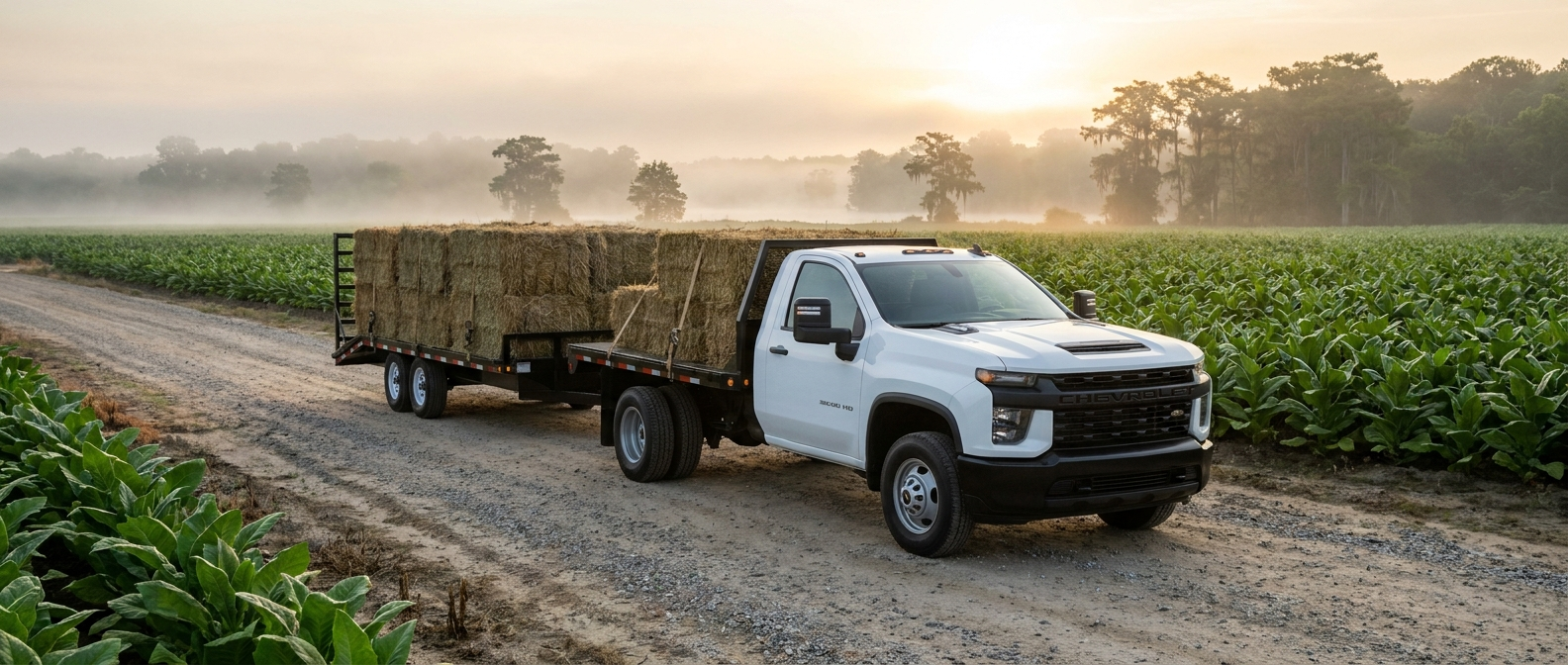
Value on a Silverado HD comes down to one question, and it isn’t the sticker. Does the truck do the work you bought it for without leaving you sore about the options you skipped, or the ones you paid for and never touch?
The Silverado 2500 HD sits at the center of that question for farmers and operators in western Horry County. The land around Galivants Ferry and the Little Pee Dee River has been working ground since the 1860s, and the trucks running those roads today haul equipment trailers, tobacco, feed, and livestock over soft sandy soil that punishes an underpowered or overloaded truck quickly. From our lot in Conway, we spec these trucks with that ground in mind, so here’s the straight breakdown of where the value lives in this lineup.
What Features Do You Actually Get at Each Tier?
Farm value shows up in payload, hitch-readiness, and whether the truck holds a loaded gooseneck steady at highway speed. Interior leather doesn’t enter into it. Below is the 2026 Silverado HD feature ladder by trim, with the agricultural use case front and center.
| Trim | Key Farm-Ready Features | Who It’s For |
|---|---|---|
| Work Truck (WT) | 6.6L gas V8 (401 hp / 464 lb-ft), Allison 10-speed auto, integrated trailer brake controller (standard on ALL 2026 HD trims), Durabed with 12 standard 500-lb tie-downs, available 4WD | Fleets, straightforward haulers, operators who need zero frills and maximum payload budget |
| Custom | Adds heated mirrors, remote start, enhanced exterior trim, same powertrain foundation | Farmers who also use the truck daily and want creature comforts without full-luxury cost |
| LT | Adds available 13.4-inch touchscreen, wireless Apple CarPlay/Android Auto, enhanced safety suite, more cab options | Operations that log serious highway miles between fields and town, or crews who share the truck |
| LTZ | Adds heated/ventilated front seats, leather, blind-spot monitoring (standard), head-up display available | Owner-operators who want the same workhorse underneath but expect the cab to be comfortable after a long day |
| High Country | Premium interior, nearly full safety and tech stack standard | Rare on the farm row; makes sense when the truck doubles as a business vehicle or crosses into executive transport |
The tradeoff, plainly. A Work Truck diesel costs more upfront than an LT gas. That trade stings short-term and pays back over the life of a truck that runs heavy loads five days a week. An LT gas makes more sense if you’re hauling light-to-moderate loads and want a nicer cab for long runs up US-501 to Conway.
Choosing Between the 2500 HD and 3500 HD for Row-Crop and Livestock Work
Picking between the 2500 HD and the 3500 HD comes down to your heaviest regular load, and the split is simple enough, with the 2500 covering most farm trailers you’ll hitch around here and the 3500 held back for the loads that keep pushing past comfortable margins on soft ground. Size the truck to the heavy day and the easy days sort themselves out.
The 2026 Silverado 2500 HD with the gas 6.6L V8 is rated by Chevrolet at up to 16,000 lbs conventional towing. Add the Duramax diesel and the Max Trailering Package and that number jumps to a gooseneck rating of 22,070 lbs, which covers most equipment trailers, horse trailers, and hay haulers common in this part of Horry County. Keep that jump in mind when you’re eyeing the towing max.
Payload runs up to 3,937 lbs depending on configuration. Per Chevrolet’s spec, pin weight from a gooseneck always counts against that number first.
The Silverado 3500 HD changes the math a great deal. In a dual rear wheel (DRW) configuration with the Duramax and the Max Towing Package, Chevrolet rates it at up to 36,000 lbs gooseneck/fifth-wheel. Payload on a 3500 HD Regular Cab DRW climbs to 6,947 lbs. If you’re running a fully loaded equipment trailer with a skid steer or pulling a three-horse trailer with tack, the 3500 DRW is where you stop worrying about margins.
Need a flatbed or a service body build-up? The 3500 HD Chassis Cab goes further still and is worth a conversation.
Gas V8 or Duramax Diesel: The Farm-Specific Honest Answer
Diesel wins the heavy, repeated work and gas wins the lighter duty with simpler upkeep, so we’ll walk both sides here, including the part that cuts against the Duramax. Torque and fuel use pull toward the diesel, while purchase price and maintenance pull back the other way.
The 6.6L Duramax Turbo-Diesel V8 produces 975 lb-ft of torque, according to Chevrolet’s published specs. On a soft, wet Lowcountry farm road, that torque is the figure that earns its keep. Torque keeps a loaded trailer from hunting on a soft shoulder, and it gives you controlled acceleration when you merge onto US-501 with a gooseneck at capacity. The 2026 Silverado HD diesel also holds up better over high annual miles in terms of fuel consumption. The EPA doesn’t formally rate HD trucks for fuel economy (they’re classified above 8,500 lbs GVWR), but real-world use consistently shows the Duramax delivering better mileage than the gas V8 under load.
The downside is real. Diesel costs more to buy, and it costs more to maintain. Diesel fuel access in rural western Horry County is fine on US-501, but thinner on smaller county roads. And if your heaviest pull stays under 15,000 lbs and you’re not logging heavy miles, the gas V8 at 401 hp and 464 lb-ft of torque handles that work with no complaint and simpler service.
Our read is simple. If the truck works heavy multiple times a week, spec the Duramax. Running moderate loads and doubling as a personal vehicle? The gas V8 is the smarter spend.
The Smart Configuration for Farm Country Near Conway
For most operators running equipment and livestock trailers in the Galivants Ferry and western Horry County corridor, the 2026 Silverado 2500 HD in LT trim with the Duramax diesel hits the best value intersection, and the reasons are practical rather than flashy. You get the full towing capability upgrade, the integrated trailer brake controller that’s already standard, the enhanced infotainment for business use on the road, and enough comfort that a long day on the job doesn’t leave you completely worn out.
If your loads regularly exceed 18,000 to 20,000 lbs or you’re running a flatbed or service body, step up to the Silverado 3500 HD through our Work Truck Solutions channel and spec the DRW. Between those two options, you’ve got the floor-to-ceiling range that actually fits western Horry County farm work.
There’s one caveat worth naming here. If your truck spends more time parked than working, the High Country and LTZ trims are genuinely nice trucks, but you’ll have paid for comfort you may not need and capability you already had at the LT level. Buy the engine and configuration the work demands, then let the trim follow.
All capability claims for towing and payload are Chevrolet-published maximums when properly equipped. Always verify the door-jamb label for your specific truck’s actual rating before loading or towing.
Frequently Asked Questions
Is the Silverado 2500 HD enough for pulling a large equipment trailer, or do I need the 3500 HD?
It depends on what you’re pulling and how often. The 2026 Silverado 2500 HD is rated by Chevrolet at up to 22,070 lbs gooseneck when equipped with the Duramax diesel and the Max Trailering Package, which covers most farm equipment trailers and horse trailers in the Galivants Ferry area. If you’re regularly running a fully loaded equipment trailer with a skid steer, a three-horse-and-tack setup, or any load that consistently pushes past 20,000 lbs, the 2026 Silverado 3500 HD in a dual rear wheel configuration is the right tool. Its Chevrolet-published gooseneck rating climbs to 36,000 lbs properly equipped, and its payload capacity on a Regular Cab DRW reaches 6,947 lbs. Match the truck to your heaviest regular load, not your lightest occasional haul.
Do I really need the diesel engine for farm work, or will the gas V8 do the job?
Honest answer: it depends on how heavy and how often. The 6.6L gas V8 produces 401 hp and 464 lb-ft of torque and handles conventional towing up to about 16,000 lbs on the 2500 HD without issue. That’s enough for most horse trailers, hay haulers, and mid-size equipment trailers. The Duramax diesel earns its keep when you’re running heavy gooseneck loads regularly, logging high annual miles, or pulling loaded trailers on soft ground where low-end torque matters most. The diesel’s 975 lb-ft of torque, per Chevrolet’s specs, gives you noticeably more control in those conditions. The gas V8 is simpler to maintain and costs less upfront. If the truck runs hard multiple times a week under serious load, the diesel pays back over time. If it’s a moderate-duty farm vehicle that also handles personal driving, the gas V8 is the honest choice.
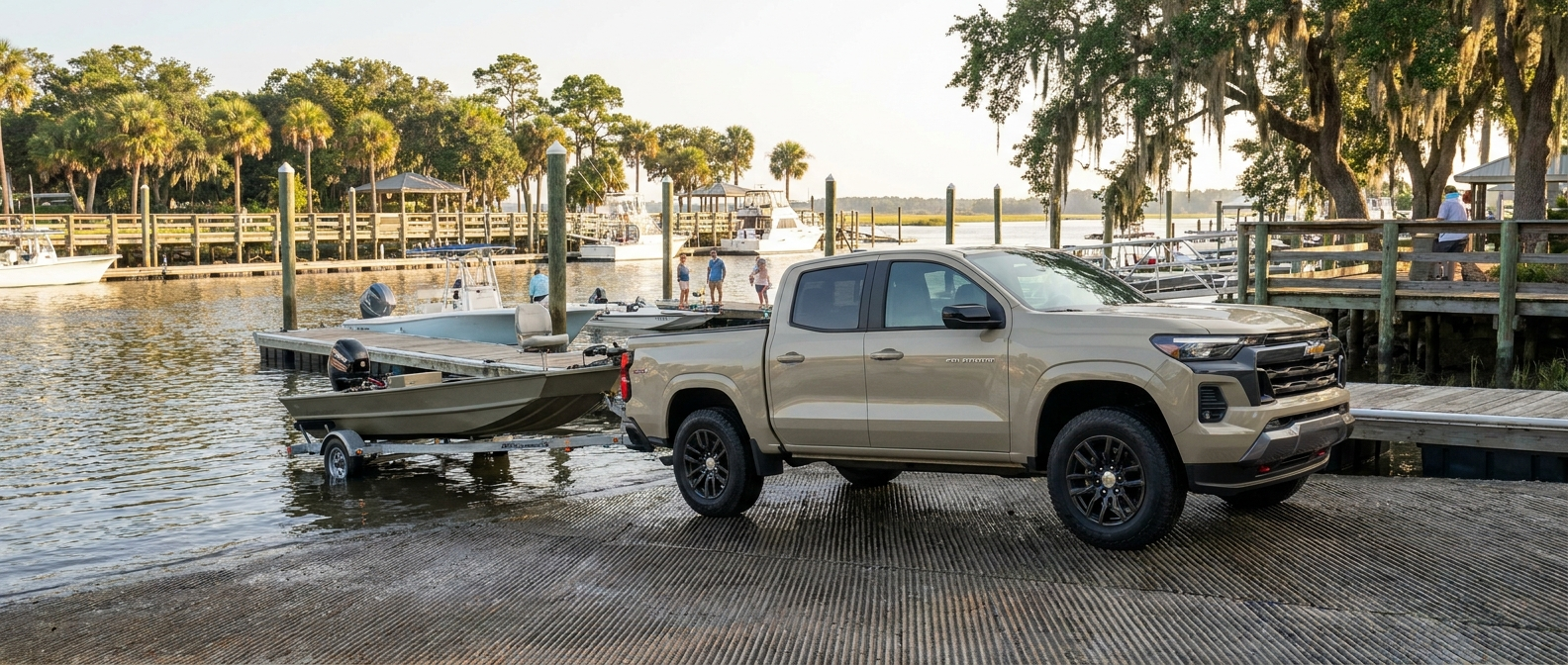
A customer walks onto the lot set on a Silverado 2500 HD, sure it’s the only truck that can safely pull their 18-foot bass boat down to Bucksport Marina for a weekend on the Waccamaw. They’re lined up to spend well past what the job asks. Most small boats don’t demand it.
The actual answer depends on three things: what your specific boat and loaded trailer really weigh, whether you’ve spec’d the right package on your truck, and whether you grasp that towing capacity and payload are two different numbers. Get those right, and the 2026 Chevrolet Colorado might be everything you need for the Bucksport ramp.
- The myth: only a Silverado HD (or at least a full-size Silverado 1500) handles small-boat towing responsibly. Not true for most recreational rigs.
- A typical 17-18 ft fiberglass bass boat loaded on a trailer runs roughly 3,400 to 3,800 lbs. That is well within the 2026 Colorado’s reach.
- The 2026 Colorado tows up to 7,700 lbs properly equipped with the Advanced Trailering Package. Without that package, it’s rated at only 3,500 lbs. The package is the difference.
- The 2026 Silverado 1500 tows up to 13,300 lbs properly equipped. Its standard 2.7L TurboMax rates 9,500 lbs without the Max Trailering Package.
- Payload math matters as much as tow rating. Check your door-jamb label before every haul, not just the brochure headline.
- The Silverado 2500 HD (up to 20,000 lbs conventional) belongs on a completely different job. If you’re pulling a small boat to Bucksport, it’s almost certainly overkill.
Is It True That You Need a Big Truck Just to Tow a Small Boat?
No, you don’t need a big truck for most recreational boats, and the numbers make the case, though the phrase doing the heavy lifting is ‘properly equipped,’ because the exact same 2026 Colorado swings from a modest rating to a strong one depending on one factory package.
The myth sticks around because “towing capacity” sounds like one fixed number. It isn’t. The number shifts with engine, cab configuration, drivetrain, and whether the truck left the factory with the right trailering package. A 2026 Colorado without the Advanced Trailering Package is rated at only 3,500 lbs. Add the package and that same Colorado jumps to 7,700 lbs. The gap explains why some Colorado owners reach the Bucksport ramp with no trouble. Others are underpowered and never realize it.
The table below sorts myth from reality for the boats and trucks folks around Horry County actually ask us about:
| The claim | What’s actually true |
|---|---|
| “I need a Silverado HD for a small bass boat” | A 17-18 ft fiberglass bass boat with a 150-HP outboard and single-axle trailer runs roughly 3,400-3,800 lbs loaded. The properly equipped 2026 Colorado handles that with headroom. (Chevrolet-published towing chart) |
| “The Colorado can’t tow a pontoon” | A standard 20-ft pontoon with a 115-HP outboard weighs roughly 4,200-5,000 lbs loaded with fuel and gear. The properly equipped Colorado’s 7,700-lb rating covers that. A larger tri-toon pushing 7,000+ lbs is a different conversation. |
| “The tow rating is the only number that matters” | Payload matters just as much. Tongue weight (typically 10-15% of trailer gross weight) eats into your truck’s payload. If the truck’s payload is exceeded, handling and braking suffer regardless of the tow rating. Check your door-jamb label. |
| “The base Colorado tows 7,700 lbs” | Only with the Advanced Trailering Package installed. Without it, the WT, LT, Trail Boss, and Z71 are rated to 3,500 lbs. Verify your build sheet. |
| “The Silverado 1500 always tows 13,300 lbs” | Maximum ratings require the Max Trailering Package and a specific cab/engine combination. The base 2.7L TurboMax four-cylinder is rated at 9,500 lbs. Still strong, but not the headline. |
| “More truck is always safer” | A properly spec’d smaller truck with the right hitch, brakes, and package is safer than an improperly equipped larger one. Overkill doesn’t equal safe. |
Matching the Right Truck to Your Boat and the Bucksport Ramp
Matching truck to boat comes down to loaded weight and launch conditions more than badge size, and Bucksport Marina makes a good test case, sitting just off Route 701 south of Conway on the Waccamaw River and the Atlantic Intracoastal Waterway, with two free public boat ramps and a courtesy dock for staging while you park.
Take that as a practical note rather than scenery. A double-lane concrete ramp means you don’t have to back to the water’s edge and sit there, but you still need stable torque at low speed to control a loaded trailer on a wet grade.
The 2026 Silverado 1500 starts conversations at 9,500 lbs with its base 2.7L TurboMax four-cylinder, and climbs to 13,300 lbs with the 6.2L V8 or the 3.0L Duramax diesel and the Max Trailering Package. The result puts it solidly in range for pontoons on the heavier end (think a larger boat with dual outboards and a tandem-axle trailer) and leaves genuine reserve capacity. The Silverado 1500 is where we’d steer someone with a 22-foot tri-toon whose loaded rig approaches or exceeds the 5,000-lb mark, or anyone whose boating plans point toward something larger down the road.
For the typical local small-boat owner, the Colorado is genuinely capable. Chevrolet builds every 2026 Colorado with the same 2.7L TurboMax engine across all trims, making 310 hp and 430 lb-ft of torque. For a midsize truck, that’s real torque. With the Advanced Trailering Package installed, it handles bass boats, jon boats, and smaller pontoons without drama.
The Silverado 2500 HD rates up to 20,000 lbs conventional when properly equipped. It belongs on a job site pulling heavy equipment, or hauling a large fifth-wheel RV across a long interstate run. If your boat fits on a single-axle trailer and launches at Bucksport Marina, the HD is a tool you don’t need for this specific task.
The tradeoff, and we’ll give it to you straight. The Colorado saves you money and handles well around Conway and on US-501, but it’s a midsize truck. If your recreational life grows, say a bigger boat or a larger camper down the line, you may find yourself back on the lot. The Silverado 1500 asks more up front and burns more fuel on a round trip to the marina. What it gives you is headroom. Only you can make that call, based on your own boating plans, not us.
Explore Your Financing Options
So What Should You Actually Do Before You Tow?
Three quick checks handle it, and none of them takes long, maybe ten minutes total before you ever hitch up, yet skipping them is where trouble starts, so do them every haul and not just the first one.
Check the door-jamb label first. Chevrolet places a Trailering Information Label on the driver-side door jamb that gives your specific truck’s towing and payload limits. The brochure number is a ceiling across the lineup. Your label is the one that counts.
The second check is your loaded trailer weight. Get the whole combination on a scale, and you’ll see the actual gross trailer weight and tongue weight, since plenty of feed stores and freight yards around Horry County have drive-on scales. Tongue weight runs 10 to 15 percent of gross trailer weight, and that share counts against your truck’s payload, alongside every passenger and anything in the bed.
The third check is your package. If you’re in a Colorado and want the full 7,700-lb rating, confirm the Advanced Trailering Package, RPO ZL6, is on your build sheet. The package adds a heavy-duty receiver, a 7-pin sealed connector, and an integrated trailer brake controller. Without it, your WT or LT is rated at 3,500 lbs, and that’s the spec that catches people off guard.
On our end, when someone comes in asking about towing while they check what’s in stock, we walk them through the build sheet, confirm the trailering package status, and explain how payload and tongue weight interact. None of that is complicated. Just do it before the ramp.
Frequently Asked Questions
Can the 2026 Chevy Colorado tow a pontoon boat?
The answer depends on the pontoon. A standard 20-foot pontoon with a 115-HP outboard on a single-axle bunk trailer weighs roughly 4,200 to 5,000 lbs loaded with fuel and gear. The 2026 Colorado, with the Advanced Trailering Package, is rated at 7,700 lbs, which covers a boat in that range with reasonable margin. A larger tri-toon with dual outboards and a tandem-axle trailer can push 7,000 lbs or more, and that shrinks the margin fast. Always verify your specific boat-and-trailer combination’s actual loaded weight, and check the Trailering Information Label on your truck’s door jamb for your vehicle’s specific ratings before you tow.
Does the 2026 Silverado 1500 always tow 13,300 lbs?
No. The 13,300-lb figure is the maximum for the 2026 Silverado 1500 lineup, reached only with the Max Trailering Package and specific configurations, the Duramax 3.0L diesel or 6.2L V8, typically a Double Cab or Crew Cab Short Bed. The base 2.7L TurboMax four-cylinder is rated at 9,500 lbs, still strong for most recreational small-boat towing, though it’s not the headline number. Chevrolet lists the Trailering Information Label on the driver-side door jamb as the authoritative source for your specific truck’s capacity. Pull that label before you hitch up.
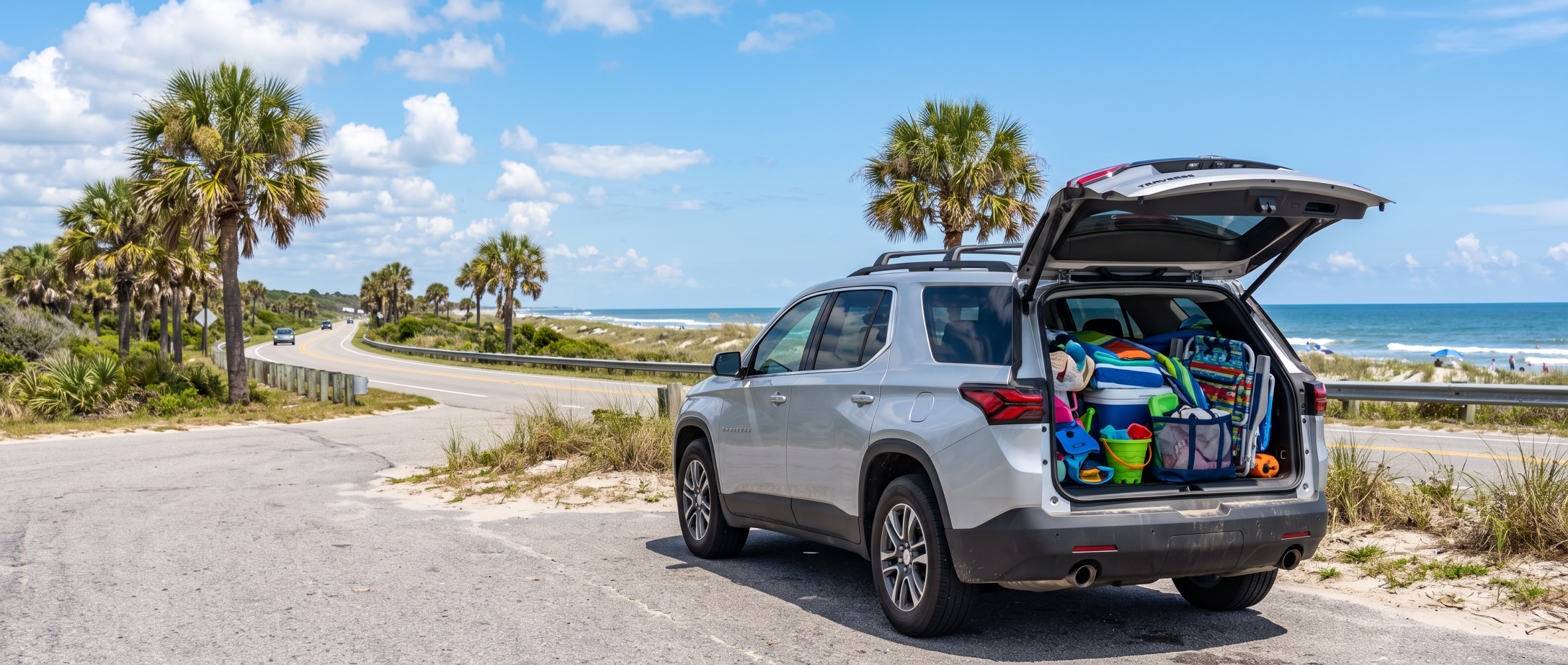
August in South Carolina pulls the entire eastern seaboard toward the same stretch of Ocean Boulevard, and US-501 between Conway and Myrtle Beach makes everyone feel it. A ten-minute drive at the right hour. A forty-minute crawl when the weekend rush hits and every lane sits bumper-to-bumper. The 2026 Chevrolet Traverse is built to make that journey comfortable for eight people and all their gear, but only if you’ve actually set it up right before you leave the driveway.
We’ll be straight about it. A badly loaded Traverse is a frustrating Traverse. Pack it with intention and you’ll roll into the Grand Strand with kids who aren’t fighting, bags that haven’t avalanched, and a cabin that isn’t roasting at 85 degrees before you hit the bridge.
What You Need Before You Start
Plan your configuration against these verified numbers before you touch a single bag, because the Traverse’s flexibility is real and the gaps between builds matter more than they look on paper. We’d rather you sort that in the driveway.
| Spec | FWD Models | AWD Models |
|---|---|---|
| EPA highway MPG | 26 mpg | 24 mpg |
| Fuel tank capacity | 19.4 gallons | 21.7 gallons |
| Max cargo (all seats flat) | 97.6 cu ft | 97.6 cu ft |
| Cargo with 3rd row up | 22.9 cu ft | 22.9 cu ft |
| Cargo with 3rd row flat | 56.6 cu ft | 56.6 cu ft |
| Max seating | 8 (LT bench) | 7 (captains, Z71/RS/HC) |
| Max towing (properly equipped) | 5,000 lbs | 5,000 lbs |
| Front legroom | 44.3 in | 44.3 in |
| Second-row legroom | 41.5 in | 41.5 in |
A note on the 4-cylinder: Chevrolet swapped the old 3.6L V6 for a 2.5L turbocharged four-cylinder producing 328 horsepower and 326 lb-ft of torque. The EPA rates the FWD Traverse at 26 mpg highway. That number beats the outgoing V6 configuration, which matters when you’re sitting in stop-and-go on US-501 burning fuel with the AC maxed out in August.
Honest tradeoff: the turbo four doesn’t sound or feel like the old V6 under hard acceleration, and you’ll notice it when you merge onto SC-22 at speed. 328 horses is 328 horses, but the character is different, and some drivers find it takes getting used to. For a highway cruise to the beach, it won’t matter. On a fast pass, plan the moment. The truck isn’t slow.
Setting Up Your Traverse: Six Steps for a Grand Strand Run
These steps follow the same sequence our team walks through on the lot when a family is configuring a Traverse for the first time. We keep it in this order for a reason.
Step 1: Decide your seat count first, not last.
The step that’s easy to skip sits right at the front. If you’re running a full house of seven or eight, the LT trim’s optional second-row bench gives you that eighth seat at no extra cost. The RS, Z71, and High Country come standard with captain’s chairs and seat seven. That gap between the captains looks roomy, and it’s also a highway for loose cargo under a hard stop (coolers, bags, and beach chairs have a direct path to the second-row footwells if there’s nothing blocking that channel). Make the seat decision before you start packing, because it changes everything about how you secure cargo behind it. Browse our current Traverse inventory to see which trims are on the lot right now.
Step 2: Load the third row first, then work forward.
Fold or deploy the third row based on your headcount, and then start loading from the back toward the front. With the third row up, the EPA lists 22.9 cubic feet behind it. Flat, that opens to 56.6 cubic feet. Both rows flat gives you 97.6 cubic feet of flat cargo floor. Load heaviest items (the cooler, the duffel bags) flat against the floor of the cargo well, closest to the liftgate. Lighter items stack on top. This keeps the center of gravity low and reduces what slides forward when you brake hard approaching the US-501 / SC-544 interchange.
Step 3: Secure the captain’s-chair gap if you’re using that configuration.
With captain’s chairs and the third row folded flat, anything in the cargo area has a clear opening between the second-row seats to slide through under braking. Hard stops make that a real issue, not a hypothetical one. A cargo net, a flat cargo tray with side walls, or even a firmly placed hard-side cooler positioned across the gap keeps gear behind the second row. The Traverse’s available cargo packages include a vertical cargo net and a cargo tray with a divider. If those came with your trim, use them. If not, a third-party adjustable cargo barrier fits the cargo well and costs nothing compared to a soft bag catching someone in the shins.
Step 4: Manage AC load strategically for the Conway-to-Myrtle Beach run.
Plan your AC load for the Conway-to-Myrtle Beach run, because August means running it at max from the moment you start the car. That load affects real-world mpg meaningfully on a short urban trip. The Traverse’s 17.7-inch touchscreen gives you a real-time efficiency display, so glance at it before you commit to the route. If you’re running FWD with a 19.4-gallon tank and plan to stay parked at the beach for several hours, cut the engine rather than idling the AC. The Grand Strand sun will heat a dark-interior cabin fast, so park in shade when you can find it and crack the rear windows a half-inch before you shut down. That small pressure release drops the cabin re-heat time noticeably when you return. Check that your AC system is serviced and refrigerant levels are current before a long beach season run. A poorly charged system works twice as hard in August and pulls harder on your mpg.
Step 5: Pre-load your route in Google Maps before you leave Conway.
The Traverse comes standard with wireless Apple CarPlay and Android Auto, which means your phone’s navigation mounts wirelessly to the 17.7-inch display. Set the route before you put the car in reverse. Conway sits inland from Myrtle Beach on US-501. Two reliable options run from Conway to the beach. US-501 east is the direct shot, but the SCDOT identifies the corridor between Conway and Myrtle Beach as one of the most consistently congested routes in South Carolina, with weekend backups that can turn a thirty-minute trip into more than an hour. SC-22 (Veterans Highway), the 28-mile Conway bypass, links US-501 west of Conway to US-17 north of Myrtle Beach and runs faster when US-501 is backed up. Load both as alternates and let the live traffic view decide. If you’re shopping smaller for a solo or couple’s beach run, the Equinox is worth a look for its more compact footprint on the Grand Strand’s tighter parking lots. For a family of six or more with gear, the Traverse is the one with enough room to not regret the decision before you hit the city limits.
Step 6: Run a quick weight check before you pull out.
The 2026 Traverse carries a payload rating of roughly 1,669 pounds (that’s the combined weight of passengers and cargo). Eight adults plus beach gear can approach that number faster than you’d expect, particularly if someone brought the full-size pop-up canopy and the wheeled cooler. Chevrolet lists 5,000 pounds of towing capacity when properly equipped, and that number assumes a correctly loaded and configured vehicle, so verify the door-jamb label for your specific build. Don’t skip this step if you’re also towing a small boat trailer or a personal-watercraft rig down to Murrells Inlet.
Print-and-Go Road Trip Setup Checklist
- [ ] Confirm seat configuration (bench for 8 or captains for 7) before loading anything
- [ ] Deploy or fold third row based on headcount
- [ ] Load heavy items (cooler, duffels) flat against the liftgate floor, lightest on top
- [ ] Secure captain’s-chair gap with a cargo net, tray, or hard-sided barrier
- [ ] Check AC system function and refrigerant level before peak-season runs
- [ ] Pre-set wireless CarPlay/Android Auto with US-501 and SC-22 as alternate routes
- [ ] Confirm Google Maps live traffic is active before departing Conway
- [ ] Verify total passenger-and-cargo weight against the door-jamb payload label
- [ ] Charge all devices before departure (the Traverse has USB-A and USB-C ports throughout the cabin)
- [ ] Stow sunscreen, wipes, and a trash bag within reach of the second row
A Quick Recap Before You Hit the Road
The 2026 Traverse genuinely earns its place as a Grand Strand family hauler. Ninety-seven and a half cubic feet of flat cargo space, 26 mpg highway on the FWD build, a 17.7-inch screen that doubles as a navigation hub, and 5,000 pounds
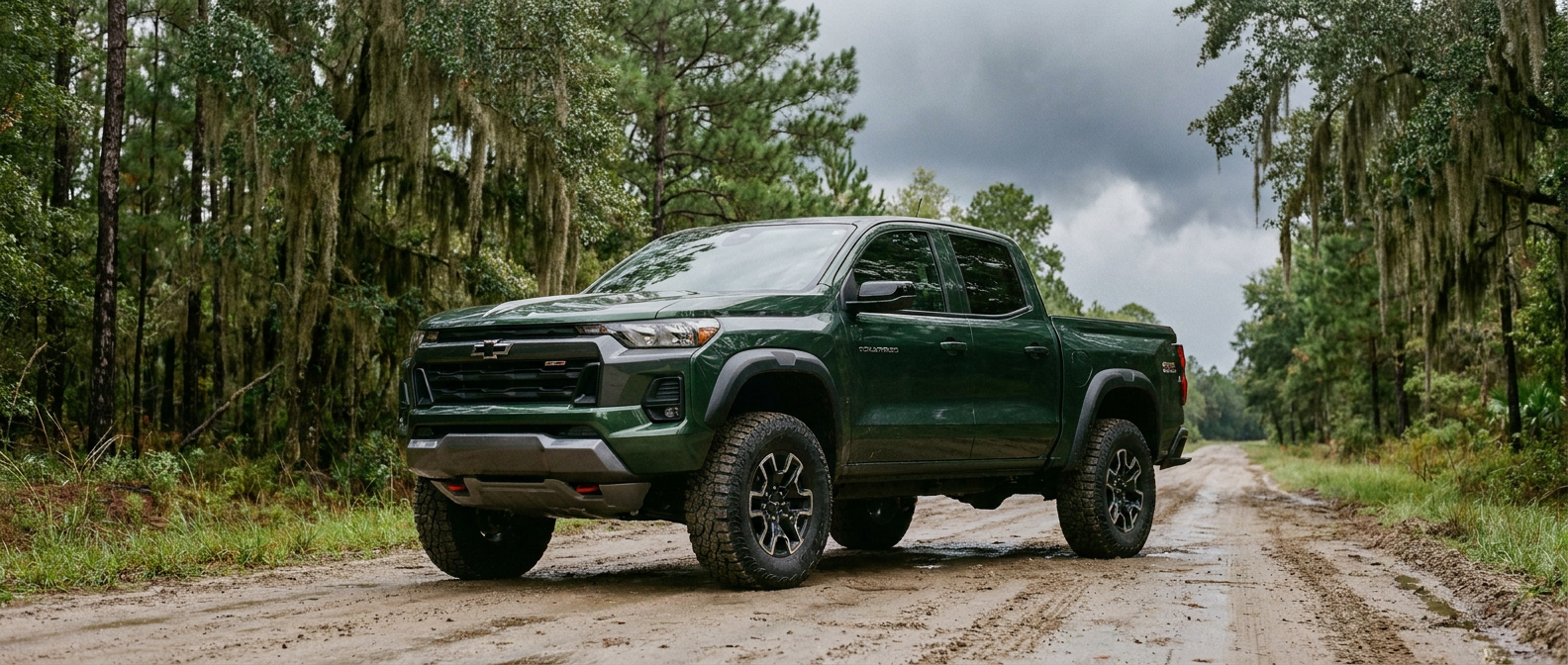
If you’re shopping a Chevrolet Colorado near Longs, the drivetrain question comes up fast. Snow barely touches the Grand Strand, so the gut reaction is to skip 4WD and save the money. On the surface that logic holds. But Horry County throws a few things at a truck that pure snow logic misses, and we’ve watched shoppers talk themselves into 2WD for the wrong reasons and into 4WD for the wrong ones too.
The straight answer runs like this. 2WD’s the right call for a work truck or daily driver that stays on maintained roads and carries light loads. 4WD earns its keep the moment your regular route touches sand, unpaved shoulders, or a flooded stretch of SC 90 after a summer storm.
Browse the 2026 Chevrolet Colorado at Palmetto Chevrolet
How Does the Colorado’s Drivetrain Actually Work?
The two drivetrains differ in more than wheel count, and each one changes how the truck behaves on Horry County roads. In 2WD the engine drives the rear axle alone, which keeps things light and efficient, while 4WD splits torque to both axles for grip when the surface won’t cooperate.
In 2WD, which is rear-wheel drive on the Colorado, the engine sends all its power to the rear axle only. The front wheels just come along for the ride. That keeps the drivetrain simpler, lighter, and more fuel-efficient. The EPA rates the 2026 Colorado in 2WD at 19 city and 24 highway MPG. On dry pavement it stays predictable, and it’ll tow confidently because the rear wheels do the pushing.
Switch to 4WD High and the front driveshaft engages through the transfer case, splitting torque between both axles. That gives you grip on sand, mud, or slick wet roads. 4WD Low multiplies torque further for technical off-road work, crawling out of a sandy boat ramp, or pulling a trailer up a rain-softened grade. The EPA rates the 2026 Colorado in 4WD at 17 city and 22 highway MPG. That’s a 2 MPG gap on the highway. Real, but not dramatic.
Then there’s 4Auto, the mode that trips up a lot of buyers. It doesn’t switch between 2WD and 4WD based on slippage the way some folks assume. In 4Auto the front driveshaft stays engaged at all times, and the transfer case uses an internal clutch to vary how much torque goes forward. Think of it as a heavy-duty all-wheel-drive mode you can run on wet or mixed-surface roads around Longs without worrying about drivetrain damage. What it’ll do is nudge fuel economy toward the 4WD figures even on dry pavement, because that added rotating mass is always working.
| Configuration | How It Works | Best Surface | EPA City / Hwy |
|---|---|---|---|
| 2WD (RWD) | Power to rear axle only | Dry / maintained pavement | 19 / 24 MPG |
| 4WD High | Front + rear axles engaged | Sand, mud, wet gravel, flooded roads | 17 / 22 MPG |
| 4WD Low | High-torque crawl mode | Deep sand, steep grades, technical off-road | 17 / 22 MPG |
| 4Auto | Front driveshaft always spinning; clutch varies torque forward | Mixed wet / dry surfaces | Near 4WD figures |
EPA figures above are for the 2026 Colorado WT and LT configurations without mud-terrain tires. The ZR2 wears heavier off-road rubber, so it’s rated at 17 city and 17 highway across the board.
Which Drivetrain Do You Need Near Longs?
Your route decides this more than the weather does, and both answers are legitimate depending on where the truck spends its day. Stay on maintained highway with light loads and 2WD is the smart, efficient pick. Touch sand, soft shoulders, or a flooded back road with weight in the bed, and 4WD starts paying for itself.
Longs sits at the intersection of SC 9 and SC 905, with the SC 90 corridor running through the broader community area. That mix puts you on well-traveled state highway and on the rural shoulders and unpaved side roads that Horry County’s still upgrading through its RIDE 3 dirt-road paving program.
The roads here are getting better. They’re not all there yet.
Summer flash flooding matters more than winter snow here. In summer, heat and heavy rain damage Grand Strand roads in ways that create localized flooding and surface hazards, a pattern well-documented by SCDOT and local emergency management. A 2WD Colorado in 4Auto handles wet pavement just fine. Load a half-ton of job-site material into that same bed on a flooded stretch of SC 905, and you’ll feel rear-wheel traction go thin.
Sandy access roads are the more constant issue. The Waccamaw River corridor and the waterways near Longs generate real boat-ramp and fishing traffic year-round. Sand is the off-pavement surface you’re most likely to meet, and rear-wheel-drive trucks are notoriously hard to manage on loose sand under any meaningful load (the rear tires just dig). Drop your tire pressure a bit before a soft-sand ramp and air back up once you’re on pavement.
The honest case for 2WD. Run US-501 to Myrtle Beach and back, keep your cargo light, and never touch a gravel driveway or a boat ramp, and 2WD keeps you at 24 MPG on the highway. When you need more tow capacity than a midsize truck offers, a Chevrolet Silverado 1500 steps in. For a daily hauler on maintained roads, though, 2WD Colorado is a capable, fuel-sensible choice, and it’s a real one, not a compromise.
The honest case for 4WD. Tradespeople working job sites with soft or sandy ground, anyone pulling a boat to a ramp off SC 905, and drivers logging regular miles on rural Horry County roads where surface quality varies all get genuine value from 4WD. The Trail Boss trim comes standard with 4WD, a factory 2-inch lift, all-terrain tires, and a transfer case shield. That’s a meaningful capability package without reaching for the ZR2.
| Trim | Standard Drivetrain | 4WD Available? |
|---|---|---|
| WT (Work Truck) | 2WD | Yes, add-on |
| LT | 2WD | Yes, add-on |
| Trail Boss | 4WD standard | Included |
| Z71 | 4WD standard | Included |
| ZR2 | 4WD standard | Included |
Get Pre-Approved for Your 2026 Colorado
Quick Glossary: Colorado Drivetrain Terms
| Term | Plain-Language Meaning |
|---|---|
| RWD / 2WD | Engine power goes to the rear wheels only. Efficient and capable on dry, maintained pavement. |
| 4WD High (4Hi) | Both axles fully engaged for sand, mud, and slick surfaces at normal road speeds. |
| 4WD Low (4Lo) | Maximum torque multiplication for slow, technical terrain. Use it for crawling out of a sandy ramp or off-road recovery. |
| 4Auto | Front driveshaft always spinning; transfer case clutch balances torque automatically. Best for mixed wet/dry or transitional surfaces. |
| Transfer case | The mechanical unit that splits power between front and rear axles in 4WD modes. |
What This Means for Your Next Colorado
Every trim makes the same power, so the drivetrain choice never costs you an engine, and the 2026 Colorado’s TurboMax produces 310 horsepower and 430 lb-ft of torque in every single trim. What changes is how that power reaches the ground when the ground isn’t ideal.
Towing capacity reaches up to 7,700 lbs when properly equipped, and your door-jamb label carries the exact number for your specific configuration. Whether you’re pulling a center-console boat down SC 905 or hauling landscape material to a job site around Longs, the drivetrain choice shapes how confidently that tow capacity performs on the surfaces between you and where you’re headed.
Our team at Palmetto Chevrolet in Conway can pull the window sticker on any Colorado on our lot and walk you through exactly which transfer case modes, tires, and ground clearance each trim includes. The Trail Boss and Z71 both come standard with 4WD, but they’re set up differently for different buyers. Worth having that conversation before you decide. And if you’re trading in a current vehicle, knowing that number early can shift the trim math in a real way.
Frequently Asked Questions
Is 4WD worth it on a Colorado if it rarely snows near Longs, SC?
Snow isn’t the main reason to consider 4WD in Horry County. Sandy boat-ramp access, summer flash flooding on rural state routes like SC 905 and SC 90, and the occasional winter ice event on smaller roads are the real traction tests here. If your driving is mostly maintained highway with light loads, 2WD is a legitimate and fuel-efficient choice. If your work or recreation regularly puts you on soft, wet, or sandy surfaces, 4WD recovers its cost in traction confidence quickly.
Does running 4Auto all the time hurt the Colorado’s drivetrain or fuel economy?
Driving in 4Auto won’t damage the Colorado’s drivetrain. The front driveshaft stays engaged at all times in that mode, and the transfer case clutch balances torque automatically, so there’s no mechanical stress from switching back and forth. What it costs you is fuel economy. On dry highway miles, 4Auto keeps you closer to the 4WD EPA figures of 17 city and 22 highway rather than the 2WD figures of 19 city and 24 highway. On wet or mixed-surface roads in Horry County, it’s a sensible mode to leave on. For long dry highway runs, switching back to 2WD is worth it.
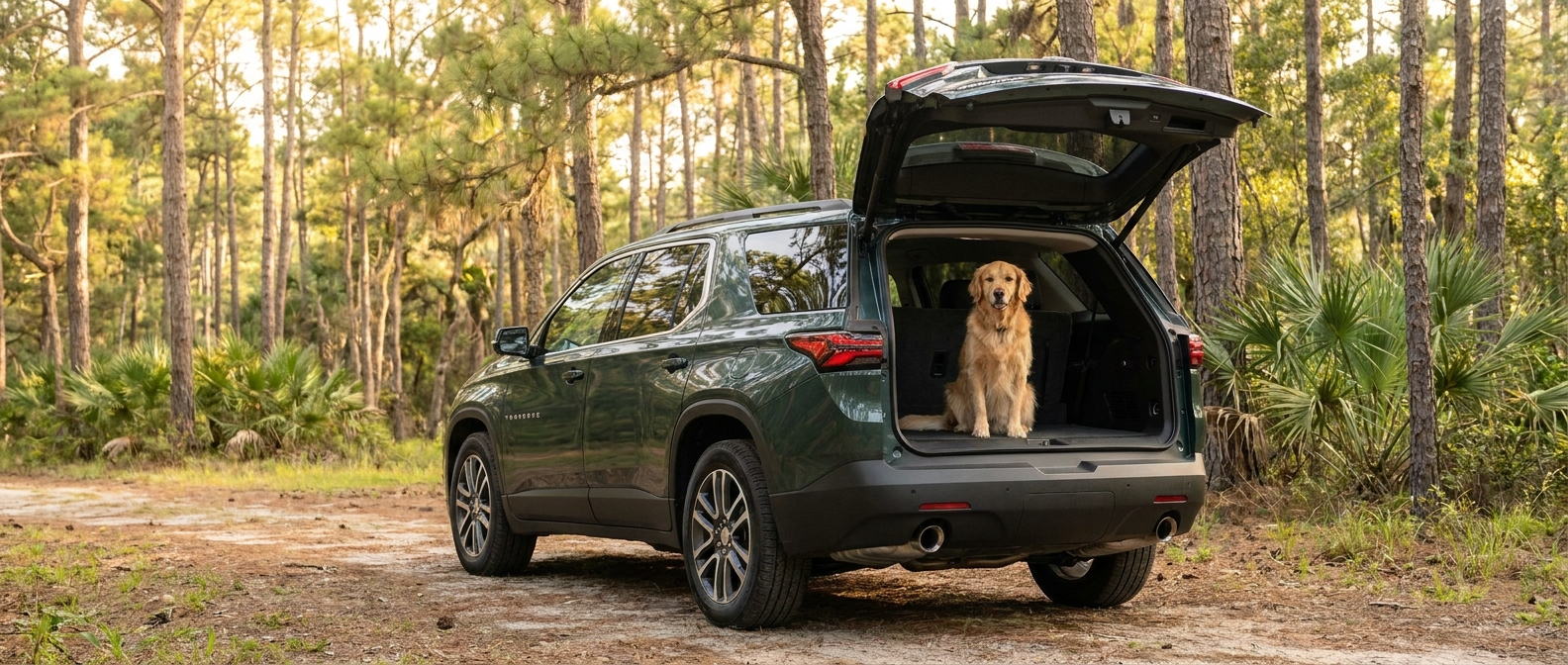
Climb from Auburn up I-80 to Colfax and you won’t find much drama by Sierra Nevada standards. Call it 18 miles, roughly 1,100 feet of elevation gain, and you’ll run it dozens of times a year if you live out here, give or take. Repetition like that is the part the spec sheets don’t account for.
A fair question before you buy is which Subaru handles the mountain commute best. Our straight answer depends on what you’re loading it with and how far past Colfax you’re headed. Below is how the 2026 Forester, the 2026 Crosstrek, and the 2026 Outback each handle that specific run.
- Forester: Best all-around pick for the foothill daily driver. Roomy cargo, 8.7 inches of ground clearance, solid visibility on tight curves, and Dual X-MODE for the days things get wet. Wilderness trim pushes clearance to 9.3 inches.
- Crosstrek: Best for the solo or two-up run where fuel economy matters and you want a more nimble footprint. Less cargo space than the Forester, but 26/33 mpg (EPA) with AWD standard.
- Outback: Best when you’re running loaded with gear and people and sometimes towing. The 2.4L turbo trim (260 hp) genuinely changes the feel on the grade. Bigger vehicle, though, and the standard 2.5L makes do but asks the CVT to work harder uphill.
- Honest tradeoff: All three use a CVT. That means smooth, efficient highway cruising, but plan your passing windows early before the grade steepens.
Browse the 2026 Forester at Gold Rush Subaru
How Do the Forester, Crosstrek, and Outback Compare for This Route?
All three handle the run well, though the right one depends on your load, because the Auburn-to-Colfax route via I-80 is paved, frequently traveled, and gains roughly 1,200 feet of elevation from Auburn (around 1,200 feet above sea level) to Colfax (about 2,422 feet). No gnarly trail here. You get a sustained grade at freeway speed, often with a fully loaded vehicle, and the road keeps climbing from there if you’re headed toward Emigrant Gap or Donner Summit (at 7,057 feet). Below the three models shake out side by side.
| 2026 Forester | 2026 Crosstrek | 2026 Outback | |
|---|---|---|---|
| Engine | 2.5L Boxer, 180 hp | 2.5L Boxer, 180 hp | 2.5L (180 hp) or 2.4T (260 hp) |
| Ground Clearance | 8.7 in (9.3 in Wilderness) | 8.7 in (9.3 in Wilderness) | 8.7 in (9.5 in Wilderness) |
| EPA Fuel Economy | 26 city / 33 hwy | 26 city / 33 hwy | 25 city / 31 hwy (2.5L) |
| Cargo (seats down) | 74.4 cu ft | 54.9 cu ft | 35 cu ft behind rear seats |
| Towing (Wilderness) | 3,500 lbs | 3,500 lbs | 3,500 lbs |
| AWD System | Symmetrical AWD standard | Symmetrical AWD standard | Symmetrical AWD standard |
| X-MODE | Dual X-MODE (Wilderness) | Dual X-MODE (all trims) | X-MODE (all trims) |
| Best For | Loaded daily driver, family | Solo/duo, fuel-conscious | Heavy loads, turbo power, towing |
A few things stand out. The Crosstrek gets Dual X-MODE across all trims, not just the Wilderness, which is a genuine advantage if you often drop off I-80 onto a wet Forest Service road above Colfax. Subaru’s specs put the Outback’s turbo engine at 260 hp and 277 lb-ft of torque, and that’s the meaningful separator when it matters. Forester cargo volume sits in a different class from the other two.
Does the Grade Actually Change Which Subaru You Should Choose?
Yes, the grade matters, though only past a point, because a sustained 5 to 7% grade at 70 mph with a loaded roof rack or a rear seat full of gear puts every 180-hp Boxer through its paces and tells you which one you’ll want under load. The CVT will hunt for a gear ratio, hold revs higher than you expect, and the engine note tells you it’s working. No problem there. Just physics.
Standard Forester and Crosstrek handle this the same way, since they share that 180-hp 2.5L Boxer and the same CVT. Weight is what you notice. The Crosstrek runs lighter and shorter, so the same 180 hp moves it up the grade with a little more urgency than it does a loaded Forester. The Forester pays you back with the cargo and passenger room to justify the full load in the first place.
Outback XT changes the equation. Subaru’s 2.4L turbocharged Boxer in the XT and Wilderness trims produces 260 horsepower and 277 lb-ft of torque, a meaningful difference on the American River Canyon stretch where you’re climbing and passing at once. Run that grade often with a bike rack, kayak boards, or a light trailer, and the turbo earns its place. The trade is the Outback Wilderness dropping to 21 city / 27 highway per EPA, which adds up on a route you drive every week.
See 2026 Outback trims at Gold Rush Subaru See 2026 Crosstrek trims at Gold Rush Subaru
What the Auburn-Colfax Pattern Actually Demands
The Cape Horn section of I-80, those tight curves just east of Colfax, asks a different set of questions than a straight freeway climb, so power matters less here and composure matters more. Body roll counts. Visibility counts. So does the ability to make a confident adjustment when a slower vehicle shows up on a corner.
Our team notices a few things about each model’s behavior in those conditions:
- Forester’s upright boxy shape gives you genuine sightlines on curves. Those large windows earn their keep on a curvy road.
- The Crosstrek sits lower to the ground (8.7 inches, same clearance as standard Forester but a shorter, lighter platform), which gives it a slightly tauter feel through quick corners.
- Outback’s redesigned 2026 body runs taller and wider than its predecessor. You get a composed drive in a bigger vehicle through tighter lanes.
- All three carry Subaru’s EyeSight safety suite as standard. Adaptive cruise on the I-80 approach from Auburn proves useful on days when traffic stacks through the Clipper Gap section.
- None of these feel like performance vehicles on that road, and that’s fine. They feel competent, planted, and secure, which is what a route you drive in November rain and August haze demands.
Picking the Right Subaru for How You Use This Route
The matrix below maps your actual use case to the right model, and the pick shifts less on paper capability than on the real pattern of the Auburn-Colfax commuter, so read your own week before you read the chart.
| Your Situation | Our Pick | Why |
|---|---|---|
| Daily I-80 commute, 2-3 people, gear in back | Forester (standard trims) | Cargo volume, sightlines, AWD reliability at any elevation |
| Solo or paired, efficiency first, occasional trail | Crosstrek | Lighter, same mpg, Dual X-MODE on all trims |
| Loaded with camping/ski gear + occasional light tow | Outback XT | 260 hp turbo earns its keep on sustained grades |
| Dirt roads off Highway 174 above Colfax | Forester Wilderness or Outback Wilderness | 9.3 or 9.5 in clearance, Dual X-MODE, A/T tires |
| Family of 5, need every cubic foot | Forester (74.4 cu ft seats down) or Outback | Crosstrek’s 54.9 cu ft is good but limiting |
One tradeoff runs across all three. The CVT rewards planning over aggression, transferring power smoothly and holding the hill without drama, though it won’t give you a traditional downshift the way a stepped automatic does. On a long descent from Donner Summit, Hill Descent Control does the work the gear selector used to do. Use it.
One thing worth flagging. If your runs often go well past Colfax toward Emigrant Gap or the summit, the Wilderness trims on all three models earn a harder look. The Forester Wilderness and Outback Wilderness each bring 9.3 and 9.5 inches of ground clearance respectively, Dual X-MODE, and shorter gearing designed to climb grades up to 40 percent (per Subaru). Standard trims are fine for I-80. The Wilderness trims are built for when you turn off it.
Check our current Subaru inventory
Frequently Asked Questions
Which Subaru is best for the Auburn to Colfax drive on I-80?
The 2026 Forester is the strongest all-around pick for drivers who make this run often with a full load. It carries 74.4 cubic feet of cargo with the seats folded, earns an EPA-estimated 26 city / 33 highway, and its standard Subaru Symmetrical AWD handles wet pavement and the occasional unpaved side road with the same system. The Crosstrek fits better when you’re running lean (solo or two-up) and want the lightest, most fuel-efficient option with AWD standard. The Outback XT makes sense when you’re loaded heavily or occasionally towing, since its turbocharged 260-hp engine is the only one of the three that meaningfully changes the feel on a sustained grade.
Does the 180-hp Subaru Boxer engine struggle on the Colfax grade?
It doesn’t struggle, but you feel it working. The 2.5-liter Boxer in the standard Forester, Crosstrek, and base Outback all produce 180 horsepower and 178 lb-ft of torque. On a sustained freeway-speed climb with a full vehicle and loaded roof rack, the CVT holds revs higher and the engine works harder than it does on flat valley roads. That’s a normal characteristic of this powertrain, not a reliability concern. If that on-demand power reserve matters to you, the Outback’s available 2.4-liter turbocharged Boxer (260 hp, 277 lb-ft) is the practical answer. The Forester and Crosstrek’s 180-hp engines are well-suited for the Auburn-Colfax run as a daily commute route. FAQ:
Which Subaru is best for the Auburn to Colfax drive on I-80?
The 2026 Forester is the strongest all-around pick for drivers who make this run often with a full load. It carries 74.4 cubic feet of cargo with the seats folded, earns an EPA-estimated 26 city / 33 highway, and its standard Subaru Symmetrical AWD handles wet pavement and the occasional unpaved side road with the same system. The Crosstrek fits better when you’re running lean (solo or two-up) and want the lightest, most fuel-efficient option with AWD standard. The Outback XT makes sense when you’re loaded heavily or occasionally towing, since its turbocharged 260-hp engine is the only one of the three that meaningfully changes the feel on a sustained grade.
Does the 180-hp Subaru Boxer engine struggle on the Colfax grade?
It doesn’t struggle, but you feel it working. The 2.5-liter Boxer in the standard Forester, Crosstrek, and base Outback all produce 180 horsepower and 178 lb-ft of torque. On a sustained freeway-speed climb with a full vehicle and loaded roof rack, the CVT holds revs higher and the engine works harder than it does on flat valley roads. That’s a normal characteristic of this powertrain, not a reliability concern. If that on-demand power reserve matters to you, the Outback’s available 2.4-liter turbocharged Boxer (260 hp, 277 lb-ft) is the practical answer. The Forester and Crosstrek’s 180-hp engines are well-suited for the Auburn-Colfax run as a daily commute route.
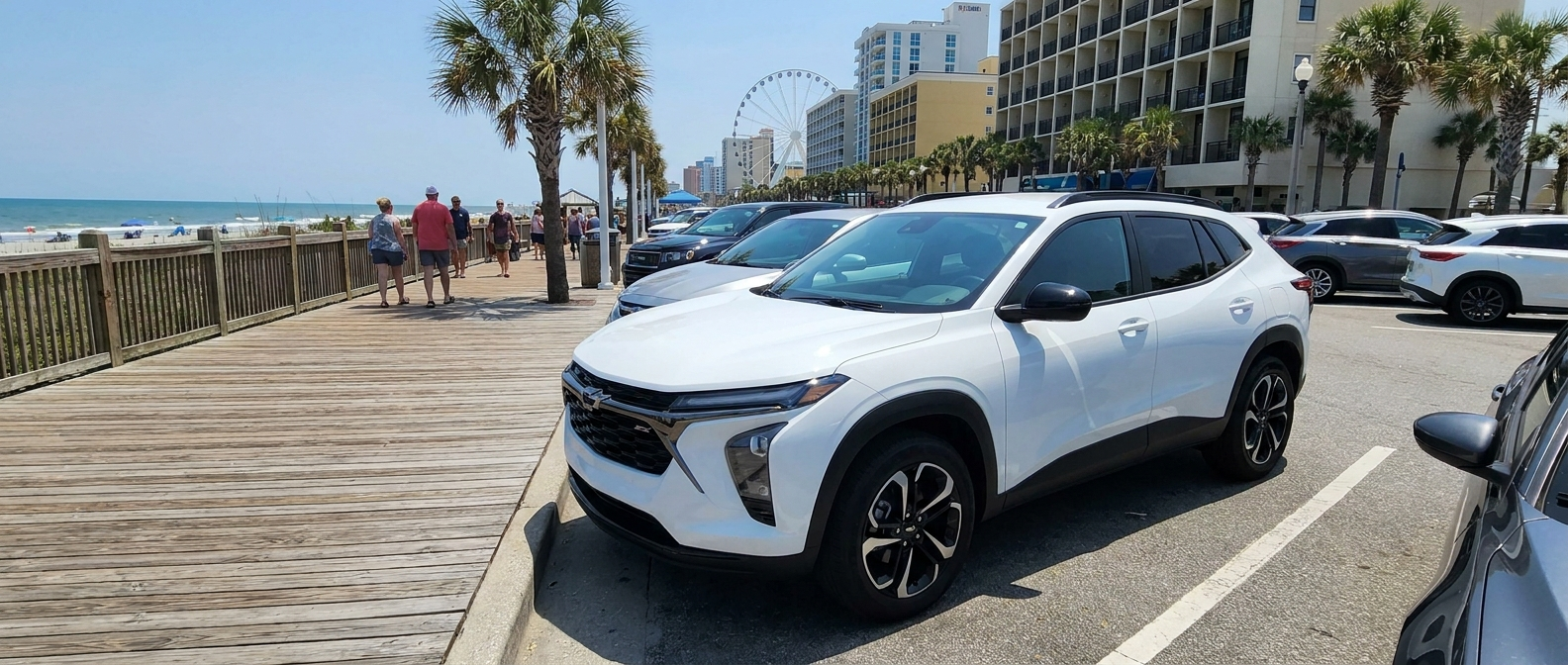
Park the 2026 Chevrolet Trax near the Myrtle Beach Boardwalk before 10 a.m., aim for the lots along Mr. Joe White Avenue between Business 17 and Ocean Boulevard, and you’ll slide into a spot that would stress out a bigger SUV. That’s the plan. Everything else is just enjoying the walk.
The boardwalk earns the trip. You get 1.2 miles of oceanfront promenade running from the Second Avenue Pier all the way up to 14th Avenue North, and on a summer Saturday it’s genuinely packed. The parking around it reflects that. Still, it’s navigable once you know where the open spots really live, and it gets a lot more navigable when you’re not maneuvering a vehicle that’s pushing 193 inches.
What’s the Plan at a Glance?
| Stop | What to Do | Best Time | Parking Spot |
|---|---|---|---|
| Mr. Joe White Ave lots (ParkMB) | First stop (park and walk to the boardwalk) | Before 10 a.m. or after 6 p.m. | 10 private lots on Joe White Ave; compact stalls, easy entry |
| Pavilion Parking Garage (9th Ave N) | Garage option if lots are full | Any time; garage structure | 914 N. Kings Highway; walk to boardwalk in minutes |
| Metered street parking (8th-14th Ave N) | Closest to the action | Before 9 a.m. (meters start 9 a.m.) | City meters run March-October, monitored to midnight |
| Public lot (14th-15th Ave N) | North end access near the 14th Ave Pier | Morning on weekdays | City-managed, first-come basis |
| Boardwalk Promenade | SkyWheel, Second Avenue Pier, shops, seafood | Mid-morning through evening | Walk from any of the above; 1.2-mile stretch |
The Boardwalk Parking Reality, Honestly Stated
Parking near the Myrtle Beach Boardwalk during peak summer is competitive, and we won’t pretend otherwise, though the corridor is compact enough that a good plan and an early start put the odds firmly in your favor before the meters even wake up. The metered spaces on 8th and 9th Avenues North and along Ocean Boulevard run on paid city meters from March 1 through October 31, monitored from 9 a.m. to midnight. The City of Myrtle Beach enforces those meters actively, and citations begin at a standard rate. Miss your meter by a few minutes and you’ll find out quickly.
The good news is the corridor around the boardwalk is compact, geographically speaking. The lots that serve the SkyWheel and boardwalk area cluster along Mr. Joe White Avenue (formerly 10th and 11th Avenues North) between Business 17 and Ocean Boulevard. ParkMB runs ten private lots in the Boardwalk Entertainment District, and most of them sit right in that corridor. The Pavilion Parking Garage sits at 914 North Kings Highway, between 9th and 10th Avenues North, and you’ll be within an easy walk of the whole promenade. A public city lot also sits between 14th and 15th Avenues North for the north-end approach.
None of those spots feel generous, and you’ll notice that fast. Older resort-district infrastructure means tighter lane widths, cars parked on both sides, and pedestrians crossing constantly. Arriving in something 14 feet 10 inches long rather than 16-plus makes every one of those moves less stressful.
Why the Trax Footprint Fits This Corridor Specifically
The 2026 Trax measures 178.6 inches long and 71.2 inches wide without mirrors, small enough to thread this corridor yet roomy where it counts, and Chevrolet lists 25.6 cubic feet of cargo space behind the rear seat, which grows to 54.1 cubic feet with the seat folded. You’ll have enough room for beach gear, a cooler, and the chairs nobody wants to carry but everyone brings.
Why do those dimensions matter here? The Joe White Avenue lots and the metered grid between 8th and 14th Avenues North weren’t designed with modern large crossovers in mind. The lane widths and stall depths in the boardwalk corridor suit a compact footprint. At nearly 15 feet long, the Trax is genuinely shorter than a Honda Civic (which runs about 184 inches). For context, our own Chevrolet Equinox is about 14 inches longer. That gap doesn’t sound dramatic until you’re nosing into a tight angled stall with someone waiting behind you.
The Trax’s Electric Power Steering gives it a tight turning radius that makes reversing out of those stalls (with pedestrians passing and cars queued) less tense than it’d be in a longer vehicle. Tight spaces are where you stop noticing the Trax’s modest 137-horsepower figure and start appreciating what the compact package does for you.
- The EPA rates the 2026 Trax at 28 mpg city and 32 mpg highway. The run from Conway down US-501 is almost entirely highway, so your fuel burn on the trip is low
- Cargo room with the seats up (25.6 cubic feet) beats several vehicles in this class, per Chevrolet’s spec
- The 7.3-inch ground clearance handles the speed bumps that mark almost every private lot in the boardwalk district without drama
- Standard rear cross-traffic alert (available in the Driver Confidence package) helps on the way out of tight stalls when foot traffic is heavy
- The 61.4-inch roofline clears any parking structure in the boardwalk area without a thought
Making the Trip Work from Conway
The Trailblazer is another compact option from our lot that handles the same corridor well, so you’ve got a real choice here, though the Trax’s slightly shorter length makes it the one we’d send to the boardwalk first when parking ease is the priority. The honest tradeoff is simple enough. The Trax is a front-wheel-drive, city-oriented vehicle, and it’s not the pick for someone towing a boat or needing all-wheel drive for a trail. What it is good at is the trip from Conway to Myrtle Beach and back (a highway run on US-501, a tight parking situation at the destination, and a full day of walking with beach gear in the back).
The boardwalk meters go free from October 1 through February 28 each year, per a City of Myrtle Beach ordinance passed in late 2025. If you’re flexible on timing, a fall or winter weekday at the boardwalk is a different experience than a July Saturday. You’ll find quieter lots, free street parking, and a promenade that lets you walk at your own pace. The Trax handles all seasons, just bring a jacket in January.
We keep the Trax on our lot in Conway because it’s built for how this trip runs for Grand Strand families. One practical compact SUV, a city that asks you to park in tight spots, a beach that rewards people who get there early. It fits.
Explore Financing Options for the Trax
The Myrtle Beach Boardwalk is worth the trip in any season. Get there in something that makes the parking part easy, walk the 1.2-mile promenade from Second Avenue Pier up to the 14th Avenue Pier, and let the vehicle worry about nothing more than a tight stall and a metered block. That’s about all it needs to do.
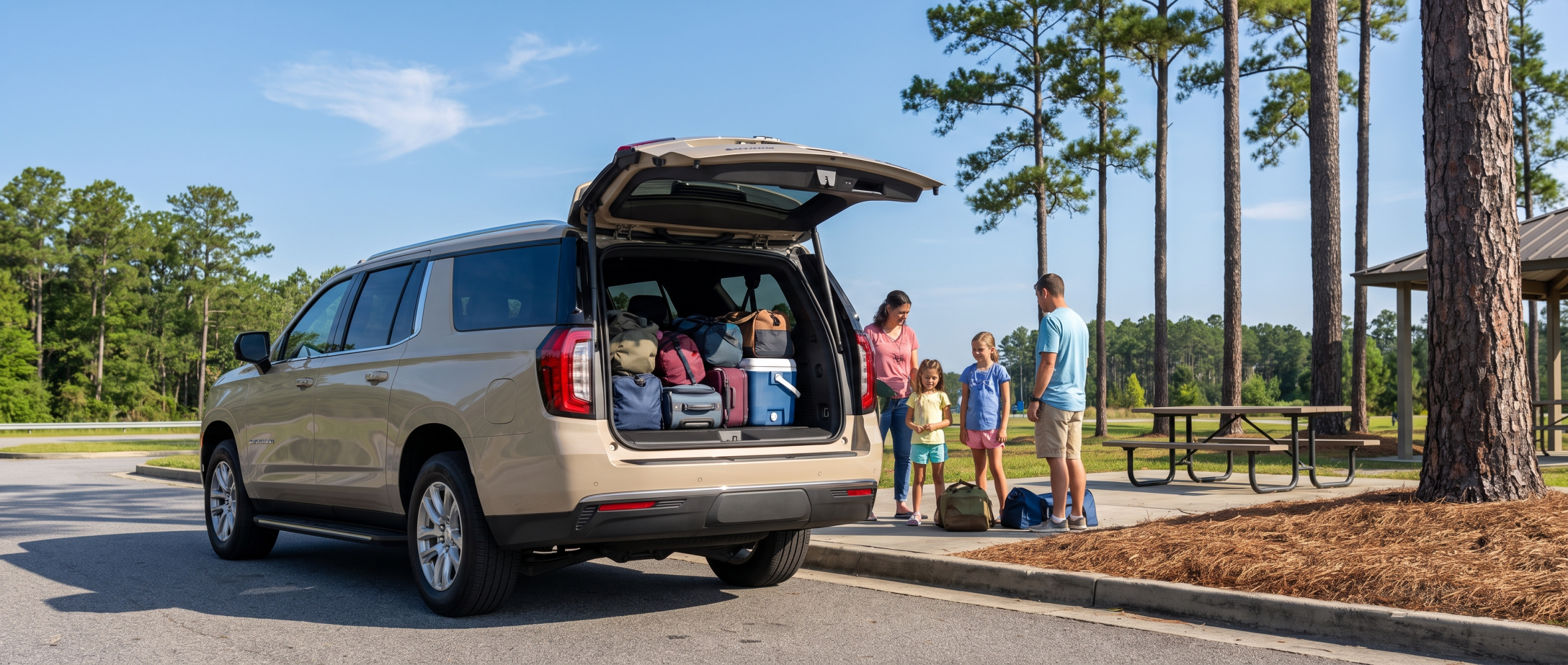
The 2026 Chevrolet Suburban is genuinely built for what Grand Strand families ask of it every summer. Load eight people, every suitcase, maybe a trailer, then put 600 or 800 miles behind you in a single day. It can do all of that. What trips people up is that leaving Myrtle Beach in August takes a little more strategy than pointing the nose toward I-95, and the Suburban rewards a driver who understands its systems instead of trusting it to sort things out.
Below is the short version our team at Palmetto Chevrolet runs through before you’re loaded up and rolling out of Conway or the Grand Strand.
Do’s and Don’ts for a Long-Haul Suburban Trip
The moves in the table below are the ones that actually change your day, and most of them are small, so skipping any single one on a cool morning probably costs you nothing, while skipping two or three together on a hot August Saturday is how a family ends up parked on an I-95 shoulder instead of a mountain cabin. Read it before you load the truck.
| Situation | Do | Don’t |
|---|---|---|
| Departing the Grand Strand | Leave before 10 a.m. or after 7 p.m. Take SC-22 to SC-31 (Carolina Bays Parkway) to bypass Conway congestion | Attempt US-501 eastbound on a Saturday afternoon between noon and 5 p.m. |
| I-95 speed | Set cruise at the 70 mph limit in South Carolina; ease to 65 through the Lumberton, NC curves | Speed past the state line. South Carolina Highway Patrol is notoriously active on I-95 near the NC border. |
| Fuel stops | Fill the 28-gallon tank before you leave. The diesel Suburban carries up to 728 miles of EPA-estimated highway range per tank. The V8 trims get roughly 19-20 mpg on the highway | Let the fuel gauge drop below a quarter tank on rural I-95 stretches. Service areas thin out between Florence and the NC Welcome Center |
| Tire pressure + load | Check cold tire pressure before loading. A full passenger load plus luggage shifts weight to the rear axle | Assume the tires are fine because they looked fine last weekend |
| Trailer or camper | Verify your actual tow rating on the door-jamb sticker. The 5.3L V8 is rated up to 8,200 lbs when properly equipped (confirm via your build sheet) | Use the class maximum figure as your personal maximum without checking your specific vehicle’s placard |
| Cabin temperature | Pre-cool the interior while still parked. The Suburban’s tri-zone climate can hold a comfortable temperature at highway speed with less A/C load | Blast the A/C from a scorching standstill. It drags highway fuel economy noticeably on V8 trims. |
| Tech | Enable available Super Cruise on compatible highway stretches to reduce driver fatigue on long flat I-95 sections | Use hands-free tech as permission to stop paying attention. It still requires eyes on the road |
| Night driving | Use the available head-up display to keep your eyes forward in low-light conditions | Drive fatigued. Pull over. The Suburban will still be there when you wake up |
The One Thing That Matters Most: Leave on the Right Route at the Right Time
Your route out of town and your departure time decide whether the trip starts smooth or starts stuck, more than any other single choice you’ll make that morning, because US-501 is the obvious artery from Myrtle Beach toward I-95 through Conway, and on a summer Saturday afternoon it can stretch a 90-minute drive to the interstate into a two-and-a-half-hour crawl. We know it, visitors know it, and people still leave at 2 p.m. on a Saturday in August.
Take SC-22 (the Conway Bypass) to SC-31 (Carolina Bays Parkway). SC-31 runs as a limited-access highway alongside the Intracoastal Waterway, heading west without a single traffic light until it ties into SC-544. From there you slide onto I-95 at Florence and skip the US-501 tourist drain entirely. It adds roughly ten minutes over a theoretical direct shot, and it spares you the standstill everyone else creates by running the same math at the same time.
Once you’re on I-95, north or south, the Suburban settles in beautifully. Diesel-equipped trims give you a Duramax 3.0L pulling 495 lb-ft of torque at 2,750 rpm, and the EPA puts highway fuel economy at 26 mpg (RWD) or 24 mpg (4WD). Pair that with the 28-gallon tank and you land on Chevrolet’s stated 728-mile highway range. On the diesel you can leave Conway and pass through Florence, Santee, Columbia, Charlotte, Statesville, Wytheville, and be closing in on the Virginia-West Virginia line before you need fuel. V8 buyers should plan stops every 400 to 450 miles based on 19-20 mpg highway.
A pre-trip service check before you leave is never wasted on a big run. Fresh oil, a correct coolant level, and cold tire pressure take about twenty minutes and pull a lot of uncertainty out of an 800-mile day.
The Chevy Tahoe is worth a mention here as a comparison point, since it shares the same powertrain family. What sets the Suburban apart is its 16 additional inches of length behind the third row, which means you carry real luggage without folding seats. You get 41.5 cubic feet of cargo space with all three rows occupied (enough for actual suitcases and a stroller without an argument).
Keep Everyone Comfortable and Stay Aware
Long trips reward preparation over willpower, so the comfort you set up before you roll matters more than the toughness you try to summon at mile 400, especially with a full third row of kids and a low-country sun loading the cabin from every angle. Small habits carry the day here.
The Suburban’s third row offers 36.7 inches of legroom, per Chevrolet’s specifications, and that number holds up in person instead of reading like brochure math. Plan a stop every 90 minutes when kids ride back there, no matter how roomy it feels. Kids need to move. The I-95 North Carolina Welcome Center near the state line keeps clean facilities and covered parking. Kenly 95 Travel Plaza gives you amenities without leaving the interstate corridor at all.
Comfort systems for an August drive:
- Available ventilated front seats and rear-row climate controls help when the SC low country sun loads the cabin from every angle.
- Pre-cooling the Suburban while it’s still in the shade lets the system hold temperature efficiently at 70-75 mph.
- The efficiency hit is measurably lower than clawing your way down from a 100-degree interior.
Check the National Weather Service forecast for the full corridor before you depart, and don’t stop at the Myrtle Beach beach forecast. South Carolina summer heat runs hot, and the Grand Strand sits close to hurricane-track weather, so the sky over the sand tells you very little about the sky over I-95. An I-95 thunderstorm between Florence and Santee is a different animal than afternoon clouds at the beach.
Our Chevy Traverse serves families who need three rows in a smaller, more maneuverable package. But if your crew fills all three rows and you’ve got beach gear to haul, the Suburban is the honest answer. There’s no substituting for 144.5 cubic feet of maximum cargo volume when everyone’s bringing actual luggage.
Your 2026 Suburban’s ready for wherever US-501 and I-95 take you. Schedule a Pre-Trip Service Check before a long run, and our service team’ll make sure everything’s ready to go.
if you’re thinking the Suburban might be the right upgrade for the trip you’ve been putting off. We’re right here in Conway.


