





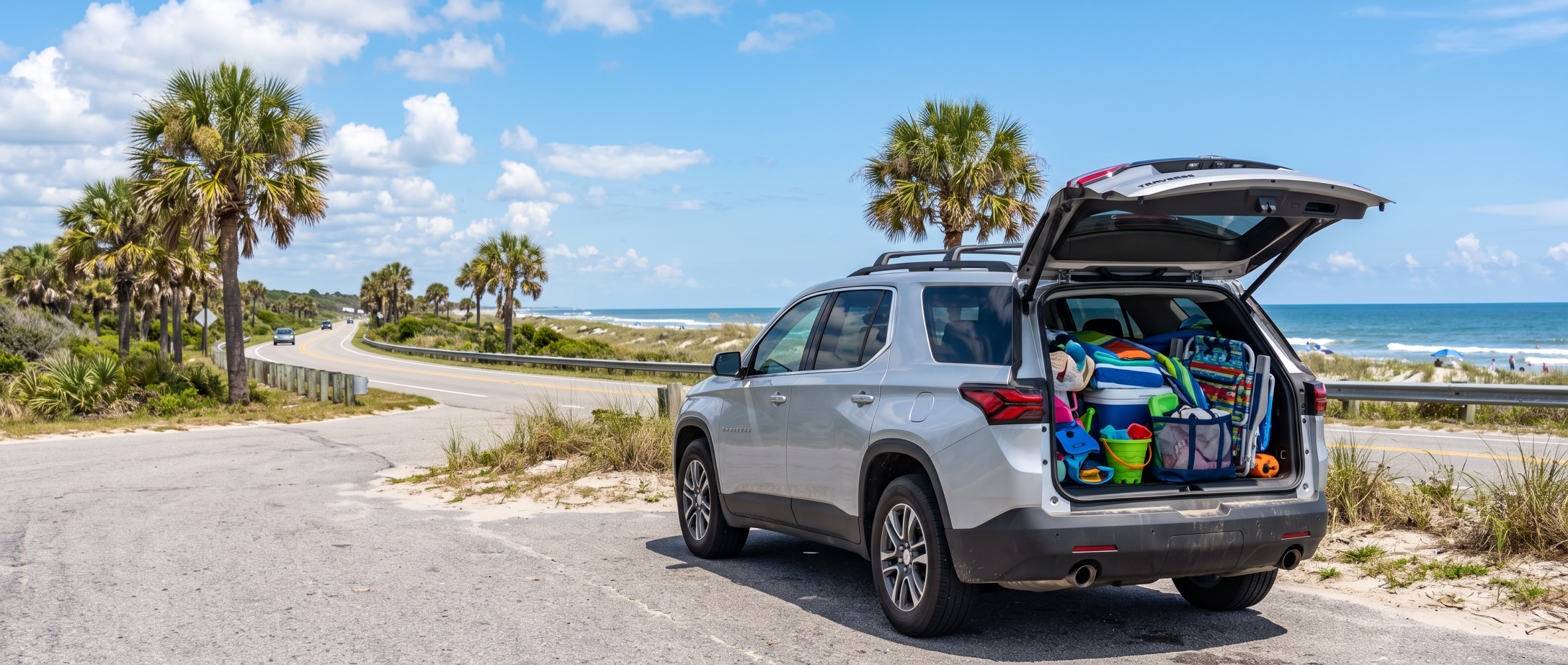
August in South Carolina pulls the entire eastern seaboard toward the same stretch of Ocean Boulevard, and US-501 between Conway and Myrtle Beach makes everyone feel it. A ten-minute drive at the right hour. A forty-minute crawl when the weekend rush hits and every lane sits bumper-to-bumper. The 2026 Chevrolet Traverse is built to make that journey comfortable for eight people and all their gear, but only if you’ve actually set it up right before you leave the driveway.
We’ll be straight about it. A badly loaded Traverse is a frustrating Traverse. Pack it with intention and you’ll roll into the Grand Strand with kids who aren’t fighting, bags that haven’t avalanched, and a cabin that isn’t roasting at 85 degrees before you hit the bridge.
What You Need Before You Start
Plan your configuration against these verified numbers before you touch a single bag, because the Traverse’s flexibility is real and the gaps between builds matter more than they look on paper. We’d rather you sort that in the driveway.
| Spec | FWD Models | AWD Models |
|---|---|---|
| EPA highway MPG | 26 mpg | 24 mpg |
| Fuel tank capacity | 19.4 gallons | 21.7 gallons |
| Max cargo (all seats flat) | 97.6 cu ft | 97.6 cu ft |
| Cargo with 3rd row up | 22.9 cu ft | 22.9 cu ft |
| Cargo with 3rd row flat | 56.6 cu ft | 56.6 cu ft |
| Max seating | 8 (LT bench) | 7 (captains, Z71/RS/HC) |
| Max towing (properly equipped) | 5,000 lbs | 5,000 lbs |
| Front legroom | 44.3 in | 44.3 in |
| Second-row legroom | 41.5 in | 41.5 in |
A note on the 4-cylinder: Chevrolet swapped the old 3.6L V6 for a 2.5L turbocharged four-cylinder producing 328 horsepower and 326 lb-ft of torque. The EPA rates the FWD Traverse at 26 mpg highway. That number beats the outgoing V6 configuration, which matters when you’re sitting in stop-and-go on US-501 burning fuel with the AC maxed out in August.
Honest tradeoff: the turbo four doesn’t sound or feel like the old V6 under hard acceleration, and you’ll notice it when you merge onto SC-22 at speed. 328 horses is 328 horses, but the character is different, and some drivers find it takes getting used to. For a highway cruise to the beach, it won’t matter. On a fast pass, plan the moment. The truck isn’t slow.
Setting Up Your Traverse: Six Steps for a Grand Strand Run
These steps follow the same sequence our team walks through on the lot when a family is configuring a Traverse for the first time. We keep it in this order for a reason.
Step 1: Decide your seat count first, not last.
The step that’s easy to skip sits right at the front. If you’re running a full house of seven or eight, the LT trim’s optional second-row bench gives you that eighth seat at no extra cost. The RS, Z71, and High Country come standard with captain’s chairs and seat seven. That gap between the captains looks roomy, and it’s also a highway for loose cargo under a hard stop (coolers, bags, and beach chairs have a direct path to the second-row footwells if there’s nothing blocking that channel). Make the seat decision before you start packing, because it changes everything about how you secure cargo behind it. Browse our current Traverse inventory to see which trims are on the lot right now.
Step 2: Load the third row first, then work forward.
Fold or deploy the third row based on your headcount, and then start loading from the back toward the front. With the third row up, the EPA lists 22.9 cubic feet behind it. Flat, that opens to 56.6 cubic feet. Both rows flat gives you 97.6 cubic feet of flat cargo floor. Load heaviest items (the cooler, the duffel bags) flat against the floor of the cargo well, closest to the liftgate. Lighter items stack on top. This keeps the center of gravity low and reduces what slides forward when you brake hard approaching the US-501 / SC-544 interchange.
Step 3: Secure the captain’s-chair gap if you’re using that configuration.
With captain’s chairs and the third row folded flat, anything in the cargo area has a clear opening between the second-row seats to slide through under braking. Hard stops make that a real issue, not a hypothetical one. A cargo net, a flat cargo tray with side walls, or even a firmly placed hard-side cooler positioned across the gap keeps gear behind the second row. The Traverse’s available cargo packages include a vertical cargo net and a cargo tray with a divider. If those came with your trim, use them. If not, a third-party adjustable cargo barrier fits the cargo well and costs nothing compared to a soft bag catching someone in the shins.
Step 4: Manage AC load strategically for the Conway-to-Myrtle Beach run.
Plan your AC load for the Conway-to-Myrtle Beach run, because August means running it at max from the moment you start the car. That load affects real-world mpg meaningfully on a short urban trip. The Traverse’s 17.7-inch touchscreen gives you a real-time efficiency display, so glance at it before you commit to the route. If you’re running FWD with a 19.4-gallon tank and plan to stay parked at the beach for several hours, cut the engine rather than idling the AC. The Grand Strand sun will heat a dark-interior cabin fast, so park in shade when you can find it and crack the rear windows a half-inch before you shut down. That small pressure release drops the cabin re-heat time noticeably when you return. Check that your AC system is serviced and refrigerant levels are current before a long beach season run. A poorly charged system works twice as hard in August and pulls harder on your mpg.
Step 5: Pre-load your route in Google Maps before you leave Conway.
The Traverse comes standard with wireless Apple CarPlay and Android Auto, which means your phone’s navigation mounts wirelessly to the 17.7-inch display. Set the route before you put the car in reverse. Conway sits inland from Myrtle Beach on US-501. Two reliable options run from Conway to the beach. US-501 east is the direct shot, but the SCDOT identifies the corridor between Conway and Myrtle Beach as one of the most consistently congested routes in South Carolina, with weekend backups that can turn a thirty-minute trip into more than an hour. SC-22 (Veterans Highway), the 28-mile Conway bypass, links US-501 west of Conway to US-17 north of Myrtle Beach and runs faster when US-501 is backed up. Load both as alternates and let the live traffic view decide. If you’re shopping smaller for a solo or couple’s beach run, the Equinox is worth a look for its more compact footprint on the Grand Strand’s tighter parking lots. For a family of six or more with gear, the Traverse is the one with enough room to not regret the decision before you hit the city limits.
Step 6: Run a quick weight check before you pull out.
The 2026 Traverse carries a payload rating of roughly 1,669 pounds (that’s the combined weight of passengers and cargo). Eight adults plus beach gear can approach that number faster than you’d expect, particularly if someone brought the full-size pop-up canopy and the wheeled cooler. Chevrolet lists 5,000 pounds of towing capacity when properly equipped, and that number assumes a correctly loaded and configured vehicle, so verify the door-jamb label for your specific build. Don’t skip this step if you’re also towing a small boat trailer or a personal-watercraft rig down to Murrells Inlet.
Print-and-Go Road Trip Setup Checklist
- [ ] Confirm seat configuration (bench for 8 or captains for 7) before loading anything
- [ ] Deploy or fold third row based on headcount
- [ ] Load heavy items (cooler, duffels) flat against the liftgate floor, lightest on top
- [ ] Secure captain’s-chair gap with a cargo net, tray, or hard-sided barrier
- [ ] Check AC system function and refrigerant level before peak-season runs
- [ ] Pre-set wireless CarPlay/Android Auto with US-501 and SC-22 as alternate routes
- [ ] Confirm Google Maps live traffic is active before departing Conway
- [ ] Verify total passenger-and-cargo weight against the door-jamb payload label
- [ ] Charge all devices before departure (the Traverse has USB-A and USB-C ports throughout the cabin)
- [ ] Stow sunscreen, wipes, and a trash bag within reach of the second row
A Quick Recap Before You Hit the Road
The 2026 Traverse genuinely earns its place as a Grand Strand family hauler. Ninety-seven and a half cubic feet of flat cargo space, 26 mpg highway on the FWD build, a 17.7-inch screen that doubles as a navigation hub, and 5,000 pounds


