





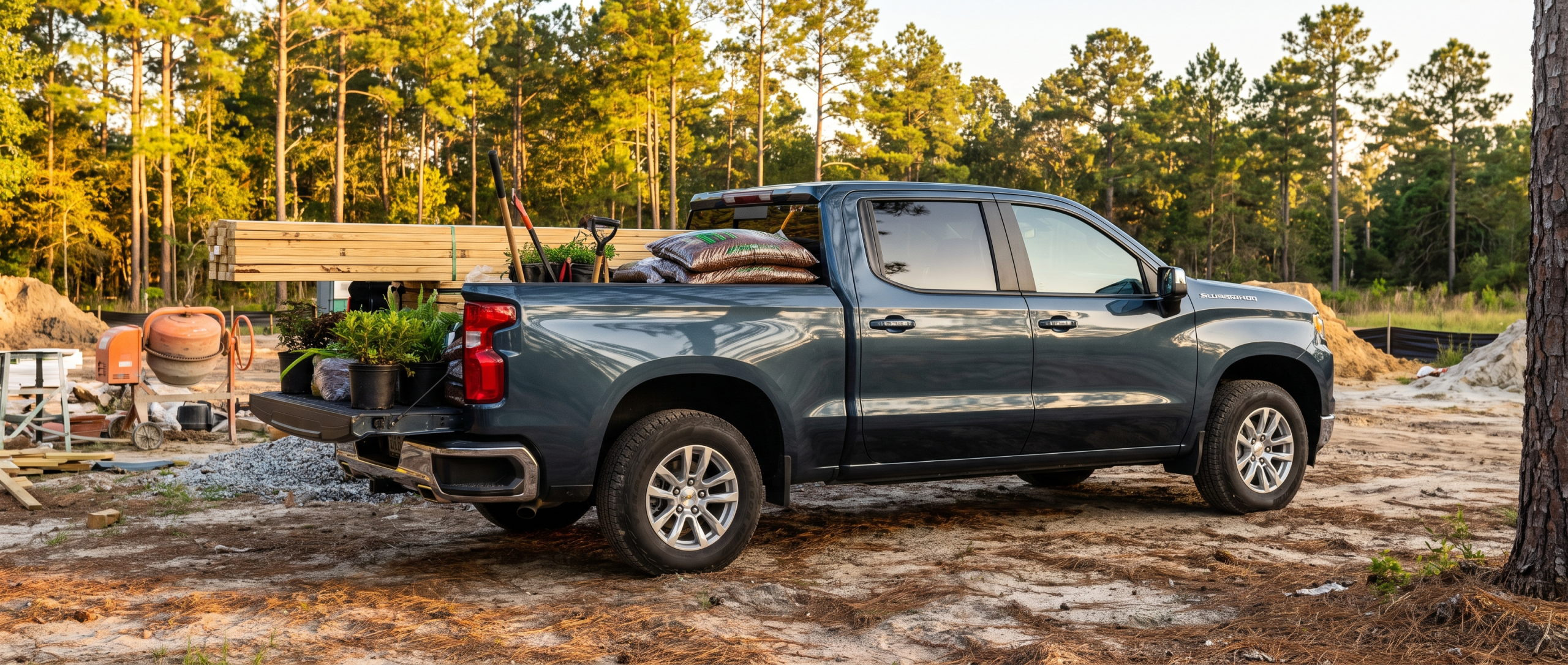
For most Saturday-morning lumber runs and mulch hauls around Conway, the 2026 Chevrolet Colorado does the job and fits your driveway. The moment you’re hauling full 4×8 sheets flat, pulling a loaded dump trailer, or stacking drywall by the bundle, the 2026 Silverado 1500 is the truck you truly need. Payload and bed dimensions decide this, not the trim level.
Horry County’s construction market is booming right now. New subdivisions are going up along US-501, there’s a Coastal Ready Mix concrete plant coming to the Conway area by end of 2026, and homeowners all over the Grand Strand are tackling backyards, additions, and storm-prep renovations. We see the downstream of that activity on our lot, with contractors grabbing Work Trucks at opening time and DIYers trying to figure out whether they need a full-size rig. This guide answers that question with real numbers, not brochure-speak.
What Do You Actually Get at Each Tier?
At each tier you get the same core powertrain and plenty of everyday hauling, but the honest split shows up in bed geometry and maximum payload, so the right pick depends on whether you need sheets to lie flat and heavy pallets to ride legally more than on any trim badge. The Colorado and the Silverado 1500 share the same 2.7L TurboMax engine, and Chevrolet lists 310 horsepower and 430 lb-ft of torque for both. Where they part ways is bed width and payload ceiling. Below is how the two trucks compare across the scenarios Conway homeowners run into:
| Project Scenario | 2026 Colorado | 2026 Silverado 1500 | Who It’s For |
|---|---|---|---|
| Mulch bags, potted plants, general hauling | Plenty of bed space (41.9 cu ft, 5’2″ bed) | More than enough | Either truck handles it easily |
| Standard 4×8 plywood or drywall sheets, flat | Tight. 45.5″ between wheelhouses; sheets must angle or hang over tailgate | Yes. 50.6″ between wheelhouses; sheets lay flat per Chevrolet’s Durabed spec | Silverado 1500 if sheets-flat matters to you |
| A pallet of pavers or concrete blocks | Up to 1,710 lbs payload (2WD WT/LT, Chevrolet-published) | Up to 2,260 lbs payload (Chevrolet-published) | Silverado 1500 for heavier pallet loads |
| Towing a utility or landscape trailer (light) | Up to 7,700 lbs when properly equipped with the Advanced Trailering Package | Same capability on the 2.7L TurboMax, up to 9,500 lbs | Colorado handles most homeowner trailers |
| Towing a loaded dump trailer (6,000-9,000 lbs) | Approaches the Colorado’s ceiling fast | Comfortable range on the 5.3L V8 (up to 11,300 lbs) or diesel (up to 13,300 lbs) | Silverado 1500 gives real breathing room |
| Parking in a standard garage or tight subdivision | Easier. Colorado is a midsize truck | Longer and wider; check your garage clearance | Colorado wins for tight fits |
| Five days a week commuting + weekend projects | Fine. Same TurboMax, better fuel manners at highway speeds | More truck than a daily commuter needs | Colorado for the hybrid-use buyer |
Smart Buying: Matching the Truck to Your Real Project Load
Match the truck to the load you truly carry, because the easy trap here is buying up or down on the headline towing figure when payload and bed dimensions are the specs that decide your week, and both trucks tow more than most homeowner trailers will ever ask. Towing capacity grabs the attention. Payload and bed dimensions are what bite you on a Tuesday at the hardware store.
The Colorado wins for homeowners who run one or two project loads a month, need a vehicle that parks in a normal garage, and plan to drive the truck daily. At up to 1,710 lbs of payload, Chevrolet’s published figure for the 2WD WT and LT trims, it handles most landscape supply runs cleanly. Its 7,700 lbs towing capacity with the Advanced Trailering Package means a loaded utility trailer or pontoon boat is no problem whatsoever.
Step up to the Silverado 1500 when three things are true. You’re regularly hauling full sheets of plywood or drywall, your project loads approach or exceed 1,500 lbs, or you’re towing anything over 8,000 lbs with margin to spare. Chevrolet’s published max payload on the Silverado 1500 reaches 2,260 lbs. The extra 550 lbs of headroom isn’t theoretical (it’s a full pallet of pavers you don’t have to split into two trips).
One thing our team notices at Palmetto Chevrolet is that buyers who overlook bed width end up frustrated. A standard 4×8 sheet of plywood is 48 inches wide. The Silverado 1500’s Durabed measures 50.6 inches between the wheelhouses, a Chevrolet spec. Those 2.6 inches decide whether the sheet lays flat or wrestles diagonally on every run. The Colorado measures 45.5 inches between the wheelhouses. Neither is wrong. You just need to know which situation you’re in.
The Smart-Choice Framing: Conway Projects, Conway Conditions
Conway summers put a loaded truck under real thermal stress, so the smart-choice framing here comes down to how hard you push the cooling system, and both trucks handle a flat coastal run without strain while the Silverado gives you more margin when you tow near the ceiling on a hot afternoon. Sustained heat and humidity push engine cooling harder on any vehicle sitting in stop-and-go traffic on US-501 during beach season. Both the Colorado and the Silverado 1500 use the same 2.7L TurboMax. At 430 lb-ft of torque from a four-cylinder, neither truck is straining on a flat coastal run. The difference shows up when you’re towing near the Colorado’s ceiling on a hot afternoon. The Silverado’s larger cooling system and heavier-duty running gear give you more thermal margin. Not a deal-killer for the Colorado, but worth naming plainly.
The honest downside of the Silverado 1500 for a homeowner is that it’s a lot of truck if you’re not using it like a truck. Longer, wider, and harder to park in a tight subdivision, with fuel economy that drops as well.
The Colorado’s TurboMax usually returns better real-world highway numbers than the Silverado running the same engine in a heavier body. If your “home projects” consist mostly of one trailer pull per season and monthly trips to the landscape supply yard off SC-544, the Colorado may be everything you need.
Our recommendation for the classic Conway situation runs like this. A homeowner with an active renovation or landscaping calendar, pulling a utility or dump trailer a handful of times a year and needing sheet goods regularly, should be looking at the Silverado 1500 configured with at least the standard bed, 78.9 inches of interior length, and the 5.3L V8 for towing headroom. The homeowner doing lighter seasonal work who commutes daily is the Colorado buyer. Both are the right answer. They serve different people.
Browse our current truck lineup through our Work Truck Solutions page if you’re shopping for a commercial or fleet configuration. It covers upfit options the standard product pages don’t.
Frequently Asked Questions
What payload can I actually put in a Chevy Colorado for a home project?
Chevrolet publishes a maximum payload of 1,710 lbs for the 2026 Colorado in its lightest configuration, the 2WD WT and LT trims. A load like that covers a strong run of mulch bags, smaller paver loads, or general tools and materials. A full pallet of concrete blocks or pavers typically runs 2,000 to 3,000 lbs, which would exceed the Colorado’s rated capacity. For that kind of load, the Silverado 1500’s published max of 2,260 lbs gives you more room, and splitting a heavy delivery into two trips is the safer call regardless of which truck you drive. Always check the door-jamb label in your specific vehicle before loading, since ratings vary by trim and configuration.
Can a Chevy Colorado haul 4×8 sheets of plywood or drywall?
Yes, with a caveat. The 2026 Colorado bed measures 45.5 inches between the wheel housings. A standard 4×8 sheet is 48 inches wide, so it won’t lay completely flat and will ride at a slight angle or hang over the tailgate. For an occasional sheet or two, that works fine. If you’re running regular sheet goods every week, whether framing, drywall, or roofing panels, the 2026 Silverado 1500’s Durabed measures 50.6 inches between the wheelhouses, wide enough for full sheets to lie flat. For serious sheet-goods work, that gap is the practical reason to step up to the full-size truck.


