




Blog

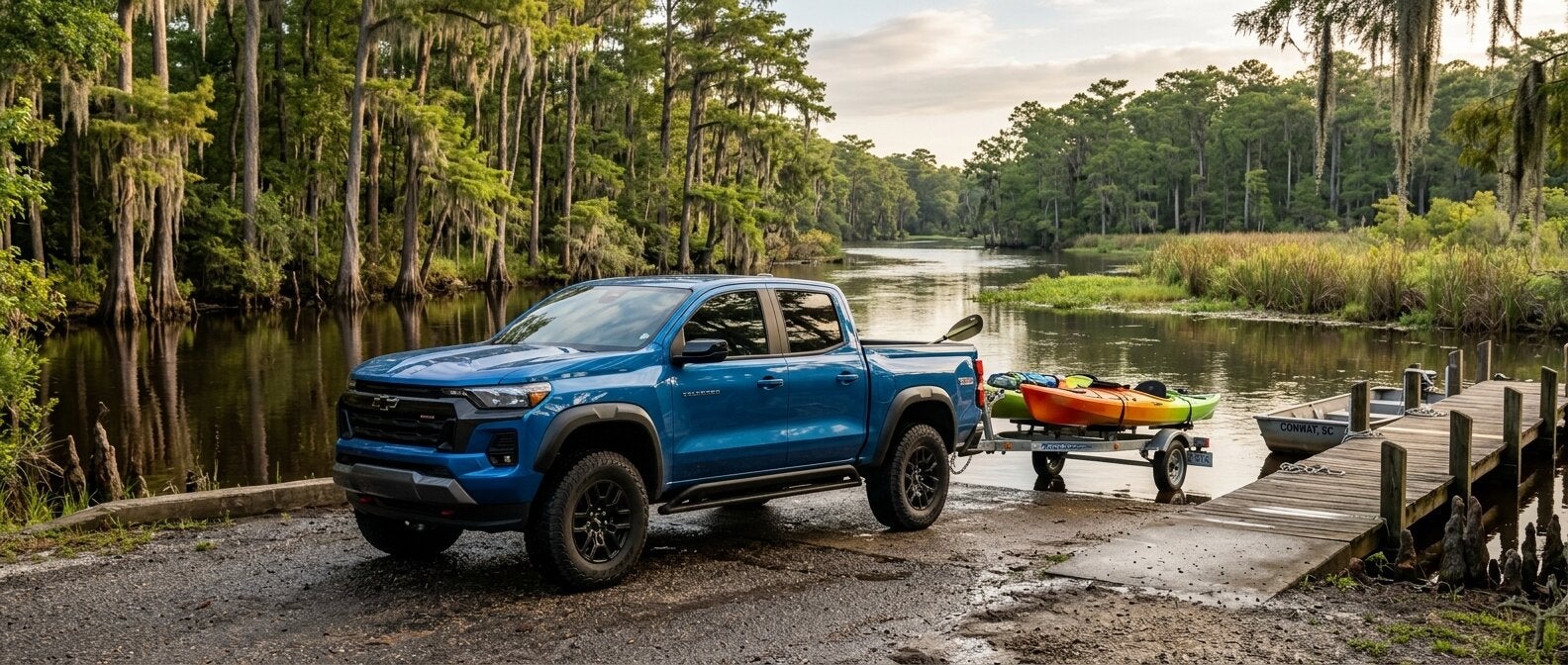
2026 Chevrolet Colorado Trail Boss at a lowcountry boat ramp with kayak trailer near Conway, SC

Chevy Colorado vs. Trailblazer for Conway Adventurers

In this article Which Chevy Actually Has the Capability the Grand Strand Demands? What Does the Drive from Conway Actually Cost You in Fuel? Which Chevy Makes More Sense for the Specific Way Conway People Adventure? Which Chevy Should Conway Adventurers Actually Buy? For Conway and Grand Strand drivers who want a Chevrolet built for outdoor life, the Colorado wins if you ever hitch a trailer, and the Trailblazer wins if your adventure lives in the cargo area. The 2026 Colorado tows up to 7,700 pounds when properly equipped and delivers genuine truck capability, while the 2026 Trailblazer caps towing at 1,000 pounds but returns an EPA-estimated 31 mpg combined in FWD trim. You'll find those two numbers answer most of the question right there. Check Colorado availability at Palmetto Chevrolet Which Chevy Actually Has the Capability the Grand Strand Demands? Your answer depends almost entirely on what you're hitching up, so the Colorado is the capable choice the moment a trailer enters the picture, while the Trailblazer holds its own only when your gear rides inside the cabin. That split decides most of this comparison, and plenty of articles skip right past it. Across every trim, the 2026 Chevrolet Colorado runs a single 2.7L TurboMax four-cylinder, good for 310 horsepower and 430 lb-ft of torque, paired to an 8-speed automatic. Chevrolet rates it at up to 7,700 pounds of towing capacity when properly equipped with the Advanced Trailering Package (RPO ZL6). Drop that package and the standard tow rating falls to 3,500 pounds (still more than enough for a loaded jon boat or a tandem kayak trailer headed to the Waccamaw River). The bed handles up to 1,710 pounds of payload on the 2WD WT and LT trims. Every 2026 Colorado comes as a crew cab with a 5-foot bed, so there's genuine back-seat room for passengers whether you're running a job site or loading up a family. The 2026 Trailblazer tells a very different story. Its standard engine is a 1.2L turbocharged three-cylinder producing 137 horsepower and 162 lb-ft of torque, and the available 1.3L turbo bumps output to 155 horsepower and 174 lb-ft. Towing capacity tops out at 1,000 pounds total. You can pull a lightweight cargo carrier or a folding bike rack, but that rules out a trailered kayak rig, a bass boat, or virtually any watercraft you'd want to put on the Waccamaw National Wildlife Refuge. It is not a truck. It was never designed to be one. Decision Axis 2026 Colorado (Trail Boss 4WD) 2026 Trailblazer (ACTIV AWD) Engine 2.7L TurboMax I-4 1.3L ECOTEC Turbo I-3 Horsepower 310 hp 155 hp Torque 430 lb-ft 174 lb-ft Max Towing (properly equipped) 7,700 lbs 1,000 lbs Max Payload 1,710 lbs (2WD WT/LT) Not rated for cargo hauling EPA Fuel Economy (4WD / AWD) 17 city / 22 hwy / 19 combined 26 city / 29 hwy / 27 combined Bed / Cargo 5-ft truck bed 54.4 cu ft max interior Ground Clearance (approx.) Higher with Trail Boss / ZR2 lift Up to ~8 inches (ACTIV trim) Best For Towing, hauling, job sites, heavy gear Daily commuting, beach gear, road trips Our take at Palmetto Chevrolet: Anyone weighing which one is "more adventure-ready" should answer one question first. Are you trailering anything? Kayak trailer, fishing boat, jet ski, utility trailer (the Trailblazer physically cannot move those loads). The Colorado can, and it still seats four adults comfortably in the cab. What Does the Drive from Conway Actually Cost You in Fuel? Fuel cost comes down to how you drive and what you drive, and these two Chevys sit far apart, since the Trailblazer sips fuel on a US-501 commute while the Colorado asks for more at the pump in exchange for real towing muscle. Summer traffic on the Grand Strand only widens the gap. The 2026 Trailblazer with the 1.3L engine and front-wheel drive earns an EPA estimate of 29 city / 33 highway mpg, a standout number for the segment. Choose AWD and that figure settles to 26 city / 29 highway. For someone doing the Conway-to-Myrtle Beach corridor daily, the FWD Trailblazer stretches farther per tank (its 13.2-gallon tank and 33-mpg highway rating work out to roughly 435 miles of highway range). That matters when your weekday drive is I-501 and your weekend plans involve Francis Marion National Forest fire roads or a barrier island ferry run. See Trailblazer trims on our lot In 4WD trim (Trail Boss or Z71), the 2026 Colorado is EPA-rated at 17 city / 22 highway / 19 combined. The 2WD WT or LT versions do better at 19 city / 24 highway / 21 combined. Its ZR2 sits at 17 mpg flat regardless of cycle, since those 33-inch tires and specialized suspension create drag that doesn't vary much between city and highway. So there's the honest tradeoff. You get a truck that can access a gravel landing on the Waccamaw, tow your boat rig out, and haul gear back, but you're buying more fuel to do it. Explore financing options at Palmetto Chevrolet If you're towing any trailer (even a small one) the Colorado is the only Chevy here that can legally and safely do it. The Trailblazer's 1,000-lb tow limit is not a starting point for negotiation. Tip from our team. The Colorado's fuel economy split tells you more than the combined number does. If most of your miles are US-501 highway miles, anchor your expectations to the 2WD LT's 24-mpg highway figure. The city rating isn't the number to plan around. Which Chevy Makes More Sense for the Specific Way Conway People Adventure? Conway's version of adventure leans on water and wet ground, so the Colorado makes more sense if you're trailering to a river put-in, while the Trailblazer fits the family that packs everything inside for a beach weekend. Lowcountry outdoor life reads differently from the mountain-town trails that drive most comparison posts. The Waccamaw River Blue Trail is one of only 21 designated National Water Trails in the country, running 100 miles through the blackwater swamps of the Waccamaw National Wildlife Refuge before passing right through Conway and down to Winyah Bay. Reaching the good put-ins often means pulling a kayak or canoe trailer down unpaved refuge roads. The Colorado can handle that (both the trailer weight and the softer, sometimes wet ground on river accesses). Its truck bed also handles the muddy gear, the coolers, and the crab trap without interior cleanup anxiety. The Trailblazer's interior cargo story is genuinely strong for a different version of adventure. With seats folded, it opens to 54.4 cubic feet of interior space (enough for a family's beach weekend without a trailer at all). Kayaks can go on a roof rack. Paddleboards fit with the right carriers. And you're doing all of it at SUV-level fuel efficiency while keeping four to five passengers comfortable on the run from Conway to the coast. Browse current Chevrolet inventory at Palmetto Chevrolet The tradeoff up front is simple. The Trailblazer is easier to own day-to-day. Parking is simpler. Fuel costs less. The ride is more car-like. You give up nothing for a casual beach weekend. What you give up is the ability to grow into heavier gear (a bass boat for the refuges, a camper trailer for a long haul south, a utility trailer for a home project in Horry County). The Colorado costs more to operate per mile and is a larger vehicle to manage. What you gain is a legitimate truck. Real payload. Real towing. A truck bed that doesn't care what goes in it. Which Chevy Should Conway Adventurers Actually Buy? Buy the Colorado if a trailer hitch is part of your routine, and buy the Trailblazer if your gear rides inside and your driveway stays hitch-free. Those two paths cover most Conway adventurers, and the deciding factor is almost always whether you tow. If your adventure regularly involves a trailer hitch (a kayak rig, a jon boat for the Waccamaw, a camper for a fall trip through Horry County) buy the Colorado. It's the only one of these two that's actually built to do that work. Trim to the Trail Boss or Z71 with the Advanced Trailering Package if you want the full 7,700-pound rating, and a 2WD LT gets you 3,500 pounds of standard towing at better fuel economy if you tow occasionally rather than constantly. If your adventure is beach-weekend logistics (surfboards on the roof, gear in the back, family in tow on US-501, and no trailer in the driveway) the Trailblazer is the smarter daily choice. The 1.3L AWD model in ACTIV trim adds some light-duty all-terrain credibility for those graveled refuge roads you might wander down. Just don't hitch anything heavy to it. Our team at Palmetto Chevrolet keeps both on the lot. Come in, stand next to both of them, and tell us what's going in the back this fall. Start Your Financing Application Frequently Asked Questions Can the Chevy Trailblazer tow a kayak trailer? A loaded tandem kayak trailer typically weighs well over 1,000 pounds once both kayaks and gear are accounted for. The 2026 Trailblazer is rated to tow only 1,000 pounds total, which is its hard limit. For trailered kayaks on the Waccamaw River or any coastal waterway, the 2026 Colorado is the correct choice (it tows up to 3,500 pounds without the optional package, and up to 7,700 pounds when properly equipped with the Advanced Trailering Package). How does the Colorado's fuel economy compare to the Trailblazer for Grand Strand commuting? The 2026 Colorado in 4WD configuration earns an EPA estimate of 17 city / 22 highway / 19 combined mpg. The 2026 Trailblazer with the 1.3L engine and FWD earns 29 city / 33 highway mpg (a substantial difference on a US-501 commute). Buyers who drive primarily highway miles and don't need a trailer hitch will notice that difference across a full year of fill-ups. Does the 2026 Chevy Trailblazer have all-wheel drive for Lowcountry back roads? Yes. The 2026 Trailblazer's AWD system is available on trims equipped with the 1.3L turbocharged engine and pairs with a 9-speed automatic transmission. The ACTIV trim is specifically packaged for buyers who want some light-duty off-road styling and added traction for uneven terrain. AWD does reduce fuel economy (from 33 highway to 29 highway) compared to the FWD version, so it's worth considering how often you'll actually need it on those Horry County back roads. Value Your Trade-In Online Palmetto Chevrolet 1122 4th Ave, Conway, SC 29526 (843) 248-4283
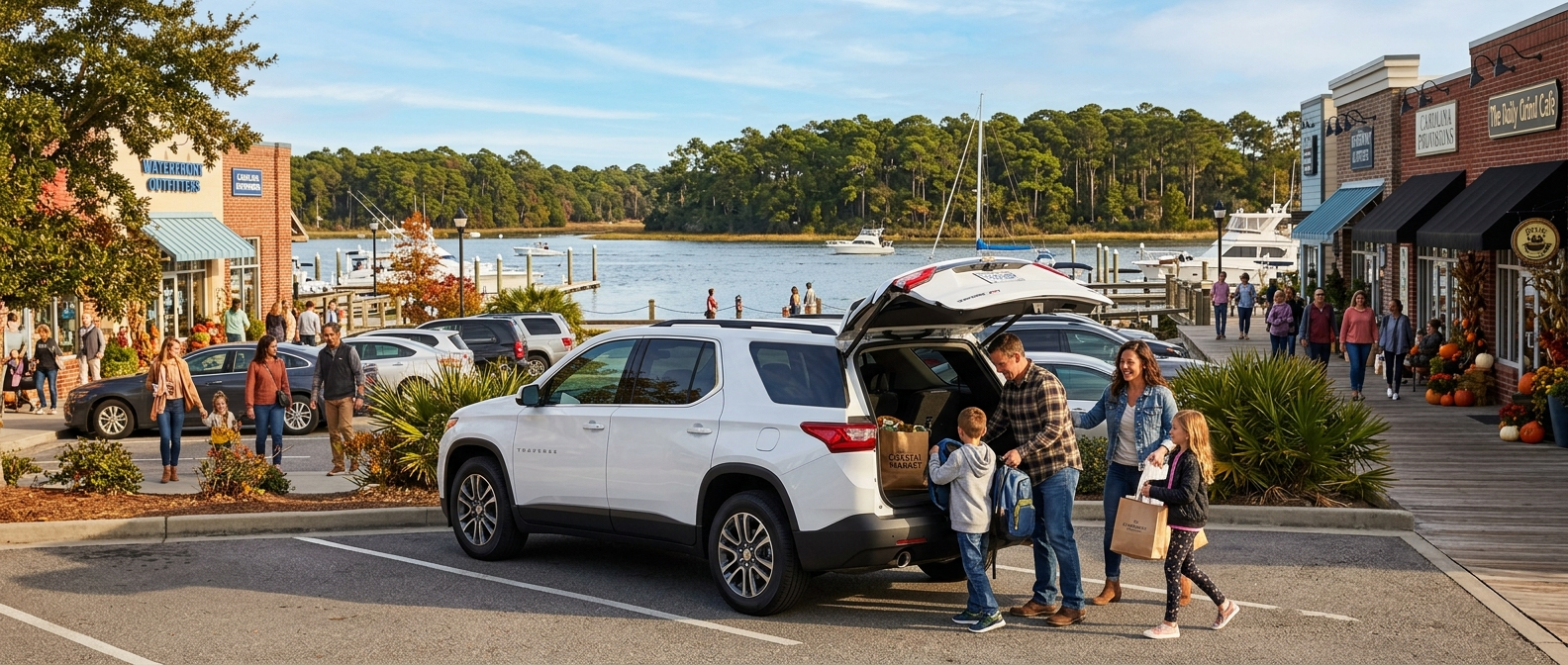
2027 Chevrolet Traverse parked at Barefoot Landing North Myrtle Beach on a fall afternoon with the Intracoastal Waterway in the background

A Day at Barefoot Landing: 4 Stops, One Chevy SUV

Here's our case for treating Barefoot Landing as a full day rather than a quick loop. The complex sits along the Intracoastal Waterway in North Myrtle Beach at 4898 US-17 South, holds over 100 shops, 15 or more restaurants, an actual wildlife park, a live-music venue, and a winery tasting room, and it costs nothing to get in. From Conway you're roughly 25 miles down US-501 East and then a short stretch on US-17 (call it 35 to 40 minutes on a weekday morning, longer if you leave after 10 a.m. on a weekend). We'll get to the timing. The trip rewards planning. Each stop asks something a little different from your vehicle. You want easy loading in the morning, climate control while you walk the boardwalk, and room for shopping bags and a wet dog on the way home. The 2027 Chevrolet Traverse handles most of those asks beautifully, and the 2027 Tahoe handles the ones that demand more. Pick the one that fits your crew, not the one with the best brochure. What Is the Route? The route runs four stops in order, morning to evening, with realistic drive times between each segment, and it's built for a September or October visit when beach-season crowds have thinned and the heat has backed off a degree or two. The Monday-night SummerFest fireworks have wrapped, so parking is genuinely easy. Stop Drive Time from Conway What to Do What to Pack 1. Palmetto Chevrolet departure (Conway) Start by 9 a.m. Top off the tank, check tire pressure Cooler, sunscreen, snacks, any strollers 2. Alligator Adventure 35-40 min via US-501 E + US-17 N Reptile and wildlife park inside Barefoot Landing Water bottles, comfortable shoes, camera 3. Boardwalk, shops & LuLu's Ropes Course Walking from parking 100+ shops, 48-foot ropes course (LuLu's), waterfront stroll Small backpack for purchases, layers for evening 4. Dinner at House of Blues or 21 Main Walking from boardwalk Live music patio or waterfront steakhouse Reservation if going to 21 Main; no cover at HOB Deck Return to Conway 35-40 min via US-17 S + US-501 W Decompression drive Bags, tired crew, maybe a leftover River Street Sweets box The Four Stops in Detail Stop 1: Leave Conway Right. Leave by 9:00 a.m. or wait until after 11:00. The middle window on US-501 is where tourist traffic and local commercial traffic overlap, and it's slow. There's no clever route around it. On a Tuesday or Wednesday the road is relaxed enough that a 9:30 departure works fine. The Traverse's EPA-estimated 26 miles per gallon on the highway means the round trip barely dents the 19.4-gallon tank on a FWD model. Fuel before you go, because North Myrtle Beach station pricing runs higher, particularly on US-17 closer to the beach. Check tire pressure and fluids before any Grand Strand run in September. The asphalt stays hot well into fall here, and underinflated tires generate heat through sidewall flexion, which is the leading cause of tire failure. A five-minute check like that matters. Stop 2: Alligator Adventure. Alligator Adventure is the anchor stop, a genuine wildlife park with Utan, billed as one of the world's largest crocodilians, plus reptiles, birds, mountain lions, and a full reptile-handling show schedule. It sits right inside the Barefoot Landing complex, which means one parking spot covers everything. Barefoot Landing offers free on-site parking. Plan on 90 minutes here, maybe two hours with kids who want to see the feeding demos twice. The Traverse's 22.9 cubic feet of cargo behind the third row is exactly enough for a soft cooler, a stroller, and the backpack that accumulates during any family outing. If you fold that third row, you get to 56.6 cubic feet, which is more than most families will ever need for a day trip. The 2027 Tahoe is the move when the crew is large enough to fill that third row for real (the Tahoe seats up to nine when configured for it) AND you still want cargo room behind it. Chevrolet lists 25.5 cubic feet behind the Tahoe's third row. More bodies, more stuff, same principle. Stop 3: The Boardwalk, Shops, and LuLu's. The loose middle of the day is the best part. Walk the wooden boardwalk over the 27-acre lake, browse the shops at whatever pace you want, and let the kids spend 45 minutes on LuLu's 48-foot Mountain of Youth Ropes Course (26 obstacles inside a Beach Arcade). It's the kind of afternoon that stretches because nobody's watching the clock. A practical note worth flagging is that shopping bags accumulate fast here. The Traverse's rear hatch opens wide, and we've found that a reusable tote in the cargo area at the start of the day saves a lot of juggling by the time you head back. Leave a little room when you load up in the morning. See What Your Current SUV Is Worth Stop 4: Dinner on the Water. The Traverse's 17.7-inch infotainment screen with Google Built-in will handle the reservation lookup and the navigation back. Two restaurants earn the planning. The House of Blues patio (The Deck) runs live tribute bands on weekend evenings and most weekday nights in shoulder season, with no cover charge at the outdoor space. For something quieter, 21 Main Prime Steakhouse sits on the waterfront side and takes reservations. Make that one before you leave Conway. The ride home is 35 to 40 minutes with a full car, and it's completely comfortable. The Traverse's turbo engine makes 328 horsepower and 326 lb-ft of torque per Chevrolet's published specs, enough that US-501 West feels unhurried even with eight aboard. Timing note for fall 2026. September and October are the sweet spot for this run. SummerFest at Barefoot Landing wraps after Labor Day, which drops weekday afternoon crowd density noticeably. The Alabama Theatre season runs through the holidays, so you can add a show to the evening stop if the kids are up for it. Tuesday through Thursday departures from Conway see the lightest US-501 traffic of any weekday. The 2027 Traverse's EPA-estimated 26 mpg highway means the 50-mile round trip from Conway to Barefoot Landing and back costs roughly two gallons of fuel in a FWD model. Tweak It to Your Crew The itinerary above is built for a family with mixed ages, but it's not the only way to run it. Couples or adults-only trip. Skip the ropes course, linger longer at Duplin Winery's tasting room (inside Barefoot Landing), and make the 21 Main reservation for 7:00 p.m. You don't need a Traverse. A Chevy Blazer fits two adults and a weekend's worth of gear with room to spare, and it handles US-17 South the same way any Grand Strand local would expect. Pet-friendly crew. Can you bring the dog? Yes, Barefoot Landing is explicitly pet-friendly, so pack a collapsible water bowl and a towel for the walk home. In September, the Traverse's dual-zone climate control keeps the cabin at a reasonable temperature between stops, which matters when you're walking the complex and someone needs to stay with the dog in the car. Do not leave a pet in a vehicle without active climate control running. Period. Towing something. Conway-area families who tow a small boat or a camper toward the Grand Strand use Barefoot Landing as a lunch-and-stretch stop. The Traverse tows up to 5,000 pounds when properly equipped (verify your specific door-jamb label). If you need more than that, the 2027 Tahoe with the Max Trailering Package reaches 8,200 pounds (correctly equipped, same caveat). For that crew, the Tahoe is the only Chevy SUV in our lineup that makes sense for this trip. Get Pre-Approved Before You Shop Palmetto Chevrolet 1122 4th Ave, Conway, SC 29526 (843) 248-4283
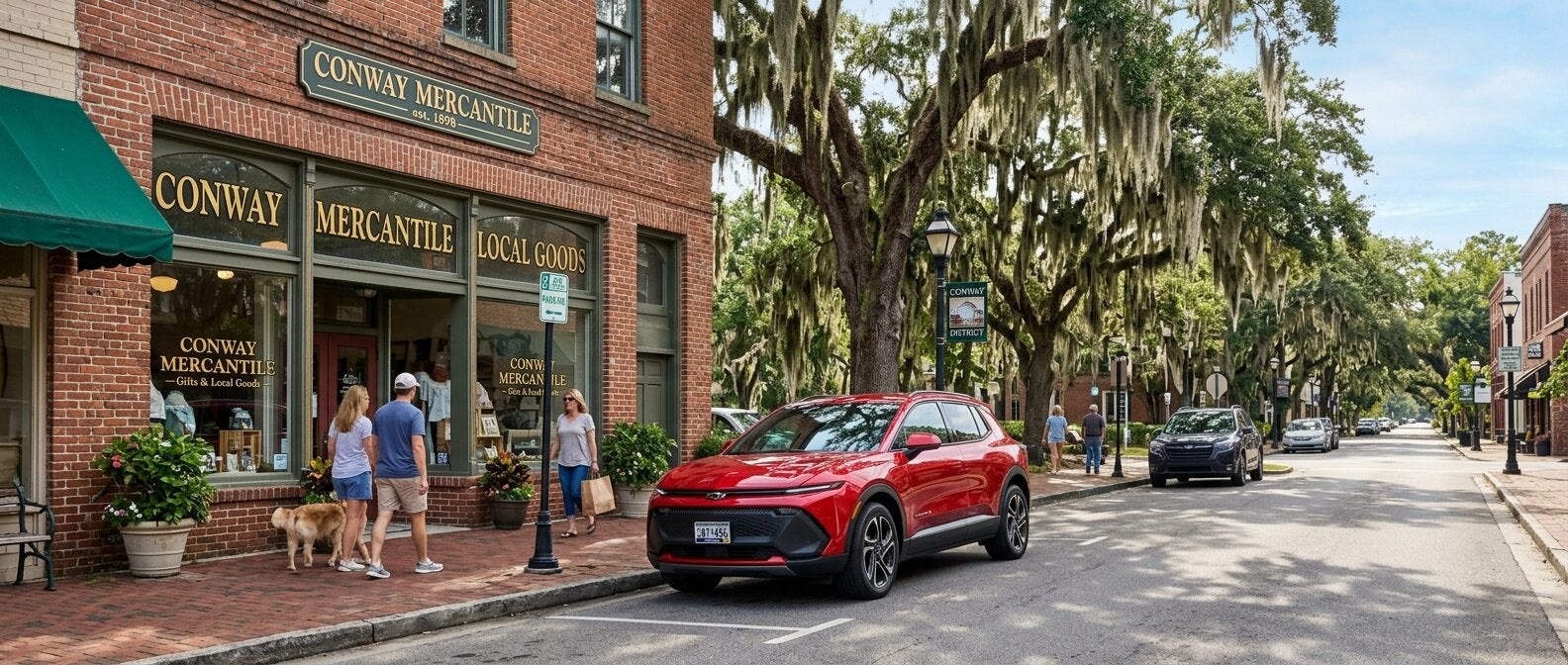
2026 Chevrolet Equinox parked in downtown Conway SC near historic oak-lined brick storefronts on a sunny day

The 2026 Chevy Equinox and Conway's Everyday Errands: A Real Match",

If you've ever sat in the left lane on US-501 watching a traffic light cycle through a full five-minute rotation while your coffee goes cold, you already understand the core problem with daily driving in Horry County. Conway is growing fast, and the corridor between town and Myrtle Beach hasn't kept up. The 2026 Chevrolet Equinox isn't magic. It won't make that light change sooner. What it does is make the wait cheaper, calmer, and a lot less cramped when you've got a full haul in the back from your run out to the shopping centers on US-501 Business. The honest case comes down to sizing. The 2026 Equinox is sized and specced for Conway's actual errand loop, genuine stop-and-go traffic, a compact historic downtown with tighter-than-expected parking near the Riverwalk, a grocery run that doubles as a school-pickup, and September heat that turns every cabin comfort from a nice-to-have into a necessity. The 2026 Equinox's front-wheel-drive EPA rating of 26 city / 29 highway MPG means the stop-and-go grind on US-501 costs noticeably less at the pump than running a larger SUV on the same route. Why Does the Equinox Actually Fit Conway? The Equinox fits Conway because the town's errand routes are a dense mix of signalized surface streets, and this SUV is tuned for that low-speed grind rather than open highway, though drivers logging mostly interstate miles will lean on other strengths. US-501 Business and the surrounding surface streets pack in signalized intersections. The signal cycles on the main 501 corridor can run up to five minutes per cycle, per the public advocacy group that has documented the congestion problem for years. A ten-minute drive in summer regularly stretches past forty minutes. It's stop-and-start driving on hot asphalt. The Equinox's 1.5-liter turbocharged four-cylinder is tuned for exactly this environment. Chevrolet specs 203 lb-ft of torque on the AWD variant, arriving at just 2,000 rpm. Low in the rev range. You want that pull when you're inching through an intersection and then accelerating to the next one rather than cruising. The EPA rates the front-wheel-drive Equinox at 26 miles per gallon city, 29 highway, 27 combined. Real-world Conway driving leans heavier on city miles than highway for most residents, so you'll stay closer to the city figure, and that's still solid efficiency for a five-passenger SUV. Local Condition / Use The Feature That Handles It Why It Matters in Conway US-501 stop-and-go traffic 1.5L turbo; EPA 26 city MPG (FWD) Low-rpm torque for repeated acceleration; city mpg holds up through signal-dense corridors Compact downtown parking near the Riverwalk 183.2-inch overall length Shorter than a three-row SUV; fits standard street-level spots in the historic district Grocery run plus school-pickup combo 29.8 cu ft cargo behind rear seats; 60/40 split bench Fits a real haul without folding a seat; fold one side and you still carry a passenger Hands-free errand running Wireless Apple CarPlay and Android Auto, standard all trims No cable hunting when kids pile in; navigation and calls without fumbling the console September heat and long afternoon commutes Chevy Safety Assist with Forward Collision Alert and Following Distance Indicator Keeps focus during slow, hot runs; alerts display clearly and chime intuitively Bigger bulky pickups around Horry County Max 63.5 cu ft cargo (seats folded); hidden under-floor rear storage Handles flat-pack items and large bags; under-floor compartment keeps valuables out of sight The Cargo Space Is More Useful Than the Spec Sheet Makes It Sound The cargo space works harder than a compact-SUV badge suggests, though anyone who needs five seats and a full load at the same time will feel its limit. Walk up to one on our lot and open the liftgate, and the size reads bigger than expected. Chevrolet lists 29.8 cubic feet of cargo space with the rear seats up. That number covers a real grocery run, not just a couple of paper bags. Fold the 60/40 split rear bench flat and you're at 63.5 cubic feet, which handles furniture store pickups, CCU move-in day, and large-format hauls without a trailer. A hidden storage compartment sits under the rear cargo floor (genuinely useful when you're parked at a busy shopping center and you don't want bags visible through the rear glass). Naming the tradeoff plainly matters. If you regularly need all five seats occupied and a full load at the same time, the Equinox will feel the tension. The Traverse gives you more room for both at once, and it's worth the comparison when that's your actual use case. Browse our current inventory and you can look at both trims side by side. For the two-to-three-passenger weekday errand loop that describes most Conway daily driving, the Equinox earns its argument. Downtown Conway detail: Parking near the Conway Riverwalk and the historic business district runs on compact street-level spots, not big-box surface lots. At 183.2 inches long, the Equinox fits where a longer three-row SUV makes parallel parking a project. Chevy Safety Assist is standard on every 2026 Equinox trim and includes six features: Automatic Emergency Braking with Front Pedestrian Braking, Forward Collision Alert, Lane Keep Assist with Lane Departure Warning, Following Distance Indicator, and IntelliBeam automatic high beams Wireless Apple CarPlay and Android Auto come standard, no upgrade required The 11.3-inch infotainment touchscreen and a separate 11-inch Driver Information Center are both standard equipment OnStar 4G LTE Wi-Fi hotspot (up to seven connected devices) is included across all trims Available Super Cruise hands-free driver assistance is offered on the High Country trim for longer Grand Strand commutes Explore Financing Options The Size Does Real Work on Conway's Surface Streets At 183.2 inches long, the Equinox lands in a genuinely useful middle ground, more maneuverable than the Traverse through the tighter blocks of downtown Conway and the narrower lots off US-501 Business, yet still a real five-passenger SUV with cargo numbers that earn daily-driver status. The 8.05 inches of ground clearance handles Horry County's occasional post-rain flooding puddle without drama. For the run between Coastal Carolina University's campus along SC-544 and downtown Conway, a corridor that gets congested during the academic year, the size stops being an afterthought and starts being the reason you're not spending three minutes backing out of a spot. We'll be straight with you. If you're running work crews or towing anything heavier than a small utility trailer, look at the Silverado lineup instead. The Equinox is rated to tow up to 1,500 lbs when properly equipped, so verify the door-jamb label on your specific configuration before hitching anything up. For Conway errands, though, the towing rating isn't the point. The point is that this vehicle fits the actual pattern of Horry County daily life without asking you to sacrifice cargo room, fuel economy, or your ability to park on 4th Avenue. See What Your Trade-In Is Worth Palmetto Chevrolet 1122 4th Ave, Conway, SC 29526 (843) 248-4283
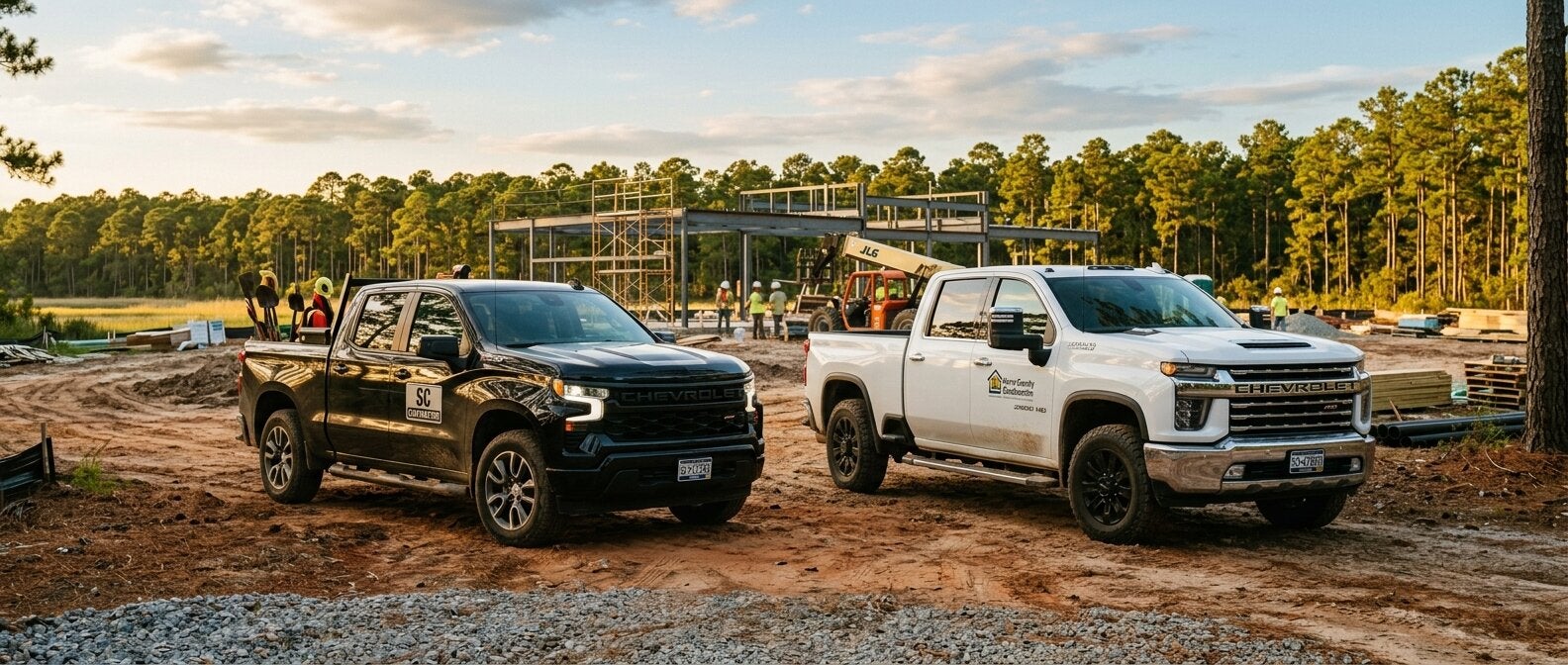
2026 Chevrolet Silverado 1500 and 2026 Silverado 2500 HD parked side by side at a Conway, SC job site

Silverado 1500 vs. Silverado 2500 HD: Which Truck Do Conway Drivers Actually Need?

In this article What's the Real Difference Between These Two Trucks? Does Towing Capacity Actually Matter for What You're Pulling? Ride Quality and Daily Drivability: The Honest Tradeoff So Which Silverado Should You Pick? If your load stays under 13,000 pounds and you spend most mornings driving US-501 into Myrtle Beach, the Silverado 1500 is probably your truck. If you're pulling a loaded gooseneck, running a Horry County construction fleet, or hauling anything that needs a real 975 lb-ft of torque on a regular basis, skip ahead to the Silverado 2500 HD. The tougher call is where you land between those two extremes. This guide sorts that out. The short version The 2026 Silverado 1500 tows up to 13,300 lbs when properly equipped; the 2026 Silverado 2500 HD tows up to 20,000 lbs with a conventional hitch and up to 22,420 lbs fifth-wheel or gooseneck. The 1500 carries an EPA rating (up to 28 mpg highway with the 3.0L Duramax diesel); the 2500 HD has no EPA rating by federal rule. Real-world gas owners see 11 to 14 mpg, diesel owners 13 to 17 mpg unloaded. The 1500 rides on a coil rear suspension and feels like a daily driver empty; the 2500 HD uses a solid axle and leaf springs, so it's noticeably firmer when the bed isn't loaded. The crossover point is simple. If your regular haul or trailer is above 13,000 lbs, the 1500 is at or past its rated limit and the 2500 HD is doing real work. For Grand Strand boat trailers, occasional camper trips, and commuter duty, the 1500 wins. For job-site work trucks, heavy goosenecks, and commercial fleets, the 2500 HD earns every dollar. What's the Real Difference Between These Two Trucks? Both trucks wear the Silverado name and share a cab silhouette, but underneath they ride on completely different platforms built for completely different jobs, and that gap matters far more than the badge they share, because one is tuned to daily-drive and tow on weekends and the other is built to haul heavy for a living. The distinction runs deeper than the sheet metal. So what changes underneath? Almost everything that carries weight, from the frame steel to the springs. The 2026 Silverado 1500 offers four engine choices. There's a 2.7L TurboMax four-cylinder making 310 hp and 430 lb-ft of torque, a 5.3L V8 rated at 355 hp and 383 lb-ft, a 6.2L V8 good for 420 hp and 460 lb-ft, and the 3.0L Duramax inline-six diesel producing 495 lb-ft of torque. Chevrolet rates maximum towing at 13,300 lbs when properly equipped with the Duramax diesel or 6.2L V8, the Max Trailering Package, and a Crew Cab 2WD configuration. The 2.7L TurboMax base engine pulls up to 9,500 lbs. Maximum payload tops out at 2,260 lbs in a Regular Cab, Long Bed, 2WD with TurboMax. Always confirm it on your door-jamb label. The 2026 Silverado 2500 HD is a different truck underneath. It runs two engines only, a 6.6L V8 gas engine rated at 401 hp and 464 lb-ft of torque, plus the available Duramax 6.6L Turbo-Diesel V8 producing 470 hp and 975 lb-ft of torque. Both mate to a 10-speed Allison automatic transmission built for sustained heavy loads. Conventional ball-hitch towing runs from 14,500 lbs on base configurations up to 20,000 lbs on a Crew Cab with the NHT package and Duramax. Hook up a fifth-wheel or gooseneck and that ceiling climbs to 22,420 lbs. Payload reaches 3,689 lbs, so you can load the bed hard and still have room to work. The frame is heavier steel, because it's designed to absorb those loads without flexing over the years. Spec 2026 Silverado 1500 2026 Silverado 2500 HD Engines 2.7L Turbo I4, 5.3L V8, 6.2L V8, 3.0L Duramax I6 6.6L V8 Gas, 6.6L Duramax V8 Peak Torque 495 lb-ft (3.0L Duramax, properly equipped) 975 lb-ft (6.6L Duramax, properly equipped) Max Conventional Tow 13,300 lbs (properly equipped) 20,000 lbs (properly equipped) Fifth-Wheel / Gooseneck Not rated at this capacity 22,420 lbs (properly equipped) Max Payload 2,260 lbs (properly equipped) 3,689 lbs (properly equipped) Rear Suspension Coil spring (smoother empty ride) Solid axle, leaf springs (firmer empty ride) EPA Fuel Economy Up to 23 city / 28 hwy (3.0L Duramax, 2WD) No EPA rating (GVWR exceeds federal threshold) Real-World Fuel (Gas) N/A (see EPA above) 11 to 14 mpg (owner-reported, unloaded) *All capability specs require proper equipment; always confirm your specific configuration on the door-jamb label.* The deciding number is 13,000 lbs. If your regular load or trailer is at or above that figure, the Silverado 2500 HD is the structurally correct truck for the job. The 1500 is operating at the edge of its rated limit. Does Towing Capacity Actually Matter for What You're Pulling? It matters, but only in proportion to what's actually riding behind you on US-501, so the answer comes down to your trailer weight rather than a spec-sheet ceiling, and a weekend boat versus a loaded gooseneck can send you toward two completely different Silverados. Let's get specific about the Grand Strand, because the local reality is where generic comparisons fall apart. A typical 22- to 24-foot center-console boat with trailer and fuel runs 6,000 to 8,500 lbs. A loaded dual-axle camper sits in the 8,000 to 11,000 lb range. Both slot comfortably under the Silverado 1500's 13,300 lb ceiling when it's set up with the 5.3L V8 and the standard Trailering Package. So if the Waccamaw River boat ramp is your Saturday morning, or you're towing a fifth-wheel camper to Myrtle Beach State Park on weekends, the 1500 handles it without working anywhere near its limit. Browse our 2026 Silverado 1500 inventory and filter by engine and cab to match the configuration to your trailer weight. Now flip the script to Horry County job sites. A loaded equipment trailer carrying a skid steer or mini-excavator routinely clears 14,000 lbs. A gooseneck hauling materials for a framing crew on a Grand Strand build can push 18,000 to 20,000 lbs. That's where the Silverado 2500 HD does work the 1500 simply isn't rated for. The 975 lb-ft of torque from the Duramax 6.6L diesel is also doing something real at low RPM that matters on a flat coastal highway. It pulls from a stop without strain, and that separates a truck built for daily heavy hauling from one that can manage it once in a while. For commercial buyers running a fleet in Conway or Myrtle Beach, our Work Truck Solutions team can walk you through fleet configurations, upfit options, and the right trim for the job. Explore Financing Options Ride Quality and Daily Drivability: The Honest Tradeoff Ride comfort is where these two trucks split most clearly, and the tradeoff genuinely cuts both ways, since the 2500 HD trades empty-bed smoothness for the stability it needs under a heavy trailer, whereas the 1500 holds its car-like ride and gives up that same load ceiling in return. Neither setup is wrong. They're tuned for different lives. The 2500 HD's solid rear axle and leaf spring suspension are what keep it steady under a 15,000 lb trailer. That same setup rides firmer with an empty bed. Over the expansion joints and rough pavement on SC-544 or stretches of US-378, you feel that stiffness when there's nothing back there. It isn't punishing, just clearly different from the coil-suspended 1500. The 1500 uses a coil rear suspension. Empty, it rides like a normal daily driver. That comfort holds up on a long beach-season commute, and you won't recalibrate your expectations every morning the way the HD sometimes asks. Fuel cost is the other line item worth being straight about. The 2026 Silverado 1500 with the 3.0L Duramax diesel carries an EPA-estimated 23 mpg city and 28 mpg highway. The 2500 HD has no EPA rating, because federal rules exempt trucks with a GVWR above 8,500 lbs. Owner-reported figures put the 2500 HD gas engine at 11 to 14 mpg in mixed driving. If you're commuting 40 miles each way from Conway into the Grand Strand five days a week, that fuel gap is a real monthly cost (not a footnote). "Heavy-duty trucks like the Silverado 2500 HD and 3500 HD do not receive official EPA fuel economy ratings due to their weight class." Per federal classification, this applies to any vehicle with a GVWR above 8,500 lbs. The maintenance side is real too. The 6.6L Duramax needs diesel exhaust fluid and more frequent fuel filter changes. Tires on the 2500 HD are larger and load-rated, so they cost more to replace. Those are fair ownership factors if this truck is also your daily driver. So Which Silverado Should You Pick? The right pick comes down to how you actually use the truck most days, and the split almost always tracks load weight rather than badge loyalty, since one truck is sized for weekend towing and the other for heavy daily work. Here's how it shakes out by buyer type, because one answer never fits everyone who walks onto our lot in Conway. Pick the Silverado 1500 if: You regularly tow a boat, camper, or landscape trailer under 12,000 lbs Your truck doubles as a daily driver, a family vehicle, or a commuter Fuel economy matters and you put real miles on between Horry County and the beach You want a smoother ride on empty roads Pick the Silverado 2500 HD if: Your work regularly puts more than 13,000 lbs behind the hitch You haul equipment trailers, goosenecks, or heavy construction loads You run a commercial operation that needs the heavier frame to hold up over time Ride stiffness and fuel cost are trade-offs you're willing to make for that capability headroom The 5.3L V8 Silverado 1500 is the most flexible daily-work truck we sell. It'll haul a loaded bass boat to the Waccamaw River boat ramp in the morning and drive back to Conway comfortably that evening without complaint. You get plenty of capability, EPA-rated fuel economy, and a ride that won't beat you up. If your towing stays under its rated ceiling, it earns its keep every day. The 2500 HD with the Duramax diesel is built for the way heavy Horry County job sites load a truck, because that work loads it hard and needs the margin that 975 lb-ft of torque and a 3,689 lb payload rating provide. For that work it isn't overkill, just right-sized. See our current 2026 Silverado inventory and use the engine and trim filters to narrow by configuration. If you're not sure which platform fits your trailer weight and workload, call our sales team at (843) 248-4283 and we'll match the right truck to the real numbers. Frequently Asked Questions Does the Silverado 2500 HD make sense as a daily driver in Conway? It can work as a daily driver, but it comes with genuine trade-offs worth knowing before you buy. The solid rear axle and leaf spring suspension that keep the 2500 HD stable under heavy loads also make for a firmer, stiffer ride on an empty bed, and that's a clear step away from the coil rear suspension in the 1500. Fuel costs run higher too, since the 2500 HD carries no EPA rating and real-world gas engine owners report 11 to 14 mpg in mixed driving. If your truck spends more days loaded and towing than empty and commuting, the HD earns its place. If it's mostly a commuter with occasional heavy towing, the 1500 will feel like the better daily fit. What's the maximum towing capacity of the Silverado 1500 versus the 2500 HD? The 2026 Silverado 1500 tows up to 13,300 lbs when properly equipped with the 3.0L Duramax diesel or 6.2L V8, the Max Trailering Package, and a Crew Cab 2WD configuration. Its 2.7L TurboMax base engine pulls up to 9,500 lbs. The 2026 Silverado 2500 HD tows up to 20,000 lbs with a conventional ball hitch on a Crew Cab with the NHT package and Duramax diesel, and up to 22,420 lbs with a fifth-wheel or gooseneck setup. Always confirm your specific truck's rating on the door-jamb label, since configuration, cab style, bed length, and installed options all move the number. Value Your Current Truck Palmetto Chevrolet 1122 4th Ave, Conway, SC 29526 (843) 248-4283
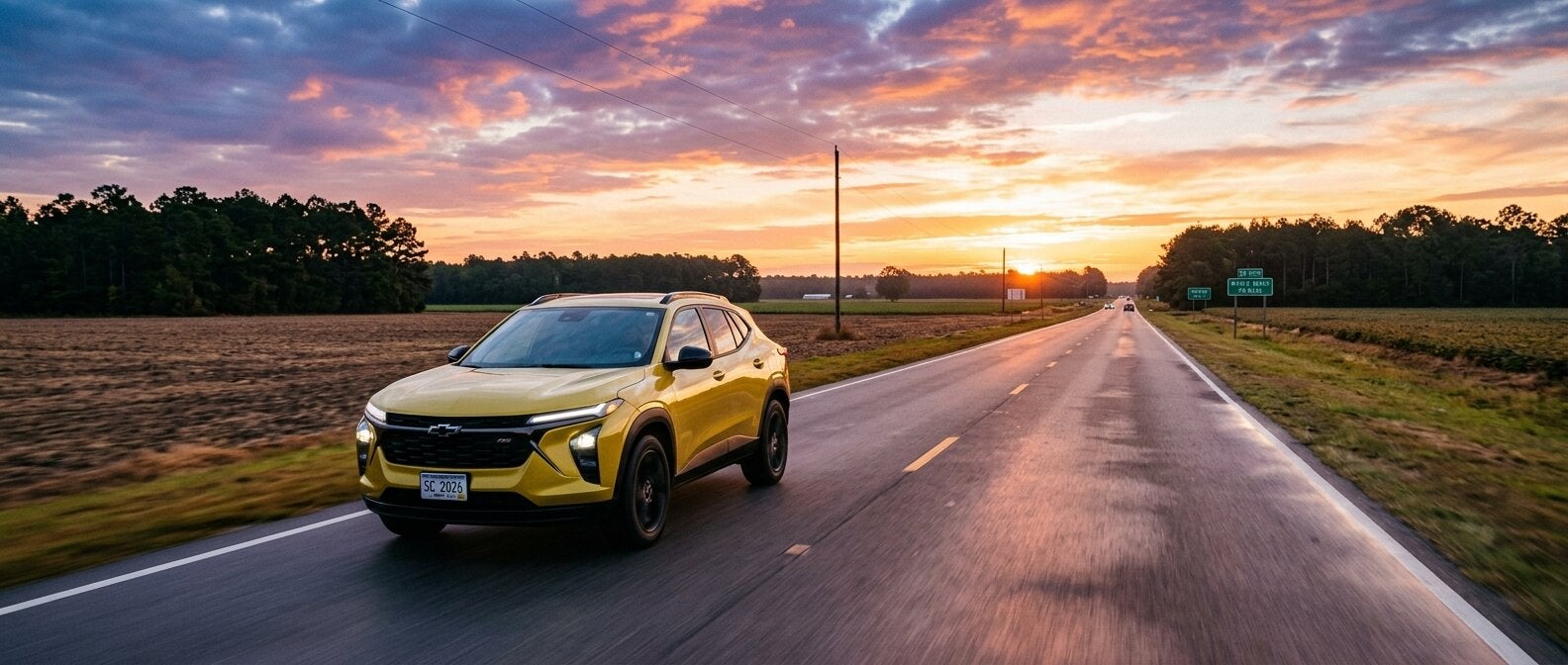
2026 Chevrolet Trax on a South Carolina highway near Aynor for the daily Myrtle Beach commute

Your Aynor-to-Myrtle Beach Commute Is Costing You More Than It Should

In this article What's Actually Going On? Two Routes, Two Different Problems The Trax Is the Right Answer on US-501 The Equinox Fits the SC-22 Runner The Equinox EV: When the Commute Is the Whole Justification DIY Assessment vs. Talking with Our Team The wrong vehicle on a 30-mile daily run adds up faster than you'd guess. Thirty miles each way, five days a week, is roughly 300 miles before the weekend even starts. At that pace, the gap between a well-matched commuter and a poorly matched one shows up in your fuel budget, your stress level, and your maintenance schedule by the end of the first year. Our bottom line is straightforward. For most Aynor-to-Myrtle Beach commuters, the 2026 Chevrolet Trax is the sharpest daily tool when you're grinding through US-501 stop-and-go. The 2026 Equinox earns its keep when SC-22 is your regular path. And the Equinox EV is the long-game play if you can charge at home. The route you take every morning changes the answer, and that's the piece a lot of commuter guides skip. What's Actually Going On? Two Routes, Two Different Problems The Aynor-to-Myrtle Beach commute runs about 30 miles and about 35 to 40 minutes on a clear morning via US-501, but clear through Conway isn't a given, which is why the route you pick decides the answer. You've got two ways to do it. Grind through Conway on US-501 with its signals and merge points, or pick up SC-22 (Veterans Highway) right at Aynor and run a 65-mph limited-access expressway straight to the coast. Those are two meaningfully different commutes. One favors city efficiency, the other favors highway comfort and range. Pick wrong for your actual route and you'll feel it every week. Commuter Problem Likely Cause What It Costs You Right Fix Too many fill-ups on a 30-mile run US-501 through Conway: signals, merges, beach-season congestion Low city MPG multiplied by 300-plus weekly miles 2026 Trax: EPA-rated 28 city / 32 highway mpg Highway run feels sluggish or noisy SC-22 Veterans Highway: 65 mph, 32 miles of expressway Engine spinning harder than the road demands 2026 Equinox: EPA-rated 26 city / 29 highway mpg (FWD) Fuel cost is the constant frustration 60-mile round trip, five days a week, every week Gasoline accumulates at this volume 2026 Equinox EV: EPA-estimated 319 miles of range per charge Too little cargo for real daily life Hauling work gear, groceries, and a commuter bag simultaneously Undersized vehicle for what you actually carry Equinox or Equinox EV: up to 63.5 and 57.2 cu. ft. max cargo, respectively See commuter models available at Palmetto Chevrolet The Trax Is the Right Answer on US-501 On US-501, the Trax is the right answer, since stop-and-go traffic is exactly where a small, well-calibrated turbocharged engine earns its place, and the front-wheel-drive-only setup rarely bites on the flat Grand Strand. The EPA rates the 2026 Trax at 28 city / 32 highway mpg. The engine is a 1.2-liter turbo three-cylinder making 137 horsepower and 162 lb-ft of torque. It also carries an automatic stop/start system that cuts the engine at extended red lights, which is part of how it holds that city rating when you're crawling in real traffic. The Trax has a 13.2-gallon fuel tank. At the EPA highway figure, you're looking at a theoretical range north of 420 miles. On a real mixed commute in Horry County, you'll land in the 29 to 31 mpg range on most days. That's genuinely competitive for a non-hybrid gas vehicle. The honest tradeoff is worth naming. The Trax is front-wheel-drive only, every 2026 model. On the Grand Strand that's mostly irrelevant (Horry County doesn't see the kind of snow that makes AWD a necessity), but if you haul heavier loads or want a confidence buffer on a wet road, that limitation is real, worth a thought if you tow. The Equinox addresses it. From our team: That stop/start system can feel abrupt if you're not used to it. It can be turned off. Just know the city rating reflects it running, so switching it off will affect real-world fuel economy at a noticeable margin. The Equinox Fits the SC-22 Runner If SC-22 is your morning, the Equinox is the fit, since it trades a couple points of city mpg for the calmer, torquier highway cruise a 65-mph expressway rewards. Veterans Highway breaks off from US-501 right at Aynor. It runs 32 miles to the coast as a true 65-mph limited-access expressway. If that's your actual morning, you want sustained highway comfort and a torquey engine that doesn't sound strained at speed. The 2026 Equinox runs a 1.5-liter turbocharged four-cylinder making 175 horsepower. FWD models are EPA-rated at 26 city / 29 highway / 27 combined mpg. The AWD version returns 25 city / 29 highway / 26 combined. That highway number doesn't look dramatically different from the Trax on a spec sheet, but the Equinox delivers it with a roomier, quieter cabin and a torque advantage (184 lb-ft FWD, 203 lb-ft AWD) that makes 65-mph cruising feel settled rather than pushed. The 1.5-liter turbo does the quiet work here. It doesn't feel rushed at 65. The real tradeoff is city efficiency. The Equinox's 26 city mpg runs a couple of points behind the Trax in the stop-and-go that stacks up on US-501 through Conway during beach season. If that traffic is your reality, that gap matters across 300 weekly miles. The city-efficiency gap isn't a fatal flaw, just a good reason to know which route you actually drive before you decide. Identify your primary route before you shop: US-501 through Conway vs. SC-22 expressway from Aynor Calculate real weekly mileage (60-mile round trip x 5 days = 300 miles at minimum) Check whether home charging is realistic for your setup Decide whether AWD matters for cargo weight or wet-road confidence Think about cargo needs now and 18 months from now Ask our team about trim-level differences in standard safety features before committing The Equinox EV: When the Commute Is the Whole Justification Thirty miles each way is almost exactly where an EV's practical argument becomes hard to dismiss, as long as you can plug in at home. The 2026 Equinox EV carries an EPA-estimated 319 miles of range on front-wheel-drive models. Is range a real worry on this corridor? Not here. A 60-mile daily round trip uses roughly 19 percent of that capacity, so charging anxiety on this specific corridor isn't a realistic concern. The EPA rates the FWD Equinox EV at 108 MPGe combined. Spread across 300-plus miles per week, that gap over a gas model isn't trivial. The honest part is the charging question. Without home charging, the experience changes. A Level 2 (240-volt) charger at home means you wake up to a full battery every morning. That's the scenario where EV commuting becomes seamless. Public charging in Horry County is expanding, but it's not the same as plugging in in your own driveway overnight. The Equinox EV carries 57.2 cubic feet of maximum cargo space, per Chevrolet. Same practical footprint as the gas Equinox. You don't trade away anything practical. Schedule a Commuter Model Comparison at Palmetto Chevrolet DIY Assessment vs. Talking with Our Team Three things are worth doing before you ever come in, and one's worth a real conversation with us. What you can do right now. Time both routes on a normal work morning, US-501 through Conway versus SC-22 from Aynor to the coast. You'll spot the traffic patterns immediately, and that drive will tell you more about which MPG number matters to you than any comparison guide. Also, check whether your home has a 240-volt outlet in the garage, or room to add one. That single fact changes the Equinox EV case dramatically. What's worth a conversation. Chevy Safety Assist (forward collision warning, lane keep assist, automatic emergency braking, and more) comes standard across all three models. But what else is standard versus optional shifts by trim in ways that matter on a daily driver. We'd rather walk you through that in 15 minutes on the lot than have you discover a gap after the purchase. Frequently Asked Questions How long is the commute from Aynor to Myrtle Beach? The drive is about 30 miles. Via US-501 through Conway, the trip typically runs 35 to 40 minutes under normal conditions. Commuters who take SC-22 (Veterans Highway) from Aynor directly access a 65-mph expressway that bypasses Conway and can move faster when beach-season traffic builds on the main US-501 corridor. Is the 2026 Equinox EV realistic for an Aynor-to-Myrtle Beach commuter? Yes, particularly when home charging is available. The 2026 Equinox EV carries an EPA-estimated 319 miles of range on front-wheel-drive models. A 60-mile round trip from Aynor to Myrtle Beach and back uses roughly 19 percent of that range, so the commute itself is never the concern. The practical question is where you charge: a Level 2 home charger gives you a full battery every morning, which is the scenario where the EV commuting experience is most seamless. Public charging infrastructure in Horry County is growing, but home charging remains the cleaner daily setup. Value Your Current Vehicle Toward a Commuter Upgrade Palmetto Chevrolet 1122 4th Ave, Conway, SC 29526 (843) 248-4283
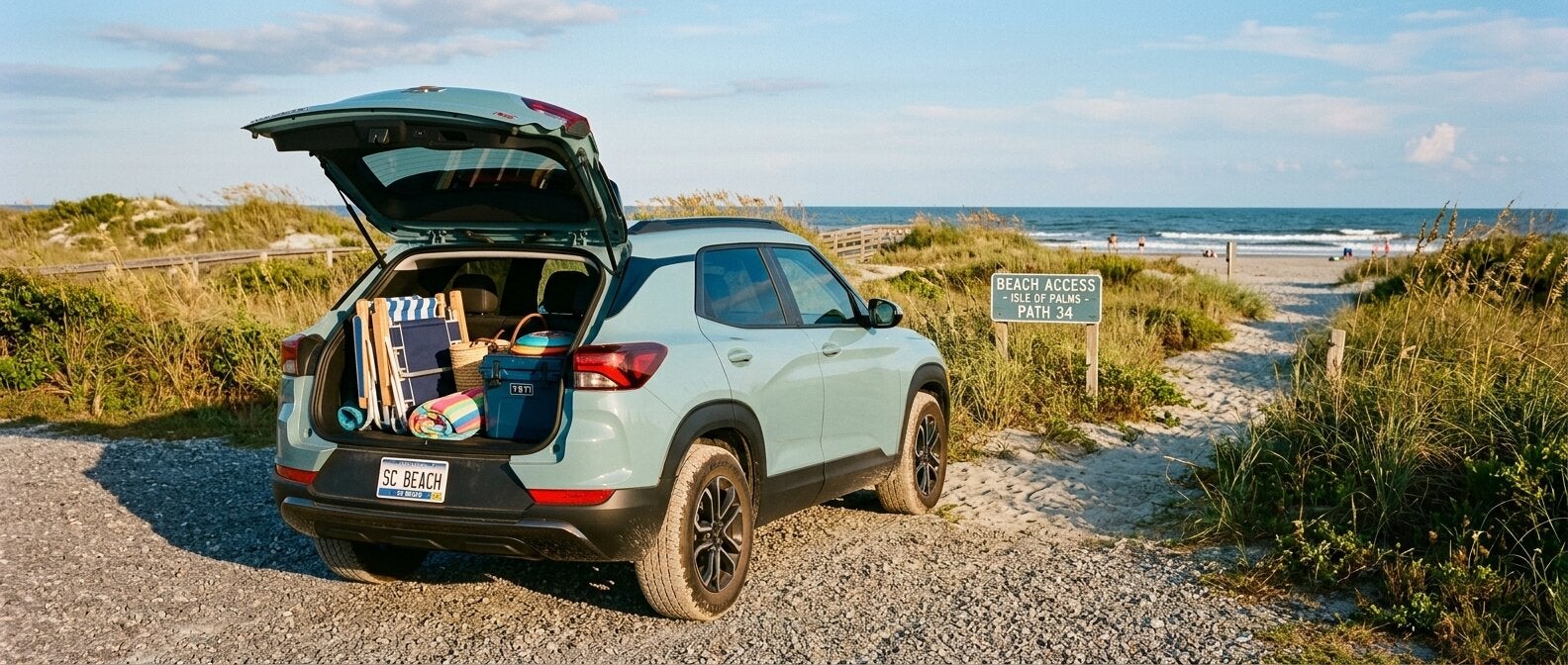
2026 Chevy Trailblazer at a Pawleys Island beach access with liftgate open and beach gear loaded

How to Set Up Your Chevy Trailblazer for a Pawleys Island Weekend Getaway

Pawleys Island sits less than 35 miles from Conway. Easy, right? Mostly, until you're circling the south-end lot at 9:45 on a Saturday morning and watching every spot vanish. The island's nine public beach access points share roughly 141 combined parking spaces, and the Town of Pawleys Island enforces its parking regulations strictly. So before you load up and head south on US-501, the questions worth asking aren't about whether the 2026 Trailblazer can make the run. The Trailblazer can. What matters is which trim gets your gear there comfortably, which setup handles the island's tight, narrow access roads, and where the Trailblazer's honest limits sit. The short version Parking-friendly choice: The Trailblazer's 174.1-inch overall length fits Pawleys Island's tight street and lot spaces better than a full-size SUV. FWD is enough for most trips; add AWD (ACTIV or RS with AWD) if you're also hauling to Huntington Beach State Park's soft sand lots or want confident wet-road grip on rainy US-17 runs. Cargo sweet spot: 25.3 cubic feet behind the rear seats handles a family beach day. Fold the rear seats and the fold-flat front passenger seat and you get 54.4 cubic feet. That's enough for surf gear, folding chairs, and a cooler without a rack. Towing limit is real: When properly equipped, the Trailblazer tows up to 1,000 lbs. A single jet ski on a light trailer fits; a full-size boat does not. Go early or go to the state park: Parking lots at Pawleys fill by 10 a.m. on busy summer weekends. Plan arrival before 9 a.m. or use Huntington Beach State Park as your backup. What Actually Matters When Choosing Your Trailblazer Setup? Four variables decide which Trailblazer configuration earns its spot in your driveway on a Pawleys weekend, and while the spec sheet lists them all, the island decides which ones matter (overall size, cargo capacity, drivetrain grip, and tow rating). Overall size counts because the causeway road and island streets are genuinely narrow. Cargo capacity counts because beach gear multiplies faster than you'd guess. Drivetrain grip counts because late-summer afternoon thunderstorms on US-17 aren't rare in the Grand Strand, and tow rating counts the moment any watercraft or trailer joins the trip. The four main configurations sort out like this against a Pawleys weekend. Configuration Best For Key Spec Real Tradeoff LS or LT / FWD / 1.2L Day trips, 1-2 adults, light gear EPA est. 30 city / 31 hwy mpg No AWD option; less torque in wet turns LT / FWD / 1.3L Family day trip, more gear, better highway pace EPA est. 29 city / 33 hwy mpg Still FWD only at this pairing ACTIV / AWD / 1.3L Families with beach gear, Huntington Beach soft lots, rainy-day confidence EPA est. 26 city / 29 hwy mpg; 8-in ground clearance Lower mpg; slightly higher cost RS / AWD / 1.3L Style-first buyers who want AWD grip and 19-in wheels EPA est. 26 city / 29 hwy mpg; sport-tuned look Same drivetrain as ACTIV, no skid plate All mpg figures are EPA estimates for the 2026 Trailblazer. Chevrolet lists max towing at 1,000 lbs when properly equipped, and that holds across all trims. Getting Your Gear to the Beach: Cargo Is the Real Differentiator Cargo is where the Trailblazer earns its keep for a beach weekend, and though it wears a compact badge, the 2026 model gives you 25.3 cubic feet behind the rear seats and 54.4 cubic feet with that seat folded. Compact SUV doesn't have to mean cramped. The feature almost nobody in the crossover segment can match is the flat-folding front passenger seat, which creates a load floor up to 8.5 feet long, entirely inside the closed cabin. What does that mean on a Pawleys run? A family of four with beach chairs, a cooler, a bag of sand toys, and a pop-up shade tent can pack everything behind the rear seats and still leave room for wet towels on the way home. Traveling solo or as a couple, you can fold one rear section and the front seat and carry paddleboards, a folding kayak, or fishing gear without roof racks or a trailer. Losing the trailer matters when you're squeezing into a Pawleys Island street-parking slot. The Equinox steps up if your crew regularly fills every seat and needs serious cargo on top of that. For a two-to-four-person coastal weekend, though, the Trailblazer's flexible interior handles the load without the extra footprint. Browse our current Trailblazer inventory to see which trim configurations are on the lot right now. Gear packing note: The 2026 Trailblazer's available hands-free liftgate lets you open the tailgate with a foot kick while your hands are full of gear (useful when you're juggling a cooler and a bag of chairs at the Pawleys Island south-end lot). It's available on LT, ACTIV, and RS trims but not on the base LS. Pros Cons 174.1-inch length fits tight Pawleys parking spaces and the narrow causeway 1,000-lb tow max means jet ski or light utility trailer only (no pontoon boats) Fold-flat front passenger seat creates an 8.5-ft load floor (unique in the segment) AWD configuration drops highway mpg from 33 to 29 compared to 1.3L FWD 54.4 cu ft max cargo swallows a full beach kit without roof racks ACTIV's 8-inch ground clearance helps in soft lots; LS and LT are lower at 7 inches EPA-estimated 33 mpg highway on 1.3L FWD trims makes the US-501 run efficient Base 1.2L engine produces 137 hp (adequate but not spirited for four adults) Wireless Apple CarPlay and Android Auto standard across all trims Parking fills by 10 a.m. peak weekends. That's a Pawleys reality, not a vehicle issue. Matching Your Trailblazer to How You Actually Drive to Pawleys For a Pawleys Island day trip or a weekend stay, the LT or ACTIV in FWD is where our team would start, since the 1.3L FWD gives you EPA-estimated 33 mpg on the highway and covers the 35-mile US-501 run down and back without complaint. Get there early enough to beat the parking rush and the standard ground clearance is fine for paved access lots. Save AWD for trips that involve Huntington Beach State Park, whose sand parking areas run softer, or for the stretch of US-17 Alternate through Murrells Inlet when a late-afternoon storm slicks the road. If a jet ski is coming along, the properly-equipped Trailblazer handles up to 1,000 lbs of tow. A single personal watercraft on a light trailer fits within that, on the lighter trailers anyway. Confirm the actual trailer weight before you hitch anything up, and verify the specific door-jamb label for your trim and configuration. Bigger boat, bigger crew, or camping gear for a Huntington Beach overnight? That's when the Traverse earns a look instead. Different trip, different vehicle. See What Your Current Vehicle Is Worth Frequently Asked Questions Is the 2026 Chevy Trailblazer big enough for a family beach trip to Pawleys Island? For two to four people with a full day's worth of beach gear, yes. The 2026 Trailblazer offers 25.3 cubic feet behind the rear seats and 54.4 cubic feet with those seats folded. The fold-flat front passenger seat extends the load floor to 8.5 feet for longer items. A family of four with chairs, a cooler, bags, and a pop-up shade tent fits comfortably. A family that regularly travels with five adults and needs full rear seating plus overflow cargo should look at a mid-size SUV like the Traverse. Does the Trailblazer have enough towing capacity to bring a jet ski to Pawleys Island? When properly equipped, the 2026 Chevy Trailblazer has a maximum towing capacity of 1,000 lbs. A single personal watercraft on a light trailer usually falls within that range, but you'll want to confirm the actual weight of your trailer and watercraft before hitching up. Heavier trailers, multi-ski setups, or any full-size boat will exceed that limit. For anything over 1,000 lbs, we'd point you to a truck like the Colorado or a larger SUV in our lineup. By the Palmetto Chevrolet Team | September 2026 Schedule a Pre-Trip Service Check Palmetto Chevrolet 1122 4th Ave, Conway, SC 29526 (843) 248-4283
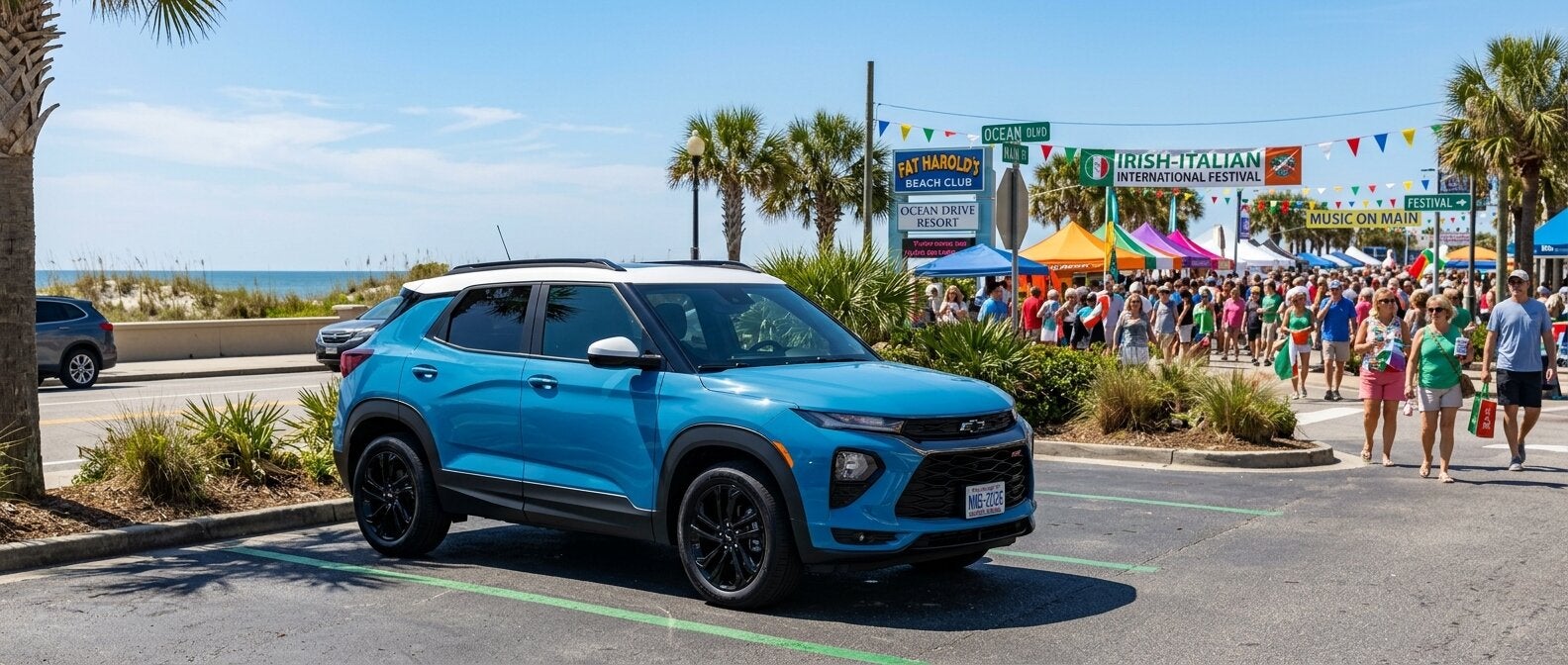
2026 Chevrolet Trailblazer parked near Ocean Boulevard in North Myrtle Beach SC on a festival day

Your NMB Live! and Music on Main Parking Playbook: Which Chevy SUV to Drive

Main Street in North Myrtle Beach closes to traffic on event day. The Horseshoe lot shuts at 2 PM for concert setup every Thursday during Music on Main. When NMB Live! rolls in on September 26 with 150-plus vendors and an expected 15,000 people in town, the free lots at 2nd Avenue North and 1st Avenue South fill early. The SUV you drive to an NMB event is a logistics decision first and a preference second. A 204-inch three-row that can't squeeze into the McLean Park overflow lot is a problem you don't want to be solving at 10:15 AM once the festival has already started. So how do you choose? Match your Chevy to the event, the lot, and how many people you're hauling, and the pick makes itself. We've laid it all out below. The 2026 Chevrolet Trailblazer is the one we'd reach for first if your group is four people or fewer. Keep reading to see exactly why we'd reach for it first. Where Do You Park, and When? Park in a designated free lot and get there early, because for Music on Main (Thursday evenings, June through September at the Horseshoe on 11 S. Ocean Blvd.) the Horseshoe lot closes at 2 PM for stage setup and Ocean Boulevard from 1st Avenue North to 1st Avenue South closes at 5 PM. For NMB Live! on September 26, the City of North Myrtle Beach has confirmed three free parking locations and a shuttle option. Plan around them rather than hoping to find something on Main Street itself. Arrive by Park here Fit / space note Insider tip Before 10 AM 2nd Ave N & Ocean Blvd (free lot) Tight rows; a Trax (178.6" long) or Trailblazer (174.1" long) slots cleanly This lot fills fastest; arriving at opening gets you a pull-through 10-11 AM 1st Ave S & Ocean Blvd (free lot) Similar tight-lot layout; Equinox (183.2" long) still fits; Traverse needs care Standard 18-20 ft spaces; longer three-rows get pinched at the ends 11 AM-noon McLean Park, 93 Oak Drive Larger lot with better spacing for any SUV, including the Traverse Good shade trees; slightly longer walk to Main St, but worth it mid-day Midday or later Shuttle from Ocean Drive Elementary, 901 11th Ave N Any vehicle; free shuttle runs 8 AM-5 PM Best move for a large group in a Traverse; skip the parking scramble entirely Music on Main note: the two-hour street parking limit on Main Street (Ocean Blvd to Oak Street) runs 9 AM to 5 PM daily, and the city enforces it. Get to a designated lot instead of a Main Street curbside spot you plan to feed for five hours. The Maneuvering Play: Which SUV Fits This Street Grid The smaller the footprint, the easier this grid is, because North Myrtle Beach's Ocean Drive section runs on a classic old beach grid of short blocks with angled and parallel spots mixed together, and on event day you'll be threading past golf carts, pedestrians crossing mid-block, and the occasional beach cruiser going the wrong way. Every inch of vehicle length matters here. Chevrolet lists the 2026 Trailblazer at 174.1 inches long and 71.2 inches wide, the smallest footprint in our lineup for a full five-passenger SUV. It turns in a tight 103.9-inch wheelbase, which translates to noticeably less nose overhang when you're backing out of an angled spot on 2nd Avenue North. The Trax is even shorter (178.6 inches, actually a hair longer than the Trailblazer, so call it comparable at this scale), with Chevrolet's cargo figure of 54.1 cubic feet with the rear seat folded. The 2026 Chevrolet Trax is the sharpest choice if you're bringing two people plus a stroller, beach chairs, and a cooler. For a family of five or six, the 2026 Chevrolet Equinox at 183.2 inches is the sweet spot. It gives you 63.5 cubic feet of total cargo space, fits standard parking spaces without drama, and still clears the Traverse's bulk. Where we'd steer you away from the Equinox is a group of seven or eight people, when you're splitting two vehicles or you want the 2026 Chevrolet Traverse (204.5 inches, 97.6 cubic feet of cargo). The Traverse is genuinely capable and comfortable for a big family day out. The tradeoff is real. At 204 inches it's tighter to manage in a compact beach lot when other cars are pulling in and out around you. If you're bringing the Traverse, target McLean Park or use the shuttle. It's not the wrong choice. It just wants more room to work with. Tip: Time the lot, not the event. For Music on Main, arriving before 5 PM secures a lot spot before Ocean Boulevard closes. That buys you two hours of wandering Main Street before the 6:30 PM show starts. Arriving right at 6 PM means circling for street parking blocks away, then walking in as the first song starts. Etiquette note: Golf cart parking is designated and marked along Main Street starting at 5 PM for Music on Main. Don't park in those spots with a full-size SUV, even if they look open at 4:45 PM. The city marks them for a reason, and locals will notice. Next step: If you're unsure which Chevy SUV fits your regular Grand Strand life (not just event day), come see the lineup side by side on our lot. We're in Conway, about 30 minutes from Main Street via US-501, and we're happy to walk you through the differences in person. Before You Go: Your Event-Day Checklist Pack for warm, humid coastal afternoons and plan to beat the road closures, because these events run outdoors in coastal South Carolina in September and the lots and streets shut on a fixed schedule that won't wait for you. Run through everything on this list before you leave the driveway. Download the NMB city parking map before you leave home; cell coverage can slow near the event zone when 15,000 people are on the same cell towers Arrive before 10 AM for NMB Live! or before 4:30 PM for Music on Main to beat road closures and lot fills Load chairs, sunscreen, and a small cooler before you leave so you can walk straight from the lot to the event; don't dig through the cargo area on 2nd Avenue in traffic Park, then unload. Stop at your lot, set your group loose to walk toward Main Street, then find your space; it's faster than loading up on the curb Note your lot name and the cross street on your phone; McLean Park, Ocean Drive Elementary, 2nd Ave N / Ocean Blvd, and 1st Ave S / Ocean Blvd all look similar if you're turned around after a few hours in a crowd Trax and Trailblazer owners: fold the rear seat and load cargo before you go; 54 cubic feet of flat floor loaded at home beats wrestling beach chairs out of a folded-seat configuration in a packed lot Traverse owners: confirm your group is using the shuttle from Ocean Drive Elementary if you're arriving after 11 AM; that's the right call See What Your Current Vehicle Is Worth The right SUV for event day is the one that fits your group, clears the lot you're parking in, and doesn't require a 12-point turn to back out. None of that is a sales line, just plain lot geometry (something our team at Palmetto Chevrolet thinks about whenever customers ask which Chevy makes sense for Grand Strand life). Go enjoy it. Explore Financing Options Palmetto Chevrolet 1122 4th Ave, Conway, SC 29526 (843) 248-4283
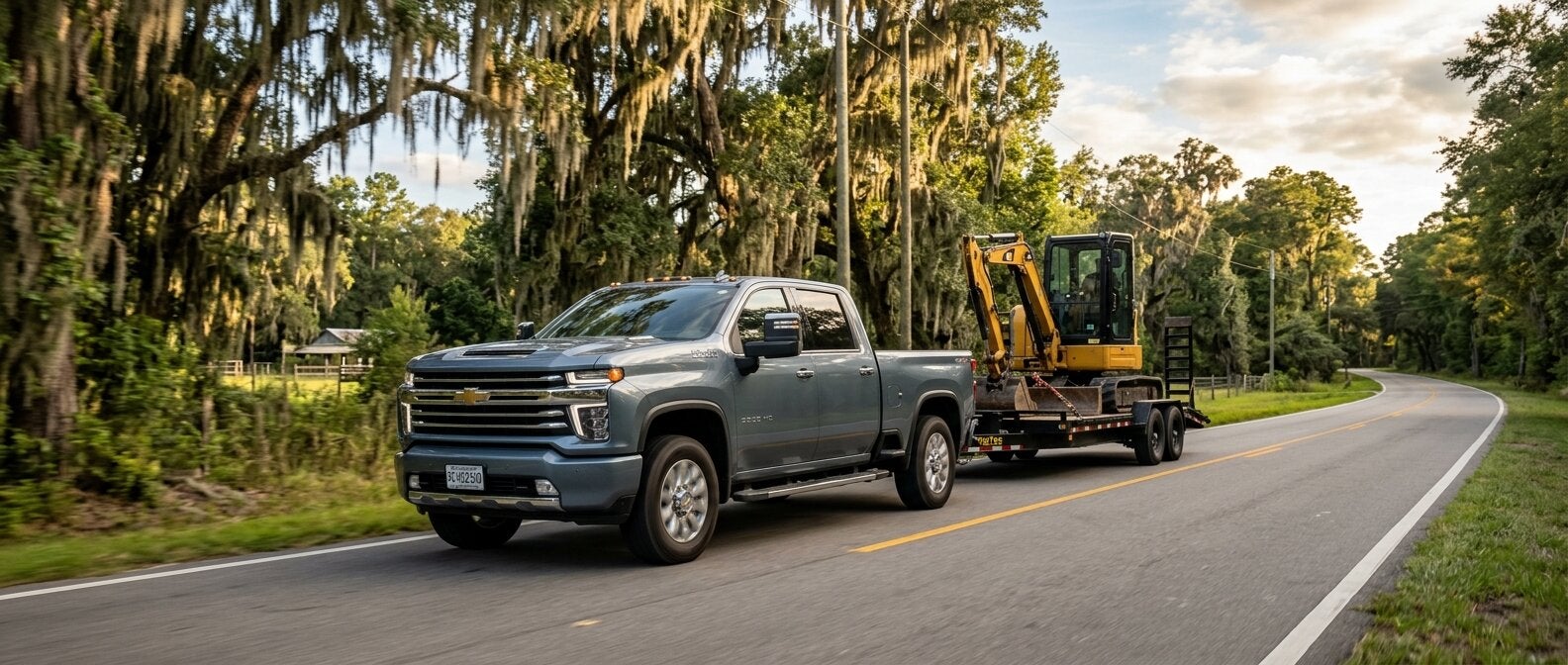
2026 Chevrolet Silverado 2500 HD towing a flatbed trailer on a rural Highway 701 corridor in Horry County, South Carolina

4 Best Chevy Trucks for Towing Near Highway 701 | Palmetto Chevrolet

In this article The 2026 Chevy Towing Lineup at a Glance Silverado 2500 HD: The Workhorse for Hwy 701 Silverado 3500 HD: When the Load Is Commercial Buying Caution: Read the Door-Jamb Label Before You Tow Anything Three More Things Worth Knowing for This Corridor Silverado 1500: Capable, and More Honest Than Its Reputation Colorado: The Right Truck for the Right Trailer If you're pulling anything significant on Hwy 701, from the Waccamaw River boat ramps south toward Georgetown County or north through the active construction zones toward Loris, you need a truck configured for the job rather than one picked for a big spec-sheet number. Which Chevy truck actually fits your trailer? For most real towing jobs in this market, the answer is the 2026 Silverado 2500 HD, and it's a fair question from Horry County tradespeople, farmers, and families who pull loads on this corridor. But it isn't the only right answer, and we want to walk through why before you drive in and choose one on badge alone. Below is the breakdown across four trucks, ranked by towing capability and matched to the real loads this corridor carries. The 2026 Chevy Towing Lineup at a Glance Rank Truck Best For Max Conventional Tow (Properly Equipped) 1 Silverado 2500 HD Most serious towing: boats, equipment trailers, large campers 20,000 lbs (Duramax diesel) 2 Silverado 3500 HD Commercial and gooseneck work (dually loads) 36,000 lbs gooseneck 3 Silverado 1500 Moderate towing: pontoon boats, cargo trailers, campers 13,300 lbs 4 Colorado Light towing: small boats, utility trailers, weekend gear 7,700 lbs Every figure here depends on proper equipment and configuration. Chevrolet publishes the specific ratings on the Trailering Information Label on the driver's door jamb of each individual truck. Treat that sticker as the authoritative number for your build; the headline figure is only a starting point. Silverado 2500 HD: The Workhorse for Hwy 701 The 2026 Silverado 2500 HD is where we point buyers who tow seriously on this corridor, since it pairs a genuine heavy-duty rating with the stability hardware a two-lane road demands, though the payload math keeps it from being automatic for every gooseneck. Full stop. The stretch between Conway and Georgetown County on 701 is a two-lane road through rural, low-elevation terrain. On a road like that, trailer sway demands real stability hardware, not just a high headline number. Chevrolet rates the 2026 Silverado 2500 HD at up to 20,000 lbs of conventional towing capacity when equipped with the 6.6L Duramax turbodiesel V8 producing 470 horsepower and 975 lb-ft of torque, paired with the Max Trailering Package. That setup covers a heavy equipment trailer, a large fifth-wheel camper, or a loaded flatbed without straining the system. For a heavy hauler on this corridor, that combination is what matters. It tows and stays composed doing it. Chevrolet also made the integrated trailer brake controller standard for 2026 on every single trim of the 2500 HD. You used to have to spec up or add aftermarket hardware to get in-dash brake control. Now the lowest Work Truck trim has it from the factory, and that's a genuine step forward for the tradespeople on this corridor who buy the base spec and work it hard. The tradeoff here is payload, and there really is one. The Duramax diesel adds meaningful curb weight, which cuts your available payload compared to the gas 6.6L V8 rated at 401 hp and 464 lb-ft. Chevrolet lists maximum payload at 3,689 lbs, but that number shrinks once you account for passengers, tools in the bed, and the engine itself. If your gooseneck pin weight runs heavy, the gas V8 variant, rated at approximately 14,500 lbs conventional, can give you more headroom in the payload column. Know your pin weight before choosing the engine. Gooseneck note: The 2026 Silverado 2500 HD gooseneck and fifth-wheel rating reaches up to 22,420 lbs with the Duramax and the 5th Wheel/Gooseneck Hitch Prep Package. Skip that package and you're working with a lower number. Verify the build configuration on your own truck. Explore Financing for a Silverado 2500 HD Silverado 3500 HD: When the Load Is Commercial The 2026 Silverado 3500 HD exists for the loads a 2500 HD can't legally touch, so it's the pick when you're moving commercial gooseneck weight, though most residential buyers will find it's more truck than their trailers ever ask for. That's the short version. If you're moving heavy equipment on a gooseneck, say a loaded skid steer, a full-size excavator, or a commercial flatbed hauling material south on 701, the 3500 HD Dually with the 6.6L Duramax diesel and the Max Trailering Package is rated up to 36,000 lbs gooseneck. Conventional towing tops out at 20,000 lbs. The engine family matches the 2500 HD, the 470 hp / 975 lb-ft Duramax paired with the Allison 10-speed automatic, but the dual rear wheel configuration handles far greater pin weight at the back axle. One detail is easy to miss. The 36,000-lb gooseneck rating requires a very specific build (Regular Cab, 2WD, dual rear wheel, NHT package, Duramax). A residential setup rarely calls for that build. Most everyday 3500 HD jobs live in the 18,000-to-22,000-lb range, which the 2500 HD also covers comfortably. We'd point you to the 3500 HD if you're running commercial volumes of equipment on 701 South, or if your trailer's pin weight routinely stresses the limits of a 2500 HD's payload ceiling. A short list of operators truly needs this truck: Commercial contractors running fully loaded equipment trailers regularly Hotshot operators running gooseneck flatbeds on the 701/17 corridor Agricultural operations towing large livestock or full-scale equipment trailers Anyone whose primary use case is the job itself rather than an occasional weekend Buying Caution: Read the Door-Jamb Label Before You Tow Anything The window-sticker rating isn't your truck's actual rating. Your truck's rating is the number on the Trailering Information Label on the driver's door jamb, which accounts for your specific cab, bed, engine, drivetrain, axle ratio, and trailering package. Two identical-looking Silverados parked in adjacent spots on our lot can carry meaningfully different tow ratings. Chevrolet's guidance is that tongue weight for conventional towing should run approximately 10% of the total trailer weight. For gooseneck setups, pin weight runs roughly 15%, and that pin weight counts against your payload rating, not just your tow rating. Three More Things Worth Knowing for This Corridor Heat and humidity stress the cooling system on long pulls. The stretch of 701 from Conway south into Georgetown County is low-elevation and plenty hot in September. On any engine, Tow/Haul mode is the setting the transmission calibration was designed for. Use it. Active widening construction on 701 north of Conway means merge points and lane changes with a trailer behind you. The 2026 HD models offer up to 14 camera views including a hitch view. Those are practical tools on a two-lane construction zone, and they earn their place. The Advanced Trailering Package or Max Trailering Package is what unlocks the top rating on every truck in this lineup. Confirm it's actually on the truck you're buying, not just available for the trim. Silverado 1500: Capable, and More Honest Than Its Reputation The 2026 Silverado 1500 earns its spot here for the buyer who tows a few times a season and handles a pontoon boat or a mid-size camper cleanly, though it isn't the truck for a trailer that lives near its ceiling week in and week out. The timing is worth a note too. This is the last year of the fourth-generation Silverado 1500 before Chevrolet launches a redesigned truck for the 2027 model year. Chevrolet rates the 2026 Silverado 1500 at up to 13,300 lbs of conventional towing when properly equipped with the 3.0L Duramax turbodiesel inline-six making 495 lb-ft of torque or the 6.2L V8, plus the Max Trailering Package. The 5.3L V8, which is more often what you'll find on the lot, is rated up to 11,300 lbs. The base 2.7L TurboMax reaches 9,500 lbs. For a pontoon boat headed to the Waccamaw, a mid-size travel trailer, or a single-axle equipment trailer, those numbers work without drama. The 1500 earns its keep in a clear way. If you're trailering a boat or camper a few times a season, a well-equipped 1500 handles it cleanly. Its smaller footprint is easier to maneuver at a boat ramp, easier through downtown Conway, and easier on fuel the other 340 days you're not towing. The catch worth naming is the sustained pull. If your loaded trailer sits near the 12,000-lb mark, you're working close to the ceiling of what the half-ton is built to manage over distance. The 2500 HD carries that load without the thermal stress the 1500 would eventually feel. Buyers who tow often or near capacity should step up. The 1500 fits the buyer who tows regularly but doesn't earn a living doing it. Colorado: The Right Truck for the Right Trailer The 2026 Chevrolet Colorado closes out this list as the right answer for the towing jobs where a full-size truck is more than the trailer needs, though it runs out of room quickly once the loaded weight climbs. It suits a big slice of Horry County towing where a full-size truck feels like the default and the trailer doesn't actually require one. Chevrolet rates the 2026 Colorado at up to 7,700 lbs of towing capacity when equipped with the Advanced Trailering Package, powered by the 2.7L TurboMax four-cylinder producing 310 horsepower and 430 lb-ft of torque. Without the package, that drops sharply to 3,500 lbs. So confirming the package is on the specific truck you're buying matters a lot. Inside 7,700 lbs you can fit a bass boat, a small to mid-size camper, a loaded single-axle utility trailer, or a side-by-side on a small enclosed. What it won't handle is anything with a loaded weight pushing past 7,000 lbs, or any trailer where the tongue weight approaches the Colorado's 1,710-lb maximum payload. Base your decision on the trailer's loaded weight, since the empty weight always reads lower, and check it before you buy. The Colorado's advantage around here is an everyday one. If you're commuting on US-501 between Conway and Myrtle Beach and only towing a few times a month, its smaller footprint, improved daily fuel economy, and lower overall cost of ownership make sense. A 2500 HD is a serious tool. Sometimes a serious tool is more truck than the job calls for. By the Palmetto Chevrolet Team | September 2026 Value Your Current Truck Toward a New One Palmetto Chevrolet 1122 4th Ave, Conway, SC 29526 (843) 248-4283
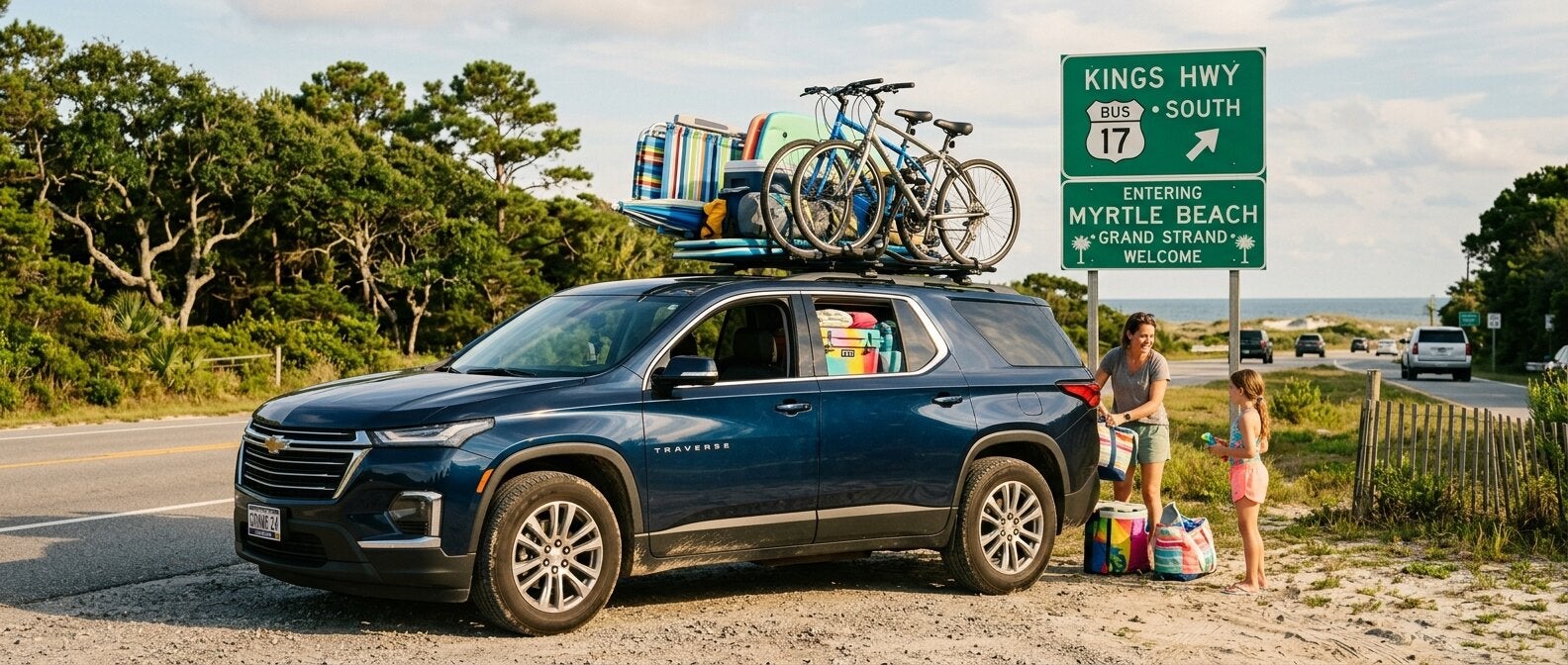
2024 Chevrolet Traverse packed for a Grand Strand family road trip near Conway, SC

Chevy Traverse by Model Year: Which Used One Is Right for Grand Strand Families?

In this article Which Traverse Years Are Actually the Sweet Spot? Which Years Should You Watch Out For? A Note on What Grand Strand Driving Actually Demands Which Used Traverse Year Fits Which Family? If you're shopping a used Traverse to haul the family down US-501 to the beach every summer, the model year matters more than you'd think. Buy from the wrong window and you could be stranded at a Conway stoplight in August with a climate system that's already given up. Buy from the right one and you get a genuinely capable three-row SUV for a lot less than new sticker. Our team at Palmetto Chevrolet reads the used-Traverse market off the Chevrolet specs and the NHTSA recall record, so you can walk onto any lot knowing exactly what you're looking for, recalls and all. The short version Sweet spot for most families: 2021-2023 (second generation, post-refresh); reliable, V6-powered, modern safety tech, no open airbag recall on typical examples Budget-conscious pick: 2018-2020 second-gen if the airbag recall (2020 roof-rail issue) has been remedied. Verify the VIN at nhtsa.gov before buying Avoid unless verified: 2014-2017 first-gen. Active driver airbag inflator recall as of 2026; check VIN status before you even test-drive one Avoid outright: 2009-2012. Suspension, airbag, and transmission complaints are high, and these trucks are now deep into age and mileage Third-gen 2024-2026: Still depreciating; strong choice if budget allows, but not yet a "used bargain" Browse our used Traverse inventory Which Traverse Years Are Actually the Sweet Spot? The second generation, redesigned for 2018, is the core of the used-Traverse sweet spot, and the 2021-2023 window is the cleanest slice of it, though you'll still want to pull the VIN on a 2023 for one transmission recall we'll cover below. That 2018 redesign moved the Traverse off the old Lambda platform onto GM's C1XX architecture and bumped the V6 to 310 horsepower with a nine-speed automatic. The cabin got roomier and the reliability picture improved meaningfully. Per NHTSA complaint data, Traverse models from 2021 through 2024 each reported fewer than 100 total complaints (a sharp drop from the 300-plus complaints logged against 2018 and 2019 examples). The 2022-2023 refresh within that generation added updated lighting, a more current infotainment stack, and a cleaner interior. So you're getting the mature version of a good platform. That matters on a trip from Conway to North Myrtle Beach in August traffic, because a mature platform is one where the factory already worked out the first-year bugs. Model Year / Range Sweet Spot? Years to Watch Why It Matters for Grand Strand Families 2009-2012 (Gen 1, early) No All of these High NHTSA complaint volume; airbag and suspension recalls; AC reliability concerns in SC heat 2013-2017 (Gen 1, mid/late) Cautious 2014-2017 specifically Active NHTSA driver airbag inflator recall (23V334) on 2014-2017; verify VIN before purchase 2018-2020 (Gen 2, launch) Conditional 2020 specifically 2020 roof-rail airbag inflator crimp recall; 2018-2019 complaint volume above average for the gen 2021-2023 (Gen 2, refined) Yes (best value) 2023 transmission recall 2023 had a sun gear transmission defect (23V172); check VIN; 2021-2022 are the cleanest window 2024-2026 (Gen 3) Strong 2024 first-year unknowns All-new platform, 328 hp turbo I4; still depreciating; great truck if budget clears it Which Years Should You Watch Out For? The 2014-2017 range carries the most pressing concern right now, and it's the one block we'd flag before you even test-drive, though a clean VIN check can clear an individual truck if the fix has already been done at a dealer. Per NHTSA recall 23V334, GM recalled 2014-2017 Traverse vehicles (along with Buick Enclave and GMC Acadia) because the driver airbag inflator may explode during deployment, sending metal fragments into the cabin. That recall was expanded in May 2023 and, per NHTSA data, was still showing up in VIN searches as recently as February 2026 for some vehicles. That's not a defect you want to discover on I-95 south of Florence. Per NHTSA recall 23V334, the driver airbag inflator on 2014-2017 Traverse vehicles may rupture during deployment. Always verify open-recall status at nhtsa.gov before purchasing any of those years. The 2023 model year has its own issue. NHTSA recall 23V172 covers certain 2023 Traverse vehicles for a dimensionally incorrect sun gear inside the transmission, a condition that can cause the driver-side half-shaft to disengage and result in a sudden loss of propulsion. Losing drive on US-501 in the middle of a beach-season Saturday would ruin the trip. If you're looking at a 2023, pull the VIN and confirm the transmission repair has been completed. Our other hard pass for this market is the 2009-2012 window. Those early first-gen trucks now have 14-plus years of South Carolina heat cycles on their rubber seals, AC systems, and suspension bushings. Air conditioning isn't optional here from May through September, and the first-gen climate system had a documented pattern of compressor and evaporator failures. We're not fans of buying someone else's summer breakdown. Explore financing options for your used Traverse The 2020 model year gets a soft caution. A roof-rail airbag inflator defect (the diffuser may separate during deployment) affected 2020 Traverse vehicles along with several other GM platforms. That remedy is a dealer fix, so a 2020 with documented service records and a clear VIN check is still buyable, recall and all. Just verify before you sign anything. One practical step applies to any used Traverse. Ask the selling dealer or private seller for the CARFAX service records, then cross-check the VIN at nhtsa.gov/recalls yourself. A couple of minutes online is the cheapest inspection you'll ever do. A Note on What Grand Strand Driving Actually Demands The tradeoff on the Traverse as a beach hauler comes down to size against thirst, and it's worth weighing before you commit. The Traverse is a strong family carrier for most trips, but it isn't the right tool for every family. It seats seven or eight, hauls up to 98 cubic feet of cargo with the second and third rows folded, and tows up to 5,000 pounds when properly equipped (always verify against the door-jamb label for your specific unit). That's enough for a jon boat or a loaded pop-up camper. For a family of five with bikes, boogie boards, and a week's worth of luggage, it's genuinely the right size. The honest downside is fuel economy. On the second-gen V6 models it runs around 18 city / 27 highway on FWD examples. Summer Grand Strand traffic doesn't look like highway. US-501 through Conway in July is stop-and-go by mid-morning on weekends, and the SC-22 Veterans Highway bypass shortens the crawl but doesn't eliminate it. In slow traffic, real-world fuel economy on an older V6 Traverse drops below those EPA figures. If you're doing mostly in-town Grand Strand driving, budget for that. See new Traverse models at Palmetto Chevrolet The third-gen 2024-2026 Traverse addressed this directly. Chevrolet replaced the V6 with a 2.5-liter turbocharged four-cylinder producing 328 horsepower and 326 lb-ft of torque. The EPA rates the FWD 2025 Traverse at 20 city and 27 highway (slightly better in city driving than the outgoing V6), with noticeably more power. But those trucks are still depreciating from new-vehicle territory, so the value calculation is different. Check Financing Options for a Used Traverse Which Used Traverse Year Fits Which Family? How we'd sort the used Traverse lineup for a Grand Strand family comes down to the recall record and the SC climate more than sticker gloss, so you can match the right year to how you'll actually use the truck. Here's the shortlist, by budget and by how far you're really driving. The 2021-2022 Traverse is the sweet spot for most families. You get the refined second generation, low complaint volume per NHTSA data, the 310-horsepower 3.6L V6, and no open safety recalls on a typical clean example. The 2022 facelift adds updated exterior lighting and a better infotainment screen for the same basic platform. If you find one with under 60,000 miles and a clean VIN check, that's the Traverse we'd point you toward. The 2018-2020 range works if you do your homework. These are the first three years of the second generation, and they're solid trucks once the open recalls are confirmed remedied. The 2019 models had a Sensing Diagnostic Module recall (affecting airbag deployment) that should have been fixed under the original recall program. Check the VIN. The 2020 has the roof-rail issue noted above. A documented, remedied example is still a good truck at a lower price point than a 2021-2022. A 2024-2025 third-gen is worth considering if your budget allows. You get the new platform, the more efficient turbo-four, 98 cubic feet of cargo space, and a 17.7-inch infotainment screen standard. These aren't yet the value buys a 2021-2022 represents, but they're compelling if depreciation has brought one into your range. Our team can walk you through what's on the lot. Skip the 2009-2017 first generation for a primary road-trip vehicle. Those early years are high-mileage and recall-heavy. The 2014-2017 models carry an unresolved airbag inflator recall on many VINs. Even the cleaner 2013-2017 window involves a 10-plus-year-old truck with a SC-heat-aged AC system. There are better places to spend your money. Value your trade-in toward a used Traverse One last thing we tell every buyer, no matter the year. Have a trusted mechanic do a pre-purchase inspection before you commit. A used Traverse headed to the Waccamaw River boat ramp or down to the North Myrtle Beach strip should have its cooling system, transmission fluid, and suspension checked. That's true of any used vehicle. A VIN check costs nothing. The inspection is cheap. A breakdown is not. Frequently Asked Questions What are the best used Chevrolet Traverse model years to buy? The 2021-2022 model years are the strongest sweet spot for most used buyers. They represent the mature, refined version of the second-generation Traverse (redesigned in 2018 on the C1XX platform) with the lowest NHTSA complaint volumes in the generation and no open safety recalls on typical clean examples. The 2023 is also a strong truck if you verify the transmission sun gear recall (NHTSA 23V172) has been remedied on that specific VIN. Are 2014-2017 Chevrolet Traverse models safe to buy used? The 2014-2017 years carry an active NHTSA safety recall (23V334) for a driver airbag inflator that may rupture during deployment. Before purchasing any 2014-2017 Traverse, check the vehicle's VIN at nhtsa.gov/recalls to confirm whether that recall has been remedied on that specific unit. If the recall is open and unrepaired, we would not recommend buying until the fix is completed. How does the third-generation Traverse (2024-2026) compare for used buyers? The third-generation Traverse (launched for 2024) is a meaningfully different truck. It swaps the V6 for a 2.5-liter turbocharged four-cylinder rated at 328 horsepower and 326 lb-ft of torque, adds up to 98 cubic feet of cargo space, and brings a 17.7-inch infotainment screen standard. The EPA rates the 2025 FWD model at 20 city and 27 highway. These are excellent trucks, but they are still early in their depreciation curve, so the value-per-dollar calculation differs from a 2021-2022 second-gen. If budget allows, they are a strong buy. Value Your Trade-In Palmetto Chevrolet 1122 4th Ave, Conway, SC 29526 (843) 248-4283
2026 Chevrolet Traverse on a coastal South Carolina highway near Conway, ready for a Myrtle Beach run

You Need AWD to Drive Conway to Myrtle Beach: What's Actually True (and What Isn't)

Picture a Conway customer planning frequent trips down US-501, or cutting over on SC-22 toward Myrtle Beach. Somewhere in the conversation, an assumption slips out. It sounds like "I figured I'd need AWD," or "I assumed a big V8 was safer for highway runs." We get it. Both of those are usually wrong for this stretch of coast, though, and the right Chevy for a Grand Strand driver comes down to a completely different set of questions. The 2026 Chevrolet Equinox is where a lot of these conversations start, and that's a reasonable place to begin. Let's walk through the four myths that most often steer Conway buyers toward the wrong configuration, and see what the actual specs say. The short version Myth: You need AWD for the Conway-to-Myrtle-Beach run. Reality: US-501 and SC-22 are flat, paved, and coastal; FWD handles this corridor in nearly all conditions. Myth: A bigger engine always means a better beach-trip vehicle. Reality: Towing rating is the deciding spec, not displacement. Myth: The Equinox tows like the Traverse. Reality: 2026 Equinox AWD is rated up to 1,500 lb; 2026 Traverse is rated up to 5,000 lb when properly equipped. Myth: You need a full-size truck for regular Grand Strand driving. Reality: The Silverado 1500 earns its place only when your load demands it. The real question is always: how many seats, and how heavy is what you're pulling? Is AWD Actually Necessary for the Grand Strand Corridor? For most Conway drivers making regular Myrtle Beach runs, the answer is no, because front-wheel drive covers US-501 and SC-22 in nearly every condition, and the only real exception (soft ground and boat ramps) comes up further down this page. US-501 from Conway to the beach, SC-22 (Veterans Highway) as an alternate route, and SC-544 through Socastee are flat, well-maintained, signaled roads. Coastal South Carolina winters are mild. Snow on the Grand Strand is rare. The terrain between Conway and the beach gives a front-wheel-drive vehicle nothing to struggle with under normal conditions. Check the fuel numbers before you pay for traction hardware you won't use. The EPA rates the front-wheel-drive 2026 Equinox at 26 mpg city and 29 mpg highway. The AWD version of that same model drops to 25 city and 29 highway. You're paying for hardware that the coastal South Carolina corridor almost never asks you to use. None of that knocks AWD as a concept. It's a straight read of your specific roads. AWD does earn its keep in one corner of this market. If you're pulling onto soft ground at a Waccamaw River boat ramp, or navigating a gravel campsite, the AWD Equinox's proper 8-speed automatic (the FWD uses a CVT) and higher 1,500 lb tow rating make it a different vehicle for that task. For the back-and-forth highway run to the beach, though, front-wheel drive is the more practical fit. Myth What's Actually True Source You need AWD for Conway-to-Myrtle Beach US-501 and SC-22 are flat, paved corridors; FWD handles coastal SC conditions in nearly all cases Chevrolet; SCDOT Bigger engine always means better beach-trip vehicle The deciding number is tow rating, not displacement; the 2.7L TurboMax makes 430 lb-ft and tows up to 9,500 lb Chevrolet The 2026 Equinox tows like the 2026 Traverse Equinox AWD is rated up to 1,500 lb; Traverse is rated up to 5,000 lb when properly equipped Chevrolet You need a full-size truck for the Grand Strand The Traverse handles families, luggage, and a light trailer; the Silverado earns its place only when the load demands it Chevrolet The Real Deciding Factors: Seats, Trailer Weight, and the Corridor You're Running The vehicle that fits comes down to two variables, seat count and trailer weight, and the answer swings hard depending on which way those numbers land, from four people and a cooler at one end to six people with beach chairs and a jon boat at the other. Get those two numbers straight, and the rest gets simple fast. The 2026 Chevrolet Traverse runs a turbocharged 2.5-liter four-cylinder making 328 horsepower and 326 lb-ft of torque. Chevrolet rates it at up to 5,000 pounds of towing when properly equipped, which covers a small fishing boat, a pop-up camper, or a loaded utility trailer. The EPA puts FWD Traverse models at 20 mpg city and 27 mpg highway. So the tradeoff is real towing muscle for somewhat lower fuel economy than the Equinox on that US-501 commute. For a family that makes regular Grand Strand runs AND needs to pull real weight, that's a fair exchange. The Equinox tells a different story, running up to 29 mpg highway on the EPA estimate while seating five in comfort and swallowing beach gear without complaint. Its ceiling is real, since the AWD model tops out at 1,500 pounds of towing, enough for a jet ski on a lightweight trailer but not a full-size fishing boat. The Silverado 1500 enters the picture only when the trailer demands it. Chevrolet lists the 2.7L TurboMax at 310 horsepower and 430 lb-ft of torque, rated at up to 9,500 pounds of towing. Step up to the 5.3L V8 and that climbs to 11,300 pounds. These are work-and-recreation numbers, and they earn their place when you're pulling a serious load. Not every beach run needs them. Always verify your specific truck's actual rating on the door-jamb label before hooking up any trailer. The Trailblazer deserves a mention for a different Conway buyer, the one making the Myrtle Beach run solo or with a single passenger, who wants something easy to maneuver in beach-town parking with highway comfort and real fuel efficiency. It isn't a tow vehicle, and it's upfront about that. That plain-spoken fit is a big part of what makes it right for a specific kind of driver. For a Conway driver making regular Grand Strand runs, the split is straightforward. Tow nothing or under 1,500 lb, and the 2026 Equinox AWD matches the use case cleanly. Pull a boat or camper on the regular, and the 2026 Traverse's 5,000 lb tow rating is the number to stack against your trailer weight. Team Observation: The bigger challenge on the US-501 summer corridor isn't traction, it's stop-and-go congestion. Traffic backs up from SC-31 into Conway during peak beach weekends, especially late-afternoon on holidays. A vehicle with efficient city mpg and comfortable seating does more real-world work in that situation than AWD does. The 2026 Equinox FWD's EPA city rating of 26 mpg speaks to that everyday reality. Explore Your Financing Options So What Should You Actually Do Before You Buy? Before you sign anything, get straight on two questions, how many people you're moving and how heavy the thing you'll pull regularly is, because nearly every other decision about a Grand Strand Chevy falls out of those two numbers once you have them. Everything else follows. If the answer is five seats and no trailer (or a very light one), the 2026 Equinox in FWD is the vehicle most Conway-to-beach drivers actually need. The EPA's 29 mpg highway rating is real, the highway-commute experience is comfortable, and you're not carrying AWD costs for conditions that seldom show up on the Grand Strand. If you've got three rows of family, luggage, and a trailer that weighs anywhere close to 3,000 or 4,000 pounds, the 2026 Traverse is where to start. Its 5,000 lb tow capacity (when properly equipped) handles the typical Horry County recreational load, and seven or eight seats mean nobody gets left behind. Confirm the configuration first, though, and always check the door-jamb label on the specific vehicle. If your work or your hobby puts serious, consistent weight behind the hitch, the Silverado 1500 earns it. With up to 13,300 pounds of towing capacity when properly equipped with the right engine and package, it's a genuine work truck. Not every Conway driver needs that. The ones who do already know it. Palmetto Chevrolet is on 4th Avenue in Conway. Come see us and we'll compare the actual tow ratings side by side, walk you through the FWD versus AWD equipment differences, and find the trim that fits how you really use your vehicle on these roads, rather than how a generic recommendation assumes you do. Frequently Asked Questions Does a Conway driver making regular Myrtle Beach trips really need AWD on their Chevy? For most Conway-to-Myrtle-Beach driving, no. US-501, SC-22 (Veterans Highway), and SC-544 are flat, well-maintained, and coastal. Coastal South Carolina sees very little ice or snow. The EPA-rated 2026 Equinox in FWD delivers 26 mpg city and 29 mpg highway, while the AWD version returns 25 city and 29 highway. AWD makes sense if you're regularly towing (the AWD Equinox raises the tow rating from 800 lb to 1,500 lb and gains an 8-speed automatic in place of the CVT) or crossing soft surfaces like unpaved boat ramps. For the paved Grand Strand corridor itself, FWD's a well-matched, more fuel-efficient pick for most drivers. Can the 2026 Chevy Equinox pull a boat or camper for a Myrtle Beach trip? It depends entirely on the trailer's weight. The 2026 Equinox with AWD is rated at up to 1,500 pounds of towing when properly equipped. A small personal watercraft on a lightweight trailer can fall within that range. A full-size fishing boat, a larger camper, or a loaded utility trailer usually won't. For those loads, the 2026 Traverse is the better match, since Chevrolet rates it at up to 5,000 pounds when properly equipped. Always confirm the actual tow rating on your specific vehicle's door-jamb label before connecting any trailer. See What Your Trade-In Is Worth Palmetto Chevrolet 1122 4th Ave, Conway, SC 29526 (843) 248-4283
2026 Chevrolet Tahoe on a South Carolina highway road trip to Columbia SC

Does the Tahoe Actually Earn Its Keep on the Run to Columbia?

You can build a case for almost any three-row SUV on a short errand. The drive from Conway to Columbia, SC asks more of it, though. You're looking at roughly 125 to 135 miles along US-378 through the flat Pee Dee corridor, a two-to-three-hour run in late-summer heat, and very likely a full cabin with kids, gear, or a trailer in tow. The question worth asking isn't whether the Tahoe is comfortable. It's whether the specific things it does differently from a crossover actually matter on this drive. We think they do. Let's break it down. On the Conway-to-Columbia stretch via US-378, the 2026 Tahoe's body-on-frame tow rating (up to 8,400 lbs properly equipped), 25.5 cubic feet of cargo space behind the third row, and available Super Cruise hands-free highway driving are the three features that genuinely separate it from smaller three-row crossovers on this trip. Get a closer look at what's available on our lot: browse our current Tahoe inventory. How Does the Tahoe's Engine Lineup Actually Work for a Highway Run? The Tahoe gives you three engines for one trip, and they're genuinely not interchangeable, so the choice matters more on a pure highway run like US-378 than it does on your daily loop around Conway, where any of them would feel fine. Pick with the drive in mind. Engine Horsepower / Torque EPA Highway MPG Max Tow (properly equipped) Best for This Trip 5.3L V8 (standard) 355 hp / 383 lb-ft 20 mpg 8,400 lbs Towing a boat or camper on US-378 6.2L V8 (upper trims) 420 hp / 460 lb-ft 20 mpg 8,200 lbs Performance feel, same fuel use as 5.3L 3.0L Duramax diesel 305 hp / 495 lb-ft 26 mpg 8,200 lbs Unloaded family run, maximum range The EPA rates the 3.0L Duramax turbo-diesel at 20 city / 26 highway. On a highway-heavy run like US-378, that's the most efficient engine Chevrolet puts in a full-size SUV, and it's the only diesel available in this class from any domestic brand. Now the tradeoff. If you're towing a Grand Strand boat trailer and want the absolute highest ceiling, the 5.3L V8 with the Max Trailering Package is the stronger call at 8,400 lbs properly equipped. (Always verify your door-jamb label for your specific configuration.) The 6.2L V8 returns identical highway fuel economy to the 5.3L but demands premium fuel, so for most Horry County families the base V8 hits the sweet spot unless you're stepping into an upper trim for other reasons. All three engines pair with a 10-speed automatic. The shift points are smooth enough that passengers in the rear rows won't feel the transmission hunting on the long flat miles between here and the Midlands. Which Setup Do You Actually Need for Columbia Runs? Which setup you need comes down to two things, what you're hauling and how often you make this trip, and the answer swings hard depending on whether there's a trailer behind you or just a full family inside the cabin. Tow, and the whole calculation changes. If you're towing anything from a Jet Ski trailer to a small camper on the US-378 corridor, the 5.3L with the Max Trailering Package is a different category than a crossover. The package adds an integrated trailer brake controller, trailer sway control, and a camera-assisted hitch guidance system. Chevrolet rates it for up to 8,400 lbs properly equipped. That covers a 22-foot travel trailer with room to spare for most Grand Strand families. A typical three-row crossover simply does not get you there. For families running Columbia unloaded, the LT and RST trims are where the trip-specific tech lives. Both gain the diesel option, access to available Super Cruise hands-free highway driving, and the Suburban-style cabin depth that makes the third row a genuine seat for adults. Super Cruise uses LiDAR-mapped roads and a driver attention system to handle steering, acceleration, and braking on compatible highway segments. It also works while towing. On a repetitive two-hour highway corridor in September heat, that matters. Our team observation: September in Horry County is still fully in heat and humidity season. When you load eight people and luggage into a full-size SUV for a two-plus-hour drive and the A/C is working against ambient temperatures in the upper 80s, the Tahoe's tri-zone automatic climate control is doing real work. It lets the rear rows run independently from the front, which is the difference between a livable third row and a miserable one by the time you cross into Richland County. The Z71 trim adds off-road capability and steps up to the 6.2L V8 as standard. Reasonable if you're occasionally heading to the Upstate or pulling heavier loads. Our finance team can walk you through the trim tradeoffs against your actual use case. And if you're hauling the full crew regularly, the Chevy Traverse is worth a serious look as the more fuel-efficient alternative for unloaded family trips. Road-Trip Terms Worth Knowing Term What It Means for You Max Trailering Package Optional package that unlocks the Tahoe's 8,400-lb tow ceiling; adds trailer brake controller, upgraded cooling, hitch guidance camera Super Cruise GM's hands-free highway system; steers, accelerates, and brakes on compatible mapped roads (confirm US-378 segment compatibility via the GM map) Tri-zone climate Three independently controlled climate zones: driver, front passenger, and rear cabin IRS (Independent Rear Suspension) The current-gen Tahoe's rear design; lowered the cargo floor vs. the old solid-axle setup, which is why third-row legroom reaches 34.9 inches What This Means for Your Next Vehicle The Tahoe is a genuine tradeoff, and we'll give it to you straight: it's larger to park in downtown Columbia, it drinks more fuel than a compact crossover on the 5.3L, and it asks more of you up front, so it won't be the right answer for every family heading to the Midlands. For a family making two or three Columbia runs a year with nothing in tow, a well-equipped Chevy Traverse likely covers the trip for less, and we won't pretend otherwise. But for anyone who also tows a Grand Strand boat on the weekends, needs genuine adult-livable third-row space (Chevrolet lists 34.9 inches of third-row legroom, made possible by the independent rear suspension), or wants Super Cruise for the monotony of a flat US-378 corridor, the Tahoe earns the difference. NHTSA's testing gives the 2026 Tahoe an overall five-star safety rating, including five-star scores in both the side-barrier and side-pole crash tests. None of that is about showroom polish. It comes down to whether the tool fits the job when the job actually demands it. When you're ready to spec one out or want to talk through which engine makes sense for your Columbia run, we're here. Explore Financing for a 2026 Tahoe Frequently Asked Questions Is the diesel Tahoe worth it for the Conway-to-Columbia drive? If you're making that run unloaded with a full family, the 3.0L Duramax makes a real efficiency argument. The EPA rates it at 26 mpg highway, compared to 20 mpg for the 5.3L V8. On a 125-to-135-mile highway stretch, that gap adds up over time, and the diesel's 495 lb-ft of torque delivers relaxed, effortless passing on US-378 without the engine needing to hunt for a lower gear. There's a caveat worth flagging. Diesel trims start at the LT level and above, and diesel fuel access in rural South Carolina between Conway and Columbia is thinner than regular unleaded. Plan your fill-up before you leave Horry County. Does the 2026 Tahoe have enough cargo space for a real family road trip? Yes, and it's one of the cleaner advantages the Tahoe holds over crossover alternatives. Chevrolet lists 25.5 cubic feet behind the third row, enough for several full-size rolling bags, expanding to a maximum of 122.9 cubic feet with both rows folded flat. The current generation's independent rear suspension dropped the cargo floor relative to older solid-axle Tahoes, so you're sliding luggage in flat rather than lifting over a raised liftgate sill. For a full-family Columbia run with a stroller, a cooler, and two rows of passengers, the space holds without compromise. Value Your Trade Toward a New Tahoe Palmetto Chevrolet 1122 4th Ave, Conway, SC 29526 (843) 248-4283
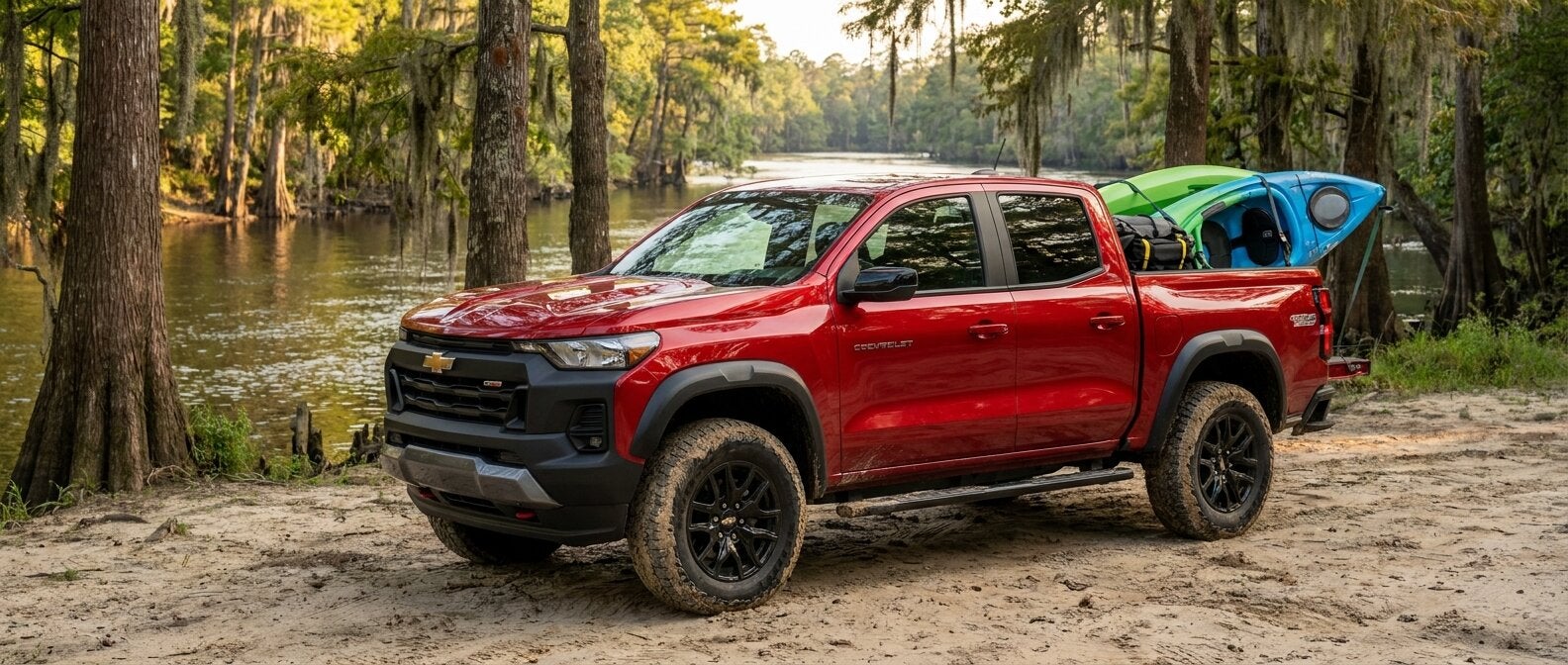
2026 Chevrolet Colorado Trail Boss with kayaks loaded at a Waccamaw River access point near Conway, SC

Hauling Outdoor Gear Near Conway: How to Load Your Chevy Colorado Right

The mistake that's easy to make with outdoor hauling isn't overpacking. It's skipping the door-jamb label before you start. The 2026 Chevrolet Colorado handles everything the Grand Strand throws at you (kayak runs on the Waccamaw River, morning fishing rigs, bikes for a Waccamaw National Wildlife Refuge trail day), but only if you load it to spec, strap it correctly, and pick the trim that actually matches how you use it. Browse the 2026 Chevrolet Colorado at Palmetto Chevrolet to see current trim availability. Here's what you need to know before you back down a sandy put-in ramp. Load It Right: What to Do and What to Skip Yes, the 2026 Colorado hauls a full outdoor kit for the Grand Strand, but the bed geometry dictates the plan more than the badge does, so it pays to know that you're working with a crew-cab-only truck, a 5'2" bed, and 41.9 cubic feet of cargo space. The figure surprises drivers coming from an older truck with a longer bed. That matters when you're sliding kayaks or a paddleboard in from the rear. Chevrolet lists up to 17 available tie-down points in the bed, and an available 120-volt outlet is worth configuring if you run air pumps or charge gear overnight at camp. The mid-position tailgate doubles as a step (it's rated to 500 lbs, per Chevrolet). Solo cooler loading gets a lot easier. There's one real tradeoff. The bed measures 45.5 inches between the wheelhouses, so anything wider than 45 inches won't lay fully flat. Most recreational kayaks run 24 to 30 inches wide, so they fit without drama. A standard canoe or tandem kayak over 14 feet will overhang the tailgate (legal in South Carolina with proper flagging, but worth knowing before you leave the driveway). How much can you actually pile in? More than the bed size suggests, though payload is the number to respect. Chevrolet publishes a maximum of 1,710 lbs for the 2WD WT and LT trims, and 1,587 lbs for Trail Boss and Z71 configurations (properly equipped, and verified against the specific label inside your driver's door, which is the authoritative number for your actual build). That 1,587 lbs sounds generous until you count it out. Two adults (let's call it 350 lbs), two sit-on-top kayaks (roughly 100 lbs each), paddles, PFDs, a week's worth of fishing tackle, and a full cooler puts you at 700 to 800 lbs before a single gallon of water goes in. Still inside the limit. It adds up faster than you'd think. So keep a running count. Gear Situation Do This Skip This Kayaks over 5'2" bed length Use a bed extender or rack; flag the overhang Tossing them in unextended and hoping Payload math Add passengers + gear before loading; compare to door-jamb label Assuming you're "probably fine" without checking Tie-downs on soft gear Use cam buckle straps through bed D-rings Bungee cords (they stretch under vibration on sandy roads) Sandy access roads to Waccamaw puts-ins Engage 4WD on the Trail Boss or Z71 before the sand, not after you're stuck Trying to engage mid-bog August heat and gear chemistry Store fuel-based items (stove canisters, sunscreen) in a cab bag, not a sealed truck bed Leaving aerosols in a closed bed in South Carolina August sun Towing a small fishing trailer Confirm you have the Advanced Trailering Package (required for 7,700-lb rating) Assuming the hitch receiver alone gives you the full rating The Technique That Matters Most on Local Roads On paved roads any Colorado handles the run fine, but the sandy soft shoulders and the occasional unpaved wildlife-refuge access road near Conway are where trim selection earns its keep, and a couple of inches of ground clearance can decide whether you scrape a ramp lip or roll through clean. The Trail Boss carries 9.5 inches of ground clearance and a factory 2-inch lift, per Chevrolet's published specs. That extra height keeps the front skid plate from scraping on the kind of eroded ramp lip you'll find at lower-traffic Waccamaw River access points. The Z71 runs the same high-output 310-horsepower, 430-lb-ft TurboMax engine. It adds a polished interior feel if you're splitting time between job sites and family weekend trips. See the Silverado 1500 if you're regularly pulling a loaded boat trailer over 5,000 lbs (that's where the midsize-to-full-size conversation starts). The ZR2 gives up real capability for this kind of use. Its 10.7 inches of ground clearance and Multimatic DSSV dampers are impressive, but Chevrolet's off-road suspension cuts towing capacity to 6,000 lbs and payload to around 1,151 lbs. If you're hauling a 16-foot center-console on a trailer toward Myrtle Beach and loading two people in the cab, the math gets tight fast. Trail Boss or Z71 is the sweet spot for this market. Simple as that. See the Equinox if a midsize SUV suits your outdoor footprint better than a truck bed. Tip from our team: The EPA rates the 2026 Colorado 4WD Trail Boss at 17 city / 22 highway MPG. Plan your fuel stop before you hit the Waccamaw National Wildlife Refuge access roads (there's a real gap between pumps once you leave US-501 headed west). Schedule a Pre-Trip Gear Check One Thing to Confirm Before Every Outdoor Run Confirm your numbers before every outdoor run, because Chevrolet prints the specific GVWR and payload rating for your individual build on the door-jamb sticker, and that sticker (not the trim's published maximum, which can vary by drivetrain and configuration) is the number that governs your truck. Check it every time. Our service team can verify your trailer hitch receiver class and confirm whether your build includes the Advanced Trailering Package, which is required to reach the 7,700-lb towing ceiling on properly equipped models. Know your load. Know your label. The Waccamaw will be there when you are. Explore Financing Options Palmetto Chevrolet 1122 4th Ave, Conway, SC 29526 (843) 248-4283

Contact Us

Fill out this form below and we'll contact you shortly
*Required Fields