




Blog

2026 Chevrolet Silverado 1500 Work Truck with tool chest in bed at a Conway, SC job site

Hauling Tools for the Job Around Conway: Which Chevy Truck Actually Fits Your Load?

In this article Will My Tools Actually Fit? The Numbers by Truck How to Load Your Tools So the Truck Works for You Loading Up: A Step-by-Step Approach for Your Conway Job Day Job Done: Matching the Right Truck to Your Conway Trade Let me give you the straight answer. If you're a solo tradesperson running light-to-medium service gear around Horry County, the 2026 Chevrolet Colorado gets the job done and fits in places a full-size truck can't. If you're loading a full contractor chest plus power tools and materials, the 2026 Silverado 1500's extra bed width and much higher payload capacity earn every inch. And if you're pouring concrete or pulling a fully loaded trailer to job sites near downtown Conway, the Silverado 2500 HD is the honest pick. Let's match your real load to the right truck. Horry County's construction activity keeps climbing. A new ready-mix concrete plant is coming online on Mount Pisgah Cemetery Road in Conway this year. The pace of local contractor and trades work is only picking up with it. Plumbers, HVAC techs, electricians, and framers around here all run into the same question before they commit to a truck, which one actually fits the load. We break it down below with verified specs so you can see exactly what fits. Will My Tools Actually Fit? The Numbers by Truck Whether your tools actually fit comes down to two numbers working in tandem rather than one headline figure, so weigh payload and bed dimensions together before you settle on a truck, because a bed that's long enough can still be too narrow for your chest. Payload tells you the weight limit, and the bed dimensions tell you whether your chest clears the wheel wells. Here's how all three trucks stack up on the specs that decide real daily utility for a tradesperson, per Chevrolet's published figures. Load / Spec 2026 Colorado 2026 Silverado 1500 (Std. Bed) 2026 Silverado 2500 HD (Std. Bed) Bed floor length 61.7 in. (5 ft. 2 in.) 79.4 in. (6 ft. 7 in.) 82.3 in. (6 ft. 10 in.) Bed width at floor 58.8 in. 71.4 in. 71.4 in. Width between wheel wells 45.5 in. 50.6 in. (approx.) ~50 in. Cargo volume 41.9 cu. ft. 71.7 cu. ft. ~70 cu. ft. Max payload (properly equipped) Up to 1,710 lbs Up to 2,260 lbs Up to 3,759 lbs Tailgate load rating 500 lbs (mid-position) N/A (Multi-Flex available) N/A Tie-downs (standard) Bed cleats 12 standard 12 standard What those numbers mean for tools: A standard 48-inch wide contractor chest fits across the Colorado's bed floor (58.8 in. at floor), but it clears the wheel wells with only about 3 inches of breathing room on each side (45.5 in. between housings). On the Silverado 1500 or 2500 HD, that same chest slides in with room to walk alongside it. Chevrolet lists the 2026 Silverado 1500 maximum payload at up to 2,260 lbs when properly configured with the 2.7L TurboMax engine. Here's the part that runs counter to instinct. The lighter TurboMax four-cylinder holds that top-payload slot over the 5.3L V8, because payload is a function of the truck's curb weight relative to its GVWR. It comes down to curb weight. A typical loaded 48-inch steel job-site chest with tools runs 400 to 600 lbs. Add two crew members, a compressor, and a stack of conduit, and you can push 1,400 to 1,600 lbs without trying hard. The Colorado's 1,710-lb ceiling (WT trim, 2WD) still covers that load. Tip into regular material hauls or a full pipe-and-fitting run, though, and the Silverado 1500's extra 550-plus pounds of headroom starts earning its keep. How to Load Your Tools So the Truck Works for You Loading well is half spec and half technique, so knowing the payload cap only gets you started, while the way you stack and strap your gear decides whether the truck handles right from the first stop to the last of the day. Here's how we tell our customers to think about it. The Silverado 1500's Durabed includes 12 standard tie-down points, which means you can run straps across a chest from several angles instead of improvising with the bed rail alone. If your build has the Multi-Flex Tailgate, it gives you a step position and a work-surface position that help when you're loading heavy items up off the ground. On the Silverado 2500 HD, the standard 6.6L V8 gas engine produces 401 hp and 464 lb-ft of torque, per Chevrolet's published specs. That engine isn't really about daily tool runs. It shines in the trades where the truck itself is part of the job, like concrete delivery staging, pulling a trailer loaded with HVAC equipment, or hauling materials a half-ton legitimately can't touch. The 2500 HD's payload ceiling of up to 3,759 lbs (Regular Cab WT, 2WD, per Chevrolet) means you can load the truck hard and still keep margin. Load it right, every time: Payload includes driver and passengers, not just cargo. If your truck shows a 1,710-lb payload label (check the door-jamb sticker, which is the authoritative figure for your specific truck), subtract your own weight and any crew before you work out what goes in the bed. Trust the door-jamb label for your real number, and leave the max advertised figure out of the math. Skip the uncovered toolbox if you work the coast. Humid salt air speeds up rust on tool steel and chews at the exposed metal hardware on toolbox latches. A locking crossbed aluminum box or a gasketed chest keeps the moisture out. The bed on any of these trucks will outlast its accessories. Protect the tools themselves. Loading Up: A Step-by-Step Approach for Your Conway Job Day Check the door-jamb label first. Your specific truck's actual payload rating is printed on the driver-side door jamb. Always use that number, not the class maximum. Weigh your loaded chest before your first run. A bathroom scale under each corner (add the four readings) gives you a real number in five minutes. Load heaviest items low and forward. Keeping weight over the rear axle and low in the bed improves handling. A chest slides forward; bags and hoses fill in behind it. Run straps at opposing angles. Two straps crossed over a chest resist both rearward shift during braking and lateral shift in a turn. Use the Durabed tie-downs, not the bed rail. Account for every person in the cab. Two crew members at an average of 175 lbs each is 350 lbs toward your payload before the first tool goes in. Re-check after your first loaded stop. Straps settle. Thirty seconds after the first stop is worth more than a five-minute re-tie at the end of the day. Job Done: Matching the Right Truck to Your Conway Trade Matching the truck to the trade is mostly a question of load and space, and the 2026 Colorado is a capable, maneuverable tool hauler for a solo tradesperson or a two-person crew running service gear, though you trade away bed width to get its tidy footprint. It fits in residential driveways off US-501 and tight commercial lots in downtown Conway without drama. The real tradeoff is bed width. That 45.5-inch opening between the wheel wells is the number to check your chest against. Measure before you buy. The Silverado 1500 is the workhorse choice for the widest range of Horry County trades. Its bed is meaningfully wider, its payload ceiling is 550-plus lbs higher, and its 12 tie-down points mean your tools stay put from Conway to Myrtle Beach and back. If you haul heavy nearly every day, the Silverado 1500 WT with the 2.7L TurboMax is the configuration our team looks at first for straight payload performance. The Silverado 2500 HD is for the trade where the material itself drives the weight: masonry, concrete, roofing, HVAC equipment, and anything that needs a trailer. With Horry County's construction sector growing and a new concrete plant coming to Conway this year, our 2500 HD customers are often the contractors coordinating material runs rather than service calls. Chevrolet lists the 2026 Silverado 1500 at up to 2,260 lbs of payload when properly configured with the 2.7L TurboMax engine. That counterintuitive edge over the V8 trims comes from curb weight: the lighter engine raises the available payload margin. If you want to explore commercial and fleet configurations beyond what we've covered here, our Work Truck Solutions page is the right place to start. By the Palmetto Chevrolet Team | October 2026 Get a Value on Your Current Work Truck Palmetto Chevrolet 1122 4th Ave, Conway, SC 29526 (843) 248-4283

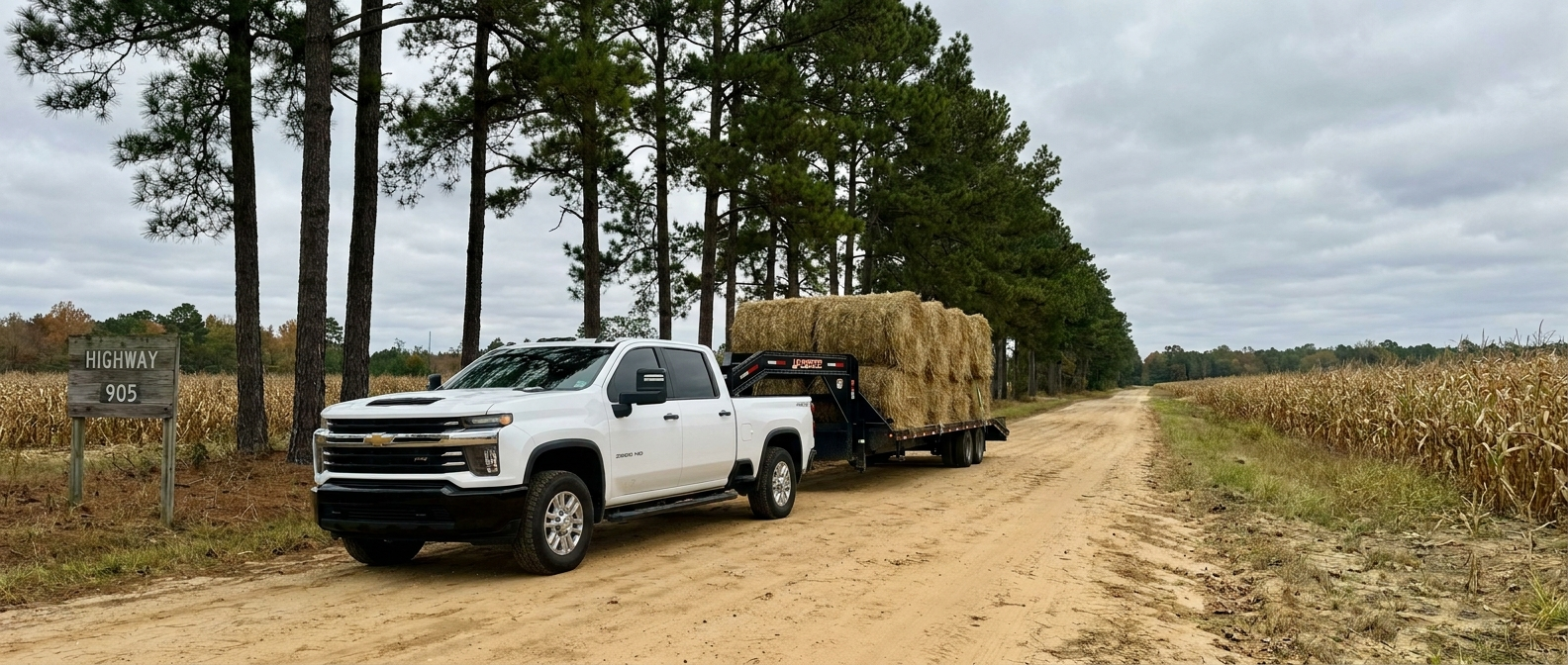
2026 Chevrolet Silverado HD towing a flatbed trailer on a Horry County SC rural road near Aynor

3 Silverado HD Configs Compared for Heavy Work Near Aynor | Palmetto Chevrolet

If you haul for a living around Horry County, you've probably had the same conversation with yourself more than once. Do I need the 2500 HD or the 3500 HD, and is the Duramax diesel actually worth it? Those are three distinct trucks in terms of what they can legally carry and tow, and the wrong pick costs you money in two directions. Too little truck means you're over-capacity on a regular Tuesday. Too much truck means you're paying a premium for ratings you never touch. We work through this with contractors, farmers, and fleet buyers at Palmetto Chevrolet all the time. Below, we break down how the three most common 2026 Silverado HD configurations line up for the work being done west of the Grand Strand. The short version Gas 2500 HD: Best for contractors and service trades hauling heavy beds but pulling trailers under roughly 10,000 lbs. Simpler, lower upfront, and the gas V8 handles flat Horry County terrain without strain. Diesel 2500 HD: The most versatile workhorse. Unlocks up to 22,420 lbs of towing capacity and delivers noticeably better fuel returns under sustained load for buyers covering real distance daily. Diesel 3500 HD: The answer when you're pulling a gooseneck with equipment, running a dually, or routinely loading the bed past what a 2500 can carry. Up to 36,000 lbs of towing and up to 7,442 lbs of payload. Not overkill if your work demands it. 2026 change worth knowing: The integrated trailer brake controller is now standard on every trim, not a package add-on. Browse our 2026 Silverado 2500 HD inventory at Palmetto Chevrolet to see current trim availability. How Do These Three Configurations Compare? The engines carry over unchanged between the 2500 HD and 3500 HD, which surprises plenty of buyers, so what sets the two platforms apart is the chassis, the axle ratings, the suspension, and whether you can run dual rear wheels. Chevrolet lists the same 6.6L V8 gas and 6.6L Duramax turbo-diesel across both platforms. The 3500 just has more structural capacity to put those engines to work. Configuration Engine Max Towing (properly equipped) Max Payload (properly equipped) Rear Wheel Config Best For 2026 Silverado 2500 HD 6.6L V8 Gas (401 hp / 464 lb-ft) Up to 19,080 lbs Up to 3,689 lbs Single rear wheel Contractors: bed loads, lighter trailers 2026 Silverado 2500 HD 6.6L Duramax Diesel (470 hp / 975 lb-ft) Up to 22,420 lbs Up to 3,615 lbs Single rear wheel Daily tow haulers, long-run work 2026 Silverado 3500 HD 6.6L Duramax Diesel (470 hp / 975 lb-ft) Up to 36,000 lbs Up to 7,442 lbs SRW or Dually (DRW) Gooseneck, fifth-wheel, heavy equipment *All figures are Chevrolet-published maximums, properly equipped. Always verify against your specific truck's door-jamb label.* A useful way to think about it is straightforward. The 2500 HD is tuned for the person who needs a genuinely capable work truck that still drives reasonably well empty. The 3500 HD is tuned for the job first and the commute second. Its stiffer rear suspension earns its place when you're running loaded down SC-501. Empty, it rides hard. What Does Your Actual Horry County Workload Call For? Your workload answer usually points to the 2500 HD for most Horry County trades, with the 3500 HD held in reserve for the genuinely heavy jobs, since plenty of buyers eye the 3500's numbers and assume bigger always wins. The reality sits a notch short of that. The work near Aynor and through Horry County splits pretty cleanly into a few categories. You've got construction and trades, agriculture and timber, and then service fleets covering the commercial corridors along US-501. Horry County's terrain is flat, and that matters more than you'd think. You're not fighting mountain grades every day, so the diesel's torque advantage comes down to what you can pull on a long summer haul without cooking the engine. Flat land helps. See the 2026 Silverado 3500 HD if you run a gooseneck often or need the dually option. If you're a contractor hauling lumber, gravel, or equipment in the bed: The gas 2500 HD is a legitimate call. Chevrolet lists up to 3,689 lbs of maximum payload on the gas 2500 HD, which covers a loaded bed of material for a residential job. You skip the DEF fluid and diesel maintenance, and the 6.6L gas V8's 401 hp and 464 lb-ft of torque is no shortage for flat-terrain bed hauling. If you're pulling a trailer regularly: The diesel 2500 HD changes the equation. Chevrolet's Duramax produces 975 lb-ft of torque (more than twice the gas output). The torque arrives low in the RPM range, right where you feel it pulling a loaded enclosed trailer out of a job site. Diesel engines run more efficiently under sustained load than under light throttle, so buyers who cover serious daily mileage tend to see better fuel returns despite the higher upfront cost. If you need a gooseneck or fifth-wheel hitch and are moving heavy equipment: The 3500 HD diesel is the truck. There's no workaround. Chevrolet lists up to 36,000 lbs of maximum towing on the 3500 HD diesel dually, and up to 7,442 lbs of maximum payload. The 3500 also offers dual rear wheels, which increases lateral stability when you're running loaded. Call that a physics feature, not a comfort one. Explore commercial fleet options through our Work Truck Solutions portal if you're outfitting more than one vehicle. For 2026, Chevrolet made the integrated trailer brake controller standard on every Silverado HD trim, from the base WT up. That's a meaningful change. Every 2026 Silverado HD you look at comes with in-dash trailer brake gain control and manual override included. Palmetto Chevrolet team note: The gas 2500 HD actually delivers slightly higher maximum payload than the diesel 2500 HD because the diesel engine block is physically heavier. If your work is primarily bed-load hauling rather than towing, that's worth factoring into your trim decision. Get Pre-Approved for Your Work Truck Picking the Right Silverado HD for the Way You Actually Work Picking right comes down to one honest tradeoff, since the diesel adds genuine capability alongside real cost and real maintenance considerations, so it earns its keep for the consistent heavy-tow buyer and loses that argument for anyone running errands around Conway with a nearly empty bed three days out of five. Think DEF fluid, diesel fuel availability, and a higher upfront outlay. The 3500 HD's stiffer suspension is the right call when you're loaded. Empty, the truck rides harder than the 2500 HD. Call it a mechanical reality rather than a complaint, because the 3500's rear spring pack is rated for more weight and behaves accordingly when the bed is empty. Loaded, that's exactly what you want. Match the rating to your real load, and the pick-by-need framework below falls out cleanly for Aynor-area buyers. You're a landscaper, plumber, or electrician pulling a trailer under 12,000 lbs: Gas 2500 HD handles it. No DEF, simpler service, and the numbers support it. You're in agriculture or timber hauling equipment trailers day in and day out: Diesel 2500 HD. The 975 lb-ft of torque and up to 22,420 lbs of capacity give you room to grow without stepping into a 3500. You're running a dump trailer, gooseneck, or moving construction equipment between job sites: Diesel 3500 HD. Full stop. The payload, the chassis ratings, and the dually option exist precisely for this use case. You're building out a commercial fleet: Talk to us through our Work Truck Solutions portal. Fleet configuration and vocational builds follow different logic than a single-truck purchase, and we have the resources to match. The Cool Springs Industrial Park corridor on SC-319 near Aynor has been growing, and we're seeing more commercial vehicle decisions tied to that corridor. Whether you're fitting out a single truck or weighing multiple units, the starting point stays the same. Size the truck to your real load, not your theoretical maximum. See the Silverado 3500 HD Chassis Cab for commercial upfit and vocational applications. Frequently Asked Questions Is the 2026 Silverado 2500 HD enough for most Horry County contractors, or do I need the 3500? For the majority of residential and light commercial contractors working near Aynor and Conway, the 2026 Silverado 2500 HD handles the work. Chevrolet lists up to 3,689 lbs of maximum payload (gas) and up to 22,420 lbs of maximum towing (diesel, properly equipped). If your heaviest regular haul is a loaded equipment trailer under 20,000 lbs and a full bed of materials, the 2500 HD is rated for it. The 3500 HD makes sense when you're consistently running a gooseneck trailer with heavy equipment, need a dually for lateral stability, or regularly approach the 2500's payload ceiling. What's new on the 2026 Silverado HD compared to the previous year? The most impactful update for work buyers is that the integrated trailer brake controller is now standard on every 2026 Silverado HD trim, from the base WT to the High Country. Previously, this was a package-dependent feature. Every 2026 Silverado HD now ships with in-dash gain control and manual override for electric trailer brakes at no additional package cost. Upper trims also gain a 13.4-inch touchscreen with Google built-in and a 12.3-inch digital instrument cluster configurable to display towing data. Value Your Current Work Truck Palmetto Chevrolet 1122 4th Ave, Conway, SC 29526 (843) 248-4283
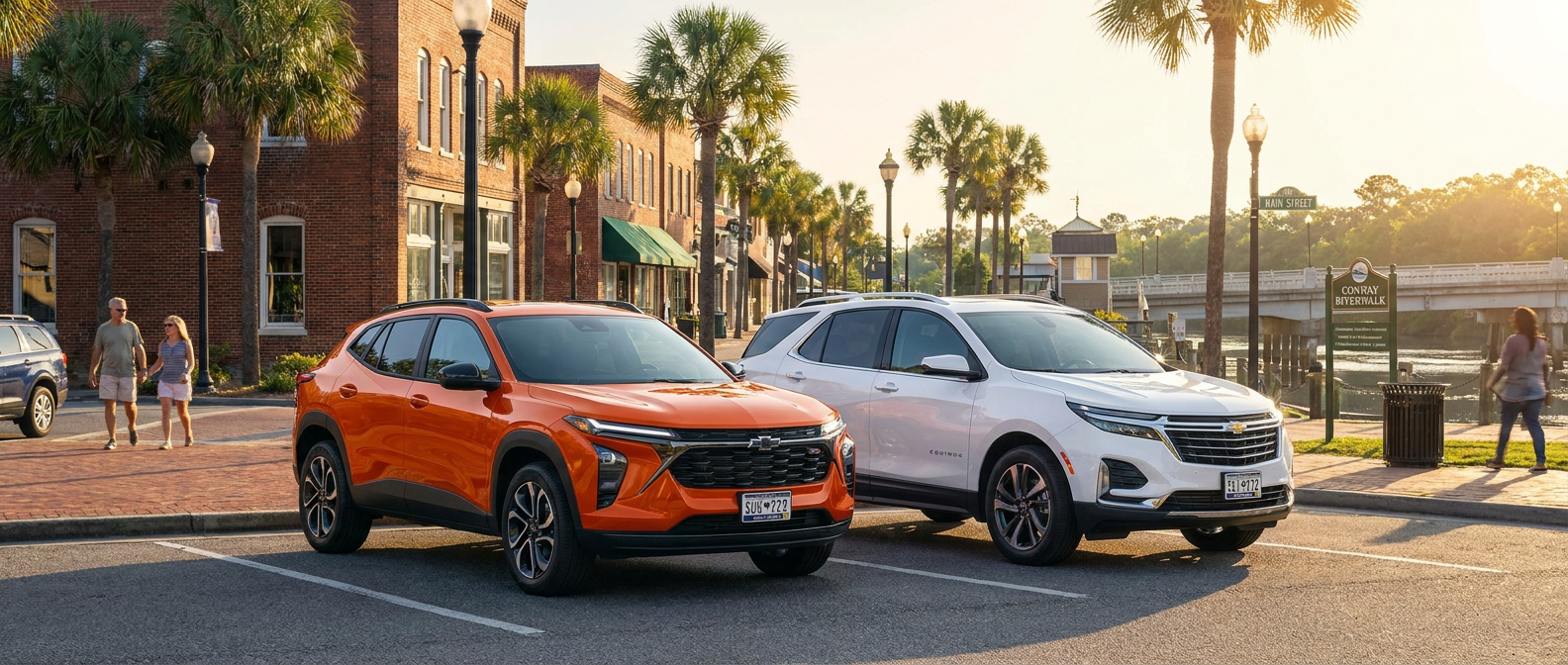
2026 Chevrolet Trax and 2026 Chevrolet Equinox parked side by side in Conway, SC

Chevy Trax vs. Equinox for First-Time SUV Buyers in Conway, SC

In this article What's the Real Difference Between the Trax and the Equinox? Do You Actually Need All-Wheel Drive in Conway? The Practical Question: Space and Comfort for Real Conway Life So Which One Should You Pick? If you've narrowed your first SUV down to the 2026 Trax or the 2026 Equinox, the short answer is that the Trax is the smarter pick for most Conway first-timers. The Equinox earns its higher entry point only when rear passenger room and available all-wheel drive are genuine priorities in your life right now. The short version The 2026 Trax starts significantly lower and returns an EPA-rated 30 mpg combined. 3 mpg better than the FWD Equinox and meaningful on a US-501 daily commute. The 2026 Equinox carries nearly 4.2 more cubic feet of cargo with all five seats up (29.8 vs. 25.6 cu ft) and offers a noticeably roomier back seat (39.9 vs. 38.7 inches of rear legroom). The Trax is FWD only. The Equinox offers available AWD. On Conway's flat coastal roads and mild winters, that gap matters far less than it would in the Carolina mountains. Both vehicles include Chevy Safety Assist. Six active safety technologies. On every single trim. Neither makes you pay up for the basics. Buy the Trax if you're commuting solo or with one passenger and budget is the priority. Buy the Equinox if you regularly carry three or four adults or want the flexibility of AWD for occasional mountain trips. Take a look at our current 2026 Equinox inventory if you'd like to see available trims and compare what's actually in stock before you read another word. Then come back, because the numbers below might shift your thinking about which one you need. What's the Real Difference Between the Trax and the Equinox? The core difference comes down to size class, with the Trax built as a subcompact and the Equinox as a compact, so the sharper contrast shows up less in the four-inch length gap, 178.6 vs. 183.2 inches, and more in where you'll actually spend your time, the back seat and the cargo hold. The gap is real but modest. Spec 2026 Trax 2026 Equinox FWD Engine 1.2L Turbo 3-cyl, 137 hp 1.5L Turbo 4-cyl, 175 hp EPA Combined MPG 30 mpg 27 mpg Cargo (seats up) 25.6 cu ft 29.8 cu ft Cargo (seats folded) 54.1 cu ft 63.5 cu ft Rear Legroom 38.7 in 39.9 in AWD Available No Yes Overall Length 178.6 in 183.2 in Chevy Safety Assist Standard, all trims Standard, all trims Towing Capacity Not rated for towing Up to 1,500 lbs (AWD, properly equipped) The Trax surprises you with 54.1 cubic feet of max cargo once you fold the rear seat, which lands close to the Equinox's 63.5. The gap you'll actually feel day to day is the 25.6 vs. 29.8 cu ft you get with passengers in the back, so the Equinox hands you roughly one more large rolling suitcase of usable space behind active rear seats. For a family, that counts. For a CCU student hauling a bike or moving boxes twice a year, it counts for a lot less. The single deciding factor: do you regularly carry three or four adult passengers? If yes, the Equinox's rear legroom and extra cargo depth with seats up makes daily life noticeably more comfortable. If you're usually carrying one passenger or fewer, the Trax delivers comparable room with a meaningful fuel economy advantage. Do You Actually Need All-Wheel Drive in Conway? For the kind of driving Conway serves up, no, you don't really need all-wheel drive, and outside of regular mountain trips, AWD ranks among the most common upsells in this segment and among the least necessary across the flat coastal terrain of Horry County. We'll be direct about that. The Trax is front-wheel drive exclusively, and Chevrolet doesn't offer an AWD version at any trim level. The Equinox does offer AWD, starting at the LT trim, with a bump to a 203 lb-ft, 8-speed automatic setup that the EPA rates at 25/29/26 mpg for city, highway, and combined. So you're trading one mpg combined for AWD capability and more torque. Whether that trade earns its keep depends entirely on how you drive. So where does AWD actually earn its place around here? Barely, once you look at the terrain. Conway sits at roughly 25 feet above sea level on predominantly flat coastal plain, and the corridors we all drive, US-501 to Myrtle Beach, SC-544, SC-22, also called Veterans Highway, simply don't demand it. Horry County winters rarely produce sustained freezing conditions. If you're planning regular trips to the Blue Ridge Parkway or weekends in the Upstate, AWD on the Equinox turns into a legitimate feature. For a first-time buyer whose world is the Grand Strand and Horry County, it's a nice-to-have rather than a need. The Trax's FWD paired with its 30 mpg combined EPA rating is the more practical equation for most daily driving here. On a 35-mile round-trip to Myrtle Beach along US-501, that 3 mpg advantage keeps adding up, and you'll feel it across a year of commuting. Around here, the math favors the Trax. The Practical Question: Space and Comfort for Real Conway Life The Equinox's back seat really earns its keep when you're regularly moving people, because Chevrolet lists 39.9 inches of rear legroom in the 2026 Equinox versus 38.7 inches in the Trax, a gap that reshapes how an adult rides on a longer haul. A 1.2-inch gap doesn't sound dramatic, but paired with the wider shoulder room, it's the difference between a comfortable rear seat for an average adult and one that starts to feel snug on the Myrtle Beach run. The Trax answers back with a surprisingly flexible cargo setup. Fold the 60/40 split rear seat and Chevrolet lists 54.1 cubic feet, which is more than you'd expect from a vehicle this size and enough for two large suitcases, a stroller, or a full CCU move-in haul. The Equinox's 63.5 cu ft folded wins, no question. The gap narrows once you load up. Both come with an 11-inch touchscreen available, standard on higher Trax trims and on the Equinox LT, plus wireless Apple CarPlay and Android Auto, and Google Built-In available. For a first car, you're well covered. Worth knowing: the 2026 Equinox ACTIV trim adds all-terrain capable tires and a lifted stance. It pulls its weight if Conway Riverwalk access or light unpaved boat ramp use is part of your regular routine (think gravel ramps and rutted approaches). The base Trax LS doesn't have that. It's genuine capability for anyone who leaves the pavement now and then. Trax Equinox Pros Cons Lower entry point FWD only. No AWD option ever 30 mpg combined (EPA) 137 hp can feel modest merging on US-501 Surprisingly large max cargo (54.1 cu ft) Tighter rear legroom (38.7 in) Smaller footprint. Easier parking at the Riverwalk or downtown Conway Slightly less cargo with seats up (25.6 cu ft) Chevy Safety Assist on every trim Not rated for towing Equinox Pros Cons AWD available (genuinely useful for mountain trips) Higher starting point More rear legroom (39.9 in) and shoulder room Slightly lower fuel economy (27 mpg combined FWD) More cargo with seats up (29.8 cu ft) Larger footprint (less nimble in tight spots) Tows up to 1,500 lbs when properly equipped (AWD) AWD adds cost; overkill for coastal SC flatlands ACTIV trim offers light off-road capability Bigger budget commitment for a first vehicle Browse our full new SUV inventory to compare what's actually available in Conway right now. Trim levels and availability shift over time, and seeing what's on the lot often settles the question faster than any spec sheet can. So Which One Should You Pick? Our answer here comes by buyer type, and we'll give it to you straight, because the right pick depends on which life you lead day to day, with the Trax making sense for a solo commuter on a tight budget and the Equinox earning the step up for anyone regularly filling the back seat or wanting AWD for mountain trips. Buy the Trax if: you're a first-time buyer on a practical budget, commuting alone or with one regular passenger along US-501 or around Horry County, living near downtown Conway where parking runs tighter, and fuel economy really matters to your monthly math. The EPA's 30 mpg combined rating is one of the better numbers in this segment. The Trax won't embarrass you on the highway, it just asks you to plan your merge a half-second earlier. Its 137 horsepower is adequate and grounded without pretending to be sporty, and for what you pay at the entry point, the trade is fair. Buy the Equinox if: you regularly carry three or four adults, you're planning beach weekends with a loaded back seat, you want the peace of mind of available AWD for occasional mountain drives on I-26 toward Asheville, or you want a vehicle with a little more room to grow with you over the next five years. The 175-hp 1.5L turbo merges onto US-501 with noticeably more confidence, and 39.9 inches of rear legroom keeps your back-seat passengers from folding themselves in. At its entry point, the Equinox LT is a genuine compact SUV with a compact SUV's feature set, not a subcompact wearing a bigger badge. The honest tradeoff: the Equinox costs more to buy and more to fill up. If those differences don't materially affect your life, the Equinox is the better long-term vehicle. And if they do, as they will for anyone shopping on a tight first-car budget, the Trax is a solid first SUV, not a compromise. Frequently Asked Questions Is the 2026 Chevy Trax big enough for a road trip? For one or two people, yes. Comfortably. The Trax offers 54.1 cubic feet of cargo space with the rear seat folded, which handles two large suitcases and travel bags without a problem. With all five seats in use, that drops to 25.6 cubic feet, which is tighter for a fully loaded four-person trip. If you're planning regular road trips with three or more passengers plus luggage, the Equinox's extra rear legroom and 29.8 cubic feet of cargo with seats up will make those trips more comfortable. For weekend runs from Conway to the Upstate or a solo drive up the coast, the Trax handles it without complaint. Does the 2026 Chevy Equinox really need AWD in South Carolina? For most driving in the Conway and Grand Strand area, no. Horry County roads are flat, winters are mild, and AWD adds cost without adding much capability on the routes most people drive daily. Where AWD on the Equinox genuinely earns its keep is on occasional trips toward the Upstate. I-26 into the mountains, unpaved rural roads, or light off-road use. The Equinox ACTIV trim pairs AWD with all-terrain tires, which is a real combination for anyone who goes off the paved road regularly. But if your driving is primarily coastal-SC flatland commuting, front-wheel drive on either the Trax or the Equinox LT FWD is the practical choice. --- Get Pre-Approved for Financing Palmetto Chevrolet 1122 4th Ave, Conway, SC 29526 (843) 248-4283
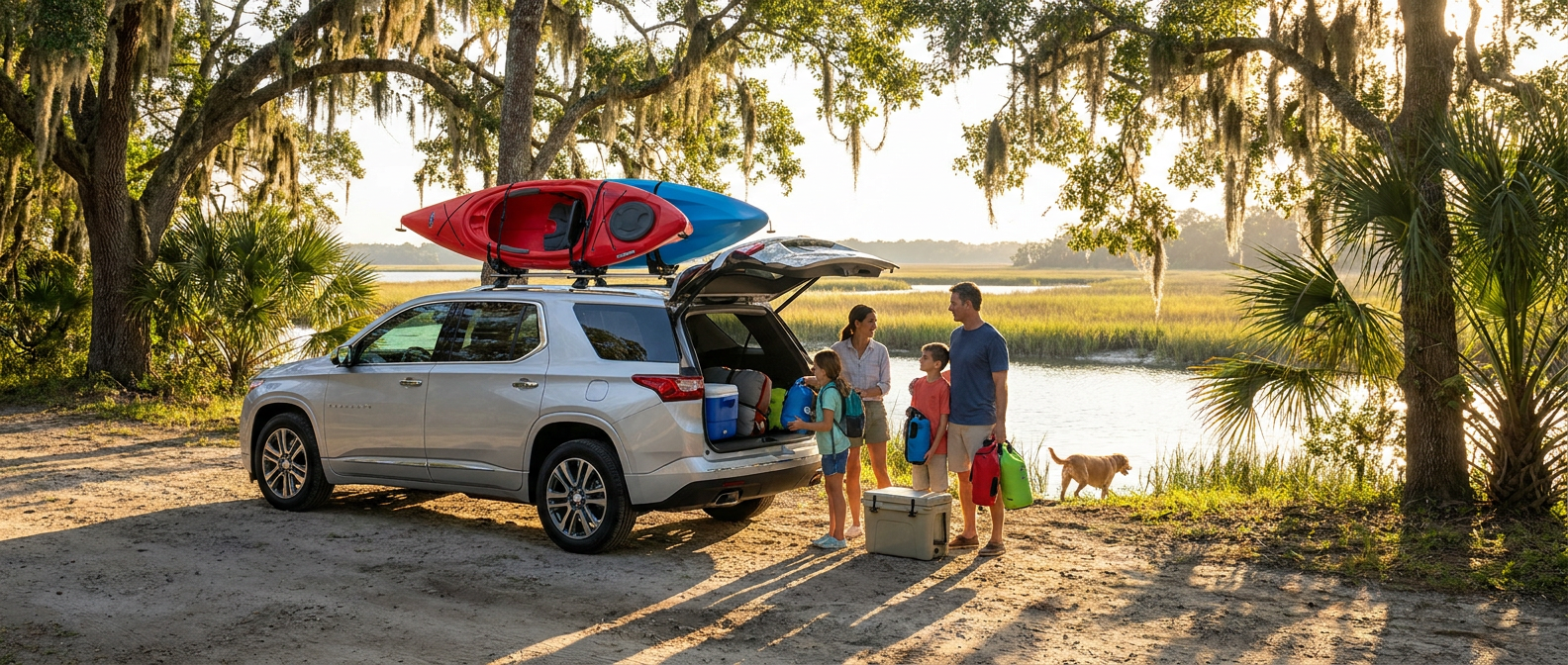
2026 Chevrolet Traverse parked near the Intracoastal Waterway in Socastee SC with family gear

Best Chevy SUVs for Families Near Socastee, SC

In this article What's the Plan at a Glance? The Recreational Park Sets the Gear Test The Swing Bridge and the Drive Down SC-544 On the Water: When Towing Decides the Vehicle Matching the SUV to Your Family Socastee Recreational Park in the morning for disc golf and the playground, then down to the Intracoastal Waterway for an afternoon on the water. Pick the right Chevy SUV and you won't need a second trip. Match the vehicle to your family's size and gear load, and the day runs. The Traverse is the natural anchor for this conversation, but it's not the only answer. Families of five with no boat in tow run a different calculus than a family of seven hauling a jon boat down SC-544. We see that split play out right here on our lot in Conway, and what follows is how we'd sort it out. What's the Plan at a Glance? Stop What to Do Best Time Parking Notes Socastee Recreational Park Disc golf, playgrounds, soccer fields, nature trails (91.5 acres) Morning, before midday heat Large paved lot, easy with a big SUV Socastee Swing Bridge area Watch the 1935 swing bridge open, grab a bite nearby Late morning Street parking; compact SUVs have the edge Island Adventure Watersports (Intracoastal Waterway) Kayak, paddleboard, jet ski rentals, guided tours Midday into afternoon Trailer-friendly lot if you're towing Waccamaw National Wildlife Refuge (nearby) Birdwatching, hiking, quiet nature trails Morning or late afternoon Gravel lots; clearance is not an issue The Recreational Park Sets the Gear Test Socastee Recreational Park runs 91.5 acres of active family space, so you're not packing light, and the Traverse answers that gear test better than anything else in this lineup, though it asks you to trade a little fuel economy for the room. The 2026 Traverse carries 22.9 cubic feet behind its third row with all seven or eight seats occupied, and that number climbs to 98 cubic feet with both rear rows folded flat. Chevrolet rates it best-in-class for max cargo volume in the three-row midsize segment. Pull in with a full set of disc golf bags, a stroller, a cooler, and everyone's shoes, and it all still fits. The Smart Slide second-row seats are the feature families with car seats actually notice. You don't have to uninstall anything to get a kid into the third row. That matters when you're loading three kids at a park. Nobody wants a parking-lot pit stop. One honest tradeoff shows up at the pump. The EPA rates the 2026 Traverse at 20 city and 26 highway mpg on FWD trims. For a big three-row SUV that's respectable, though it won't match the two-row options below. Drive this from Conway on US-501 every weekend, and that gap adds up over a year. Insider note: The park's gravel sections near the nature trail access are no issue for any of these SUVs. Ground clearance isn't a concern here. What varies instead is parking lot length, and the Traverse at 204 inches long fits standard spaces without drama. The Swing Bridge and the Drive Down SC-544 The 2026 Equinox earns its place on this route for families of five who don't need three rows and don't want to wrestle with parking near the Socastee Swing Bridge area, and at 183.2 inches long it slots into tighter street spots easily, though it gives up the third row to do it. Fuel economy lands at 26 city and 29 highway mpg on FWD trims, a noticeable difference from the Traverse's numbers on a SC-544 or US-501 run. The Socastee Swing Bridge dates to 1935. Cargo runs 29.8 cubic feet behind the rear seats, expanding to 63.5 when folded. Two adults, two kids, and a full day's worth of beach and park gear all fit. Five seats, 40 inches of rear legroom, and no third row. If you don't need that third row, its absence isn't a weakness. Next step: Before you head down, double-check the Socastee Swing Bridge schedule. The bridge swings on a regular rotation and can briefly slow traffic on SC-544. Build in ten minutes and you won't feel it. On the Water: When Towing Decides the Vehicle The Intracoastal Waterway at Socastee is where the Tahoe's numbers start doing serious work, because the 2026 Tahoe is rated at up to 8,400 pounds of towing capacity properly equipped with the 5.3L V8 and Max Trailering Package, a reach the Traverse can't match (verify the door-jamb label for your specific build). A small jon boat, a pontoon, a ski boat all sit inside that range. The gap is real. Chevrolet rates the 2026 Traverse at up to 5,000 pounds properly equipped, enough for a smaller fishing boat or a light camper that won't strain it. The Tahoe brings 122.7 cubic feet of maximum cargo space and seating for up to nine, which sounds generous until you're carpooling with another family to the water access point and nobody wants to take two vehicles. Under the hood sits a 5.3L EcoTec3 V8 producing 355 horsepower, with an available 6.2L at 420 horsepower for buyers who tow heavier rigs consistently. The diesel option (3.0L Duramax inline-six, 305 horsepower, 495 pound-feet of torque) is worth a conversation if you cover long stretches of US-501 often, since it delivers up to 28 highway mpg. Explore Financing Options Matching the SUV to Your Family From where we sit at Palmetto Chevrolet, the Traverse is the right answer for most three-row family buyers near Socastee, big where it counts, approachable to drive, and happy to tow a modest boat or camper on its 5,000-pound rating, though a heavier load points you toward the Tahoe. The Tahoe is the move when you're towing something heavier or genuinely need nine seats. The Equinox is what a family of four or five should drive when they don't need a third row. Why pay for space and fuel cost you won't use? The 2026 Trailblazer is worth a mention too. Five seats, 54.4 cubic feet of max cargo, and an EPA-estimated 31 mpg combined on the 1.3L FWD trim. If your family is done with car seats, the kids are older, and you're mostly running to Socastee Recreational Park and back, the Trailblazer is genuinely efficient and easy to park. It won't tow the boat. Draw the line right there. Vehicle Family Size Tow Rating Max Cargo Best For 2026 Trailblazer Up to 5 1,000 lbs 54.4 cu ft Smaller active families, fuel-conscious 2026 Equinox Up to 5 1,500 lbs (AWD) 63.5 cu ft Families of 4-5, daily driving 2026 Traverse Up to 8 5,000 lbs 98 cu ft Three-row families, light to mid towing 2026 Tahoe Up to 9 8,400 lbs 122.7 cu ft Large families, heavy towing All towing figures are for properly equipped vehicles. Verify the door-jamb label for your specific build before towing. Socastee is worth the trip. The park is real, the waterway is right there, and the drive down SC-544 from Conway is a straightforward fifteen minutes. Show up in the right vehicle and you won't spend the day rearranging gear or wishing you'd brought more room. Value Your Trade-In Palmetto Chevrolet 1122 4th Ave, Conway, SC 29526 (843) 248-4283
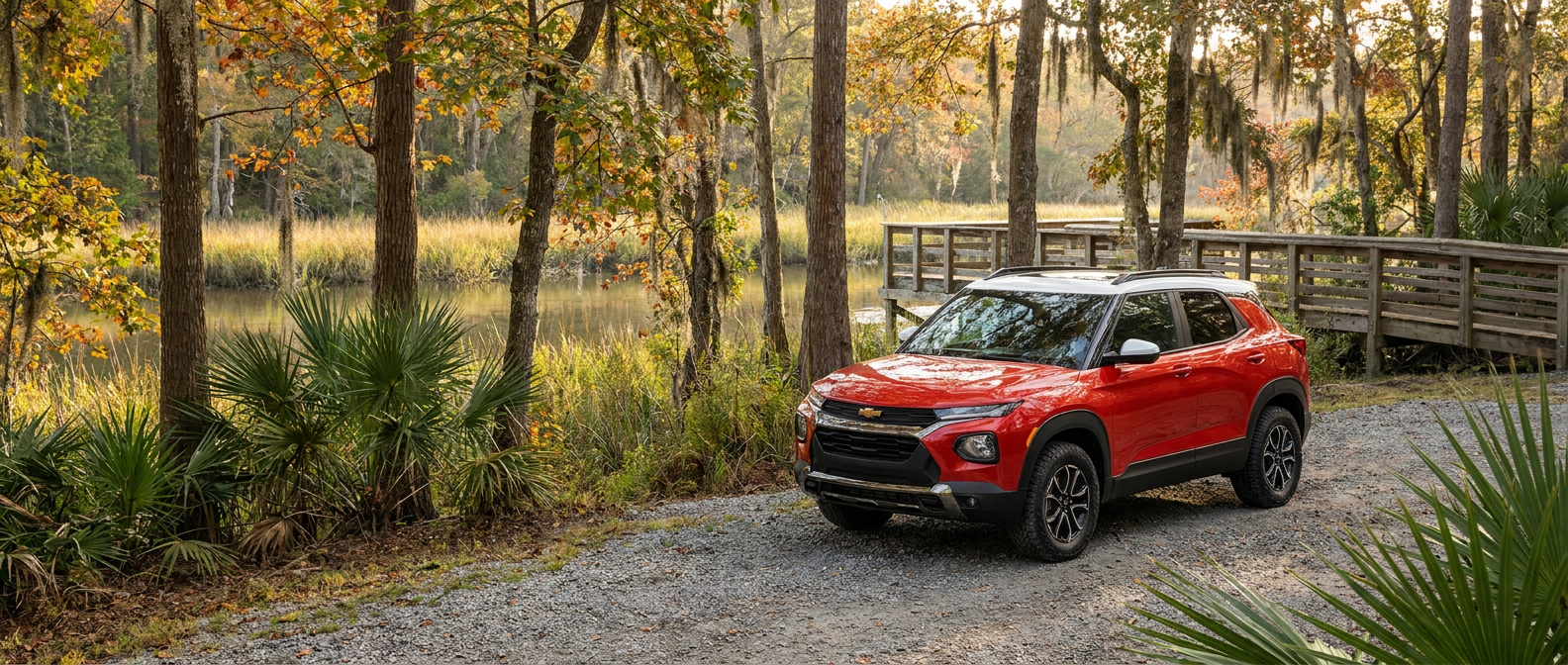
2026 Chevrolet Trailblazer ACTIV parked near a Waccamaw River access point in Horry County, SC

Why the Chevy Trailblazer Fits Horry County Life | Palmetto Chevrolet

In this article Why Does This Vehicle Fit Horry County So Well? The ACTIV Trim Is the One for This County What the Trailblazer Carries, and How Safety Tech That Makes the Grand Strand Commute Less Stressful Horry County doesn't ask much of a vehicle. It just asks a lot of different things from the same one, on the same Tuesday. Downtown Conway parking, where a full-size SUV turns into a math problem. The grind up US-501 toward Myrtle Beach when summer traffic stacks up and fuel economy starts to matter. A rutted access road into the Waccamaw National Wildlife Refuge on a Saturday morning, because you felt like it. And enough cargo room to come home with kayak paddles, a cooler, and a bag of farm stand produce without rearranging your life. The 2026 Chevy Trailblazer handles all of that. We think it fits this county specifically, not just SUV buyers in general, and the specs are where that shows up. The 2026 Trailblazer's 37.3-foot turning circle and 174.1-inch length make it genuinely easy to park in downtown Conway, while its 31 mpg highway rating (1.3L FWD, EPA-estimated) and up to 54.4 cubic feet of cargo space cover the full range of Horry County daily life. Browse the 2026 Trailblazer at Palmetto Chevrolet Why Does This Vehicle Fit Horry County So Well? Most small SUVs are designed to work fine everywhere and nowhere in particular, so the fit tends to read generic on paper. The Trailblazer earns its place here because its actual numbers, length and turning circle and cargo and range, line up with the specific friction points of driving in this county. Local Condition or Use Trailblazer Feature Why It Matters Here Tight downtown Conway parking and historic district streets 174.1-in length, 37.3-ft turning circle (Chevrolet) Maneuvers into spots that defeat longer crossovers; fits standard parallel spots with room to breathe Stop-and-go US-501 beach traffic in summer and fall 1.3L Turbo, EPA-rated 29 city/31 hwy mpg (FWD) Turbo torque handles the creep-and-surge without burning extra fuel the way larger engines do Waccamaw National Wildlife Refuge trail access roads ACTIV trim: off-road suspension tuning, functional skid plate, 8.0-in ground clearance (AWD) Handles packed-dirt and gravel access roads without scraping; skid plate protects the undercarriage Beach gear, kayak paddles, farm market hauls 25.3 cu ft behind rear seats; 54.4 cu ft seats down; 8.5-ft load floor (front seat folded flat) Chevrolet engineers a fold-flat front passenger seat. Almost nothing else in this class does that School-year CCU and Conway commuting Standard wireless Apple CarPlay and Android Auto, 11-in touchscreen Navigation and calls handled before you even pull out of the lot Hurricane-season preparedness kit in the cargo area 13.2-gal tank; ~435-mile highway range (1.3L FWD, per EPA ratings) Enough range to run inland without a fuel stop in low-supply conditions The ACTIV Trim Is the One for This County Look at all four trims if you want, LS through RS, and the RS is a sharp pick for anyone whose driving stays mostly on pavement. For Horry County, though, where the pavement ends without warning and a few gravel causeways sit between you and the good spots, the ACTIV is the build we keep pointing people toward. The ACTIV comes standard with the stronger 1.3-liter turbocharged three-cylinder (155 hp, 174 lb-ft of torque, per Chevrolet). That pull matters on the on-ramps from SC-544 where traffic gaps close fast. See what ACTIV trims are in stock right now Pair that engine with off-road suspension tuning and a functional skid plate, so when you drop off a paved road to reach a boat landing or a wildlife refuge trailhead, the undercarriage is covered. Literally. Ground clearance on the AWD ACTIV sits at 8.0 inches, per Chevrolet specs. The FWD version comes in at 7.5 inches. Both are a genuine step up from the base LS and LT trims. And the 17-inch wheels on the ACTIV use thicker tire sidewalls than the 19-inch RS setup, which soaks up more of the rough pavement and bridge expansion joints you meet on back county roads around here. One tradeoff is worth naming up front. The Trailblazer is a subcompact SUV. It seats five, but five adults on a longer run will feel the size. It isn't the vehicle for towing a boat to the Waccamaw River landing (Chevrolet rates it at 1,000 lb maximum when properly equipped. Verify your door-jamb label, and a fishing boat with a trailer clears that quickly). If that's your primary need, a Chevy Equinox is the more honest answer. What the Trailblazer does instead is cover everything else in the county better and more efficiently than a larger vehicle would. Local detail: The Conway Riverwalk parking on 2nd Avenue fills up fast during fall festivals and farmers market weekends. The Trailblazer's 37.3-foot turning circle (Chevrolet) means it fits into the perpendicular spots along the waterfront that longer crossovers end up circling past, a small thing until you've done it six times. What the Trailblazer Carries, and How Fold the rear seats: 54.4 cubic feet, enough for a weekend's worth of camping gear headed to the Waccamaw National Wildlife Refuge trailheads Fold the front passenger seat flat too: 8.5-foot load floor, which is how you fit surfboard bags, fishing rods, or a piece of furniture from downtown Conway's antique row inside the cabin with the tailgate closed Standard reversible cargo floor liner: sand from the beach, dirt from the refuge. Flip it over and you're clean again 25.3 cubic feet with all seats up: enough for a full grocery run or the gear for a family day at a Horry County park without making anyone hold something in their lap The fold-flat front passenger seat is the feature worth dwelling on with buyers who think this vehicle is too small. A fold-flat front passenger seat is a real differentiator in the class. Most compact SUVs don't offer it. Chevrolet does here, and it changes what the Trailblazer can actually carry. Safety Tech That Makes the Grand Strand Commute Less Stressful Every 2026 Trailblazer comes standard with Chevy Safety Assist, a package of six active safety features that includes Forward Collision Alert, Automatic Emergency Braking, Lane Keep Assist with Lane Departure Warning, Following Distance Indicator, and Intelligent Beam Headlamps. On a corridor like US-501 or Highway 17, where traffic density picks up sharply during peak tourist months, those systems are working in the background every time you drive. Visit us on 4th Ave in Conway to see the full 2026 Trailblazer lineup in person The 11-inch infotainment screen and standard wireless device connection mean you're not fumbling with cables when you're trying to pull up navigation before merging onto SC-22 (Veterans Highway) northbound toward North Myrtle Beach. A small vehicle, carrying a grown-up safety list. That's what sums up the package. Explore Financing Options for the Trailblazer Palmetto Chevrolet 1122 4th Ave, Conway, SC 29526 (843) 248-4283
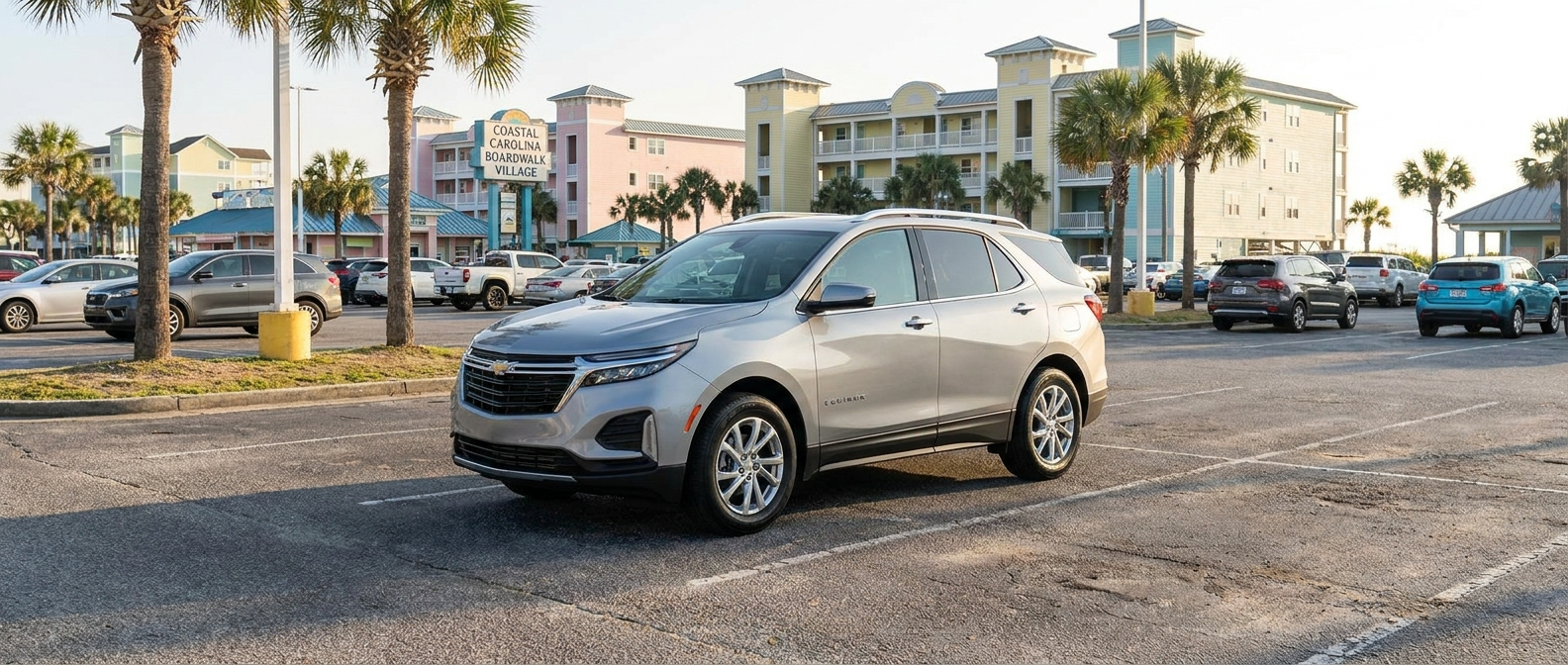
2026 Chevrolet Equinox parked at a coastal South Carolina entertainment complex on a sunny afternoon

Best Chevy Models for a Broadway at the Beach Trip

So which Chevy earns this trip? The truth is it depends less on the destination than on the four things Broadway actually tests your vehicle on. You've got a 30-to-40-minute run down US-501 or SC-22 from Conway, a massive free parking lot that turns into a slow-moving puzzle on a Saturday night, a family or a group of friends to haul, and a South Carolina summer that doesn't apologize for the heat. Pick the right Chevy and none of that is a problem. Pick the wrong one and you're circling the lot in a truck that's bigger than the parking space, or sweating out a low-fuel light on the way home. What's Actually Going On With That Drive? The drive runs short and the lot is genuinely huge, so on paper this is an easy trip, but both the road and the lot change character the moment you show up on a busy summer evening when everyone else had the same idea. Broadway at the Beach sits on 350 acres in Myrtle Beach, with more than 5,000 free parking spaces across the perimeter lots around 23-acre Lake Broadway. There's room to spare right up until a summer Friday evening slows traffic around Celebrity Circle to a crawl and leaves everyone hunting the same row. Situation You'll Face Likely Cause What to Think About US-501 stop-and-go from Conway Peak-season traffic and tourist volume Fuel economy matters; poor city MPG burns your budget Tight lot entry lanes at Broadway High visitor turnover, curb lanes blocked Shorter, narrower vehicles navigate faster Circling for a spot at 7 p.m. Breakers-style evening "going out" peak traffic Maneuverability beats raw size here Fitting the whole crew plus bags Large groups or families with strollers, chairs, coolers Cargo volume and third-row access matter Long summer days, humid heat Horry County's hot, humid coastal climate AC performance and interior comfort are real factors Which road you take matters too. SC-22, the Conway Bypass (Veterans Highway), is a four-lane freeway that runs from US-501 near Conway straight to US-17 near Myrtle Beach. That route skirts the congestion on US-501 itself and cuts a more predictable path into the Strand. Knowing which road to take, and having a vehicle that handles the crawl when you hit the lot, is half the battle. The Most Likely Fit: Match Your Group to the Right Model The 2026 Equinox is the one that suits a four-or-five-person beach day out of Conway, and in our experience it's usually the right call, even if it won't thrill anyone chasing outright pace off a merge. No, it isn't the flashiest pick. But the EPA rates it at 27 mpg combined for front-wheel-drive models, and at 183.2 inches long it fits a standard parking space with room to open the doors without elbowing the car next to you. That combination matters in a lot full of beach visitors who aren't parking carefully. Cargo runs 29.8 cubic feet behind the rear seat and opens to 63.5 cubic feet with the 60/40 rear seat folded down, which covers a stroller, a cooler, a bag of towels, and someone's souvenir from the candy shop without any creative packing. There's one tradeoff worth naming up front. The Equinox's 1.5L turbo makes 175 horsepower, and it earns its fuel numbers by not rushing. If you push it hard on a merge, the CVT on front-wheel-drive models takes a moment to find its stride. At normal US-501 traffic speeds that's a non-issue, but on a hot day with five people aboard, it shows. Plan for it. The 2026 Trax is the answer if you're going as a couple or a small group and fuel economy is the top priority. The EPA rates it at 28 city and 32 highway on all five trim levels. At 178.6 inches long, it's shorter than the Equinox and noticeably easier to slot into a tight Broadway parking space on the first try. Cargo is 25.6 cubic feet behind the rear seat, expanding to 54.1 with the seat folded. Plenty for a day out. Not for a full family haul. One limitation worth flagging is that the Trax has no all-wheel-drive option on any trim. Not a problem for a beach-town parking lot or US-501 in October, but worth knowing if your trip plans extend beyond the Strand. The 2026 Traverse is the right call when you're moving a group of seven or eight. With the available second-row bench it seats up to eight, handles up to 97.6 cubic feet of cargo, and puts 328 horsepower from a 2.5L turbo four-cylinder under your right foot. The EPA rates it at 20 city and 26 highway for front-wheel-drive models. Make no mistake, it's a bigger vehicle, full stop. In Broadway's perimeter lots, that means aiming for the outer rows where there's more space and less circulation traffic. On group trips, the Equinox or Trax simply run out of seats. The Traverse earns its keep. One thing our team notices on the lot. The 2026 Traverse's 328-horsepower engine means it merges confidently when SC-22 opens up, but its EPA 20-mpg city rating means the stop-and-go through Broadway's parking lot entrance adds up across a summer of trips. FWD is the better choice for a beach-run Traverse if you don't need AWD for the rest of the year. Print-and-Go Checklist Before You Head to Broadway Check fuel before you leave Conway (US-501 gas stops add time at peak hours) Use SC-22 (Veterans Highway) from Conway to skip the US-501 tourist crawl into downtown Arrive before 6 p.m. or after 9 p.m. to avoid the evening peak around Broadway's lot entries Target the outer west perimeter lots for easier parking in a larger vehicle like the Traverse Fold the rear seats before you leave if you're hauling chairs, a cooler, or stroller Confirm your AC is up to a full South Carolina summer afternoon before a long outing Set a Google Maps pin where you parked (Broadway's perimeter lots are large enough to lose your spot) DIY vs. Bringing It to Our Service Team Scheduling a service check before a heavy-use summer season makes sense, and while the drive from Conway to Broadway is short, the repeated summer runs on US-501 and SC-22 plus the family hauls are what quietly wear on a few systems. Tire pressure drops faster on hot pavement, and underinflation raises your fuel cost on every run. Horry County's coastal humidity and pollen load the cabin air filters faster than inland driving. And the AC works harder in that humidity and heat, especially with a full vehicle. All three you can check yourself in the driveway, where tire pressure takes two minutes with a gauge and the cabin filter is usually within reach without tools. But if your AC is blowing warm, or your fuel economy has dropped noticeably from what the EPA rates for your model, that's a service visit rather than a quick fix. We see that most often after a long summer of short trips, where the AC runs hard and the engine never gets a proper warm-up cycle. Bring it in and our team will tell you exactly what it needs. Schedule a Pre-Trip Service Check If you're taking a Traverse, get the tire pressures set to the door-jamb label spec before you load seven people. On a vehicle that size, load matters. Frequently Asked Questions Which Chevy is best for a day trip to Broadway at the Beach with a small family? For a family of four or five, the 2026 Equinox is our first recommendation. The EPA rates it at 27 mpg combined (FWD), it seats five, and at 183.2 inches long it fits a standard Broadway parking space without drama. Cargo runs 29.8 cubic feet behind the rear seat, expanding to 63.5 with the seat folded, which comfortably covers a stroller, cooler, and a full day's worth of gear for the family. Is parking at Broadway at the Beach difficult in a larger Chevy like the Traverse? Broadway at the Beach has more than 5,000 free parking spaces across its perimeter lots, so finding a spot is rarely impossible. In a 2026 Traverse (which seats up to eight), the practical tip is to head for the outer lots rather than circling the inner rows. Evening traffic peaks around the lot entries starting around 6-7 p.m. during summer; arriving before or after that window makes maneuvering a larger vehicle considerably easier. What should I check on my Chevy before heading to Broadway? Focus on three items: tire pressure (use the door-jamb spec and check it before loading), cabin air filter (coastal humidity loads it faster), and AC function (confirm it's blowing cold on a hot day). These checks take minutes in the driveway and prevent surprises on the drive or in the lot. FAQ ### Which Chevy is best for a day trip to Broadway at the Beach with a small family? For a family of four or five, the 2026 Equinox is our first recommendation. The EPA rates it at 27 mpg combined (FWD), it seats five, and at 183.2 inches long it fits a standard Broadway parking space without drama. Cargo runs 29.8 cubic feet behind the rear seat, expanding to 63.5 with the seat folded, which comfortably covers a stroller, cooler, and a full day's worth of gear for the family. ### Is parking at Broadway at the Beach difficult in a larger Chevy like the Traverse? Broadway at the Beach has more than 5,000 free parking spaces across its perimeter lots, so finding a spot is rarely impossible. In a 2026 Traverse (which seats up to eight), the practical tip is to head for the outer lots rather than circling the inner rows. Evening traffic peaks around the lot entries starting around 6-7 p.m. during summer; arriving before or after that window makes maneuvering a larger vehicle considerably easier. ### What should I check on my Chevy before heading to Broadway? Focus on three items: tire pressure (use the door-jamb spec and check it before loading), cabin air filter (coastal humidity loads it faster), and AC function (confirm it's blowing cold on a hot day). These checks take minutes in the driveway and prevent surprises on the drive or in the lot. See What Your Current Chevy Is Worth Palmetto Chevrolet 1122 4th Ave, Conway, SC 29526 (843) 248-4283
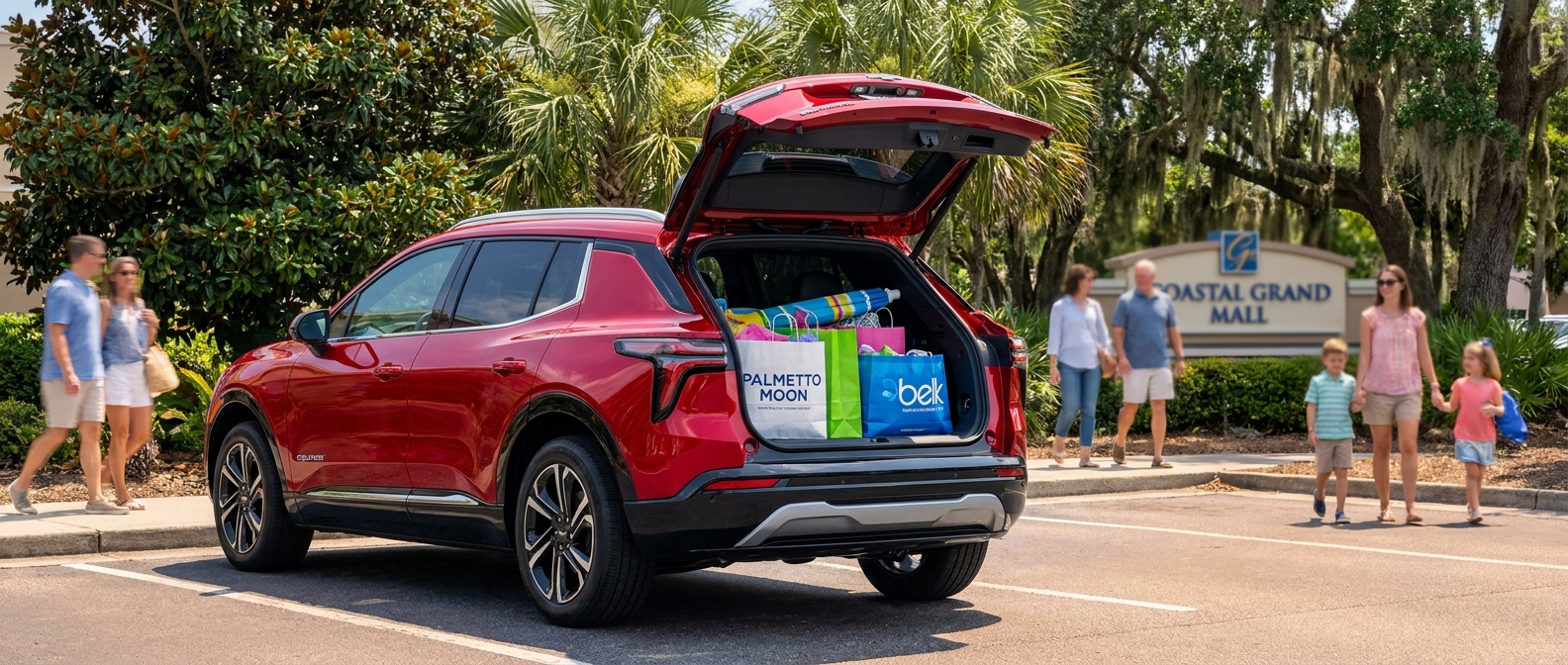
2026 Chevrolet Equinox with cargo hatch open and shopping bags inside in a large sunny mall parking lot

Best Chevy for Shopping at Coastal Grand Mall | Palmetto Chevrolet

A belief worth testing before a Coastal Grand Mall run goes like this. "I need something big enough to handle a real Coastal Grand Mall haul." The instinct makes sense. More stores, more bags, more people, so more vehicle, right? Not quite. The *best* Chevy for a Coastal Grand run leans far more on what you're hauling, how many seats you need, and what US-501 looks like on the drive home than it does on raw size. Sizing up just to size up can work against you in that lot on a busy fall Saturday. Which Chevy actually fits? The 2026 Chevrolet Equinox is where we'd steer most Conway-area shoppers, but that's one recommendation among several good ones. Let's work through the myths and realities so you can pick the one that fits your trip. The short version Myth: You always need the biggest SUV for a serious mall shopping run. Reality: Coastal Grand's 6,000-plus-space lot and single-level layout reward a vehicle sized for its specific job, not just maximum volume. The 2026 Chevrolet Trax (EPA-rated 28 city / 32 highway) is the sharpest choice for solo and two-person errand runs where US-501 stop-and-go fuel economy matters. The 2026 Equinox delivers 29.8 cubic feet of cargo space behind the rear seats and expands to 63.5 with the 60/40 seat folded. Plenty for a serious family haul without the footprint of a three-row. The 2026 Chevrolet Traverse is the correct call when you need three rows of seats and serious cargo volume (up to 98 cubic feet), but it's the most deliberate parking choice in a crowded holiday lot. Honest tradeoff: more seats and cargo volume genuinely cost you parking agility on peak-season days. We'll tell you where each vehicle earns its keep. Is "Bigger Always Better" Actually True for a Mall Shopping Run? The short answer is no, though a bigger SUV does earn its room once the people and bags genuinely fill it, and the parking math at Coastal Grand explains why sizing up for its own sake can backfire on a busy Saturday. The mall sits at 2000 Coastal Grand Circle just off US Highway 17, with over 6,000 parking spaces across a predominantly single-level surface lot. Nobody would call it a cramped urban garage. But it fills fast in tourist season and during fall sales weekends, and longer vehicles compete for the same standard-width spaces as everything else on the lot. The Myth What's Actually True "A big SUV handles any haul better" Cargo volume is only useful if it's sized to what you're actually carrying. Chevrolet lists the 2026 Equinox at 29.8 cu ft behind the rear seats. Enough for a full day of bags from 170-plus stores. "More vehicle means more room for the family" The 2026 Traverse seats up to eight and carries 98 cu ft of max cargo. Genuinely useful for big groups. For a couple or family of four, the Equinox's 104.3 cu ft of passenger volume already feels spacious. "The Trax is too small for a real shopping trip" Chevrolet lists the 2026 Trax at 25.6 cu ft behind the rear seats and 54.1 cu ft with seats folded. That's a solid haul for one or two shoppers, in a 178.6-inch footprint that maneuvers with ease in a crowded lot. "You'll waste a lot of gas on the US-501 run" The EPA rates the 2026 Trax at 28 city / 32 highway, and the 2026 Equinox earns up to 26 highway. The Traverse (EPA-rated 20 city / 26 highway FWD) covers the run efficiently for its class. "A three-row SUV is always worth it" Worth it if the third row is occupied. The Traverse's 22.9 cu ft behind the third row is tight for a full-family haul; fold that row and you get 56.6 cu ft. Three rows make sense when three rows are actually used. "EPA estimates are determined by the U.S. Environmental Protection Agency using standardized testing procedures. Your actual fuel economy will vary based on how you drive and maintain your vehicle, driving conditions, and other factors.". U.S. Environmental Protection Agency What the Right Chevy Actually Means for a Grand Strand Shopping Day The 2026 Trax is the overlooked pick here, and it earns that billing on two fronts, since at 178.6 inches long with an EPA rating of 28 city / 32 highway it handles the Conway-to-Myrtle-Beach corridor on US-501 efficiently and slides into any standard parking space at Coastal Grand without a fuss. On a Saturday afternoon in October when the lot is full of visiting families, that compact footprint is a genuine advantage. The catch is real for bigger groups. If you're shopping for a family of five and everyone's along for the trip, the 25.6 cubic feet of cargo space behind the rear seats fills up fast once the kids are buckled in. Call it a two-or-three-person vehicle rather than a family-of-five hauler. The 2026 Chevrolet Traverse sits at the other end of the spectrum, and it earns its place when the situation calls for it. Chevrolet lists maximum cargo volume at 98 cubic feet with all rows folded. More cargo than a typical mall haul will ever fill. The 328-horsepower turbocharged engine makes the US-501 corridor feel easy, and towing capacity reaches 5,000 pounds with the included trailering equipment (when properly equipped. Verify the door-jamb label). The Traverse is a large vehicle in a standard parking stall. On a slow Tuesday that poses no problem. On a packed holiday Saturday when every family on the Grand Strand decides to shop at Coastal Grand simultaneously, patience and a bit of extra maneuvering come with it. If your group fills three rows regularly, that's a fair trade. If it's usually four people with occasional guests, the Equinox handles it with less friction. The 2026 Equinox threads the needle for most Conway-area families: 63.5 cubic feet of cargo with seats folded, a 183.2-inch footprint that fits a standard space cleanly, and an EPA-rated 26 highway mpg to make the US-501 run back to Conway cost-effective. "When properly equipped. Before you buy, confirm actual trailering capability with your dealer using the door-jamb label and trailer weight.". Chevrolet (capability caveat, all Traverse towing claims) Explore Financing Options So What Should You Actually Drive to Coastal Grand? The right answer depends on who's riding along and how often, so here's how we'd frame it for a Conway-area buyer deciding today, weighing fuel economy and parking ease against the pull of the biggest badge on the lot. You're a solo shopper or a couple on a focused errand run. Take the Trax. The EPA's 28 city / 32 highway rating is the most fuel-efficient option in the lineup for this exact kind of trip. The 54.1 cubic feet of folded cargo space is enough for a serious haul when your back seat isn't occupied. Park anywhere in the lot without thinking about it twice, most days. You're a family of four or five with a mix of passengers and bags. The Equinox is the sensible call. The 60/40 split-folding rear seat lets you carry three passengers and still expand one cargo side for a big bag haul. Chevrolet lists the overall footprint at 183.2 inches. Compact enough to maneuver in a full lot without the deliberateness a three-row demands. You're hauling the whole extended family. Think six, seven, or eight people, or you're making a major holiday shopping run that genuinely fills a vehicle. The Traverse is right. Three rows, 98 cubic feet of max cargo, and a powertrain capable of pulling a boat trailer when the day calls for it. Plan to give yourself a few extra minutes to find the right spot at the Coastal Grand lot on peak days. Budget for that, and little else. One thing that catches buyers off guard. The US-501 corridor between Conway and the Coastal Grand area sees real tourist-season congestion, above all on fall weekend afternoons. A vehicle with better city fuel economy pays off during the idling, and that stretch serves up plenty of it on peak afternoons. The Trax and Equinox earn their city ratings here. The Traverse earns its keep in a different way. When you've got the passengers to fill it, nothing else on our lot handles the return trip with that much cargo and that many comfortable seats. Whatever you're driving over to Coastal Grand, we can help you find the right fit before the trip. Frequently Asked Questions Does the 2026 Chevrolet Trax have enough cargo space for a full day of mall shopping? Yes, for one or two shoppers. Chevrolet lists the 2026 Trax at 25.6 cubic feet of cargo space behind the rear seats and 54.1 cubic feet with the rear seat folded. For a focused shopping run with one or two people, that covers a full day at a mall like Coastal Grand. If you're bringing three or more passengers and need cargo room for all of them, the 2026 Equinox (29.8 cubic feet seats up, 63.5 folded) is the better match. How far is Palmetto Chevrolet in Conway from Coastal Grand Mall in Myrtle Beach? Palmetto Chevrolet's located in Conway, South Carolina, on 4th Avenue. Roughly 30 to 40 minutes from Coastal Grand Mall via US-501 East, depending on traffic. The US-501 corridor is the main artery between Conway and Myrtle Beach and sees meaningful congestion during peak tourist weekends, which is one reason fuel economy in city and stop-and-go driving matters for this particular run. See What Your Current Vehicle Is Worth Palmetto Chevrolet 1122 4th Ave, Conway, SC 29526 (843) 248-4283
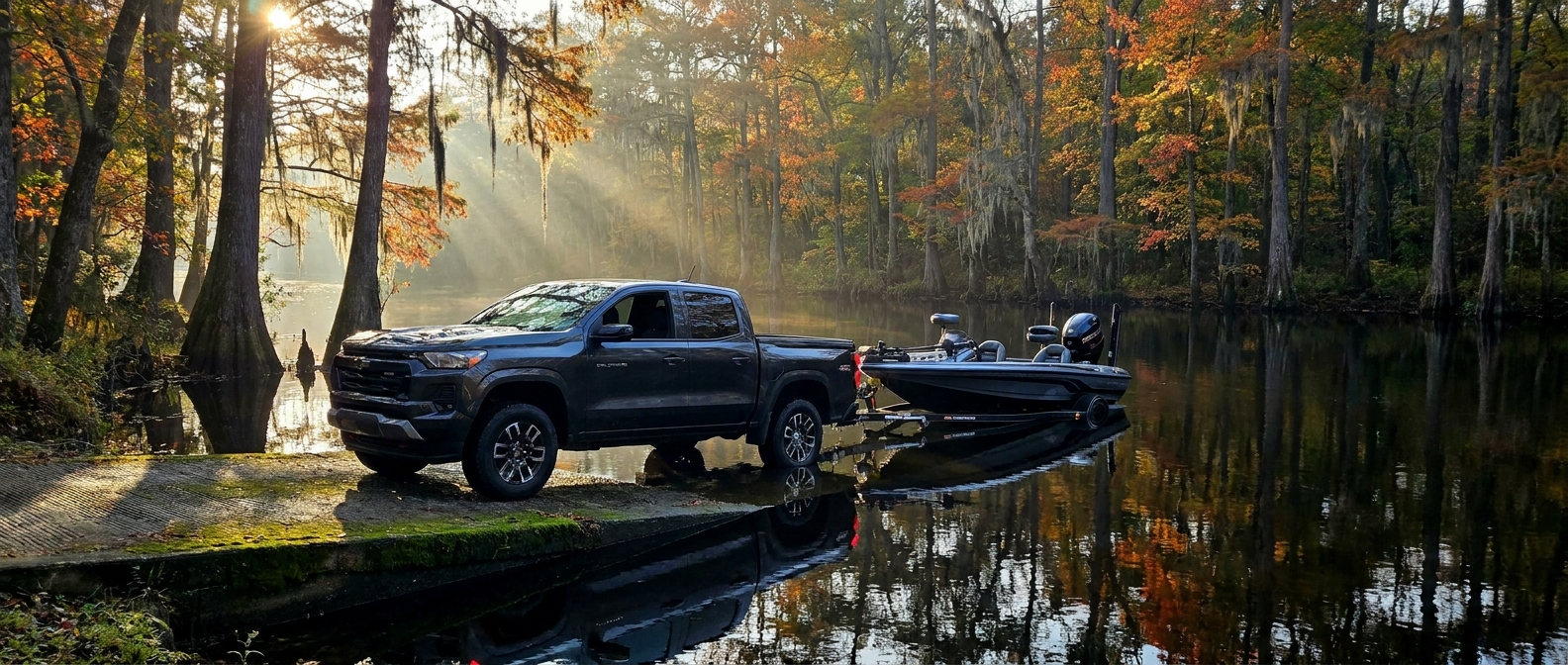
2026 Chevrolet Colorado backing a fishing boat trailer down a Waccamaw River boat ramp near Conway SC on an autumn morning

How to Set Up Your 2026 Chevy Colorado for Waccamaw River Fishing

October is the best month on the Waccamaw, and we say that with some confidence. The heat finally breaks, crappie move to center stage in the cypress cuts, largemouth feed hard before winter, and blue cats stay active through the night. We wrote this guide to walk you through exactly how to configure your 2026 Colorado, so you roll up to Pitch Landing or Bucksville Landing with a properly hitched trailer, a bed that doesn't swallow your tackle, and a truck that backs down a sandy ramp without drama. The 2026 Colorado is a legitimate fishing truck for this river. Tow the boat in, back it down, fish all day, and reload without chaos. That's the goal. The single most important prep step: confirm whether your Colorado already has the Advanced Trailering Package. Without it, Chevrolet rates the Colorado at 3,500 pounds of towing capacity. With it, that number climbs to 7,700 pounds (properly equipped, always verify your door-jamb label). For most bass boats and aluminum jon boats on the Waccamaw, you're well within the base 3,500-pound rating, but a larger fiberglass rig changes that math fast. What Do You Need Before You Start? You'll want everything gathered before you load a single rod, because skipping the checklist phase is how anglers end up at Pitch Landing without a 7-pin adapter. Pull these together the night before and you're set. The list is short, so run it top to bottom. Item Spec / Detail Where to Confirm Towing capacity (base) 3,500 lbs (no package) Door-jamb label on your specific truck Towing capacity (w/ Advanced Trailering Package) Up to 7,700 lbs, properly equipped Door-jamb label; Chevrolet lists this as the max for the platform Payload capacity (WT/LT 2WD) Up to 1,710 lbs Door-jamb label Payload capacity (Trail Boss / Z71 4WD) Up to 1,590 lbs Door-jamb label Bed length (all 2026 Colorado trims) 61.7 inches (at floor) Chevrolet specs Width between wheel wells 45.5 inches Chevrolet specs Cargo volume 41.9 cubic feet Chevrolet specs Fuel tank capacity 21.4 gallons Chevrolet specs EPA fuel economy (2WD, combined) 21 MPG fueleconomy.gov EPA fuel economy (4WD, combined) 19 MPG fueleconomy.gov Trailer hitch receiver Standard on Trail Boss / Z71 / ZR2; available via package on WT / LT Chevrolet option sheet 7-pin trailer connector Included with Advanced Trailering Package Chevrolet Get your boat's loaded trailer weight from the registration or the manufacturer's tag. You want that number, not the boat's dry weight, because that's what you're comparing against your door-jamb rating. Everything else in this guide assumes you've done that check. Setting Up the Colorado for a Full Waccamaw Fishing Trip Think of this as the spine of the day, six steps in order, from the night before you leave Conway to the moment you're on the water. Work them in sequence and nothing catches you off guard at the ramp. We've laid them out the way we'd prep our own rig. Step 1: Decide your trim and package configuration. If you already own a 2026 Colorado, check for the Advanced Trailering Package. It adds the 7-pin wiring harness, a heavy-duty hitch receiver, and trailer sway control calibrated for loaded rigs. The Trail Boss and Z71 come standard with 4WD, which matters at Bucksville Landing and Pitch Landing, both Horry County public ramps on the Waccamaw, and both can get slick from silt and river mud after rain. If you're shopping, the WT and LT in 2WD handle most lighter aluminum boats fine, though any fiberglass rig over 2,500 pounds loaded warrants the package and, frankly, 4WD for the ramp. The current Colorado inventory at Palmetto Chevrolet shows which trucks are package-equipped. We can pull the window sticker and confirm exactly what's on a given unit before you commit. Step 2: Hitch the trailer the evening before, not in the dark at 5 a.m. The 2026 Colorado's available hitch guidance camera helps line up the ball, but it still takes a minute the first time. Hook up at home in daylight. Confirm the ball mount height, since the trailer tongue should run level to the ground when loaded, which usually means the ball sits somewhere between 12 and 18 inches off the ground depending on your coupler height. Plug in the 7-pin connector and test every running light and brake light while someone stands behind the trailer. That part isn't optional. A trailer with a dead brake light gets you pulled over on US-501 heading back through Conway. Step 3: Load the bed in weight order, heaviest forward. The 61.7-inch Colorado bed holds 41.9 cubic feet. You've got real capacity there, but it fills fast when you're fishing all weekend. Keep the heaviest gear directly behind the cab (cooler, generator if you run one, batteries) and lighter gear toward the tailgate. Tongue weight from the trailer should sit at roughly 10 to 15 percent of total trailer weight, so the rear of the truck is already carrying load. Putting your heavy cooler over the rear axle area keeps the truck from getting nose-light on the highway. The available StowFlex tailgate on LT and above has a built-in mid-position that Chevrolet rates at 500 pounds. It doubles as a step and a tackle-sorting station at the ramp. If you haven't used it yet, practice at home. It opens six ways, and the cypress-tree shadows at Pitch Landing at 5:30 a.m. are not the time to figure out the cable release. The step anglers most often miss: Tie-downs. The 2026 Colorado offers up to 17 available anchor points in the bed. Loose rods, net handles, and tackle bags sliding into each other on US-501 do real damage to gear. Run at least two ratchet straps across your load even for a 20-minute drive to the landing. The bed's 45.5-inch width between the wheel wells fits a standard marine cooler with room for rods along the sides. Measure your cooler before you buy it. Our service team can install bed liners, tonneau covers, and tie-down anchor upgrades if your current setup isn't quite right for this kind of hauling. Step 4: Fill the fuel tank the night before. The EPA rates the 2026 Colorado's 4WD builds at 19 MPG combined (17 city / 22 highway, per fueleconomy.gov). The 21.4-gallon tank gives you a real-world highway range around 400 miles. Conway to Bucksville Landing is about 15 minutes. But running down river toward Georgetown, trailering back up US-501 through beach-season traffic in late afternoon, and an air-conditioned cab on a warm October day will nudge fuel consumption up. Fill it the night before. A full tank also adds predictable weight over the rear axle, which is right where you want it when the trailer is attached. Step 5: Check trailer brake controller settings if you're running a rig over 2,500 pounds. The Advanced Trailering Package includes a factory-integrated trailer brake controller. Calibrate it in a straight, empty parking lot before you load the boat. Make a 10-mph stop and note whether the trailer pushes or pulls. Nudge the gain up one notch if the trailer pushes (brakes not engaging hard enough), down one if it pulls hard left or right (over-engaging). Spend five minutes on this. The Waccamaw River runs through low country with long straight sections of SC-544 and US-501 that turn into stop-and-go during morning shifts. Loaded trailer brakes that haven't been dialed in make that miserable. Step 6: Know your ramp before you get there. Horry County Parks and Recreation manages several public boat landings on the Waccamaw River, and knowing yours ahead of time saves you a fumble in the dark. Pitch Landing (100 Pitch Landing Road, Conway) offers two concrete lanes with floating docks and a spacious unpaved parking area. No launch fee, ADA accessible, and comfortable for a truck-and-trailer setup. Bucksville Landing (500 Landing Rd, Conway) is also county-managed with two launching lanes, a courtesy dock, and six trailer parking spaces. Both put you on the blackwater Waccamaw with access to the cuts and cypress fingers where the fall bite runs hardest. October is genuine prime time here. The river's bass are feeding aggressively as water temperatures cool, crappie are stacking up in the deeper cypress structure, and blue catfish stay active on cut bait into the evening. The Waccamaw runs dark, a tannin-stained blackwater from the surrounding soil, so plan on electronics over naked-eye fish-finding in the cuts. Knowing the ramp you're using is a real advantage. Back the truck in, drop the boat, and move the rig to the parking area before the morning crowd arrives. Local ramp tip: Bucksville Landing sits in a residential area with limited turnaround space. If you're running a longer rig, say a 17-foot bass boat on a tandem-axle trailer, use Pitch Landing instead. The parking area there handles longer combinations without a multi-point turn in the dark. Before You Go: A Quick-Reference Recap Print this or screenshot it before you pull out of the driveway, because everything you need to confirm the morning of your trip lives right here. Run each line, check each box, and you'll hit the ramp with nothing left to second-guess. Keep it on your phone. Task Done? Trailer loaded tongue weight verified against door-jamb label All trailer lights tested (running, brake, turn) Bed loaded heaviest-forward, all gear strapped down StowFlex tailgate mid-position tested at home Trailer brake controller calibrated (if applicable) Fuel tank full Ramp address in GPS (Pitch Landing: 100 Pitch Landing Rd, Conway, SC; Bucksville: 500 Landing Rd, Conway, SC) SC freshwater fishing license confirmed (required west of US-17 on the Waccamaw) Need more towing capacity for a larger rig? The Silverado 1500 steps up to a full-size platform if your boat is stretching the Colorado's envelope. Our team can walk you through where the line falls for your specific trailer. Here's one straight note on the tradeoff. The 2026 Colorado's 5-foot-2 bed is the only bed option. It's right-sized for a weekend fishing load, but if you're hauling a serious amount of gear plus a generator plus a full cooler, you will feel the constraint. Know that going in. For a typical Waccamaw River weekend trip, a bass boat, two anglers, and weekend gear, it's genuinely enough space. Schedule a Pre-Trip Truck Inspection The Colorado is ready for the Waccamaw. Our team at Palmetto Chevrolet in Conway is here when you have questions about packages, bed accessories, or finding the right truck for your setup. Frequently Asked Questions Does the 2026 Chevrolet Colorado need the Advanced Trailering Package to tow a fishing boat? It depends on your boat's loaded trailer weight. Without the Advanced Trailering Package, Chevrolet rates the 2026 Colorado at 3,500 pounds of towing capacity. With the package, that rating climbs to up to 7,700 pounds when properly equipped. Most aluminum jon boats and lighter bass rigs come in well under 3,500 pounds loaded, so the base Colorado handles them fine. A larger fiberglass bass boat or a heavier aluminum rig can push past that limit, which is when the package becomes essential. Always check your door-jamb label for the exact rating on your specific truck. Which Horry County boat ramps on the Waccamaw River work best for a truck-and-trailer? Pitch Landing at 100 Pitch Landing Road in Conway is the most accommodating for truck-and-trailer combinations. It has two concrete ramps with floating docks, no launch fee, ADA access, and a spacious unpaved parking area. Bucksville Landing at 500 Landing Rd in Conway is also county-managed with two lanes and a courtesy dock, though the surrounding residential area limits turnaround space for longer trailer setups. Both are managed by Horry County Parks and Recreation and put you directly on the Waccamaw River. Explore Financing Options Palmetto Chevrolet 1122 4th Ave, Conway, SC 29526 (843) 248-4283
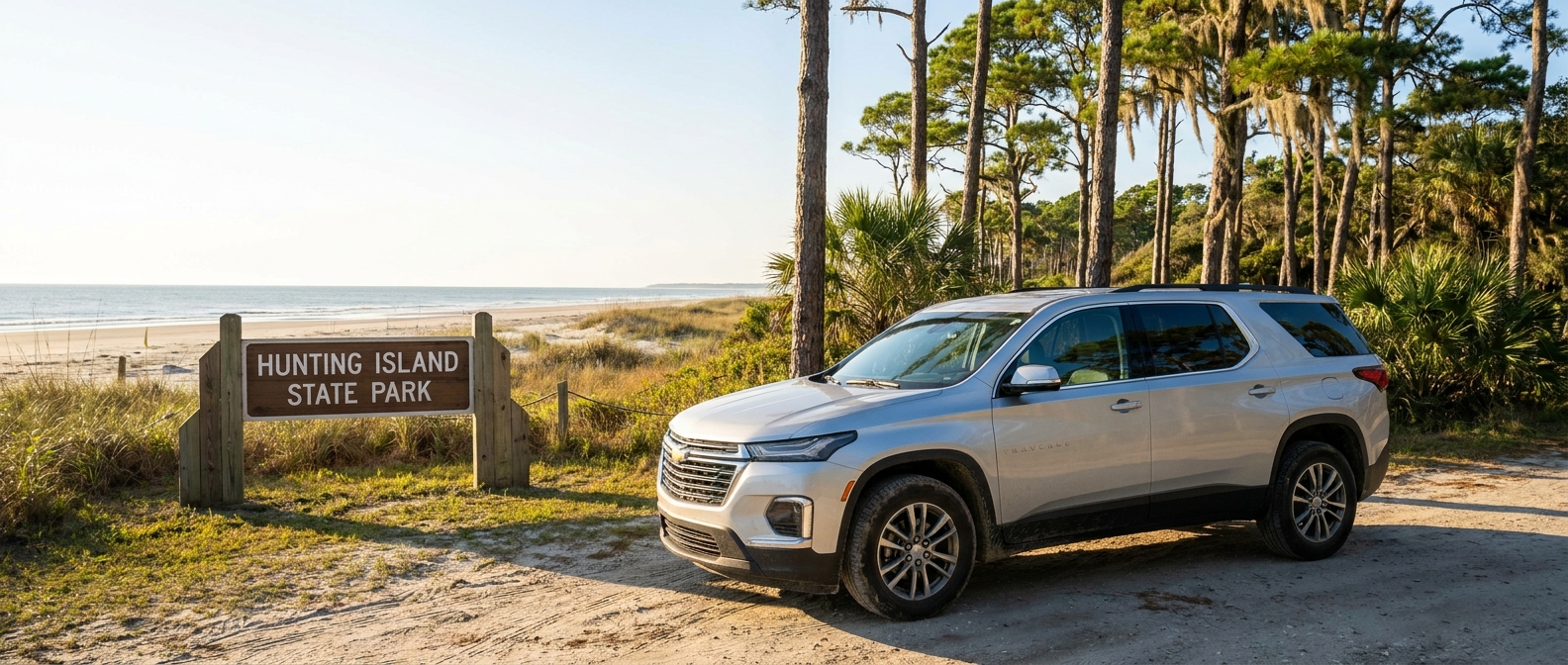
2026 Chevrolet Traverse parked near Huntington Beach State Park South Carolina coastal entrance

4 Best Chevy SUVs for Huntington Beach State Park Trips

In this article How the Chevy Lineup Stacks Up for Huntington Beach 1. Traverse: The Family Camping Workhorse 2. Tahoe: When You're Pulling a Real Camper 3. Equinox: The Smart Pick for Day-Trippers and Couples 4. Trailblazer: Lean Budget, Real Efficiency The Bottom Line: Match the SUV to Your Trip Conway to Huntington Beach State Park runs roughly 30 to 40 minutes down US-501 and SC-544. The driving is the easy part. What you're loading up before you pull out matters more. Beach chairs, a pack-n-play, a camper trailer, a kayak, a dog, all of the above. Whatever you haul decides which Chevy SUV actually earns its keep once you get there. Our pick for most Grand Strand families heading to Huntington Beach is the 2026 Chevy Traverse. Three rows, up to 97.6 cubic feet of cargo when you fold the seats, and enough towing muscle for a small camper. It fits the park and the trip better than anything else in the lineup for a family of four or more. The right SUV depends entirely on how you camp. Here's how we'd sort the lineup. See What Your Current Vehicle Is Worth How the Chevy Lineup Stacks Up for Huntington Beach Matching the right Chevy to this trip comes down to how much gear you're hauling and whether you're towing, because the campground itself ranges from full-hookup RV pads to shadier tent-friendly sites and no single model covers all of it. Huntington Beach State Park runs 173 campsites across two loops. The South Campground handles full hookups and concrete pads. Up in the North loop, you get shadier, more spacious electric-and-water sites. The park accommodates RVs up to 40 feet, which matters a lot for a towing conversation. So does the 2,500-acre footprint of salt marsh, maritime forest, and open beach, sandy surface lots in spots, and you're hauling a serious amount of gear across all of it. Rank Pick Best For Standout Spec 1 Traverse Families with full camping gear 97.6 cu ft max cargo, tows 5,000 lb 2 Tahoe Towing a camper trailer to the park 8,400 lb max tow (properly equipped) 3 Equinox Couples and day-trippers from Conway EPA-est. 26 city / 29 hwy, 63.5 cu ft cargo 4 Trailblazer Budget-first solo or duo beach runs EPA-est. 29 city / 33 hwy (1.3L FWD), 54.4 cu ft 1. Traverse: The Family Camping Workhorse The Traverse is our top pick for families hauling a full camping load to Huntington Beach, as long as you can live with its size on the tighter campground loops. Chevrolet lists the 2026 Traverse at a class-leading 97.6 cubic feet of maximum cargo space with both rear rows folded. Even with all eight seats occupied, you still have 22.9 cubic feet behind the third row. Plenty for a stroller, a tote bag, and the beach bag you swore you'd keep small. Chevrolet also rates the 2026 Traverse at up to 5,000 pounds of towing capacity when properly equipped, which covers a small pop-up camper or a bass boat headed for the park's lake launch. A 328-horsepower turbocharged engine moves the weight without drama, and the Smart Slide second-row seats mean getting a toddler to the third row doesn't become a parking-lot ordeal. The tradeoff is size. Navigating narrow campground loops or the tighter North Campground sites takes more attention than a compact does. If you're camping solo or as a couple, it's simply more than the trip requires. Before You Hitch Up: Towing ratings are configuration-specific. The Traverse's 5,000-lb figure requires proper equipment, always check the door-jamb label before hooking up a trailer, not just the marketing number. 2. Tahoe: When You're Pulling a Real Camper The Tahoe is the right pick when you're towing a genuine camper to one of the park's full-hookup pads, though it's far more truck than a beach day trip will ever need. The South Campground's 66 full-hookup sites were designed for serious RV setups. If you've got a travel trailer or a larger camper at home and you want to back it into one of those sewer-included pads at Huntington Beach, the 2026 Chevy Tahoe is the right conversation to have. Chevrolet rates the Tahoe at up to 8,400 pounds of towing capacity when properly equipped with the 5.3L V8 and the Max Trailering Package. You've got real headroom there for a single-axle travel trailer or a loaded pontoon. Body-on-frame construction handles trailer sway differently than a crossover platform, and that shows up on a long haul or even a short one with an unbalanced load. The Tahoe also seats up to nine people, so if the camping crew is large, you're not splitting into two vehicles just to get everyone there. Fair warning, the Tahoe is the biggest, heaviest option on this list, and fuel economy reflects that. Towing is where the Tahoe earns its keep. For a beach-bag day trip, it's overkill. 3. Equinox: The Smart Pick for Day-Trippers and Couples The Equinox is the smart choice for couples and day-trippers who want efficiency over cargo volume, though it tops out well short of any camper-towing job. Not every Huntington Beach trip involves a campsite reservation. Plenty are just a half-day run from Conway to that wide, uncrowded beach, and you're home by dinner. For that pattern, the 2026 Chevy Equinox is hard to argue with. The EPA rates the 2026 Equinox at 26 city and 29 highway MPG in FWD configuration, which keeps the US-501 run from Conway sensibly efficient if you're making it often. Fold the rear seats and you've got 63.5 cubic feet of cargo space. Enough for two beach chairs, a medium cooler, a canopy, and the bag of towels that somehow weighs 40 pounds. Pros Cons Cargo (63.5 cu ft max) Handles a full day-trip load easily No third-row option for larger groups EPA 26 city / 29 hwy Efficient for a regular Conway-to-park run Not the lowest fuel cost in the lineup AWD available Better traction on soft or wet park surfaces Lowers towing from 1,500 lb vs FWD on some trims Towing (up to 1,500 lb, AWD properly equipped) Covers a kayak trailer or small utility trailer Won't move a camper trailer Five people fit in the Equinox. If your group is two to four and you're not towing anything heavier than a kayak rack, this is where the value lands. 4. Trailblazer: Lean Budget, Real Efficiency The Trailblazer makes the most sense when efficiency and a small footprint matter more than towing capacity or a third row, which is also exactly why it's the wrong tool for a full family camp. Sometimes the best vehicle for a beach state park is the one that costs the least to drive there. The 2026 Chevy Trailblazer with the 1.3L turbo and front-wheel drive earns an EPA-estimated 29 city and 33 highway MPG, the most efficient non-electric SUV in the Chevy lineup, and across a full beach season it adds up. Cargo with the rear seats folded hits 54.4 cubic feet. Enough for a solo camper's full kit or a couple's day-trip gear, without much negotiation. The fold-flat front passenger seat also creates an 8.5-foot load floor inside the cabin. Handy for a surfboard, kayak paddles, or a collapsible canopy that never fits where you'd expect. Towing is where the Trailblazer hits its ceiling. It pulls 1,000 pounds. A bike rack is fine. A small utility trailer is borderline, and a camper stays in the driveway. It's also a five-seater with no third-row option, so four adults plus gear for all four of them starts to feel genuine. Think of it as a sharp, efficient run-down-the-beach vehicle rather than a family hauler, and it does that job better than anything else on this list. The Bottom Line: Match the SUV to Your Trip Matching the SUV to your trip is what this comes down to, because the park spans everything from primitive tent pads to full-hookup slabs and no single Chevy fits all of it. Huntington Beach State Park is one of the better camping spots on the Grand Strand. 3 miles of open Atlantic beach, a freshwater lagoon, marsh boardwalks, and wildlife that'll catch you off guard. The campsite options run from primitive tent pads to full-hookup concrete slabs with sewer connections. Every one of those trip types maps to a different Chevy. Pulling a real camper to a South Campground hookup site? Start with the Tahoe. Loading up a family for an overnight with beach gear and a pop-up? The Traverse. Day-tripping with a partner and a cooler? The Equinox. Keeping the fuel bill reasonable on a solo run? The Trailblazer. Our team at Palmetto Chevrolet is glad to pull any of these up on the lot, and we'll walk you through the spec that actually matters for your specific Huntington Beach trip, not just the number on the sticker. By the Palmetto Chevrolet Team | October 2026 Get Pre-Approved Before You Shop Palmetto Chevrolet 1122 4th Ave, Conway, SC 29526 (843) 248-4283
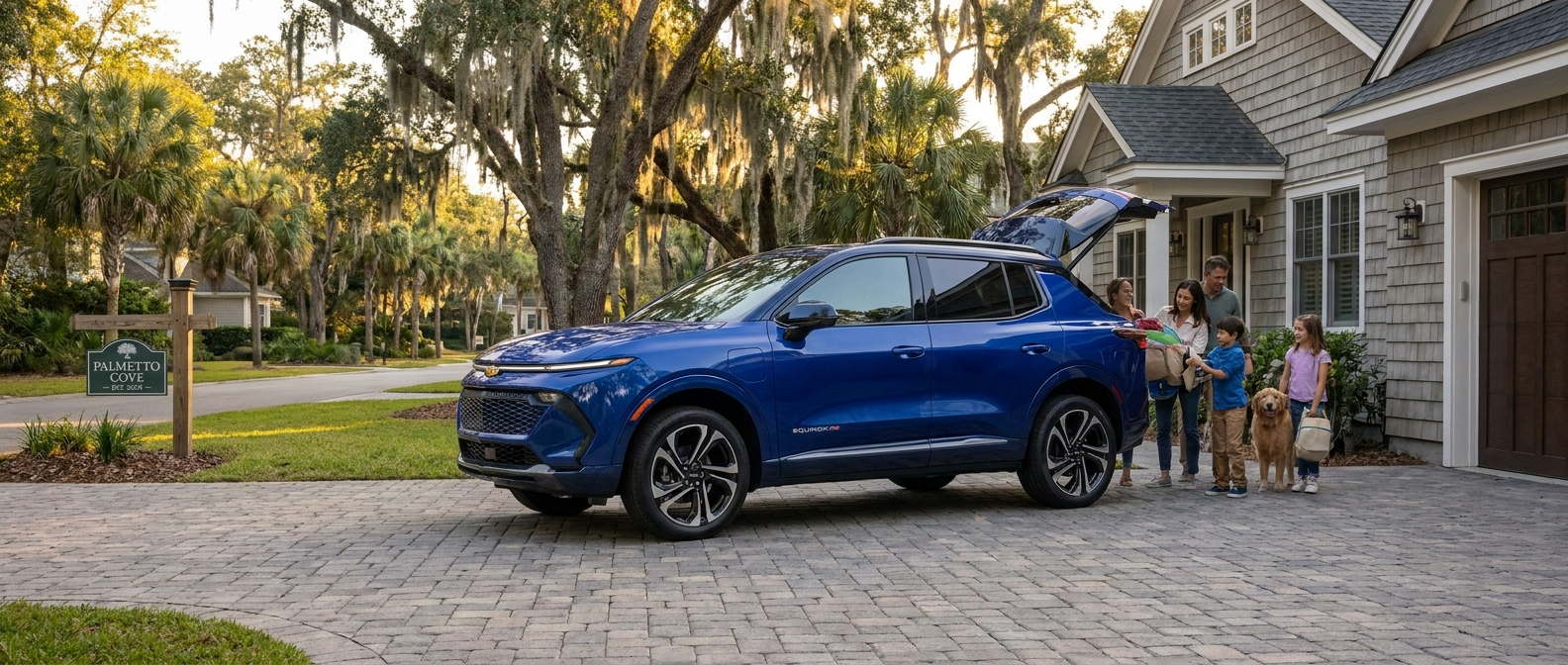
chevy-equinox-forestbrook-families-conway-sc

Why the Chevy Equinox Fits Forestbrook Families

In this article Why Does the Equinox Fit Here? Standard Safety That Covers You at Every Trim Level FWD Makes More Sense Here Than You Think What You Actually Get Day to Day Forestbrook sits right in the pinch. US-501 forms your northeastern border, SC-31 (the Carolina Bays Parkway) runs along your northwest edge, and the corridor between them is one of the most-traveled stretches in all of Horry County. According to SCDOT traffic records, US-501 from SC-31 to US-17 Bypass regularly sees more than 60,000 vehicles a day. You feel that number on the Tuesday morning school run, and you feel it again on the Friday afternoon beach crawl when the Grand Strand pulls half the coast down your route. The 2026 Chevrolet Equinox fits that life. Not because it's the flashiest compact SUV on the market (it isn't), but because it's calibrated for what Forestbrook families actually do. Daily drives on congested corridors, a back seat that has to hold real kids with real stuff, and safety tech that works without a monthly software subscription. For Forestbrook families navigating US-501 and SC-31 daily, the 2026 Equinox delivers 27 mpg combined (EPA, FWD), nearly 40 inches of rear legroom, and standard Teen Driver technology across every trim. Why Does the Equinox Fit Here? The Equinox fits Forestbrook because the question here is really a geometry problem rather than a marketing one, and three local realities shape the answer far more than any brochure claim or marketing angle ever could for a family here. Families run stop-and-go routes through one of the highest-traffic corridors in South Carolina, haul kids and their gear on two-row family budgets, and need a safety suite that covers them in dense beach-season traffic without asking for a premium trim upgrade. The Equinox solves each of those three problems with verifiable specs. Local Condition or Use Equinox Feature That Handles It Why It Matters for Forestbrook Stop-and-go on US-501 and SC-31 EPA-rated 27 mpg combined (FWD) Every extra mile per gallon adds up across a 24.7-minute average commute, five days a week Hot, humid Grand Strand summers Turbocharged 1.5L delivers full torque early, less strain at low speeds Heat loads the engine harder in slow traffic; an engine that pulls from low RPM runs cooler and more efficiently there Kids plus gear in both rows 39.9 inches of rear legroom; 29.8 cu ft cargo behind rear seats Actual teenagers can sit upright; soccer bags fit without sacrificing a seat Folded-seat hauls (Costco, beach day, school project) 60/40 split bench folds to 63.5 cu ft Split the bench and carry long items while keeping a rear passenger; fold both sides flat for serious loads Dense traffic, distracted drivers Standard Automatic Emergency Braking, Blind Zone Steering Assist, Rear Cross Traffic Braking Active braking, not just alerts, across LT, RS, and ACTIV at no extra trim cost Teen drivers on the SC-31/US-501 interchange Teen Driver comes standard on every trim Set volume limits, get a driver report card, enforce seatbelt reminders from the car's own system Dual-errand days (school pickup to grocery to beach) 11.3-inch touchscreen with Google built-in One screen handles navigation, music, and every app without phone juggling in traffic Standard Safety That Covers You at Every Trim Level Safety coverage on the Equinox runs standard across all three trims, and that stands out in a class where plenty of competitors tuck their strongest braking and collision systems behind a higher trim or an expensive option package you've got to go hunting for. Chevrolet doesn't play that game on the Equinox. Every 2026 Equinox ships with the full Chevy Safety Assist package as standard equipment across all three trims (LT, RS, and ACTIV): Automatic Emergency Braking and Front Pedestrian and Bicyclist Braking Enhanced Lane Keep Assist with Lane Departure Warning Forward Collision Alert, Following Distance Indicator, and IntelliBeam automatic high beams Blind Zone Steering Assist, Rear Cross Traffic Braking, Reverse Automatic Braking, and the HD Rear Vision Camera None of it lives behind an upcharge. Teen Driver is standard as well, and it's no throwaway line in a community where Coastal Carolina University students share the US-501 interchange with Horry County school buses every morning. Parents can set speed alerts, require seatbelts before the audio system turns on, and pull a driver report card showing top speed and any safety system activations. All of it meaningful, and all of it verifiable. Browse our current Equinox inventory to see which trim works for your family's daily pattern. There's a fair caveat worth naming. Cargo space behind the rear seats (29.8 cu ft) is below average for this competitive class. Rivals like the Honda CR-V carry more behind their second row. If you're hauling large gear with all five seats occupied most days, that's a real constraint. Where the Equinox earns the ground back is in how it uses the space it has, with a near-flat fold floor, a 60/40 split bench, and under-floor storage that keeps valuables out of sight. For a Forestbrook family doing school runs and weekend beach trips, that tradeoff lands in the Equinox's favor most weeks. Forestbrook commute note: Data compiled by the U.S. Census Bureau shows the average Forestbrook resident commutes 24.7 minutes each way, and 85.4% of residents drive alone, a meaningful daily fuel economy argument for a gas SUV that the EPA rates at 27 mpg combined on FWD. Rear legroom of 39.9 inches means a full-grown adult sits comfortably, not hunched The 60/40 split bench lets you carry a long item on one side and still seat a passenger on the other Under-floor rear storage keeps a first-aid kit, beach bag, or charging cables out of the cargo pile Occupant Presence Detection monitors both rows, including the alert that reminds you to check the rear seats before leaving Explore Financing Options FWD Makes More Sense Here Than You Think FWD makes more sense here than the Grand Strand instinct suggests, because the hard specs favor it for our climate even though plenty of buyers reach straight for all-wheel drive the moment they walk onto the lot. The EPA rates the FWD Equinox at 27 mpg combined versus 26 mpg for AWD. That difference adds up gallon by gallon across thousands of miles of Horry County commuting. And Forestbrook doesn't see the sustained winter precipitation that makes AWD mechanically necessary. The Socastee Swamp sits on Forestbrook's southeast border. It collects standing water during rain events, and SC-544 sees its share of wet road conditions. In FWD, the Equinox's standard Traction Control handles those without pulling energy from an all-wheel system. Our financing team can walk you through how FWD versus AWD affects the total picture, without any pressure either way. AWD on the Equinox does deliver 203 lb-ft of torque through an eight-speed automatic (versus 184 lb-ft on the FWD CVT), and if you're towing anything up to 1,500 pounds (properly equipped; verify the door-jamb label), AWD is worth considering. But for the typical Forestbrook school-run-to-beach-access loop? FWD earns that extra mpg without giving anything up. What You Actually Get Day to Day Day to day, the Equinox gives you a two-row, five-seat compact SUV with room that reads abstract on paper and obvious the moment the family loads in, since Chevrolet lists total passenger volume at 104.3 cubic feet. It reads like a spreadsheet figure until you're fitting a rear-facing car seat, a booster, and a teenager across one bench. The rear row has 39.9 inches of legroom and 39.2 inches of headroom. Fit isn't the problem. The Chevrolet Traverse steps up to three rows if your family's outgrown the two-row footprint, and it's worth comparing if you're hauling six or seven week in and week out. For five, though, the Equinox's geometry holds. The footprint is tighter to park at Myrtle Beach International Airport's daily lots, at Coastal Carolina University drop-offs, and in the tighter parking situations that show up when the Grand Strand fills for season. What are you really managing on the SC-31 and US-501 interchanges? A merge, a split-second lane choice, and three kids asking questions at once, which is exactly why the 11.3-inch touchscreen with Google built-in matters. It runs navigation, streaming, and app connectivity without needing a phone mounted to the dash. Having actual turn-by-turn on the screen rather than squinting at a windshield mount is a real quality-of-life difference. See What Your Current Vehicle Is Worth Palmetto Chevrolet 1122 4th Ave, Conway, SC 29526 (843) 248-4283
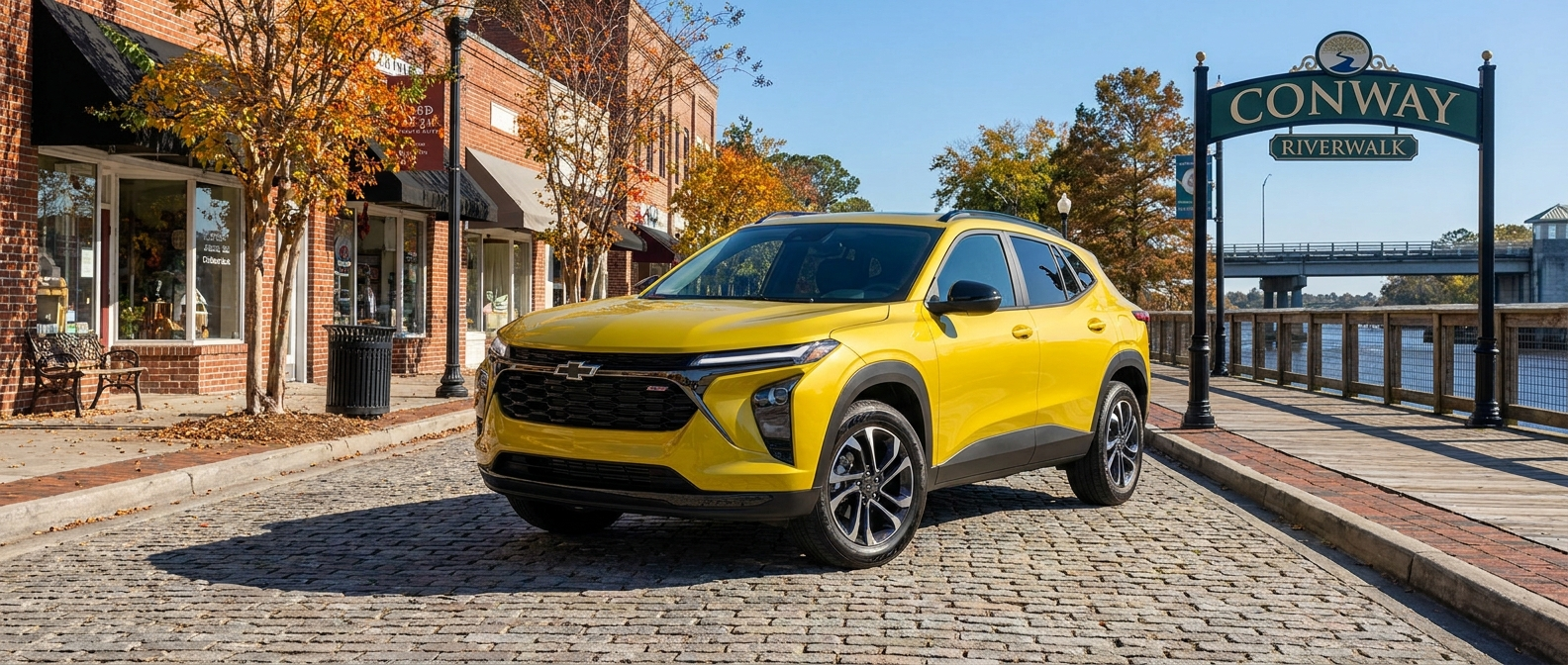
used-chevy-trax-model-year-guide-conway-sc

Chevy Trax by Model Year: Which Used Years to Target Near Conway

In this article Which Model Years Are the Sweet Spot for a Used Trax? Which Trax Years Should You Watch Out For? What Downtown Conway Drivers Actually Need to Know About the Trax Which Year Is Right for Which Conway Buyer? Shopping a used Chevy Trax near downtown Conway and wondering which years earn their keep? Here's our take: target a 2020-2022 for the tightest budget or a 2024-2025 if you can stretch a little, and skip 2015 through 2019 unless the recall history has been fully documented and cleared. The Trax story splits cleanly into two generations, and knowing where that line falls saves you real money and a few headaches. The short version Sweet spot on a budget: 2020, 2021, or 2022, the cleanest years of the first generation, well past the recall-heavy early years Sweet spot if you can stretch: 2024 or 2025, a full redesign with a roomier interior, wireless CarPlay, and modern safety tech Years to watch carefully: 2015 through 2019. NHTSA logged multiple recall campaigns for lower control arms, airbags, and electrical issues across this window No-AWD reality check: every Trax ever built is front-wheel drive only; for Conway's mild winters and summer beach runs on US-501, that's a genuine non-issue Local fit: at 178.6 inches long, the Trax slots into downtown Conway's tighter street parking and the Coastal Carolina University corridor without the drama a midsize SUV brings Browse our used Chevy Trax inventory at Palmetto Chevrolet Which Model Years Are the Sweet Spot for a Used Trax? For a budget-minded buyer, we'd point you at the 2020-2022 window first, since Chevrolet had ironed out the most serious first-generation problems by then, and a buyer who can stretch a bit is better served by the 2024 redesign. NHTSA data backs the budget call. The 2022 model year logged just 9 owner complaints on record, the lowest of any Trax model year in the database. No accident there. By 2020, the control arm welding campaigns that swept through the 2015-2019 Trax population were behind the design, and the late first-generation cars benefited from a platform refined over several years. It shows in the numbers. The 2021 and 2022 models also added Apple CarPlay and Android Auto as standard features, which matters if you're daily-driving the US-501 corridor and need hands-free navigation through beach-season traffic. The 2022 stands out as the final year of the first generation, with no rushed mid-cycle changes from Chevrolet, and the powertrain (a 1.4-liter turbocharged four-cylinder in Gen 1) had built a solid real-world track record by then. The platform was proven. Then there's the 2024. Chevrolet skipped the 2023 model year entirely and came back with a ground-up redesign. The second-generation Trax grew by nearly a foot in overall length, added 3 inches of rear legroom (now 38.7 inches per Chevrolet's published specs), and swapped in a new 1.2-liter turbocharged three-cylinder making 137 horsepower and 162 lb-ft of torque, paired with a six-speed automatic. Wireless Apple CarPlay and Android Auto are standard across all trims. The EPA rates it at 28 city and 32 highway. That's the car that showed up on the lot and made people forget there had ever been an older Trax. Model Year Generation Key Strengths Cargo (seats up) EPA Combined 2020 Gen 1 Post-recall cleanup, budget sweet spot ~18.7 cu ft ~26 mpg 2021 Gen 1 CarPlay/Android Auto standard, proven platform ~18.7 cu ft ~26 mpg 2022 Gen 1 Final Gen 1 year, lowest NHTSA complaint count (9) ~18.7 cu ft ~26 mpg 2024 Gen 2 Full redesign, roomier, wireless tech, modern safety 25.6 cu ft 30 mpg 2025 Gen 2 Same strong second-gen platform, slightly more used availability 25.6 cu ft 30 mpg See new Trax models at Palmetto Chevrolet for comparison Which Trax Years Should You Watch Out For? The years to approach with caution are 2015 through 2019, and all five carry documented NHTSA recall history worth a careful look before you hand over a check, though you shouldn't write them all off if the paperwork checks out clean. Per NHTSA recall campaign 19V652000, the 2015-2018 Chevrolet Trax was subject to a front lower control arm recall. An improperly welded joint in the control arm could partially separate from the vehicle, affecting steering and handling. Campaign 19V312000 extended that coverage to the 2017-2019 models, so the 2017 and 2018 Trax each fell under both campaigns. When you're checking VIN history, that detail matters. Two separate recall campaigns on one component mean two separate paperwork trails to verify. Check both. The 2015 and 2016 model years also logged the highest per-model recall counts in the generation, and they're the pair to scrutinize hardest. NHTSA data shows 7 recall campaigns for the 2015 Trax and 5 for the 2016, covering issues from front airbag deployment failures (campaign 16V651000) to seat belt pretensioner problems. The 2016 drew 171 NHTSA complaints in total. The 2019, despite not carrying the same volume of recalls, logged 133 NHTSA owner complaints, the second-highest complaint count across all Trax model years. None of this makes every 2015-2019 Trax a lemon. Recalls get repaired. But it does mean you'll want solid documentation on any example from those years. Always check nhtsa.gov/recalls with the vehicle's VIN before you commit. NHTSA data shows 7 recall campaigns for the 2015 Trax and 5 for the 2016, the two highest recall totals across all Trax model years. Verify recall completion status on any pre-2020 example before purchase. The 2019 is a genuinely awkward one to frame. Some sources call it a decent late Gen-1 buy, while the NHTSA complaint volume (133 filed) tells a more cautious story. If you're looking at a 2019, confirm both control arm campaigns (19V312000 and a related airbag control module recall, 18V774000) have been addressed. A clean repair history for those two items changes the picture considerably. Worth the digging. Explore financing options for a used Trax at Palmetto Chevrolet What Downtown Conway Drivers Actually Need to Know About the Trax The spec that shapes every Trax decision around here is drivetrain, because the Chevy Trax is front-wheel drive only across every single model year and every trim, and for Conway you're not actually giving up a thing that matters. A fair question before you commit is whether you're exposed without all-wheel drive, and buyers relocating from colder states raise it with us on the lot. For Conway, the answer is no. South Carolina winters on the Grand Strand are mild, and US-501's biggest challenges are summer beach traffic backups (where fuel economy matters far more than traction) and the occasional thunderstorm in hurricane season. The Trax's EPA ratings of 28 city and 32 highway on the second-generation model are genuinely useful on that corridor, and you'll feel it in beach-season stop-and-go. The other local reality is parking. Downtown Conway's historic streets and the Riverwalk area aren't built for a midsize SUV. The Trax's 178.6-inch overall length (Chevrolet's published spec for the second generation) tucks into parallel parking slots that a Blazer or an Equinox will leave you sweating through. If you're also running the SC-544 corridor to Coastal Carolina University for work, classes, or evening events, a smaller footprint is a practical advantage, not a compromise. The honest downside? The Trax has no towing capacity. None. If you're the person who hauls a small boat out to the Waccamaw River on weekends, this isn't your vehicle. A midsize SUV like the Chevy Equinox or Trailblazer would serve that lifestyle better. The Trax is built for commuting, parking, and eating up the 501 with the least amount of fuel cost, and it does those jobs very well. Which Year Is Right for Which Conway Buyer? The right year comes down to your budget and whether AWD or towing is ever in play, and in our experience on the lot, the choice tends to sort into four clear camps, each one matching a Conway driver who's shopping for something different. You want a 2022 if the budget stays tight, the newer styling doesn't pull at you, and you want the strongest used-market value with the cleanest first-generation track record. The 38.7-inch rear legroom figure belongs to the second generation, so keep in mind that the first gen ran a smaller cabin if you're regularly carrying passengers. You want a 2024 or 2025 if you'll pay a modest premium for the redesigned interior, the standard wireless tech, and the 25.6 cubic feet of cargo space behind the rear seat (which the EPA-rated second generation delivers per Chevrolet's published spec). Young professionals doing Myrtle Beach runs on weekends will feel the difference in cabin quality. The 11-inch touchscreen available on upper trims is a legitimate step up from the first generation. You want to look carefully at any 2015-2019 only when the VIN check on nhtsa.gov confirms all open recalls are completed, you've got maintenance records, and the price reflects the extra due diligence it asks for. We're not telling you to walk away from every one of them. We're telling you not to buy one without homework. You should skip the Trax entirely if AWD is non-negotiable or towing is part of your routine. That's no knock on the vehicle. For the right situation, the Trax is the right call. Frequently Asked Questions Is the Chevy Trax available with all-wheel drive? No. Every Chevy Trax, across all model years and all generations, is front-wheel drive only. For most Conway and Grand Strand buyers, that's a practical non-issue given South Carolina's mild winters and flat terrain, but it's a firm limitation worth knowing before you shop. What changed with the 2024 Chevy Trax redesign? Chevrolet skipped the 2023 model year and returned for 2024 with a fully redesigned second-generation Trax. The new model is nearly a foot longer than the outgoing first generation, offers 38.7 inches of rear legroom (per Chevrolet's published specs), and added a new 1.2-liter turbocharged three-cylinder engine rated by the EPA at 28 city and 32 highway mpg. Wireless Apple CarPlay and Android Auto are standard on all trims in the second generation. What recalls should I check on a used Chevy Trax before buying? The most significant recall activity in the Trax's history covers the 2015-2019 model years. NHTSA recall campaign 19V652000 addressed a front lower control arm welding issue on 2015-2018 Trax vehicles, and campaign 19V312000 covered the same component on 2017-2019 models. A separate airbag/seat belt pretensioner recall (16V651000) covered 2015 and 2016 models. Always run the VIN through nhtsa.gov/recalls to confirm all applicable campaigns have been completed before purchasing any used Trax from those years. Get Pre-Approved for a Used Trax Palmetto Chevrolet 1122 4th Ave, Conway, SC 29526 (843) 248-4283
2027 Chevrolet Equinox on US-501 in Conway SC during a weekday morning commute

2027 Chevy Equinox for the US-501 Commute | Palmetto Chevrolet

In this article What Do the Specs Actually Mean for a Conway Commuter? The Safety Suite That Makes 501 Traffic Feel Less Stressful How the Interior Holds Up Over a Daily Horry County Commute Who Should Drive the 2027 Equinox on This Route Every morning, Conway commuters feed onto US-501 heading toward Myrtle Beach. The corridor runs multilane and deceptively fast-moving until it isn't. Businesses line every block, cross-road intersections arrive every mile or so, and afternoons between 4 and 7 p.m. can turn a 10-minute drive into a 40-minute one. We've talked with enough buyers on this route to know the questions aren't really about horsepower bragging rights. They come down to whether this thing stays comfortable in stop-and-go traffic, whether it sips fuel instead of guzzling it when you're barely moving, and whether it packs enough safety tech to keep you out of trouble when the car ahead stops hard. The 2027 Chevrolet Equinox answers all three. See the 2027 Equinox on our lot and you'll notice right away it isn't trying to be the fastest car on the road. It's built to be the smartest one for the commute you actually have. The 2027 Equinox carries more than 15 standard driver-assistance features at the base LT trim, including Automatic Emergency Braking, Lane Keep Assist, and Adaptive Cruise Control, per Chevrolet's published specifications. What Do the Specs Actually Mean for a Conway Commuter? The EPA rates the 2027 Equinox at 27 mpg combined with front-wheel drive and 26 mpg combined with all-wheel drive, numbers that won't dazzle anyone cross-shopping a hybrid but hold up as real-world workhorses on a route like US-501 where steady efficiency beats a headline figure. Our honest note, and independent testing backs it, is that the 1.5-liter turbo four-cylinder (175 horsepower, 203 lb-ft of torque) can feel a touch relaxed when you need to merge quickly at highway speed. It gets there. It just doesn't leap. For everyday stop-and-go on 501, that tune works in your favor, since the engine isn't fighting itself constantly. Here's the spec picture at a glance. Spec FWD Equinox AWD Equinox Engine 1.5L Turbo I-4 1.5L Turbo I-4 Horsepower 175 hp 175 hp Torque 203 lb-ft 203 lb-ft Transmission 8-speed automatic 8-speed automatic EPA City MPG 25 25 EPA Highway MPG 29 29 EPA Combined MPG 27 26 Total Fuel Range ~400 miles ~406 miles Cargo (seats up) 29.8 cu ft 29.8 cu ft Max Cargo (folded) 63.5 cu ft 63.5 cu ft Standard safety features 15+ 15+ *EPA estimates via fueleconomy.gov. Cargo figures per Chevrolet. Verify your exact configuration at the dealership.* Something generic reviews skip is that for 2027, both the FWD and AWD Equinox now use the 8-speed automatic transmission (the CVT is gone on FWD). A traditional automatic manages repeated stop-and-go cycles with less of the rubbery feeling some drivers dislike in a CVT, which matters on US-501. It also feeds the auto start/stop function, which cuts the engine at a red light and restarts it cleanly when you lift off the brake. In a corridor with as many signalized intersections as the stretch between Conway and Socastee, that cycle pays off in real fuel savings over a week of commuting. The Safety Suite That Makes 501 Traffic Feel Less Stressful Safety is where the Equinox earns its commuter reputation on a road like US-501, because Chevy Safety Assist comes standard on every 2027 Equinox, and that bundle covers a lot of ground, from Automatic Emergency Braking and Forward Collision Alert to Lane Keep Assist with Lane Departure Warning, Adaptive Cruise Control, Blind Zone Steering Assist, Rear Cross Traffic Braking, and a Following Distance Indicator, among others. Adaptive Cruise Control is the feature that earns its keep on highway commutes. It adjusts your speed automatically to hold a set gap from the vehicle ahead, which means on the open sections of US-501, or once you hit the Veterans Highway (SC-22) bypass toward North Myrtle Beach, you can let the system manage pace changes without constantly tapping the pedal. Over an hour-round-trip commute, five days a week, that trims a lot of fatigue. Curious about the Equinox EV? It pushes the commuter-assist angle further with Super Cruise hands-free capability and over 20 standard safety features, if you want to move into the electric lane. The 11.3-inch touchscreen with Google Built-In (including Google Maps and Google Assistant) handles navigation on the fly without you fumbling with a phone mount, which helps when the 501 at Forestbrook Road is backed up and you want to know whether SC-544 is moving any better. Keep those safety systems calibrated with regular service so every sensor stays reading the road correctly. "Chevy Safety Assist includes automatic emergency braking, forward collision alert, front pedestrian and bicyclist braking, lane keep assist with lane departure warning, a following distance indicator, and IntelliBeam, part of a roster of more than 15 standard safety and driver assistance features." . Chevrolet product specification, 2027 Equinox Quick tip: If you're cross-shopping the LT against the RS, the core safety package doesn't change between trims. The upgrade is cosmetic and tech-forward (RS adds sport styling and a different interior feel). For pure commuter value, the LT gets you everything that matters on 501. How the Interior Holds Up Over a Daily Horry County Commute The interior holds up well over a daily Horry County commute, mostly because Chevrolet tunes the suspension on the softer side, which keeps the cabin quiet for its class even when the road surface changes under you. Spend 30-plus minutes in a car twice a day and that cabin either earns your loyalty or grinds you down. US-501 runs through Conway in Horry County, and road texture on the 501 corridor varies from smooth on the main travel lanes to the pockmarked surface roads that feed in from the surrounding neighborhoods, and the Equinox absorbs the transition without drama. Headroom and legroom: Front headroom measures 40 inches, and front legroom measures 40.9 inches, per Chevrolet's published dimensions. Those aren't luxury-SUV numbers, but they fit a tall driver without the cramped sensation you get in a subcompact. Heated front seats come standard on the LT, which is welcome on the roughly 20 or so mornings each October through February when Conway drops into the low 40s before sunrise. Storage is practical without being fancy. There's enough center console space for a laptop bag and a coffee thermos, and the rear seats fold flat when you need to haul something back from the hardware store on Coastal Grande Boulevard on the way home. On the connectivity side, wireless Apple CarPlay, wireless Android Auto, and a 5G Wi-Fi hotspot come standard on the LT, so a front-seat passenger can work the commute instead of losing it. Explore financing options to see how the Equinox fits your monthly picture. Who Should Drive the 2027 Equinox on This Route The Equinox fits a specific kind of Conway commuter well, and it's worth being clear about who that is. You're logging 20 to 50 miles a day on US-501, SC-544, or the Veterans Highway, and you want a car that doesn't demand much from you mentally, because the road already does enough of that. You have a family, or you're thinking ahead to needing the cargo space, but you'd rather not park something full-sized in a downtown Conway lot. Does it fit everyone? No. It fits less well if your commute is mostly high-speed highway miles, where you'll feel that 175-horsepower ceiling more often. The Silverado 1500 or Traverse is the better conversation if you're hauling regularly or need significantly more power and space day to day. For most commutes on this stretch of the Grand Strand, though, the straightforward answer holds. The Equinox's fuel economy, safety suite, and comfortable interior make it exactly the right size for the commute you actually have on this particular stretch of South Carolina highway. Check Financing Options for the 2027 Equinox Frequently Asked Questions Is the 2027 Chevrolet Equinox fuel-efficient enough for a daily Conway to Myrtle Beach commute? Yes. The EPA rates the 2027 Equinox at 27 mpg combined with front-wheel drive and 26 mpg combined with all-wheel drive, per fueleconomy.gov. On FWD models, the 14.8-gallon tank provides a total range of roughly 400 miles, which means most Conway commuters can go the better part of a full work week or more between fill-ups. The automatic start/stop system also trims fuel use during the stop-and-go light cycles common on the US-501 corridor between Conway and Socastee. What safety features does the 2027 Equinox include at the base LT trim? The base LT includes the full Chevy Safety Assist bundle as standard equipment. That covers Automatic Emergency Braking, Forward Collision Alert, Front Pedestrian and Bicyclist Braking, Lane Keep Assist with Lane Departure Warning, Adaptive Cruise Control, Blind Zone Steering Assist with Lane Change Alert, Rear Cross Traffic Braking, Following Distance Indicator, and IntelliBeam automatic high-beam headlights. Chevrolet lists more than 15 driver-assistance features at the base trim level, with additional items available as you move up the trim ladder. Value Your Current Vehicle Before You Upgrade Palmetto Chevrolet 1122 4th Ave, Conway, SC 29526 (843) 248-4283

Contact Us

Fill out this form below and we'll contact you shortly
*Required Fields