





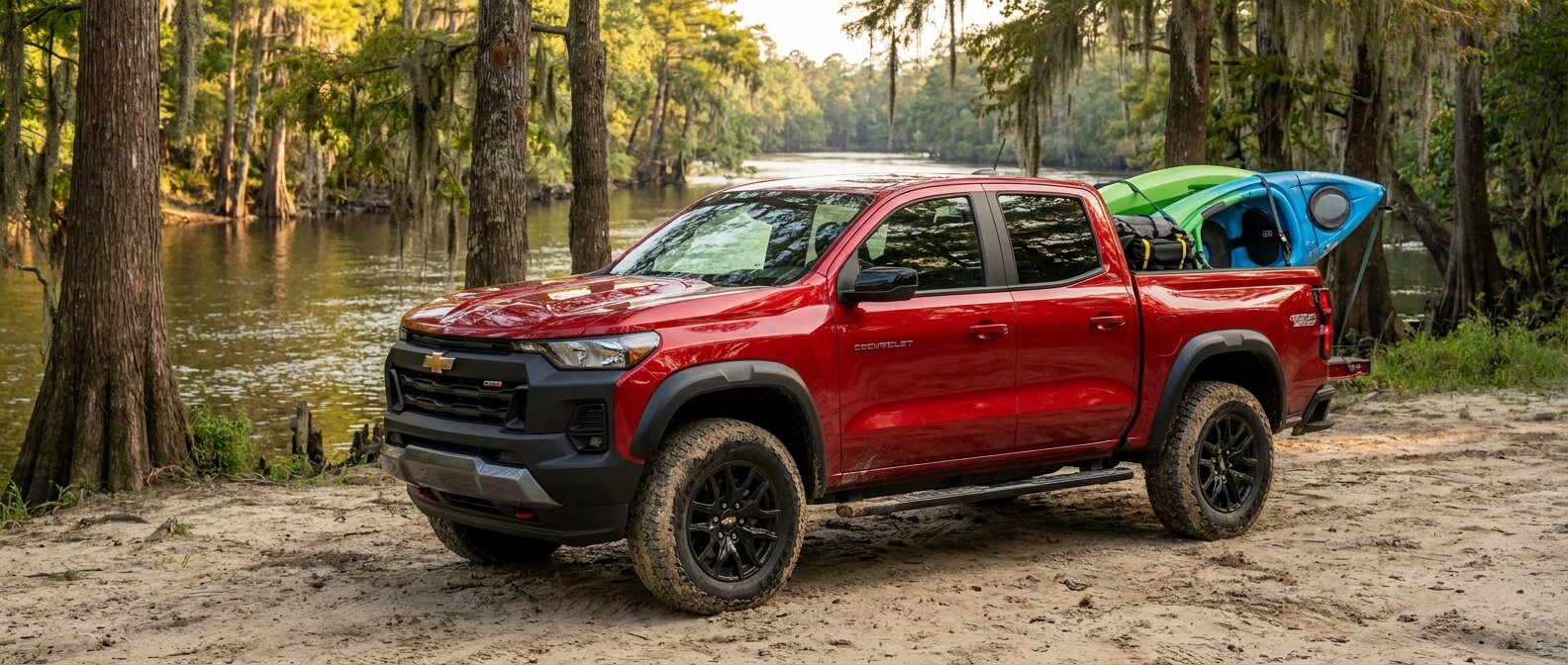
The mistake that’s easy to make with outdoor hauling isn’t overpacking. It’s skipping the door-jamb label before you start. The 2026 Chevrolet Colorado handles everything the Grand Strand throws at you (kayak runs on the Waccamaw River, morning fishing rigs, bikes for a Waccamaw National Wildlife Refuge trail day), but only if you load it to spec, strap it correctly, and pick the trim that actually matches how you use it.
Browse the 2026 Chevrolet Colorado at Palmetto Chevrolet to see current trim availability.
Here’s what you need to know before you back down a sandy put-in ramp.
Load It Right: What to Do and What to Skip
Yes, the 2026 Colorado hauls a full outdoor kit for the Grand Strand, but the bed geometry dictates the plan more than the badge does, so it pays to know that you’re working with a crew-cab-only truck, a 5’2″ bed, and 41.9 cubic feet of cargo space. The figure surprises drivers coming from an older truck with a longer bed. That matters when you’re sliding kayaks or a paddleboard in from the rear. Chevrolet lists up to 17 available tie-down points in the bed, and an available 120-volt outlet is worth configuring if you run air pumps or charge gear overnight at camp. The mid-position tailgate doubles as a step (it’s rated to 500 lbs, per Chevrolet). Solo cooler loading gets a lot easier.
There’s one real tradeoff. The bed measures 45.5 inches between the wheelhouses, so anything wider than 45 inches won’t lay fully flat. Most recreational kayaks run 24 to 30 inches wide, so they fit without drama. A standard canoe or tandem kayak over 14 feet will overhang the tailgate (legal in South Carolina with proper flagging, but worth knowing before you leave the driveway).
How much can you actually pile in? More than the bed size suggests, though payload is the number to respect. Chevrolet publishes a maximum of 1,710 lbs for the 2WD WT and LT trims, and 1,587 lbs for Trail Boss and Z71 configurations (properly equipped, and verified against the specific label inside your driver’s door, which is the authoritative number for your actual build). That 1,587 lbs sounds generous until you count it out. Two adults (let’s call it 350 lbs), two sit-on-top kayaks (roughly 100 lbs each), paddles, PFDs, a week’s worth of fishing tackle, and a full cooler puts you at 700 to 800 lbs before a single gallon of water goes in. Still inside the limit. It adds up faster than you’d think. So keep a running count.
| Gear Situation | Do This | Skip This |
|---|---|---|
| Kayaks over 5’2″ bed length | Use a bed extender or rack; flag the overhang | Tossing them in unextended and hoping |
| Payload math | Add passengers + gear before loading; compare to door-jamb label | Assuming you’re “probably fine” without checking |
| Tie-downs on soft gear | Use cam buckle straps through bed D-rings | Bungee cords (they stretch under vibration on sandy roads) |
| Sandy access roads to Waccamaw puts-ins | Engage 4WD on the Trail Boss or Z71 before the sand, not after you’re stuck | Trying to engage mid-bog |
| August heat and gear chemistry | Store fuel-based items (stove canisters, sunscreen) in a cab bag, not a sealed truck bed | Leaving aerosols in a closed bed in South Carolina August sun |
| Towing a small fishing trailer | Confirm you have the Advanced Trailering Package (required for 7,700-lb rating) | Assuming the hitch receiver alone gives you the full rating |
The Technique That Matters Most on Local Roads
On paved roads any Colorado handles the run fine, but the sandy soft shoulders and the occasional unpaved wildlife-refuge access road near Conway are where trim selection earns its keep, and a couple of inches of ground clearance can decide whether you scrape a ramp lip or roll through clean. The Trail Boss carries 9.5 inches of ground clearance and a factory 2-inch lift, per Chevrolet’s published specs. That extra height keeps the front skid plate from scraping on the kind of eroded ramp lip you’ll find at lower-traffic Waccamaw River access points.
The Z71 runs the same high-output 310-horsepower, 430-lb-ft TurboMax engine. It adds a polished interior feel if you’re splitting time between job sites and family weekend trips.
See the Silverado 1500 if you’re regularly pulling a loaded boat trailer over 5,000 lbs (that’s where the midsize-to-full-size conversation starts).
The ZR2 gives up real capability for this kind of use. Its 10.7 inches of ground clearance and Multimatic DSSV dampers are impressive, but Chevrolet’s off-road suspension cuts towing capacity to 6,000 lbs and payload to around 1,151 lbs. If you’re hauling a 16-foot center-console on a trailer toward Myrtle Beach and loading two people in the cab, the math gets tight fast. Trail Boss or Z71 is the sweet spot for this market. Simple as that.
See the Equinox if a midsize SUV suits your outdoor footprint better than a truck bed.
Schedule a Pre-Trip Gear Check
One Thing to Confirm Before Every Outdoor Run
Confirm your numbers before every outdoor run, because Chevrolet prints the specific GVWR and payload rating for your individual build on the door-jamb sticker, and that sticker (not the trim’s published maximum, which can vary by drivetrain and configuration) is the number that governs your truck. Check it every time. Our service team can verify your trailer hitch receiver class and confirm whether your build includes the Advanced Trailering Package, which is required to reach the 7,700-lb towing ceiling on properly equipped models.
Know your load. Know your label. The Waccamaw will be there when you are.


